CommandEleven Intelligence // South Asia Desk. Dossier, status as of November 3, 2026. We checked every figure against UNODC’s full 2026 survey and its World Drug Report 2026. Where the Taliban and the UN disagree, we give both numbers. Where no one has published the number, we say so.
Bottom Line Up Front
The opium economy is back, and it is bigger than it was a year ago. What no one has shown is how much of it reaches the Taliban state. UNODC’s 2026 survey, released on October 29, finds poppy on more than 43,000 hectares, up 325 percent from 10,200 in 2025, and opium production up about fivefold to 1,466 tonnes. It puts the income of first-level opium traders at $525 million, back at pre-ban levels. That is a measure of what traders earn. It is not a measure of what the Taliban collect.
The UN’s own sanctions monitors, in a December 2025 report, say the drug trade sustains traffickers, criminal organizations “and even some State actors,” and give no figure for Taliban revenue. The last sourced UN-based figures for what the Taliban earned from drugs date from 2019, when they were an insurgency taxing a crop. Our assessment is that drugs are a large and growing source of income inside Afghanistan, that methamphetamine is now the more durable business, and that the claim “drugs finance the Taliban regime” is plausible but unproven until someone publishes post-2021 revenue data.
Key Judgments
KJ1: The ban worked at scale, then began to fail. Cultivation fell from about 233,000 hectares in 2022 to 10,800 in 2023 and stayed near 10,000 to 13,000 hectares for three years. Production fell from about 6,200 tonnes in 2022 to 296 in 2025. In 2026 UNODC says the ban “appears to be weakening.” [CONFIRMED]
KJ2: The rebound is large and concentrated in the northeast. UNODC estimates 43,300 hectares (95 percent interval 31,700 to 61,200) and 1,466 tonnes (805 to 2,439). Badakhshan alone accounts for 29,482 hectares. Poppy now grows in 16 of 34 provinces, five more than in 2025. [REPORTED by UNODC, with wide error bands]
KJ3: The Taliban reject the estimate, and their own numbers disagree with each other. They give four figures for eradication or cultivation, from 22,000 to 26,800 hectares. Each is more than double UNODC’s 2025 total. UNODC could not verify them. [DISPUTED]
KJ4: The $525 million is trader income, not Taliban revenue. It equals 2.7 percent of GDP. It excludes processing, trafficking and export, and UNODC calls its figures “orders of magnitude.” [CONFIRMED as to what it measures]
KJ5: No UN or other body has published a Taliban revenue figure from drugs since 2021. The UN Monitoring Team’s December 2025 report states farmers’ and traders’ income and no state revenue. [CONFIRMED that no figure exists in the sources we reviewed]
KJ6: Methamphetamine is the part of the trade a poppy ban does not touch. UNODC finds meth seizure counts in the region stable at about twice their 2021 level and average seizure weights more than double. Meth sells in Afghanistan for about $600 per kilogram and the price is falling. No one has published a production estimate. [REPORTED]
KJ7: Heroin output may be higher than UNODC can say. The price of a kilogram of heroin relative to opium has fallen from about 30 to 1 in 2019 to just over 9 to 1 in 2026, which suggests less opium is needed per kilogram of heroin. UNODC says its heroin estimate of 107 to 168 tonnes is likely too low. [ASSESSED by UNODC]
KJ8: Two convicted drug offenders were freed in swaps for Americans. Bashir Noorzai in 2022 and Khan Mohammed in 2025. We found no 2026 release. The swaps show the Taliban value these men. They do not show how much the Taliban earn from drugs. [CONFIRMED; the inference is ASSESSED]
KJ9: Four dated calls are set below. They will be scored on the Foresight Record. [METHOD]
What the Ban Did
The Taliban announced a ban on poppy cultivation and all narcotics in April 2022. The 2022 harvest was largely exempted. UNODC then recorded the sharpest fall in the history of its Afghan surveys. Prices rose: dry opium went from under $100 per kilogram before the ban to a seasonal average of $780 in 2024, and farmers’ opium income in 2022 reached about $1.36 billion, up from $425 million in 2021, because the harvest was sold at post-announcement prices.
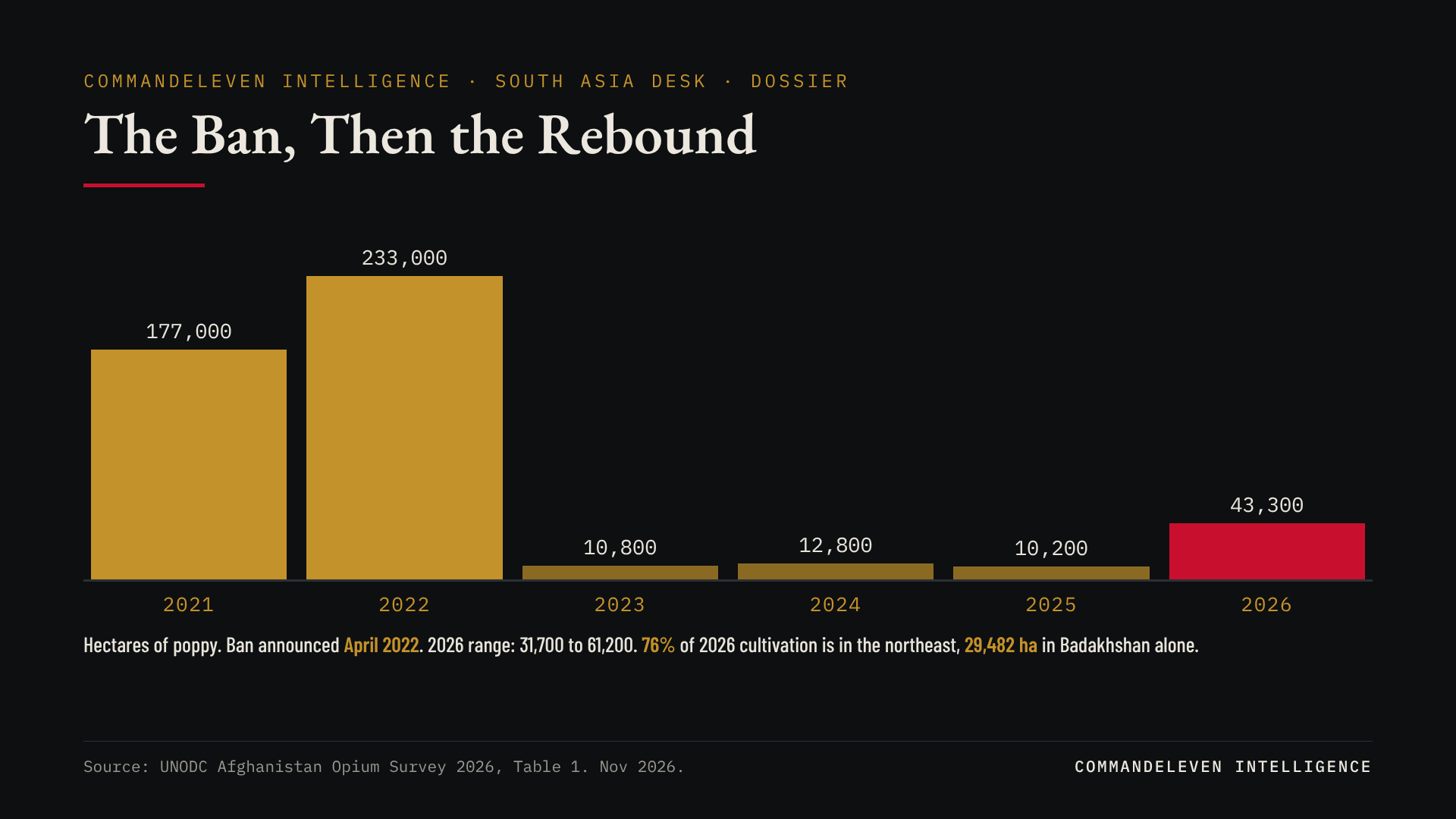
| Year | Cultivation (hectares) | Production (tonnes) | Note |
|---|---|---|---|
| 2021 | 177,000 | Not cited here | Last season before the Taliban takeover took effect. |
| 2022 | 233,000 | About 6,200 | Ban announced in April. The World Drug Report rounds the area to 232,000. |
| 2023 | 10,800 | 333 | First season under the ban. Down about 95 percent. |
| 2024 | 12,800 | 433 | Seasonal trader price peaked at $780 per kilogram. |
| 2025 | 10,200 | 296 | Trader price $570 per kilogram. |
| 2026 | 43,300 (31,700 to 61,200) | 1,466 (805 to 2,439) | Trader price $500 per kilogram. Yield up from 29 to 33.8 kilograms per hectare. |
The ban reshaped the global heroin market. The World Drug Report 2026 calls Afghanistan’s collapse a supply shock and says opium stocks in the country could last until the end of 2026. Heroin markets, mostly in Europe, face constraints: the average inflation-adjusted retail price of a pure gram of heroin across 20 destination countries rose from about $250 in 2022 to $470 in 2025. Myanmar is now the largest opium producer, up from about 420 tonnes in 2021 to more than 1,000 in 2025, a rise the report ties to Myanmar’s own conflict.
A ban that raises prices rewards whoever holds stock. UNODC says pre-ban stocks cushioned the supply shock and that traffickers released them gradually while making large profits. The survey does not say who held those stocks, and neither do we. [UNVERIFIED as to holders]
The 2026 Rebound
UNODC identifies four drivers. Opium prices stayed above $500 per kilogram, more than five times the pre-ban level. Stocks are running down. Rural poverty persists with few alternatives. And weather was better: improved rainfall lifted yields, which accounts for part of the production gain.
| Province | 2025 (hectares) | 2026 (hectares) | Change |
|---|---|---|---|
| Badakhshan | 6,639 | 29,482 | +344% |
| Hilmand | 681 | 3,525 | +417% |
| Takhar | 274 | 3,401 | +1,140% |
| Badghis | 573 | 2,538 | +343% |
| Kandahar | 481 | 1,558 | +224% |
| Jawzjan | 146 | 550 | +277% |
The northeast holds 76 percent of national cultivation and produced about 1,090 tonnes, nearly three quarters of the total. The traditional southwest, which dominated before the ban, accounts for 12 percent. Only Zabul became poppy-free in 2026, while Day Kundi, Laghman, Nangarhar, Balkh, Farah and Herat joined the list of provinces with poppy.
Concealment
UNODC’s satellite analysis found farmers hiding poppy inside cereal fields, behind compound walls and by staggering sowing dates. In Hilmand more than 90 percent of poppy fields were concealed, over half inside cereals and over 40 percent in walled areas. In 2025 only six percent of Hilmand’s fields were inside other crops. The survey calls the scale “remarkable.” It also means the satellite count has a harder job and a wider margin of error, which is part of why the Taliban dispute it.
Who finances the crop
Field discussions UNODC held in the northeast describe informal credit and land arrangements familiar from before the ban: cash advances, pre-harvest sales known as salam, loans repaid in opium, shop credit and sharecropping. Residents in Badakhshan told UNODC that people from the former southwestern cultivation areas are renting or buying land and financing poppy there. UNODC says it could not confirm that and that the discussions are not statistically representative. In Takhar, credit and partnerships appeared to involve mainly local residents. [REPORTED, not independently confirmed]
The Taliban Reply
The Interior Ministry’s Counter-Narcotics Deputy Ministry rejected the finding that compliance with the ban is declining. Its written comments, published in Annex 3 of the survey, argue that UNODC has not explained how it separates poppy from wheat at 0.5 meter resolution, how it defines a field, or what its error margin is. The ministry also says the satellite estimate ignores eradication that happens before harvest. UNODC concedes the last point: eradication usually occurs before its satellite survey, and it does not expect the Taliban’s eradication to change the area estimate.
The Taliban’s numbers do not agree with one another.
| Figure | Source | What it says |
|---|---|---|
| About 22,000 hectares | UNODC survey text | Eradication reported by the de facto authorities. UNODC could not verify it. |
| About 23,000 hectares | Annex 3, Counter-Narcotics Deputy Ministry | Hectares eradicated. |
| 24,000 hectares | Annex 3, Counter-Narcotics Deputy Ministry | The ministry’s own estimate of cultivation, from satellite imagery, GPS points and ground presence. |
| 26,000 to 26,800 hectares | Interior Ministry statements, October 2026 | Cultivation identified by satellite imagery and destroyed, or cleared, per press accounts. |
Two points follow. First, even the lowest Taliban figure describes a crop more than double UNODC’s 10,200 hectares for 2025. Second, the ministry accepted in Annex 3 that poppy was grown in Daikundi, Laghman, Nangarhar, Balkh and Farah in 2026, and that “the ban on poppy cultivation by itself is not a sustainable and long-term solution.” Foreign Minister Amir Khan Muttaqi nonetheless called the campaign one of the administration’s greatest achievements. The ministry’s spokesman said most narcotics, traditional and synthetic, enter Afghanistan from Pakistan. UNODC says supply from other countries may contribute, and reports no evidence on Pakistan specifically. [DISPUTED]
The ministry also made an arithmetic objection. At 1,500 tonnes and $500 per kilogram, production would be worth $750 million, not $525 million. Our own multiplication of 1,466 tonnes by $500 gives about $730 million. UNODC says its income estimate uses first-level trader prices around harvest, not the annual average, and that farm-gate prices have not been collected since 2023. The text we read does not show the full derivation, so the objection is fair as a question and not decisive as a rebuttal.
The eradication had a human cost. UNODC, citing the UN mission in Afghanistan, reports that attempts to eradicate poppy in Badakhshan districts in May and June 2026 triggered protests and clashes that left several people dead or injured. Some protesters supported eradication but objected to its methods and to damage to other crops.
What the Money Is and What It Is Not
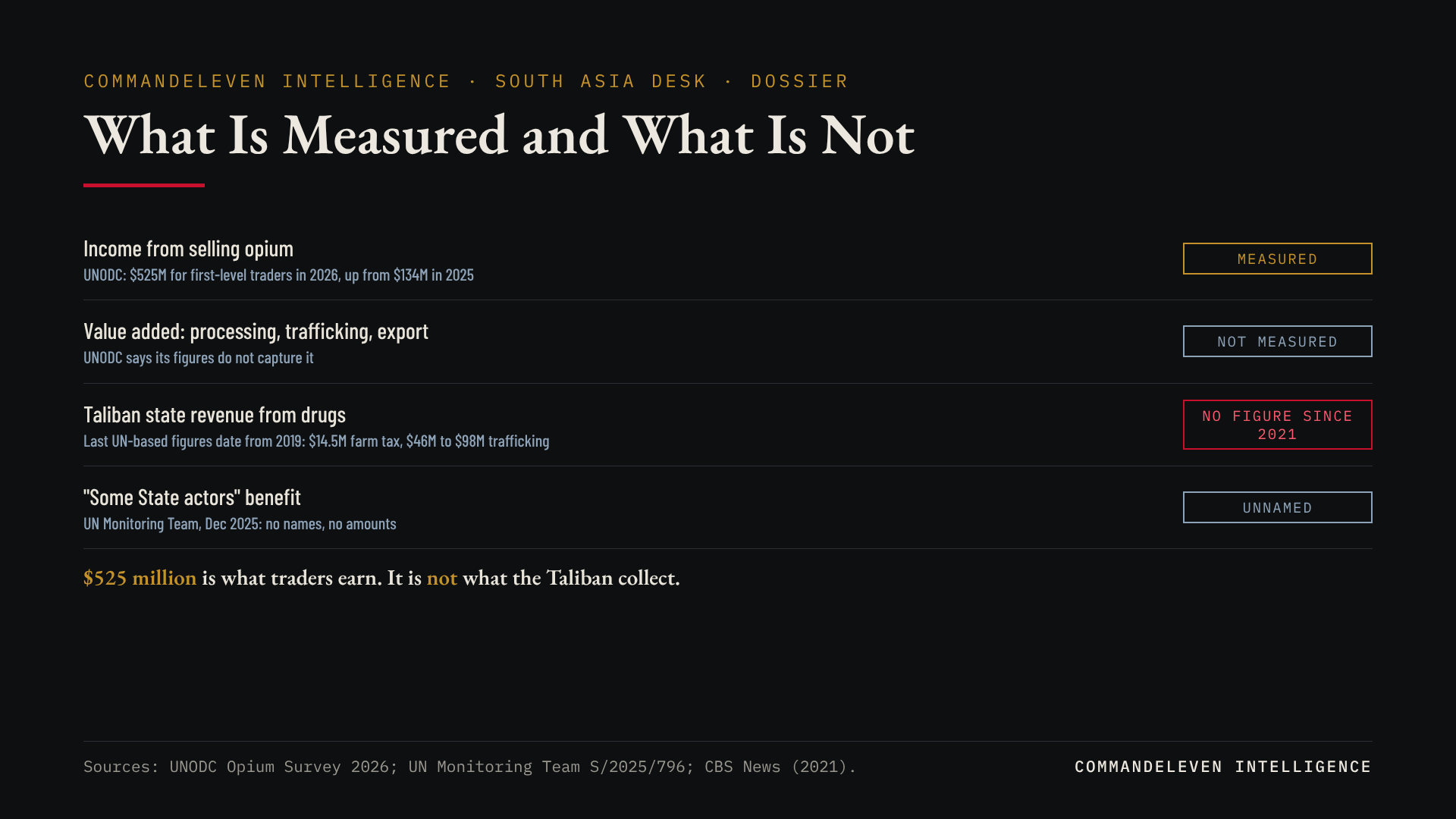
The central question needs three separate numbers, and only the first exists.
- Income from selling opium. UNODC estimates $525 million for first-level traders in 2026, against $134 million in 2025. Farmers’ income between 2018 and 2021 ranged from $350 million to about $600 million a year, and spiked to $1.36 billion in 2022. This is the number UNODC publishes.
- Value added downstream. Processing opium into heroin, trafficking and export add value that UNODC says its figures do not capture. A 2021 UN report put Taliban taxes on poppy farmers at about $14.5 million in 2019 and income from heroin processing and trafficking at $46 million to $98 million, inside an opiate economy of $1.2 billion to $2.1 billion. Those figures describe an insurgency, not a government.
- What reaches the Taliban state. We found no published estimate for any year since the takeover.
The UN Monitoring Team’s sixteenth report, dated December 8, 2025, is the closest official source. It says the narcotics trade “sustains a large network of traffickers, criminal organizations and even some State actors, who derive economic benefits.” It does not name Taliban officials, it does not describe taxation of the trade, and it gives no revenue figure. It does note that terrorist groups including ISIL-K and the TTP “could reap benefits from the poppy income” where cultivation has moved. It also records the Counter-Narcotics Directorate’s claim of 1,400 production facilities dismantled and nearly 14,000 people referred to courts. One discrepancy deserves a flag: the Monitoring Team calls the 2025 figure of $134 million farmers’ income, while UNODC’s 2026 survey labels the same figure as first-level trader income. [CONFIRMED as to what the reports say]
What this means for the title question. A state that enforces a ban gives up the tax base that a crop provides, and a state that does not enforce it regains that base. We cannot tell which describes the Taliban in 2026, because 2026 shows both: a ban that was enforced hard enough to cause deadly protests, and a crop that is growing anyway. UNODC itself lists “analysis of illicit financial flows to understand who benefits from the drug economy” as an unmet need. [UNVERIFIED]
Beyond Opium: Methamphetamine and Heroin
UNODC’s survey treats seizure data as the best available proxy for trafficking. Counts of heroin seizures within 3,000 kilometers of Afghanistan fell by about 75 percent between the third quarter of 2021 and the end of 2025. Opium seizure counts fell sharply, bottomed out in mid 2025 and have partly recovered. Methamphetamine seizure counts show no sustained decline, run at about twice the 2021 level, and average seizure weights are more than double. UNODC adds that the origin of seized drugs cannot be validated, so some may be produced elsewhere.
Prices in Afghanistan tell a similar story. Heroin trades at just under $5,000 per kilogram, steadier than opium. Methamphetamine fell to about $600 per kilogram. UNODC says the relationship between meth and opium is an open question: they may rise and fall together, or meth may be substituting for opiates. The World Drug Report 2026 adds that meth supply in the region has been largely unaffected by the opium ban and that destination markets in the Middle East are absorbing more of it. Earlier UNODC reporting, in 2023, said Afghan meth can be made from wild ephedra and legally available chemicals with mobile labs. The UN Monitoring Team records Taliban claims that ephedra production fell 80 percent, while UNODC notes a discernible rise in meth seizures. [REPORTED; production is UNVERIFIED]
The Two Prisoner Swaps
| Bashir Noorzai | Khan Mohammed | |
|---|---|---|
| Released | September 19, 2022 | January 21, 2025 |
| In exchange for | Mark Frerichs, Navy veteran, abducted in Kabul on January 31, 2020 | Ryan Corbett and William McKenty |
| US case | Arrested after traveling to the US in 2005, convicted in 2008 on drug trafficking. Prosecutors alleged he funded the Taliban in return for leave to run his drug business. | Arrested in late 2006, extradited in 2007, convicted in 2008 on drug and narco-terrorism charges, two life sentences. |
| Disputed point | His lawyers say he was lured to US territory on a promise he would not be arrested. | The Justice Department called him a violent jihadist. CNN called him a Taliban member. |
| Mediation | Qatar helped. Foreign Minister Muttaqi welcomed him in Kabul. | Qatar hosted about two years of talks. Finalized in Biden’s last hours but delayed by weather until after Trump took office. |
Both cases follow the same pattern: the Taliban held Americans and obtained the release of a convicted drug offender in return. We found no equivalent release in 2026 and no sourced report of one. What the swaps show is that the Taliban place a high value on these men. They do not show how either man earned that value, because prosecutors’ claims about Noorzai were contested by his lawyers, and they do not show that either resumed trafficking. [ASSESSED]
The Overlap With the Northeast
Our dossier on the Taliban losing control found Badakhshan to be the center of armed opposition in 2026. UNODC now finds it the center of the poppy rebound as well, with 29,482 of the country’s 43,300 hectares. The two facts meet in the eradication clashes of May and June. Any force trying to hold ground in the northeast operates in a province where this crop is the main cash income, and any force trying to enforce the ban there risks turning farmers into opponents. We found no evidence that an armed group taxes or sells opium, though the UN Monitoring Team warns of the risk. That would be a significant change if it appeared. See our dossier The Taliban Losing Control of Afghanistan. [UNVERIFIED]
What Would Change Our Assessment
- A published revenue estimate. A UN Monitoring Team, World Bank or comparable estimate of post-2021 drug income to the Taliban state would settle the title question.
- A named official. A sanctions designation, indictment or credible report naming a serving Taliban official in the trade.
- Independent verification of the Taliban’s data. Published coordinates, image dates and error margins from the Interior Ministry, which it has said it can share.
- A third swap. Another drug offender released from US custody in exchange for a detainee.
- Armed groups and poppy. Evidence that any anti-Taliban group or ISIL-K profits from the crop.
- A second survey year. UNODC says continued monitoring is needed to tell whether 2026 is a temporary adjustment or the start of a resurgence.
Calls We Will Score
- By December 31, 2026, no further release of a convicted drug offender from US custody in a Taliban prisoner exchange will be announced.
- By June 30, 2027, no UN Monitoring Team report will state a figure for Taliban state revenue from narcotics.
- In UNODC’s next Afghanistan opium survey, expected in autumn 2027, estimated cultivation will exceed the 2026 point estimate of 43,300 hectares.
- In that same survey, Badakhshan will again be the largest cultivating province, with more than half of the national total.
Each is scored confirmed, partly confirmed or missed on the Foresight Record’s method, with the date and sources in the entry. The two 2027 calls stay open until the evidence arrives. The cultivation call refers to the point estimate and not to the interval.
What This Dossier Does and Doesn’t Establish
- It establishes UNODC’s cultivation, production, price and income figures for 2021 to 2026, the Taliban’s published responses and the gaps among them, the UN Monitoring Team’s wording on drugs and revenue, and the facts of the Noorzai and Khan Mohammed releases.
- It does not establish how much money the Taliban state or its officials earn from drugs, whether the 2026 rise reflects looser enforcement or farmer desperation, who held the pre-ban stocks, or whether the non-local financing reported in Badakhshan is real.
- It does not establish methamphetamine production volumes, which no one has published, or that any released man returned to the trade.
- UNODC’s estimates carry wide intervals, and the survey itself was not formally edited at publication.
Frequently Asked Questions
Do drugs finance the Taliban government?
Possibly, but no one has shown it. UNODC measures what traders and farmers earn, $525 million for traders in 2026. The UN Monitoring Team says drugs benefit “some State actors” and gives no Taliban revenue figure. The last sourced figures date from 2019.
Did the Taliban opium ban work?
For three years it did. Cultivation fell about 95 percent after 2022 and stayed low through 2025. In 2026 UNODC reports a 325 percent rise in cultivation and a fivefold rise in production, which the Taliban dispute.
How much opium does Afghanistan produce now?
UNODC estimates 1,466 tonnes in 2026, up from 296 in 2025 and against about 6,200 in 2022. The 95 percent interval runs from 805 to 2,439 tonnes.
Where is poppy grown now?
Mostly in the northeast. Badakhshan has 29,482 hectares and the northeast has 76 percent of the national total. The southwest, once dominant, has 12 percent.
Is methamphetamine replacing opium in Afghanistan?
UNODC says it is an open question. Meth seizures in the region have not fallen since the ban, and Afghan meth prices are falling. The 2026 opium rebound shows opium has not disappeared. No one has published a meth production estimate.
Who are Bashir Noorzai and Khan Mohammed?
Both were convicted in US courts of drug offenses. Noorzai was freed in 2022 in exchange for Mark Frerichs. Khan Mohammed, convicted of narco-terrorism, was freed in 2025 in exchange for Ryan Corbett and William McKenty.
Sources
- UNODC, Afghanistan Opium Survey 2026: Cultivation, production and market analysis (October 2026; figures, tables and Annex 3 with the Counter-Narcotics Deputy Ministry’s comments)
- UNODC, World Drug Report 2026 (Insight on conflict and post-conflict transitions; key figures)
- UNODC, New UNODC survey: Afghanistan opium production resumes with fivefold year-on-year increase (press release, October 2026)
- United Nations Security Council, Sixteenth report of the Analytical Support and Sanctions Monitoring Team (S/2025/796) (December 8, 2025; paragraphs 59 to 64)
- UN News, Afghanistan opium production jumps fivefold as farmers find ways round Taliban ban (October 29, 2026)
- Amu TV, UNODC: Afghanistan opium cultivation surges 325% in 2026 (October 29, 2026)
- Associated Press via CP24, UN reports a sharp rise in Afghanistan poppy cultivation despite a Taliban ban (October 30, 2026; Taliban reply and Muttaqi)
- Afghanistan International, Interior Ministry statements on 2026 poppy cultivation (October 2026; 26,800 hectares claim and the Pakistan allegation)
- Amu TV, UN says Afghanistan’s opium collapse is reshaping global heroin market (World Drug Report 2026; June 2026)
- Digital Debate, The Opium Ban Is Cracking: Afghanistan’s Drug Economy Is Coming Back from the Shadows (analysis; figures checked against the UNODC survey)
- ThePrint, Taliban hiding boom in cross-border narcotics trade behind veil of piety, UN monitors say (December 18, 2025)
- Associated Press via Fox 11, Afghanistan is the fastest-growing maker of methamphetamine, UN drug agency says (2023)
- CBS News, Illegal drug trade thrives under the Taliban, U.N. officials say (August 19, 2021; figures date from 2017 to 2020)
- CBS News, American Mark Frerichs freed in prisoner swap for high-ranking Taliban official
- The National Interest, Taliban Frees U.S. Hostage in Swap for Afghan Drug Lord
- CNN, Taliban prisoner swap frees two Americans (January 21, 2025)