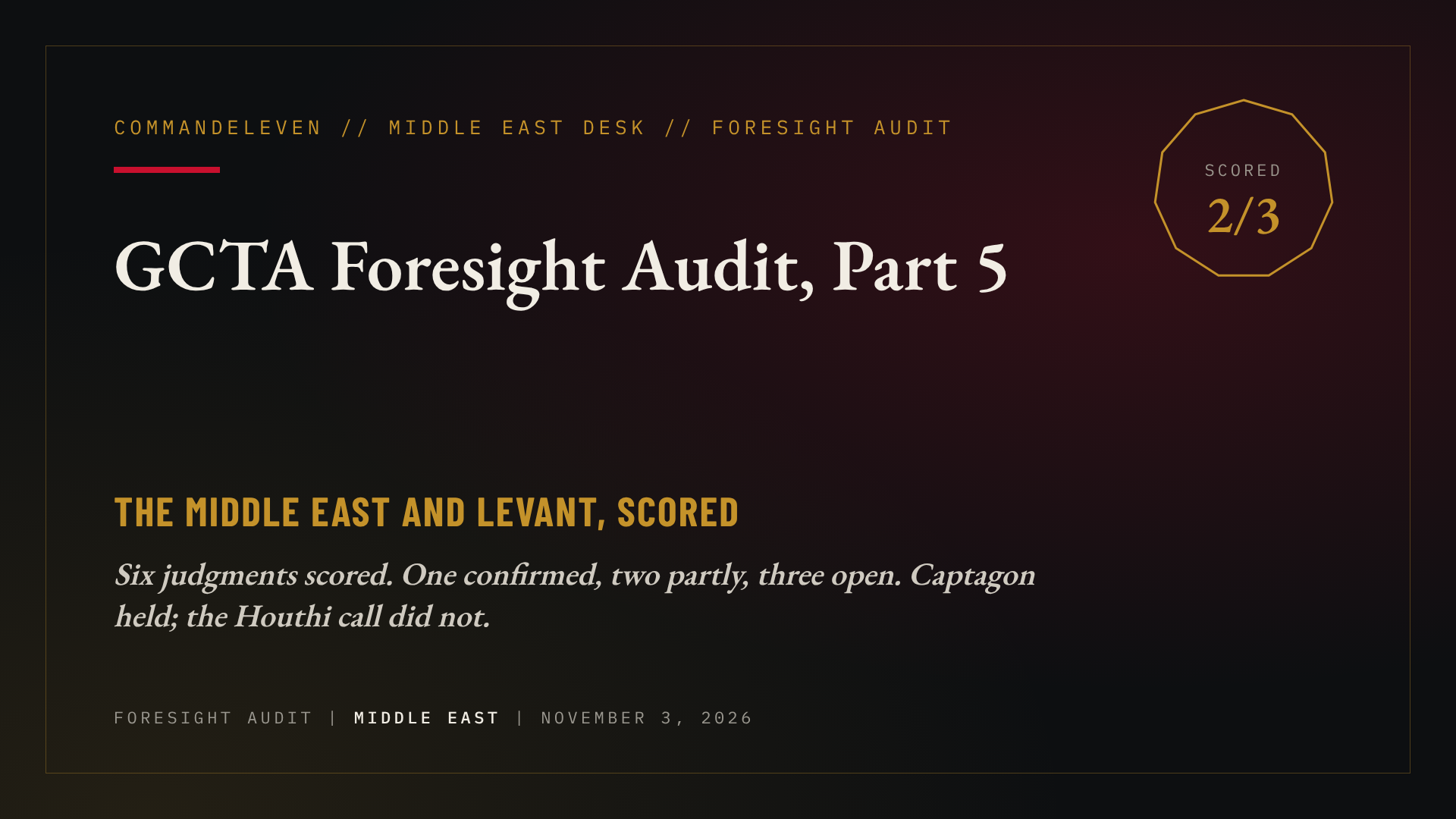
CommandEleven Intelligence // Middle East Desk. Foresight Audit, status as of November 3, 2026. This audit scores the 2026 Global Counter-Terrorism Assessment (GCTA), published in April 2026, against evidence published afterwards.
Bottom Line Up Front
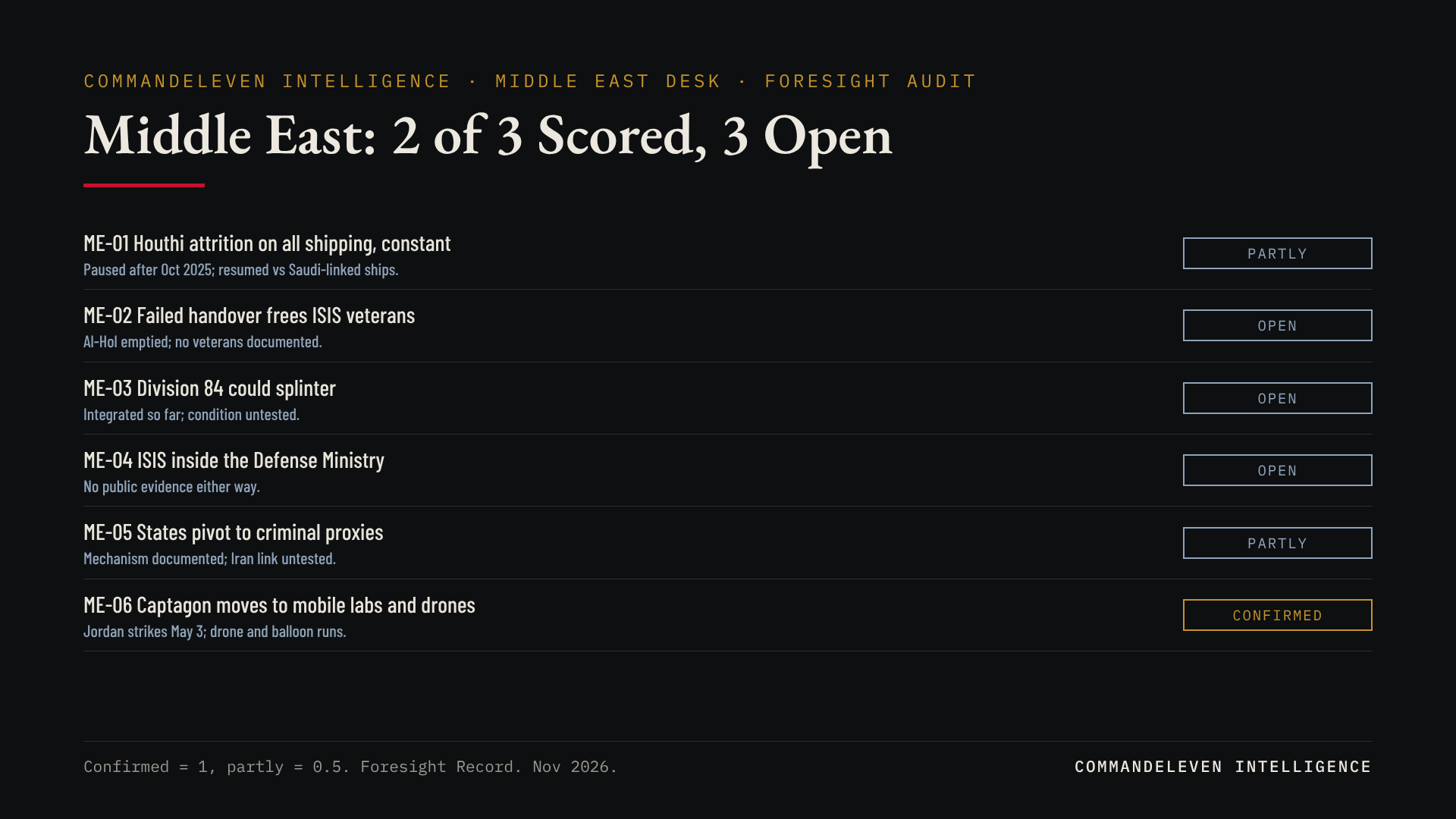
The GCTA’s Middle East chapter (pages 40 to 48) made six judgments we can score. One is confirmed, two are partly confirmed and three stay open: 2 of 3 scored, or 67 percent, on the Record’s method. The chapter is the most specific in the assessment and also the one with the most claims that cannot yet be tested.
What held was the structural argument. Syria’s drug economy moved to small mobile laboratories and drone and balloon smuggling across the Jordanian border, and Jordan struck Suwayda on May 3. The state’s use of criminal networks, notably Iran’s, is documented in Europe, though the link back to the state is untested in court. What did not hold cleanly is the Houthi call: the GCTA described a constant state of attrition against global shipping, when the group had paused attacks after the October 2025 Gaza ceasefire and resumed in 2026 against Saudi-linked shipping.
Key Judgments
KJ1: Syria’s drug economy fragmented as predicted. Small laboratories, drone and balloon crossings and Jordanian strikes all appear in the record. [CONFIRMED]
KJ2: Syria’s detention risk has not yet produced the harm we described. The handover failed at al-Hol, a camp of families, and about 20,000 people are unaccounted for. No one has documented combat-ready veterans being unleashed. [DATA DEFICIT]
KJ3: State outsourcing to criminal networks is documented, but attribution is unproven. Teenagers recruited through criminal intermediaries carried out arson attacks in Europe, and officials link them to Iran. No court has tested the link. [ASSESSED, partly confirmed]
KJ4: Two Syria claims cannot be tested from public sources. Division 84 has not splintered, and no report confirms ISIS infiltration of the Defense Ministry. [DATA DEFICIT]
How We Scored
Every call is scored under the Foresight Record rules, set out in full in the GCTA Foresight Audit introduction. The original is quoted and dated, the score rests on evidence published after the GCTA appeared, and confirmed counts 1 and partly confirmed counts 0.5. Where an official attributes something without publishing evidence, we score partly confirmed. A call that depends on a verdict or a data release is held open. Only our own judgments count.
This audit covers GCTA pages 40 to 48. The ISIS Badiya and Division 84 passages are mostly claims about conditions and capabilities. We scored only the statements that make a testable judgment. The 40 percent assassination figure, the 30 percent cryptocurrency share and the size of Division 84 are checked as baseline facts.
The Scored Calls
| ID | Judgment | GCTA page | Score |
|---|---|---|---|
| ME-01 | Houthi USVs and drones maintain constant attrition against global shipping and tax 12 percent of trade | p. 40 | PARTIALLY CONFIRMED |
| ME-02 | A failed handover of ISIS detainees could unleash combat-ready veterans | p. 45 | OPEN |
| ME-03 | Division 84 could splinter if the Syrian president’s diplomatic gamble fails | p. 44 | OPEN |
| ME-04 | Thousands of former ISIS fighters have infiltrated the Defense Ministry’s ranks | pp. 44, 47 | OPEN |
| ME-05 | Iran and other states have pivoted to criminal networks and deniable cells | p. 40 | PARTIALLY CONFIRMED |
| ME-06 | Captagon production has fragmented into mobile labs, with drone and balloon crossings | pp. 42, 43 | CONFIRMED |
ME-01. The Houthis and global shipping
What we said (GCTA, p. 40). “The use of unmanned surface vessels (USVs) and low-profile suicide drones has maintained a constant state of attrition against global shipping, effectively imposing a terrorist tax on 12% of global trade.” [ASSESSED]
What the record shows. A summary of UN and think-tank reporting says the Houthis stopped targeting merchant ships after the October 2025 Gaza ceasefire. In July 2026 they declared a naval blockade of Saudi-linked shipping, and the UN Secretary-General recorded three commercial vessels attacked between August 9 and September 9. Suez transits averaged about 41 ships a day in 2026 against 74 in 2023, so the economic effect is real. The pre-crisis Suez share of global maritime trade was about 15 percent by volume. The summary does not mention swarm tactics or unmanned boats.
Score: PARTIALLY CONFIRMED. The threat was real and the economic effect persists. “Constant” was not accurate in April, and we found no confirmation of swarms.
ME-02. The detention handover
What we said (GCTA, p. 45). “… nearly 10,000 ISIS fighters remain in precarious detention camps. A single failed handover or security breach during the 2026 transition could unleash a human reservoir of combat-ready veterans.” [ASSESSED]
What the record shows. The handover failed at al-Hol, not at a prison. Custody passed from the SDF to Damascus in January, the camp was effectively empty by late February, and Irregular Warfare estimates about 20,000 people are unaccounted for, among them citizens of about 40 countries who moved through Idlib and Aleppo. Syrian authorities said the camp had been opened in a haphazard manner. Those missing are camp residents, mostly families and not fighters held in prisons, and the author does not assess an imminent wave of violence. The collapse itself came before the GCTA appeared, so the test is what followed. About 9,000 people remain in formal detention in the northeast, and the US moved about 5,700 detainees to Iraq in January.
Score: OPEN. The condition, a failed handover, was met. The result, combat-ready veterans unleashed, has not been documented in anything published after April. Held open for the year-end review.
ME-03. Division 84
What we said (GCTA, p. 44). “This unit serves as a professionalized, “NATO-equipped” jihadi vanguard that could easily splinter if Jolani’s diplomatic gamble fails.” [ASSESSED]
What the record shows. A Soufan Center brief of September 16 describes the 84th Division as having about 2,000 mostly Uyghur fighters, with the Turkistan Islamic Party dissolved and its members integrated through religious guidance programs. It notes recent clashes between foreign fighter communities and government forces but no splintering. The call is conditional on the failure of the government’s diplomacy, which has not clearly happened.
Score: OPEN. It resolves if the division breaks or if the condition is shown to have failed.
ME-04. ISIS inside the army
What we said (GCTA, pp. 44, 47). “thousands of former ISIS fighters who disappeared after the battle of Baghouz have successfully infiltrated the Ministry of Defense’s rank-and-file. They maintain a shadow doctrine, waiting for a governance shock to defect back to the Caliphate with updated state-level SOPs.” [ASSESSED]
What the record shows. The public sources we reviewed do not describe this infiltration. The Soufan brief does not mention it, and Irregular Warfare finds that IS favors low-visibility activity over open violence. The claim is the kind that only appears after a defection or a leak.
Score: OPEN. Held open for lack of public evidence, not because it is disproved.
ME-05. Criminal proxies
What we said (GCTA, p. 40). “State actors (notably Iran) have pivoted from using large, identifiable militias toward Transnational Criminal Organizations (TCOs) and small, specialized deniable cells.” [ASSESSED]
What the record shows. Seventeen low-level attacks in Europe from March, aimed at Jewish sites, US banks and an Iranian opposition broadcaster, were claimed by a group called HAYI, according to the Irish Times on April 23. Investigators say the teenagers were recruited through criminal intermediaries, one of them on a Snapchat group used for drug deliveries. The MI5 director general said MI5 tracked more than 20 potentially lethal Iran-backed plots in the UK over 12 months, and France’s interior minister drew a direct link to Iran after a failed Paris bombing attempt. The same report says no direct proof of Iranian involvement is cited.
Score: PARTIALLY CONFIRMED. The mechanism is confirmed. State direction remains official attribution without a verdict, the same position we hold in our RAF Fairford audit.
ME-06. Captagon after Assad
What we said (GCTA, pp. 42, 43). “Production has moved from industrial-scale factories in Homs and Latakia to mobile, kitchen-scale laboratories along the Lebanese and Jordanian borders.” and smugglers use “helium balloons and low-profile drones to carry 50kg payloads over Jordanian motion sensors.”
What the record shows. Jordan’s air force struck narcotics facilities and weapons warehouses in Suwayda on May 3, 2026, according to a compiled account that includes unverified details. Jordanian intelligence reported in early 2026 that smugglers use delivery drones and helium balloons across the 362-kilometer border, and border guards reportedly shot down two drug drones in May. OCCRP had earlier described small groups running mobile laboratories in the south.
Score: CONFIRMED.
Baseline Facts Checked
These are factual statements in the GCTA that were checkable. They are not forecasts and are not counted in the Foresight Record totals. A claim we could not reproduce is marked unverified, which is not the same as wrong.
| GCTA statement | What we found | Status |
|---|---|---|
| A 40 percent rise in assassinations and sabotage by criminal gangs for state intelligence in 2025 | We found no source for the figure. The pattern is documented, the percentage is not. | Unverified |
| About 30 percent of high-level Captagon transactions are settled in USDT or Monero | OCCRP’s September 2025 report does not mention cryptocurrency. FDD documents stablecoin use by the IRGC and its proxies in general terms. | Unverified |
| Nearly 10,000 ISIS fighters in detention | Irregular Warfare puts about 9,000 in formal detention in northeast Syria after the transfers to Iraq. | Confirmed, approximate |
| Division 84 holds 3,500 to 5,000 foreign fighters | The Soufan Center counts about 2,000 fighters, or about 20,000 people with families. | Not reproduced |
| Hezbollah is in financial crisis after the war with Israel and keeps Captagon production in the Beqaa | The New York Times, via Israel Hayom on August 9, reports the worst financial pressure in years. FDD says Captagon manufacturing moved to the Beqaa Valley and Dahiyeh. | Confirmed |
What Would Change These Scores
- A conviction or plea in a European arson case that names an Iranian handler would move ME-05 to confirmed.
- A named Defense Ministry defector or arrest tied to ISIS would resolve ME-04.
- A Houthi campaign with swarm attacks or unmanned boats on commercial ships would raise ME-01.
- A UN census of the missing al-Hol residents would settle ME-02.
What We Learned
We wrote conditions as if they were current. Division 84 and the army infiltration claim are both stated in a way that can only be tested by a break the world has not seen. Next year we will state the trigger and the date.
On the Houthis, we described the pattern of the previous two years as the pattern of early 2026. We should have checked the ceasefire.
What This Audit Does and Doesn’t Establish
- It establishes that, against the public record to November 3, 2026, the Captagon judgment was right, the criminal-proxy judgment was right on mechanism, and the Houthi description was not accurate.
- It does not establish that Iran directed the European attacks.
- It does not establish that ISIS has or has not infiltrated Syria’s army.
Frequently Asked Questions
Did the GCTA predict the al-Hol collapse?
It warned of a failed handover, and the collapse came before the assessment appeared. We hold the call open because no one has documented the combat-ready veterans it said would be unleashed.
Has Division 84 splintered?
No. The Soufan Center describes it as integrated, with recent clashes between foreign fighter communities and government forces.
Why are the Syrian army infiltration claims open and not wrong?
Because the evidence for or against them is not public. We do not score what cannot be checked.
What comes next?
Parts 6 to 8 cover North Africa, Europe and North America, and Latin America.
Sources
- Irregular Warfare Initiative, Al-Hol’s Collapse: How Syria’s Detention Crisis is Enabling Islamic State Resilience (April 10, 2026, updated June 5, 2026)
- Kurdistan24, Syrian Authorities Confirm Mass Escape from Al-Hol Camp (February 25, 2026)
- The Soufan Center, From Moral Guidance to Incorporation: Uyghur Assimilation in the Syrian Armed Forces (September 16, 2026)
- The Irish Times, Iran behind low-level ‘hybrid warfare’ attacks in Europe, analysts say (April 23, 2026)
- Wikipedia, 2026 Jordanian strikes on Syria (compiled record, accessed November 3, 2026; several claims are flagged as needing citation)
- OCCRP, Captagon Drug Networks Adapt and Survive in Middle East After Assad’s Fall (September 22, 2025)
- Rio Times, The Houthis and the Red Sea Explained in 2026 (October 2026; a secondary summary of UN and Suez Canal data)
- Israel Hayom, Hezbollah faces worst financial crisis in years (August 9, 2026, relaying The New York Times)
- Foundation for Defense of Democracies, Hezbollah’s Financing Strategies: Recovering from War with Israel (July 24, 2026)