
CommandEleven Intelligence // Americas Desk. Foresight Audit, status as of November 3, 2026. This audit scores the 2026 Global Counter-Terrorism Assessment (GCTA), published in April 2026, against evidence published afterwards.

Bottom Line Up Front
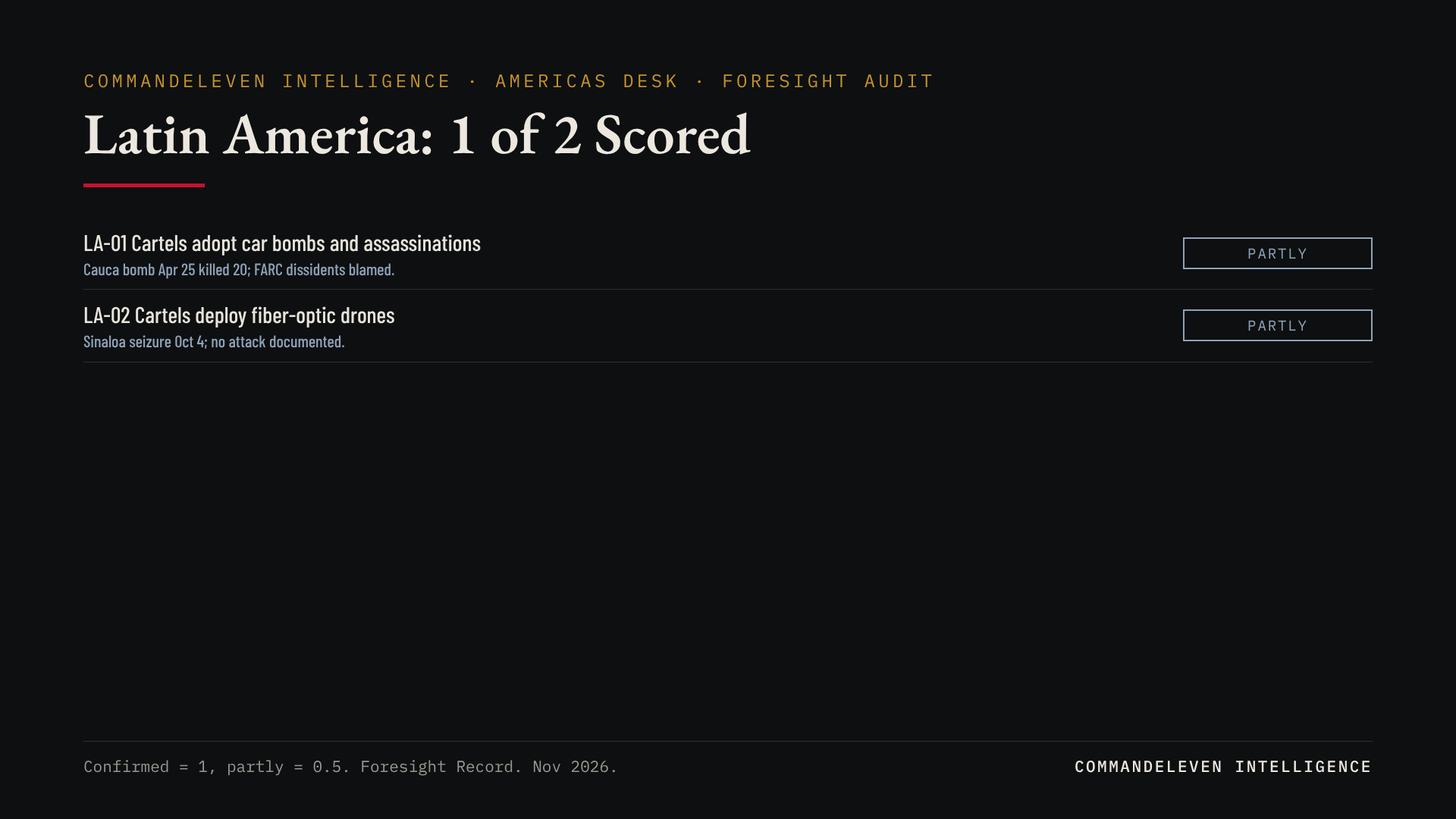
The GCTA’s Latin America chapter is mostly a set of reported facts, so only two of its statements are judgments we can score. Both are partly confirmed, 1 of 2. The factual claims in the chapter are checked separately as baseline facts and do not count.
We wrote that cartels in Ecuador, Colombia and Mexico were “increasingly utilizing classic terror tactics” such as car bombs. On April 25 a bomb on the Pan-American Highway in Cauca killed 20 civilians, and on August 8 a car bomb hit a toll plaza the day after Colombia’s new president took office. Colombian authorities blame FARC dissident groups, not cartels. We also wrote that Mexican cartels were already deploying fiber-optic drones. Mexico’s first official record of that technology came on October 4, when authorities seized 15 FPV drones and 15 spools of fiber-optic cable in Sinaloa, six months after our claim. We found no public support for several specific claims in the chapter, including a swarm of 12 or 15 drones and a Buenos Aires transit attack.
Key Judgments
KJ1: The terror tactics are real, but the perpetrators are mostly insurgents. Colombia’s 2026 bombings used the tactics we named. FARC dissidents, who fund themselves with the drug trade, are blamed for them. [PARTIALLY CONFIRMED]
KJ2: Fiber-optic drones reached the cartels, later than we said. The October 4 seizure shows possession. It does not show use in attacks. [PARTIALLY CONFIRMED]
KJ3: The Sahel connection is not shown. The Ukraine route for drone expertise is documented as an allegation. We found no public evidence for blueprints moving from JNIM to Mexican cartels. [BASELINE, unverified]
KJ4: Several figures in the chapter did not survive a check. The swarm size differs between pages 77 and 78, and we found no report of the Buenos Aires event. [BASELINE, unverified]
How We Scored
Every call is scored under the Foresight Record rules, set out in full in the GCTA Foresight Audit introduction. The original is quoted and dated, the score rests on evidence published after the GCTA appeared, and confirmed counts 1 and partly confirmed counts 0.5. Where an official attributes something without publishing evidence, we score partly confirmed. A call that depends on a verdict or a data release is held open. Only our own judgments count.
The Latin America chapter spans pages 14 and 76 to 79. Most of its sentences state what “intelligence confirms” or what we are “tracking”. We scored only the two statements that characterize a trend or predict how a capability would develop. We checked the rest as baseline facts. The Hezbollah and Tren de Aragua claim in this chapter is the same one scored as NA-03 in Part 7, and we do not count it twice.
The Scored Calls
| ID | Judgment | GCTA page | Score |
|---|---|---|---|
| LA-01 | Cartels in Ecuador, Colombia and Mexico increasingly use car bombs, political assassinations and media station takeovers to coerce governments | p. 14 | PARTIALLY CONFIRMED |
| LA-02 | Cartels deploy fiber-optic guided drones immune to jamming | p. 78 | PARTIALLY CONFIRMED |
LA-01. Terror tactics by criminal groups
What we said (GCTA, p. 14). “cartels in Ecuador, Colombia, and Mexico are increasingly utilizing classic terror tactics (car bombs, political assassinations, media station takeovers) to coerce state governments”.
What the record shows. In Colombia, an attack on a military base in Cali on April 24 killed one person, and on April 25 a bomb on the Pan-American Highway near Cajibio, Cauca, set a bus on fire and killed 20 civilians, with 36 wounded. The government blamed the main FARC dissident group and offered a reward of 5 billion pesos for its suspected leader. On August 8, the day after Abelardo de la Espriella was sworn in as president, a car bomb exploded at a toll plaza on the Pan-American Highway between Cauca and Valle del Cauca, and the army blamed two FARC dissident groups. Two guards were slightly hurt. In Ecuador, bridge blasts in October 2025 were blamed on a criminal gang, Los Lobos, and FARC dissidents. We did not find a comparable 2026 car bombing in Mexico or Ecuador, and we found no media station takeovers or political assassinations in 2026 in our review, which was not exhaustive.
Score: PARTIALLY CONFIRMED. The tactic is confirmed in Colombia. The actors are insurgent dissidents rather than cartels, and the other tactics we named are not documented in 2026.
LA-02. Fiber-optic drones in cartel hands
What we said (GCTA, p. 78). “cartels are now deploying fiber-optic guided drones. These are 100% immune to the standard electronic jamming suites currently utilized by the Mexican National Guard and CBP.”
What the record shows. On October 4, authorities seized 15 FPV drones, 15 spools of fiber-optic cable, seven pairs of goggles and 15 controllers in El Rosario, in Mazatlan, Sinaloa. A news report called it the first official record in Mexico of the technology being adapted by organized crime, and it did not name the cartel. Analyst David Mora of the International Crisis Group said earlier cases were limited to isolated videos and photos and that most documented weaponized-drone cases involve commercial drones, not fiber-optic ones. The article does not confirm any attack with these drones.
Score: PARTIALLY CONFIRMED. The capability has arrived, six months after we wrote that it was deployed. Use in attacks is not documented.
Baseline Facts Checked
These are factual statements in the GCTA that were checkable. They are not forecasts and are not counted in the Foresight Record totals. A claim we could not reproduce is marked unverified, which is not the same as wrong.
| GCTA statement | What we found | Status |
|---|---|---|
| Nemesio Oseguera Cervantes, El Mencho, died on February 22, 2026 (p. 78) | Mexican media reported on February 22 that he was killed in an army operation in Jalisco. | Confirmed |
| CJNG deployed a coordinated swarm of 12 FPV drones against a Michoacan police convoy in Q1 2026 (p. 77), and swarms of up to 15 units (p. 78) | The two pages give different sizes. We found no public report of either. The analysis we reviewed describes single-platform FPV use. | Unverified |
| Mexican operatives infiltrated foreign fighter units in Ukraine to acquire FPV skills (p. 78) | Defense News reported in July 2025 that several Mexicans with alleged organized-crime links passed through Ukraine’s International Legion. One case, a man using the alias Aguila-7, is under investigation. | Partly confirmed, allegation |
| Drone blueprints migrate from JNIM to Mexican cartels through dark web exchanges (p. 77) | A September 2026 analysis of cartel drone adaptation does not mention the Sahel, JNIM or any jihadist link. | Unverified |
| The Buenos Aires Digital Decapitation of February 2026 stalled the city’s transit grid (p. 78) | We found no report of such an event. | Unverified |
| The Tri-Border Area is a Hezbollah financing hub (p. 14) | Researchers have documented this for years, including the Barakat clan, the Galeria Page shopping center that the US Treasury designated in 2006, and a former Hezbollah treasurer imprisoned in Paraguay. This audit found no new 2026 evidence. | Confirmed as long-standing |
| A direct Monero flow runs from the Al-Karrar Office in Somalia to Lebanese-owned exchange houses in Ciudad del Este (p. 77) | We found no public record of the flow. | Unverified |
| ISKP increased its Spanish and Portuguese-language propaganda by 400 percent in 2026 (p. 77) | We found no independent measurement in the sources we reviewed. | Unverified |
What Would Change These Scores
- A documented attack with a fiber-optic cartel drone would move LA-02 to confirmed.
- A car bombing or assassination campaign attributed to a Mexican or Ecuadorian cartel in the last two months of 2026 would move LA-01 toward confirmed.
- A court filing or official report that shows Sahel-origin drone designs in cartel hands would let us score the Sahel link.
- A source for the swarm incident, the Buenos Aires event or the Monero flow would move those rows from unverified to confirmed.
What We Learned
We stated several things as intelligence that we cannot source. When a finding rests on information we cannot publish, we should say so on the page and not present it as fact. The unverified rows in this audit are the ones we will correct or document first.
We treated the cartels and the FARC dissidents as one category. The two have different structures, and the tactic we predicted came mostly from the dissidents.
What This Audit Does and Doesn’t Establish
- It establishes that car bombings and mass-casualty bomb attacks occurred in Colombia in 2026 and that Mexico recorded its first official fiber-optic cartel drone seizure on October 4.
- It establishes that several specific claims in the chapter have no public support in the sources we reviewed.
- It does not show that Mexican or Ecuadorian cartels adopted car bombing in 2026.
- It does not test the Hezbollah and Tren de Aragua claim, which is scored as NA-03 in Part 7.
- It does not rule out classified evidence for the unverified rows.
Frequently Asked Questions
Are Colombia’s bombings cartel attacks?
Colombian authorities blame FARC dissident groups, which finance themselves through the drug trade. We scored the call partly confirmed because the tactic matched and the actors did not.
Have Mexican cartels used fiber-optic drones in attacks?
Not in a documented case. The first official seizure was in Sinaloa on October 4, and an International Crisis Group analyst said most documented cartel drone attacks use commercial drones.
Why are so many rows unverified?
Because the chapter states figures and events we could not find in public sources. Unverified means we could not reproduce it, which is not the same as wrong.
What comes next?
Parts 9 to 11 cover ISKP governance, cyber-kinetic convergence and a closing synthesis.
Sources
- Wikipedia, 2026 Cauca bombing (accessed November 3, 2026)
- Illawarra Mercury, Car bomb attack after Colombia’s new president sworn in (August 8, 2026)
- Texas Public Radio, Fiber-optic drones seized in Sinaloa raise concerns in Mexico (October 19, 2026)
- GNET, From Kyiv to Culiacan: How Mexican Cartels Are Adapting Drone Warfare Lessons from Ukraine (September 28, 2026)
- Yahoo News, Two explosions rock Ecuador. Authorities blame local criminal gang and Colombian ex-FARC dissidents (October 2025)
- Emisoras Unidas, Muere El Mencho, lider del CJNG, en operativo en Jalisco (February 22, 2026)
- NewsNation, Tren de Aragua and Hezbollah links (March 18, 2026)
- Air University, Strategic Horizons, Jihad in the Jungle: An Examination of Hezbollah’s Financial Network in the Tri-Border Area (undated essay)
- Wikipedia, Timeline of the Islamic State (2026) (accessed November 3, 2026)