
CommandEleven Intelligence // Strategy Desk. Foresight Audit, status as of November 3, 2026. This audit scores the 2026 Global Counter-Terrorism Assessment (GCTA), published in April 2026, against evidence published afterwards.
Bottom Line Up Front
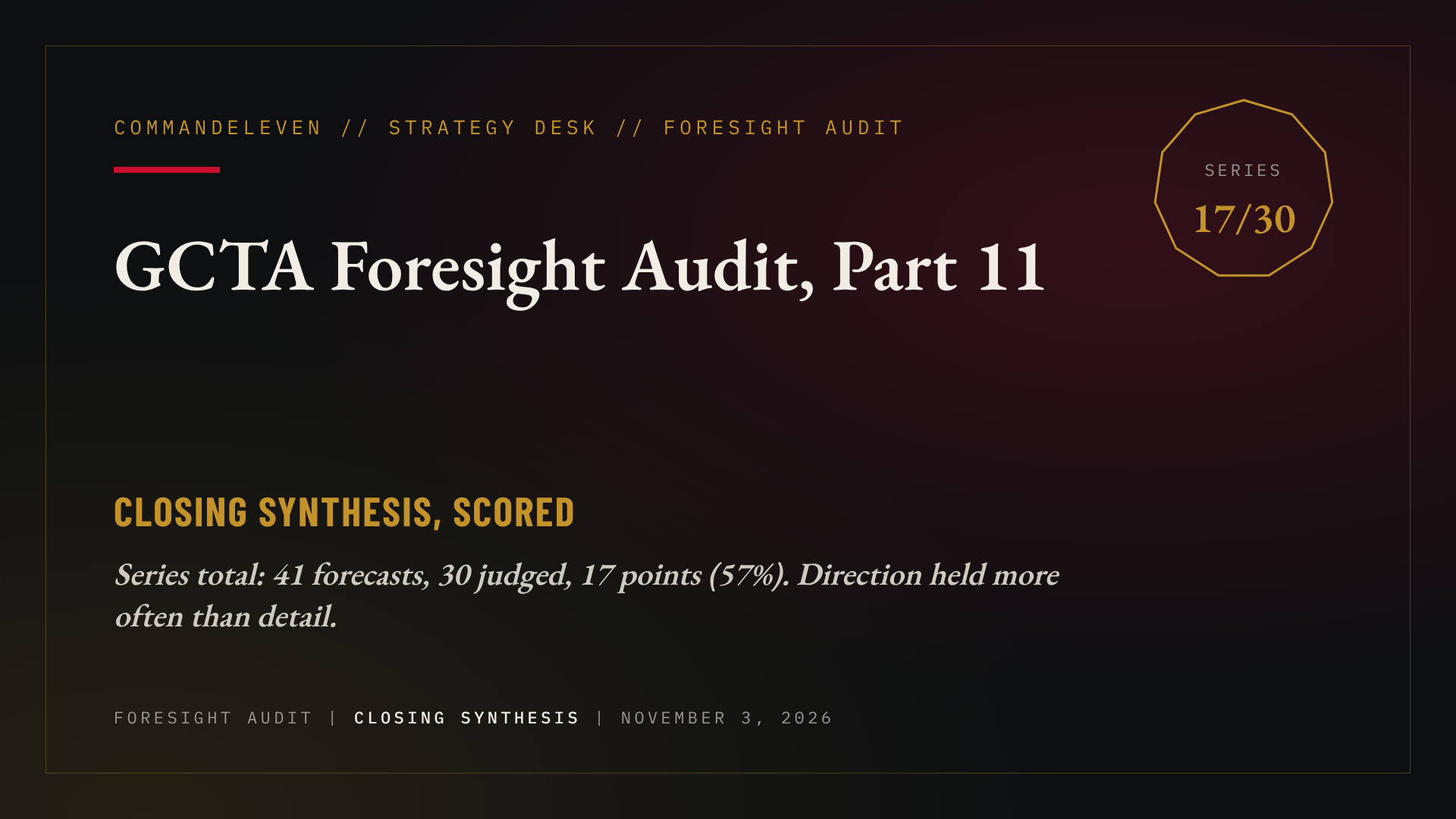
This audit closes the series. Across Parts 1 to 11 we scored 41 forecasts from the GCTA: 8 confirmed, 18 partly confirmed, 4 not confirmed and 11 still open. Of the 30 we can judge, that is 17 points, or 57 percent. This part scores the last two forecasts, from the executive summary and the strategy chapters: one partly confirmed and one open.
The pattern across the series is plain. We were right more often about direction than about detail: 26 of the 30 judged forecasts were at least partly right, and only 4 were not. The executive summary statistics match the Global Terrorism Index, but three claims in the policy chapter do not survive the public record. One credits a strategy released in January 2026 with enabling an attack in January 2025. The other two repeat the Palm Springs and ProtectEU errors we corrected in Part 7.
Key Judgments
KJ1: Direction beat detail across the series. 26 of 30 judged forecasts were at least partly right. The misses were mostly in named plots, offices and figures. [SERIES]
KJ2: The shift from spectaculars to localism is borne out in the pattern, though ISKP keeps spectaculars as an aim. [PARTIALLY CONFIRMED]
KJ3: An automated AI recruitment funnel is not documented. AI use in propaganda is. [OPEN]
KJ4: Three policy-chapter claims fail. The 22-day compression figure, the New Orleans attribution and the Palm Springs case study do not hold. [BASELINE, corrected]
How We Scored
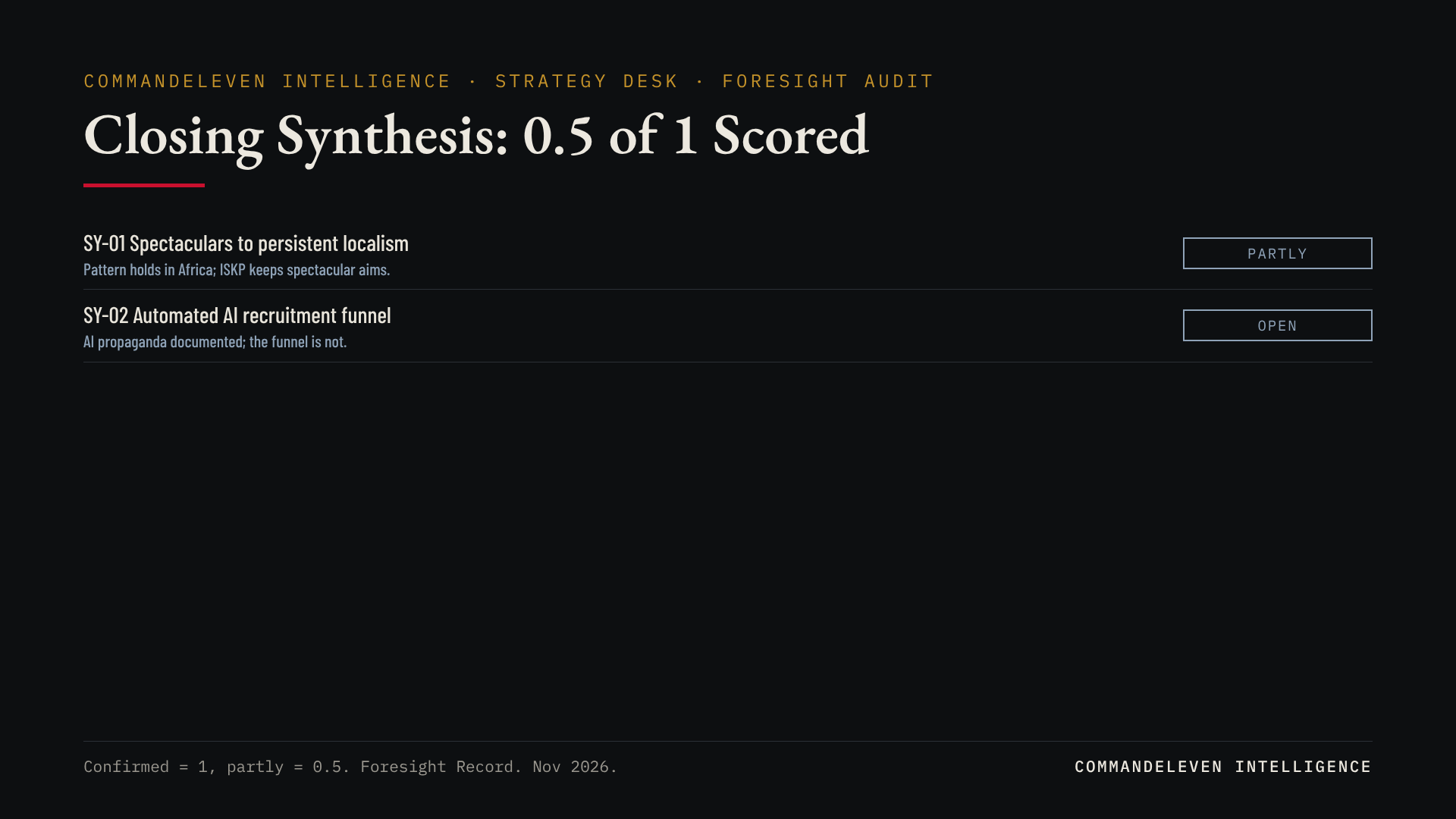
Every call is scored under the Foresight Record rules, set out in full in the GCTA Foresight Audit introduction. The original is quoted and dated, the score rests on evidence published after the GCTA appeared, and confirmed counts 1 and partly confirmed counts 0.5. Where an official attributes something without publishing evidence, we score partly confirmed. A call that depends on a verdict or a data release is held open. Only our own judgments count.
This audit covers the executive summary and strategic sections (pages 4 to 6), the policy and prevention chapters (pages 70, 71, 74 and 80 to 83) and the closing pages. The topics scored elsewhere are not rescored here: the regional chapters are in Parts 1 to 10 and the Palm Springs case is in Part 7. The policy chapters mostly make recommendations, which are not forecasts and do not count in the totals. We check the factual statements they rest on as baseline facts.
The Scored Calls
| ID | Judgment | GCTA page | Score |
|---|---|---|---|
| SY-01 | The strategy of ISIS and al-Qaeda has shifted from spectaculars to persistent localism | p. 6 | PARTIALLY CONFIRMED |
| SY-02 | Extremists use an automated AI funnel: bots find vulnerable users, chatbots test commitment, then handlers take them to encrypted channels | p. 6 | OPEN |
SY-01. From spectaculars to persistent localism
What we said (GCTA, p. 6). “In 2025/2026, the strategy of groups like ISIS and al-Qaeda has shifted from spectaculars (large-scale international attacks) to persistent localism.”
What the record shows. The Global Terrorism Index for 2026 says the Sahel accounted for roughly half or more of 2025 deaths, and that global deaths fell to their lowest since 2007. The UN monitoring team’s August report, as summarized by the Foundation for Defense of Democracies, says about two-thirds of Islamic State and al-Qaeda fighters are now in Africa. A running list of 2026 incidents that we reviewed shows no attack with 50 or more deaths since April, and the deadliest, a May 24 train bombing in Quetta, killed at least 47. The same UN report says ISIL-K still intends to attack abroad and can mount infrequent, high-profile mass-casualty attacks, which means spectaculars remain an aim.
Score: PARTIALLY CONFIRMED. The pattern of localized, Africa-centered activity holds. The word strategy overstates it, because ISKP has not given up spectaculars and a decline in them may reflect weakness, not choice.
SY-02. The AI recruitment funnel
What we said (GCTA, p. 6). We described three phases: “AI-driven bots identify vulnerable users on public platforms”, automated chatbots test their commitment, and vetted users are funneled to encrypted channels for tasking.
What the record shows. The UN report says some Islamic State affiliates, notably ISIL-K, appear to use AI tools to translate and circulate propaganda. Europol’s 2026 trend report says generative AI may make extremist content easier to create and distribute, and that encrypted services and gaming platforms support recruitment. We found no public report of bots that find recruits or chatbots that vet them. The Dutch case in Part 9 involves alleged human contact.
Score: OPEN. AI as a propaganda tool is documented. The automated funnel is not. We will score it as not confirmed at the December 31 review unless a court filing or an official report documents it.
Baseline Facts Checked
These are factual statements in the GCTA that were checkable. They are not forecasts and are not counted in the Foresight Record totals. A claim we could not reproduce is marked unverified, which is not the same as wrong.
| GCTA statement | What we found | Status |
|---|---|---|
| Global terrorism deaths fell 28% to 5,582 in 2025 and incidents fell 22% to 2,944, the lowest since 2007 (p. 4) | The Global Terrorism Index 2026 reports exactly these figures. | Confirmed |
| Deaths in the West rose 280% to 57 (p. 4) | The Global Terrorism Index reports a 280% rise to 57 deaths, driven by antisemitic, anti-Muslim and political attacks. | Confirmed |
| Pakistan became the most impacted country, with 1,139 deaths (p. 4) | The Index ranks Pakistan first for the first time, with 1,139 deaths, up 6%, and 1,045 incidents. | Confirmed |
| Islamic State, JNIM, the TTP and al-Shabaab caused 3,869 deaths, or 70% (p. 4) | The Index reports 3,869 deaths, about 70% of the total, and names Islamic State as the deadliest group, with just under 17% of attacks. | Confirmed |
| The TTP was the only major group to record more deaths (p. 4) | The Index reports 637 TTP deaths, the highest since 2011, with incidents up 24%. We could not verify the word only. | Consistent; only unverified |
| Over 76% of attacks occurred within 100 km of a border, up from 60% in 2007 (p. 4) | The Index briefing we read gives a 64% figure in a related border statistic. We could not reconcile the definitions or confirm 76%. | Unverified |
| The 2026 National Defense Strategy ranks homeland and the Western Hemisphere first, then China, then Russia (p. 70) | The strategy, released January 23, 2026, lists homeland defense, including the Western Hemisphere, first and deterring China second. Russia is not a listed priority. It names Golden Dome and says it will hunt Islamist terrorists who can and intend to strike the homeland. | Confirmed in substance; Russia ranking wrong |
| The 2026 defense strategy’s China focus caused intelligence drift that directly enabled the New Orleans truck attack (p. 71) | The New Orleans attack took place on January 1, 2025. The strategy was released on January 23, 2026. A document released a year later cannot have enabled it. | Contradicted |
| The Palm Springs bomber was an ISKP-vetted asset whose tip the FBI closed (p. 71) | The public record, set out in Part 7, shows no ISIS link, and the bomber died in the attack. | Contradicted |
| ProtectEU was launched in early 2026 (p. 70) | The European Commission presented ProtectEU on April 1, 2025, as Part 7 records. | Contradicted |
| The window from first contact to attack was under 30 days for New Orleans and Palm Springs, a 22-day compression (pp. 74, 81) | We found no public timeline for either case that supports the figure. It is our own construct, not a published statistic. | Unverified |
The Series Scorecard
This table shows every part of the series. Calls are the forecasts scored in each part. Baseline facts are not counted.
| Part | Calls | Confirmed | Partly confirmed | Not confirmed | Open |
|---|---|---|---|---|---|
| Part 1, Financing and the stealth state | 5 | 2 | 1 | 1 | 1 |
| Part 2, The Indian Subcontinent | 3 | 1 | 2 | 0 | 0 |
| Part 3, The Sahel | 6 | 2 | 2 | 2 | 0 |
| Part 4, East Africa | 4 | 2 | 1 | 0 | 1 |
| Part 5, The Middle East and Levant | 6 | 1 | 2 | 0 | 3 |
| Part 6, North Africa, Southeast Asia and the Sulu Sea | 3 | 0 | 1 | 0 | 2 |
| Part 7, Europe and North America | 4 | 0 | 1 | 1 | 2 |
| Part 8, Latin America | 2 | 0 | 2 | 0 | 0 |
| Part 9, ISKP | 4 | 0 | 3 | 0 | 1 |
| Part 10, Cyber-kinetic convergence | 2 | 0 | 2 | 0 | 0 |
| Part 11, Closing synthesis | 2 | 0 | 1 | 0 | 1 |
| Total | 41 | 8 | 18 | 4 | 11 |
Calls still open for the December 31 review.
- Part 1: one open call on terrorist financing.
- Part 4: Ethiopian sleeper cells (EA-04).
- Part 5: ISIS detainees (ME-02), Division 84 (ME-03) and ISIS in the Defense Ministry (ME-04).
- Part 6: Sulu Sea maritime drones (SE-02) and IS-Sinai and IS-Libya tempo (NF-01).
- Part 7: a strike on US data centers and the grid (NA-02) and Hezbollah and Tren de Aragua infiltration (NA-03).
- Part 9: tactical overload in Western cities (IK-03).
- Part 11: the automated AI recruitment funnel (SY-02).
What Would Change These Scores
- An official attribution of an AI-run recruitment funnel in a court filing or government report would move SY-02 toward confirmed.
- A mass-casualty attack abroad directed by ISKP or al-Qaeda before December 31 would weaken the localism reading of SY-01.
- A source for the 76% border figure or the 22-day figure would move those rows from unverified.
- The eleven open calls will be scored at the year-end review of the Foresight Record.
What We Learned
We were stronger on mechanisms than on specifics. Youth radicalization online, drones in militant hands, AI in propaganda, strikes on infrastructure and record signal jamming all held. Named plots, named offices, named transfers and precise dollar figures often did not, and our own text sometimes said that official reports confirmed claims they do not contain.
We also let our analytic labels read like facts. The 22-day compression and the Distributed Strike Doctrine are our constructs, and the evidence for them was partly cases we had misdescribed. In the next assessment we will label every construct, cite every figure to its source and keep forecasts separate from description.
What This Audit Does and Doesn’t Establish
- It establishes that the series scored 41 forecasts, 30 of them judged, and that 26 of the 30 were at least partly right.
- It establishes that the executive summary statistics match the Global Terrorism Index.
- It establishes that three policy-chapter claims fail and need correction on the GCTA page.
- It does not show that the open calls will resolve in any direction.
- It does not score policy recommendations, which are not forecasts.
Frequently Asked Questions
How did the GCTA do overall?
Of 41 forecasts, 8 were confirmed, 18 partly confirmed, 4 not confirmed and 11 remain open. Of the 30 we can judge, the weighted score is 17 points, or 57 percent.
What were the biggest misses?
The multi-city World Cup and July 4 strikes did not happen, and several named plots, offices and figures cannot be sourced. The policy chapter contains three claims that fail the public record.
Will you correct the GCTA?
We are reviewing the GCTA page against the public record and will publish any correction. The corrections noted in Parts 7, 9, 10 and 11 are the starting list.
When will the open calls be scored?
At the December 31, 2026 year-end review of the Foresight Record.
Sources
- Institute for Economics and Peace, Global Terrorism Index 2026 Briefing (March 2026)
- Human Progress, Global terrorism falls to a decade low (2026)
- Dawn, With 6pc increase in terror-related deaths, country tops Global Terrorism Index (2026)
- USNI News, 2026 U.S. National Defense Strategy (January 24, 2026)
- FDD’s Long War Journal, The UN Monitoring Team’s latest report: Where the global jihad stands now (September 2026)
- UN Security Council, Thirty-eighth report of the Analytical Support and Sanctions Monitoring Team, S/2026/651 (August 10, 2026; text as mirrored)
- eucrim, Europol TE-SAT 2026 (2026)
- Wikipedia, List of terrorist incidents in 2026 (accessed November 3, 2026)
Related CommandEleven Intelligence Reporting
- The GCTA Foresight Audit
- GCTA Foresight Audit, Part 1: Financing and the Stealth State
- GCTA Foresight Audit, Part 7: Europe and North America
- GCTA Foresight Audit, Part 9: ISKP, the Islamic State’s Engine Room
- GCTA Foresight Audit, Part 10: Cyber-Kinetic Convergence
- The Foresight Record: Every Call We Have Scored, Misses Included
- 2026 Global Counter-Terrorism Assessment (download)