
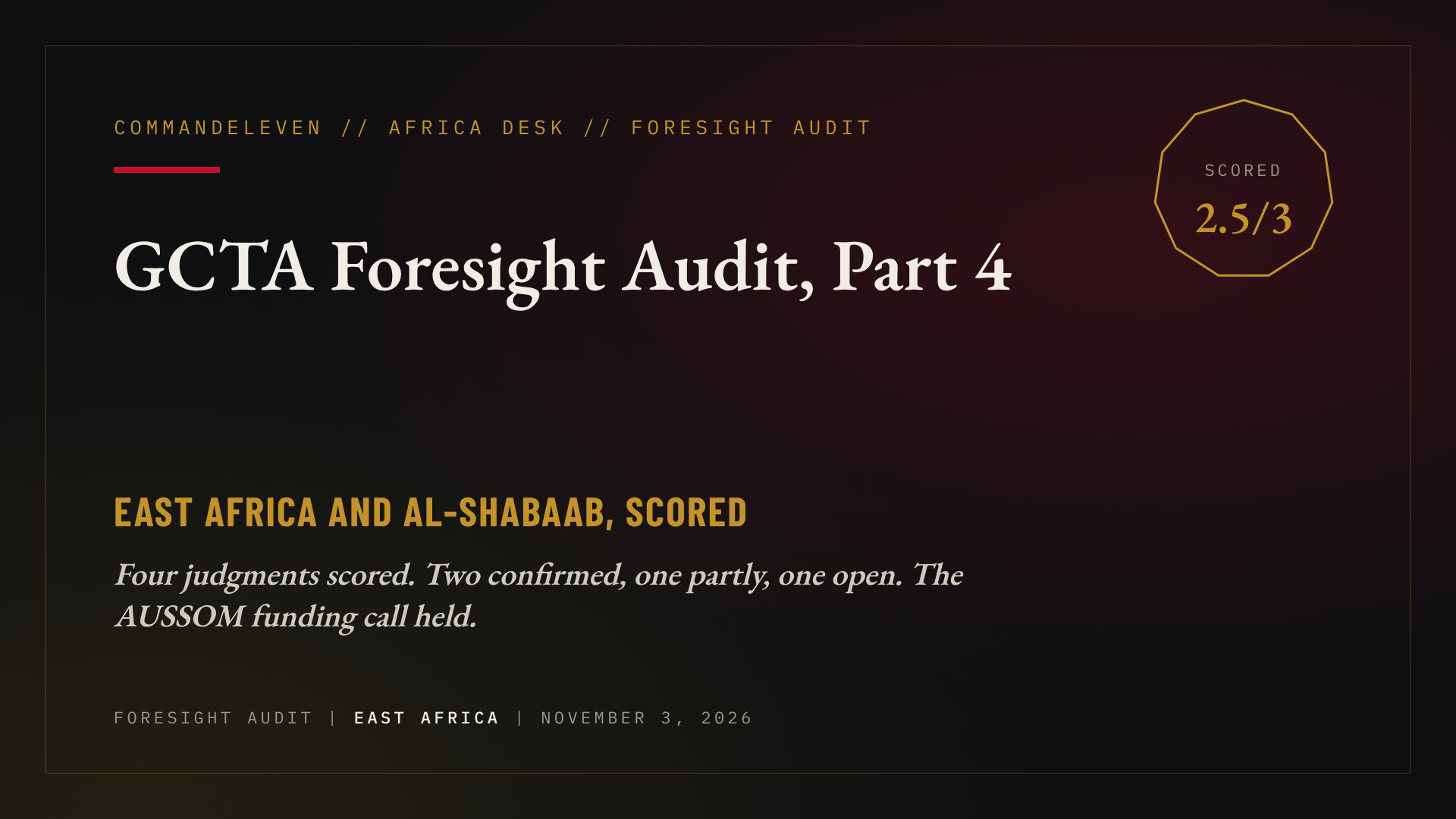
CommandEleven Intelligence // Africa Desk. Foresight Audit, status as of November 3, 2026. This audit scores the 2026 Global Counter-Terrorism Assessment (GCTA), published in April 2026, against evidence published afterwards.
Bottom Line Up Front
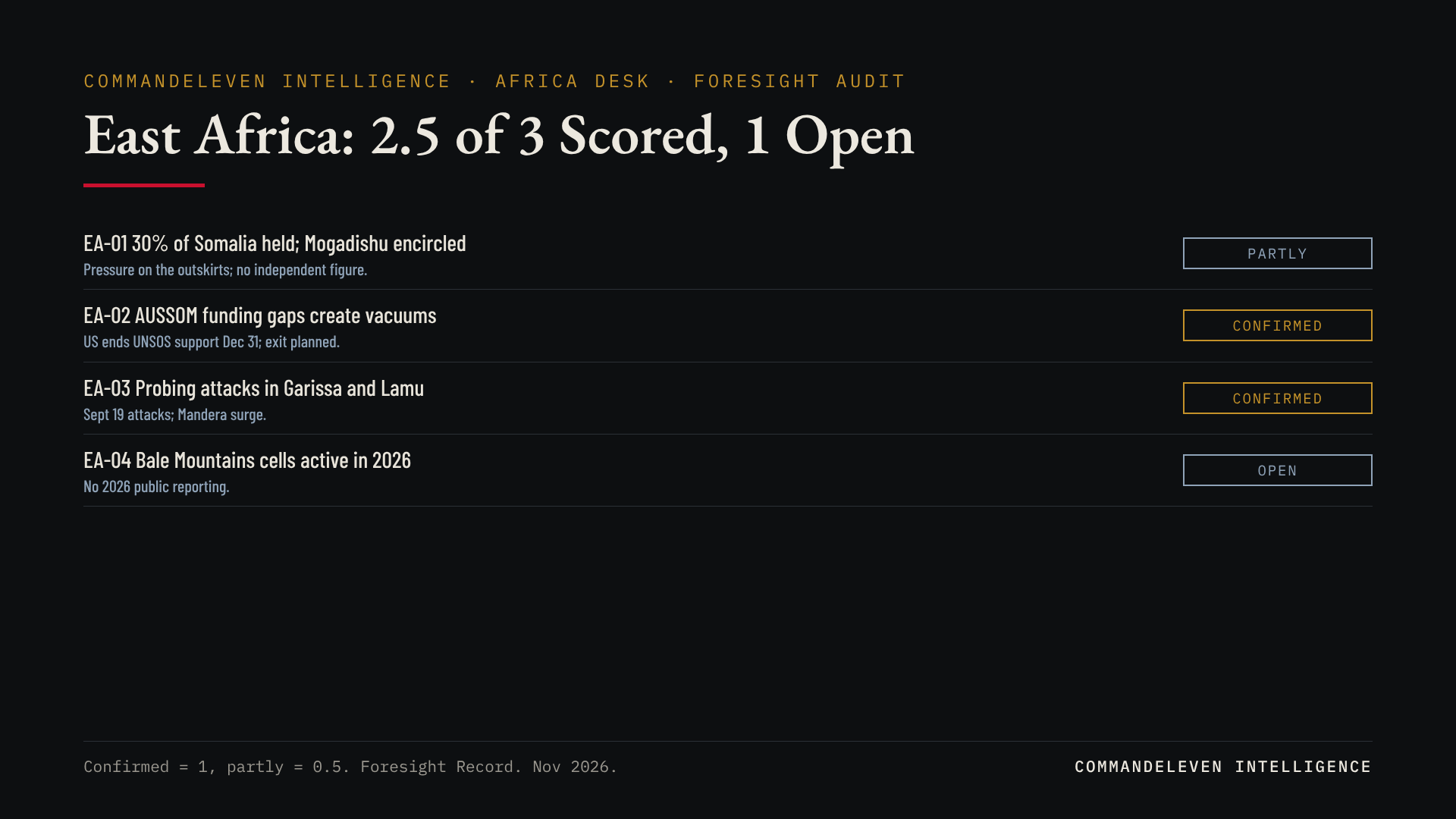
The GCTA’s East Africa chapter made four judgments we can score. Two are confirmed, one is partly confirmed and one stays open: 2.5 of 3 scored, or 83 percent, on the Record’s method. It is the strongest result in the GCTA audit so far, and also the one where the public data is thinnest.
The GCTA said al-Shabaab was exploiting an underfunded African Union mission and probing Kenya’s coast. Both held. The UN Security Council’s own forecast for November describes AUSSOM’s funding as a major challenge to its future, and the United States told the Council it will stop supporting the UN logistics office after December 31. In Kenya, attacks in Mandera in June and July exceeded the January to May total, and in September militants fired on Kenya Defence Forces teams in Lamu and Garissa. The claim we cannot confirm is the headline figure. The GCTA said al-Shabaab controls about 30 percent of Somalia and has encircled Mogadishu. No source we reviewed offers an independent percentage.
Key Judgments
KJ1: The AUSSOM funding gap is the clearest hit. The mission’s authorization expires December 31, troop contributors asked in July for a phased exit, and the United States will not support UN logistics beyond December 31. [CONFIRMED]
KJ2: Kenya’s northern and coastal frontier shows the probing pattern. The attacks are small and mostly repelled, which is what probing looks like. [CONFIRMED]
KJ3: Al-Shabaab is pressing on Mogadishu’s outskirts, not sealing the city. Attacks in Lower Shabelle rose about 60 percent in June to August against January to May, and the group took Teedan on August 2. [ASSESSED, partly confirmed]
KJ4: We cannot score the Ethiopia sleeper-cell claim. The reporting we reviewed describes no 2026 al-Shabaab activity in Ethiopia. [DATA DEFICIT]
How We Scored
Every call is scored under the Foresight Record rules, set out in full in the GCTA Foresight Audit introduction. The original is quoted and dated, the score rests on evidence published after the GCTA appeared, and confirmed counts 1 and partly confirmed counts 0.5. Where an official attributes something without publishing evidence, we score partly confirmed. A call that depends on a verdict or a data release is held open. Only our own judgments count.
The East Africa chapter (GCTA pages 54 to 57) also states al-Shabaab’s annual revenue at over $150 million. That figure was checked in Part 1 of this audit and is not rescored here.
The Scored Calls
| ID | Judgment | GCTA page | Score |
|---|---|---|---|
| EA-01 | Al-Shabaab controls about 30 percent of Somalia and has encircled Mogadishu | p. 54 | PARTIALLY CONFIRMED |
| EA-02 | AUSSOM’s funding gaps and troop realignments create security vacuums al-Shabaab exploits | p. 54 | CONFIRMED |
| EA-03 | In Garissa and Lamu the group has moved to territorial probing | p. 55 | CONFIRMED |
| EA-04 | Ethiopian sleeper cells in the Bale Mountains remain active in 2026 | p. 55 | OPEN |
EA-01. Territory and the siege of Mogadishu
What we said (GCTA, p. 54). “The group now controls approximately 30% of Somalia and has effectively encircled the capital, Mogadishu.” and “Analysts now describe the capital as an island.” [ASSESSED]
What the record shows. Critical Threats reported that al-Shabaab captured Teedan, about 55 miles east of Beledweyne, on August 2, contests the Baidoa to Mogadishu road, and carried out more attacks in Mogadishu in the first week of August than in any full month since January, according to ACLED. The Security Council Report November forecast says the group used the political crisis to expand its territorial control and gives no percentage. We found no independent measure of the 30 percent figure, and no source describes the capital as sealed.
Score: PARTIALLY CONFIRMED. The direction is right. The figure and the word encircled are not supported.
EA-02. AUSSOM’s gaps
What we said (GCTA, p. 54). “The transition to the new AUSSOM … has been plagued by funding gaps and troop realignments …, creating security vacuums that al-Shabaab continues to exploit.” [ASSESSED]
What the record shows. The US wrote on September 10 that it will stop supporting the UN Support Office in Somalia after December 31. UNSOS has begun auctioning assets. The troop contributors’ July 29 to 31 summit asked for an orderly, phased exit and 18 to 24 months of support, and Critical Threats reports the mission’s end date was moved up by 12 to 18 months. Ethiopia reportedly asked for a faster withdrawal, and the Somali army took over the Buurhakaba base from Ethiopian AUSSOM forces on August 8.
Score: CONFIRMED.
EA-03. Kenya’s frontier
What we said (GCTA, p. 55). “In Kenya’s Garissa and Lamu counties, the group has transitioned from hit-and-run attacks to territorial probing.” [ASSESSED]
What the record shows. Critical Threats reports that al-Shabaab attacks in Mandera in June and July exceeded the January to May total, including a July 28 attack that killed five Kenyan soldiers. On September 19, suspected militants fired rocket-propelled grenades at a Kenya Defence Forces camp at Bodhei Junction in Lamu and at a patrol on the LAPSSET road in Garissa. No casualties were reported, and local reports called the Lamu attack a probing attack.
Score: CONFIRMED. Small, repelled attacks fit the call. A mass-casualty attack would be a different judgment.
EA-04. Bale Mountains sleeper cells
What we said (GCTA, p. 55). “they successfully established long-term sleeper cells in the Bale Mountains, which remain active as of 2026.” [ASSESSED]
What the record shows. The Critical Threats Africa File of August 13 mentions only the 2022 incursion into Ethiopia and describes no 2026 al-Shabaab offensive there. We found no public report of Bale cells in 2026. Absence of reporting is not evidence of absence, so this stays open.
Score: OPEN. It moves if Ethiopian authorities or independent monitors report cell activity.
Baseline Facts Checked
These are factual statements in the GCTA that were checkable. They are not forecasts and are not counted in the Foresight Record totals. A claim we could not reproduce is marked unverified, which is not the same as wrong.
| GCTA statement | What we found | Status |
|---|---|---|
| Al-Shabaab revenue over $150 million a year | Verified in Part 1 of this audit. | See Part 1 |
| Kenya intercepted a Ramadan plot in Nairobi in February 2026 | Kenyan press reported the intercept citing intelligence officials. We have not seen charges or court records. | Reported |
| Al-Shabaab manufactures FPV suicide drones and uses fiber-optic guidance | Africa-wide reporting documents drone use by non-state groups, but we found no public report of fiber-optic drones in al-Shabaab’s hands. | Unverified |
What Would Change These Scores
- An independent territorial map from the UN Panel of Experts would settle the 30 percent figure in EA-01.
- A fuller breakdown of the UN Panel’s 2026 report on al-Shabaab revenue would feed the baseline checks.
- Any 2026 report of al-Shabaab or IS-affiliated activity in Bale would move EA-04.
What We Learned
The GCTA used a precise percentage for something no one measures. The next assessment will give a range, name the source, and say what the number covers.
Funding calls are the easiest to prove because institutions publish their own deadlines. We should look for more forecasts that tie to a scheduled document.
What This Audit Does and Doesn’t Establish
- It establishes that, against the public record to November 3, 2026, the GCTA was right about AUSSOM’s funding and Kenya’s frontier.
- It does not establish the share of Somalia al-Shabaab controls.
- It does not establish that the Bale Mountains claim is false.
Frequently Asked Questions
Does al-Shabaab control 30 percent of Somalia?
We could not find an independent measure. Security Council Report says the group expanded its control in 2026 and gives no figure.
What happens to AUSSOM after December 31?
Its authorization expires then. Troop contributors want a phased exit, and the US will stop supporting UNSOS. The Council is expected to decide in the coming weeks.
Why is the revenue figure not scored here?
It was checked in Part 1. We do not count the same claim twice.
What comes next?
Part 5 covers the Middle East and Levant.
Sources
- Security Council Report, Somalia, November 2026 Monthly Forecast (November 2, 2026)
- Critical Threats, Africa File, August 13, 2026 (August 13, 2026)
- allAfrica, Kenya: Suspected Al-Shabaab Militants Target KDF Teams in Lamu, Garissa, No Casualties Reported (September 21, 2026)
