What This Does and Doesn’t Establish
This is not a claim that Iran has a single, formally declared military government, or that the clerical establishment has been displaced on paper. Mojtaba Khamenei holds the Supreme Leader’s title, the Assembly of Experts process was followed, and no civilian or clerical body has publicly repudiated the arrangement. What the evidence supports is narrower, and for understanding where Iran’s decisions actually get made, more important: a wartime structure in which the IRGC’s own officers fill the posts vacated by assassination, a civilian president has been functionally boxed out of key appointments and communications, and outside analysts across multiple institutions converge on the same read, that the Guards, not the formal office-holders, are the operative center of Iranian state power. Part 2 takes up the succession question itself: whether what happened in March was a coup in any meaningful sense, or something the existing clerical system was already built to produce.
Frequently Asked Questions
Did the IRGC stage a coup in Iran?
No formal coup has been declared or confirmed. What’s documented is a wartime leadership structure, built from existing IRGC officers and allies, that multiple independent analysts assess as the actual center of power, operating alongside, not visibly replacing, the formal clerical succession. Part 2 examines this question in depth.
Who is Mojtaba Khamenei?
Ali Khamenei’s son, named Supreme Leader by the Assembly of Experts on March 8, 2026, about a week after his father’s killing. He has no history of elected office and is widely described as reliant on IRGC backing for his authority.
Is Iran’s president still in charge of anything?
President Pezeshkian retains his formal office, but multiple reports describe the IRGC blocking at least one of his ministerial appointments and restricting his communication with the Supreme Leader’s office during the war.
Is this the same “Garrison State” framework from CommandEleven’s earlier series?
No. This replaces the original six-post Garrison State series, which relied on unsourced quantitative claims. This rewrite uses only confirmed and clearly tiered reporting, cross-checked against CommandEleven’s own Iran War Doctrine & Strategy series and Iran War Status Brief: October 2026.
Sources
- Iran names Mojtaba Khamenei as new supreme leader after father’s killing, Al Jazeera, March 8, 2026
- IRGC now de facto ruler of Iran, takes control of key state functions; President sidelined, Business Today, April 1, 2026
- How the US-Israel war has cemented the IRGC’s grip on Iran, The New Arab, May 4, 2026
- Iran War Doctrine & Strategy: A Six-Part CommandEleven Intelligence Series
- Iran War Status Brief: October 2026
- The Garrison State: Succession and the Coup That Isn’t – Part 2
The Week Iran’s Chain of Command Broke
Iran’s Supreme Leader, Ali Khamenei, was killed in US-Israeli strikes in the opening days of the 2026 war, an event CommandEleven’s own Iran War Doctrine & Strategy series treats as the defining shock the IRGC’s wartime command structure was built to survive. Within the same stretch of fighting, the Guards lost their own commander-in-chief, Mohammad Pakpour, and the government lost the secretary of its Supreme National Security Council, Ali Larijani, both killed, both replaced from inside the IRGC’s own ranks: Brigadier General Ahmad Vahidi took the Guards’ top military post, and Mohammad Bagher Zolghadr took the security council seat.
Formal succession moved fast. On March 8, 2026, about a week after Khamenei’s death, the Assembly of Experts named his son, Mojtaba Khamenei, as the new Supreme Leader. By the Assembly’s own account it did not hesitate. There is no reported dissent inside the clerical establishment. But Mojtaba Khamenei had never run for office or faced a public vote, and his authority from the outset has been widely read, by analysts with no stake in Iranian domestic politics, as resting on his relationship with the Guards rather than independent clerical standing.
Who Actually Runs the Government
Beneath the formal succession, a different structure took shape. An informal five-person wartime leadership emerged: President Pezeshkian, parliament speaker Ghalibaf (himself a former IRGC brigadier general), judiciary chief Mohseni-Ejei, and one representative each from the IRGC and the conventional armed forces. Multiple regional-security academics, including Andreas Krieg at King’s College London and Ali Alfoneh at the Arab Gulf States Institute, assess the IRGC as the dominant actor inside that body, not merely a participant in it.
The clearest evidence is what Pezeshkian couldn’t do. Reports relayed through Iranian and regional media describe Vahidi blocking the president’s attempt to appoint Hossein Dehghan as intelligence minister, and describe the Guards restricting Pezeshkian’s communication with the new Supreme Leader’s office. Sina Azodi of George Washington University put it plainly to one outlet: in practice, “the IRGC will be running the show.”
Why the IRGC Was Positioned to Do This
None of this happened in a vacuum the IRGC built overnight. The Guards have been Iran’s largest non-state-run economic actor since the 1980s, when post-Iran-Iraq War reconstruction contracts gave Khatam al-Anbiya, the IRGC’s engineering and construction conglomerate, its first major foothold. By the time of the 2026 war, Khatam al-Anbiya controlled Tehran’s international airport and had built refineries, rail lines, dams, and gas pipelines. Alongside it sits the bonyad network, tax-exempt religious foundations that function as parastatal conglomerates, which outside estimates (dated, and treated here only as an order-of-magnitude indicator) have put at over half of Iran’s GDP as of 2013. Western sanctions over the past two decades pushed Iran toward a self-described “economic resistance” model that further concentrated financial control in actors, like the IRGC, already positioned to operate outside formal banking channels.
That pre-existing administrative and financial infrastructure is what let the Guards absorb functions of a damaged civilian state quickly rather than build new capacity from scratch. The Strait of Hormuz, among Iran’s most strategically valuable assets, came under direct IRGC operational management during the war, reopening to commercial shipping in mid-April under IRGC-coordinated terms before a renewed US shipping blockade restricted it again, a sequence tracked in CommandEleven’s Iran War Status Brief: October 2026.
What This Does and Doesn’t Establish
This is not a claim that Iran has a single, formally declared military government, or that the clerical establishment has been displaced on paper. Mojtaba Khamenei holds the Supreme Leader’s title, the Assembly of Experts process was followed, and no civilian or clerical body has publicly repudiated the arrangement. What the evidence supports is narrower, and for understanding where Iran’s decisions actually get made, more important: a wartime structure in which the IRGC’s own officers fill the posts vacated by assassination, a civilian president has been functionally boxed out of key appointments and communications, and outside analysts across multiple institutions converge on the same read, that the Guards, not the formal office-holders, are the operative center of Iranian state power. Part 2 takes up the succession question itself: whether what happened in March was a coup in any meaningful sense, or something the existing clerical system was already built to produce.
Frequently Asked Questions
Did the IRGC stage a coup in Iran?
No formal coup has been declared or confirmed. What’s documented is a wartime leadership structure, built from existing IRGC officers and allies, that multiple independent analysts assess as the actual center of power, operating alongside, not visibly replacing, the formal clerical succession. Part 2 examines this question in depth.
Who is Mojtaba Khamenei?
Ali Khamenei’s son, named Supreme Leader by the Assembly of Experts on March 8, 2026, about a week after his father’s killing. He has no history of elected office and is widely described as reliant on IRGC backing for his authority.
Is Iran’s president still in charge of anything?
President Pezeshkian retains his formal office, but multiple reports describe the IRGC blocking at least one of his ministerial appointments and restricting his communication with the Supreme Leader’s office during the war.
Is this the same “Garrison State” framework from CommandEleven’s earlier series?
No. This replaces the original six-post Garrison State series, which relied on unsourced quantitative claims. This rewrite uses only confirmed and clearly tiered reporting, cross-checked against CommandEleven’s own Iran War Doctrine & Strategy series and Iran War Status Brief: October 2026.
Sources
- Iran names Mojtaba Khamenei as new supreme leader after father’s killing, Al Jazeera, March 8, 2026
- IRGC now de facto ruler of Iran, takes control of key state functions; President sidelined, Business Today, April 1, 2026
- How the US-Israel war has cemented the IRGC’s grip on Iran, The New Arab, May 4, 2026
- Iran War Doctrine & Strategy: A Six-Part CommandEleven Intelligence Series
- Iran War Status Brief: October 2026
- The Garrison State: Succession and the Coup That Isn’t – Part 2
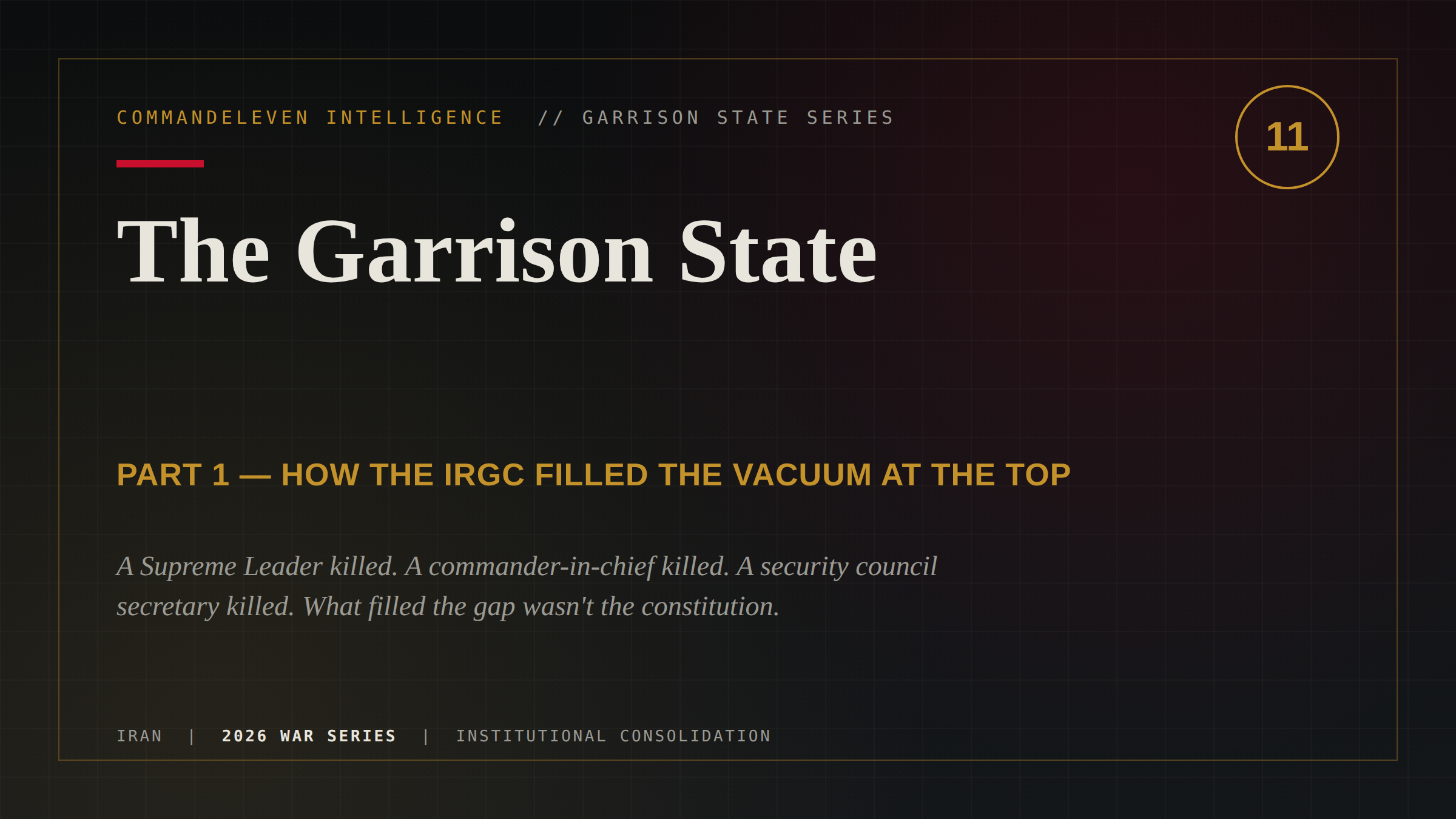
This is Part 1 of a rewritten CommandEleven Garrison State series, replacing the earlier six-post run. The original series relied on unsourced quantitative metrics; this rewrite uses only confirmed and clearly tiered reporting. Part 2 takes up the succession question directly; Part 3 will cover the Gulf flashpoint at Fujairah.
Key Judgments
- CONFIRMED — Ali Khamenei was killed in US-Israeli strikes at the war’s outset. IRGC commander-in-chief Mohammad Pakpour and Supreme National Security Council secretary Ali Larijani were also killed in the war’s opening weeks.
- CONFIRMED — Iran’s 88-member Assembly of Experts named Mojtaba Khamenei as Supreme Leader on March 8, 2026, about a week after his father’s death, with no reported internal dissent.
- CONFIRMED — The IRGC named Brigadier General Ahmad Vahidi as the Guards’ new commander-in-chief after Pakpour’s death; Mohammad Bagher Zolghadr was appointed Supreme National Security Council secretary after Larijani’s killing.
- ASSESSED — An informal five-member wartime leadership emerged around President Masoud Pezeshkian, parliament speaker Mohammad Bagher Ghalibaf (a former IRGC brigadier general), judiciary chief Gholam-Hossein Mohseni-Ejei, and one representative each from the IRGC and the regular armed forces, with multiple regional analysts assessing the IRGC as the dominant force inside that body.
- ASSESSED — IRGC leadership moved to keep critical appointments under direct Guards control during the war, including blocking President Pezeshkian’s attempted appointment of Hossein Dehghan as intelligence minister, per multiple Iranian-media reports relayed through regional outlets.
- ASSESSED — The IRGC’s wartime authority builds on a pre-existing economic base, Khatam al-Anbiya’s construction and infrastructure holdings, and the bonyad foundation network, that predates the war by decades and gave the Guards the administrative capacity to absorb state functions quickly once the civilian chain of command was disrupted.
- SINGLE-SOURCE / unconfirmed — Reports of Mojtaba Khamenei’s declining health, including claims he has been incapacitated, are not independently verified and are treated here as unconfirmed.
The Week Iran’s Chain of Command Broke
Iran’s Supreme Leader, Ali Khamenei, was killed in US-Israeli strikes in the opening days of the 2026 war, an event CommandEleven’s own Iran War Doctrine & Strategy series treats as the defining shock the IRGC’s wartime command structure was built to survive. Within the same stretch of fighting, the Guards lost their own commander-in-chief, Mohammad Pakpour, and the government lost the secretary of its Supreme National Security Council, Ali Larijani, both killed, both replaced from inside the IRGC’s own ranks: Brigadier General Ahmad Vahidi took the Guards’ top military post, and Mohammad Bagher Zolghadr took the security council seat.
Formal succession moved fast. On March 8, 2026, about a week after Khamenei’s death, the Assembly of Experts named his son, Mojtaba Khamenei, as the new Supreme Leader. By the Assembly’s own account it did not hesitate. There is no reported dissent inside the clerical establishment. But Mojtaba Khamenei had never run for office or faced a public vote, and his authority from the outset has been widely read, by analysts with no stake in Iranian domestic politics, as resting on his relationship with the Guards rather than independent clerical standing.
Who Actually Runs the Government
Beneath the formal succession, a different structure took shape. An informal five-person wartime leadership emerged: President Pezeshkian, parliament speaker Ghalibaf (himself a former IRGC brigadier general), judiciary chief Mohseni-Ejei, and one representative each from the IRGC and the conventional armed forces. Multiple regional-security academics, including Andreas Krieg at King’s College London and Ali Alfoneh at the Arab Gulf States Institute, assess the IRGC as the dominant actor inside that body, not merely a participant in it.
The clearest evidence is what Pezeshkian couldn’t do. Reports relayed through Iranian and regional media describe Vahidi blocking the president’s attempt to appoint Hossein Dehghan as intelligence minister, and describe the Guards restricting Pezeshkian’s communication with the new Supreme Leader’s office. Sina Azodi of George Washington University put it plainly to one outlet: in practice, “the IRGC will be running the show.”
Why the IRGC Was Positioned to Do This
None of this happened in a vacuum the IRGC built overnight. The Guards have been Iran’s largest non-state-run economic actor since the 1980s, when post-Iran-Iraq War reconstruction contracts gave Khatam al-Anbiya, the IRGC’s engineering and construction conglomerate, its first major foothold. By the time of the 2026 war, Khatam al-Anbiya controlled Tehran’s international airport and had built refineries, rail lines, dams, and gas pipelines. Alongside it sits the bonyad network, tax-exempt religious foundations that function as parastatal conglomerates, which outside estimates (dated, and treated here only as an order-of-magnitude indicator) have put at over half of Iran’s GDP as of 2013. Western sanctions over the past two decades pushed Iran toward a self-described “economic resistance” model that further concentrated financial control in actors, like the IRGC, already positioned to operate outside formal banking channels.
That pre-existing administrative and financial infrastructure is what let the Guards absorb functions of a damaged civilian state quickly rather than build new capacity from scratch. The Strait of Hormuz, among Iran’s most strategically valuable assets, came under direct IRGC operational management during the war, reopening to commercial shipping in mid-April under IRGC-coordinated terms before a renewed US shipping blockade restricted it again, a sequence tracked in CommandEleven’s Iran War Status Brief: October 2026.
What This Does and Doesn’t Establish
This is not a claim that Iran has a single, formally declared military government, or that the clerical establishment has been displaced on paper. Mojtaba Khamenei holds the Supreme Leader’s title, the Assembly of Experts process was followed, and no civilian or clerical body has publicly repudiated the arrangement. What the evidence supports is narrower, and for understanding where Iran’s decisions actually get made, more important: a wartime structure in which the IRGC’s own officers fill the posts vacated by assassination, a civilian president has been functionally boxed out of key appointments and communications, and outside analysts across multiple institutions converge on the same read, that the Guards, not the formal office-holders, are the operative center of Iranian state power. Part 2 takes up the succession question itself: whether what happened in March was a coup in any meaningful sense, or something the existing clerical system was already built to produce.
Frequently Asked Questions
Did the IRGC stage a coup in Iran?
No formal coup has been declared or confirmed. What’s documented is a wartime leadership structure, built from existing IRGC officers and allies, that multiple independent analysts assess as the actual center of power, operating alongside, not visibly replacing, the formal clerical succession. Part 2 examines this question in depth.
Who is Mojtaba Khamenei?
Ali Khamenei’s son, named Supreme Leader by the Assembly of Experts on March 8, 2026, about a week after his father’s killing. He has no history of elected office and is widely described as reliant on IRGC backing for his authority.
Is Iran’s president still in charge of anything?
President Pezeshkian retains his formal office, but multiple reports describe the IRGC blocking at least one of his ministerial appointments and restricting his communication with the Supreme Leader’s office during the war.
Is this the same “Garrison State” framework from CommandEleven’s earlier series?
No. This replaces the original six-post Garrison State series, which relied on unsourced quantitative claims. This rewrite uses only confirmed and clearly tiered reporting, cross-checked against CommandEleven’s own Iran War Doctrine & Strategy series and Iran War Status Brief: October 2026.
Sources
- Iran names Mojtaba Khamenei as new supreme leader after father’s killing, Al Jazeera, March 8, 2026
- IRGC now de facto ruler of Iran, takes control of key state functions; President sidelined, Business Today, April 1, 2026
- How the US-Israel war has cemented the IRGC’s grip on Iran, The New Arab, May 4, 2026
- Iran War Doctrine & Strategy: A Six-Part CommandEleven Intelligence Series
- Iran War Status Brief: October 2026
- The Garrison State: Succession and the Coup That Isn’t – Part 2