
This is Part 2 of CommandEleven’s rewritten Garrison State series. Part 1 established what’s confirmed about who actually runs Iran’s wartime government. This part asks a narrower question: was any of it a coup, and does the label hold up against what analysts said, before the war, a coup would actually look like?
Key Judgments
- CONFIRMED — No internal coup against Ali Khamenei occurred or was attempted. He was killed by external US-Israeli strikes, not displaced by IRGC action.
- CONFIRMED — Iran’s constitutional succession process was formally followed: the Assembly of Experts, the body with that constitutional authority, named Mojtaba Khamenei as Supreme Leader on March 8, 2026, about a week after his father’s death.
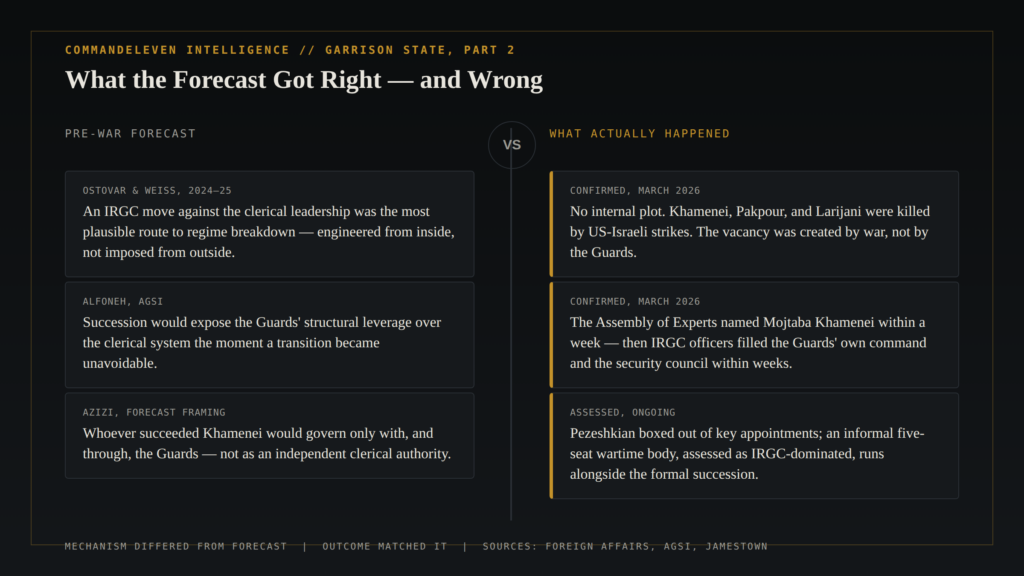
- ASSESSED — Before the war, the strongest English-language forecasting on regime breakdown (Afshon Ostovar, Foreign Affairs, January 22, 2026) argued an insider coup, most likely led by the IRGC, was “the most plausible way Iran’s present system might fall,” more likely than popular revolution or foreign-imposed regime change, and predicted it would preserve parts of the system rather than produce democratic change.
- ASSESSED — A separate pre-war analysis (Jacob Lees Weiss, Jamestown Foundation, 2023) concluded the IRGC was unlikely to move against a sitting Khamenei, but identified a leadership transition as the one scenario where IRGC elites might act to “trade the newly appointed Supreme Leader for one of their own” rather than accept a successor who threatened their position.
- ASSESSED — What followed Khamenei’s killing does not match either forecast’s mechanism (no internal plot against a sitting leader) but closely matches both forecasts’ predicted outcome: formal continuity through existing institutions, with real authority concentrated in the IRGC underneath that formal layer.
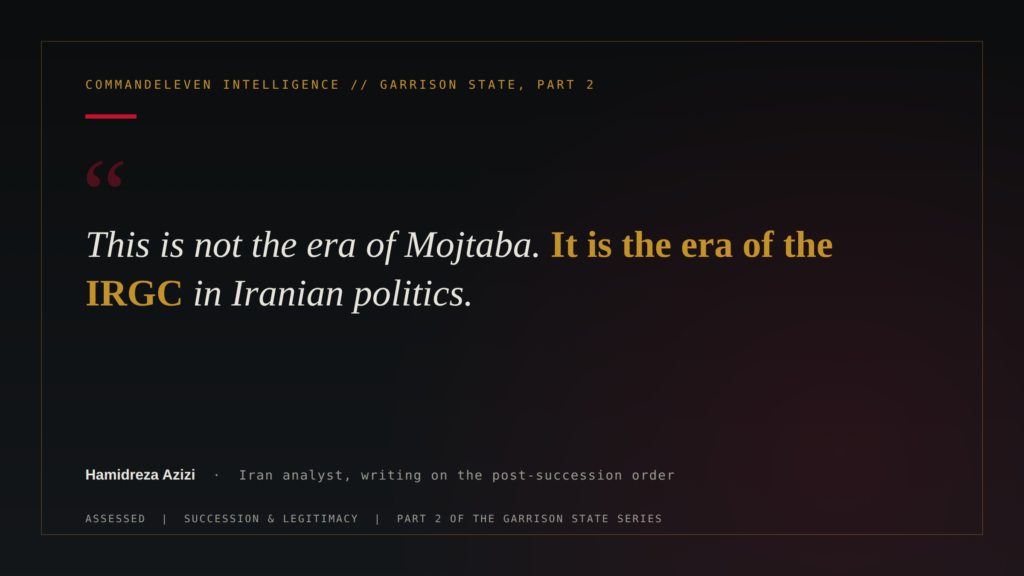
- ASSESSED — Historian Arash Azizi, speaking to RFE/RL’s Georgian service in the days after the succession, summarized the same read independently: “This is not the era of Mojtaba. It is the era of the IRGC in Iranian politics.”
- DATA DEFICIT — In the days immediately after Khamenei’s death, credible reporting (Al-Monitor, March 2, 2026) described genuine uncertainty over whether the office of Supreme Leader would continue at all “in its traditional form.” That uncertainty was resolved within about a week, but it was real, not manufactured, at the time.
- EXCLUDED — Iranian state-aligned commentary dismissing any IRGC-coup framing as a Western fabrication (e.g. Tehran Times) is treated here as a regime narrative, not independent reporting, and is not used as a source for any claim in this piece.
What the Pre-War Literature Predicted
Three weeks before Ali Khamenei was killed, Afshon Ostovar of the Naval Postgraduate School published an assessment in Foreign Affairs that reads, in hindsight, like a forecast. Writing against a backdrop of crushed but unresolved mass protests, Ostovar argued the regime’s elite had not yet fractured, but that officials who wanted to save themselves had an incentive to move against Khamenei. He weighed three paths to change: popular revolution (which he judged needed regime defectors not yet present), US-imposed regime change (which he judged would require a military commitment with no guarantee of a clean outcome), and an insider coup, which he called “the most plausible way Iran’s present system might fall, at least in the near term.” He expected it to be hidden, fast, and more likely to preserve parts of the system than to produce democracy: “the ruling apparatus, in other words, would collapse gradually, and then suddenly.”
Ostovar identified the IRGC as the most likely actor, and flagged a generational split inside it: a top command, appointed by Khamenei and shaped by the 1979 revolution and the Iran-Iraq War, with every incentive to preserve its position; and a more hawkish, ambitious tier of middle-ranking officers who came up during Iran’s regional expansion and might push for sweeping change. A separate, earlier analysis by Jacob Lees Weiss for the Jamestown Foundation reached a related conclusion from a different angle: a coup against a sitting Khamenei was unlikely, because the IRGC’s entire institutional identity is bound to the Islamic Republic. But Weiss carved out one exception, succession itself, writing that a new Supreme Leader seen as insufficiently accommodating to IRGC interests could prompt the Guards to “trade the newly appointed Supreme Leader for one of their own.”
Neither piece discussed Mojtaba Khamenei by name. Both were describing a generic succession scenario. What makes them worth revisiting now is how closely the outcome, if not the mechanism, tracks what they described.
What Actually Happened
The trigger wasn’t an internal plot. Khamenei was killed by external strikes, not displaced by his own security apparatus, so neither Ostovar’s nor Weiss’s coup mechanism technically occurred. There was no secret plotting against a sitting leader, no sudden move by officers against their commander-in-chief. In that narrow sense, “coup” is the wrong word for what happened in March 2026, and CommandEleven’s earlier Garrison State series was wrong to use it that loosely.
But the succession process that followed, and what it produced, lines up with both forecasts almost exactly. Formal continuity was preserved: the Assembly of Experts, Iran’s constitutionally designated body, met and named a successor within about a week, with no reported internal dissent. That’s the “preserve parts of the system” outcome Ostovar expected from an insider-driven transition, not the clean break a popular revolution would have produced. And the successor’s authority, as Part 1 documented in detail, has from day one depended on the IRGC rather than independent clerical standing, exactly the dynamic Weiss flagged as the risk case: a successor whose position depends on IRGC backing rather than existing on its own footing.
Historian Arash Azizi, speaking to RFE/RL’s Georgian service in the days after the appointment, put the same observation in blunter terms, independently of either academic forecast: “This is not the era of Mojtaba. It is the era of the IRGC in Iranian politics.” Azizi raised a further possibility worth flagging rather than asserting: that Mojtaba may function as a figurehead for backers who elevated him, a dynamic he summarized as “the puppet can become the puppeteer,” while cautioning that this is harder to assess if the figurehead himself is constrained. Reports of Mojtaba Khamenei’s health, discussed in Part 1, remain unconfirmed and are not treated here as established.
The Legitimacy Problem the Regime Was Already Managing
Dynastic succession was a live and sensitive question inside Iran well before the war made it moot. In January 2025, more than a year before Khamenei’s death, a Washington Post editorial naming Mojtaba as the likely successor drew a public rebuttal from Tehran Times, which quoted an Assembly of Experts member describing Khamenei as having rejected any request to consider his sons for leadership. Analyst Ali Alfoneh, writing for the Arab Gulf States Institute, read that rebuttal as potentially doing the opposite of what it intended: normalizing the idea of dynastic succession by putting it into public circulation, even while formally denying it. Alfoneh’s framing, that succession in a system without strong democratic legitimating institutions is “usually marked by crisis and uncertainty,” anticipated almost exactly the ambiguity that played out in March 2026: Al-Monitor’s reporting from those first days after Khamenei’s killing described genuine open questions in Tehran over whether the Supreme Leader’s office would continue “in its traditional form” at all.
That uncertainty closed quickly. It is still worth recording, because it shows the succession was not the clean, inevitable handoff the Assembly of Experts’ own public statements suggested, the body said it “did not hesitate for a minute,” and it undercuts any claim, from CommandEleven’s original Garrison State series or elsewhere, that this was a long-planned, tightly scripted transition rather than an improvised response to a sudden and unplanned vacancy.
So Was It a Coup?
Not in the sense the word normally carries. Nobody moved against a sitting leader; the constitutional process was followed, on schedule, by the body with authority to run it. But a narrow, literal answer undersells what the pre-war literature was actually trying to describe, which was never really “will tanks surround the palace,” but something closer to: when this system’s leadership changes, who ends up holding the real authority afterward, regardless of whose name is on the title? By that test, the forecasts were right and the mechanism was almost beside the point. Iran got a constitutionally correct, institutionally unchallenged succession that happened to leave the IRGC in de facto control of the government it formally serves. Whether that counts as a coup is a definitional argument. That it is a meaningful shift in where power sits is not.
Frequently Asked Questions
Did the IRGC overthrow Khamenei?
No. Ali Khamenei was killed by external US-Israeli strikes. No internal move against him by the IRGC or any other faction occurred or has been credibly reported.
Was Mojtaba Khamenei’s appointment legitimate under Iran’s constitution?
Procedurally, yes. The Assembly of Experts, the body with constitutional authority to select a Supreme Leader, met and named him about a week after his father’s death, with no reported internal dissent.
Was succession to Mojtaba planned in advance?
Dynastic succession was being discussed, and publicly denied by Iranian state media, more than a year before the war. But reporting from immediately after Khamenei’s death describes real uncertainty over whether the office would continue at all, which argues against a fully scripted handoff.
If it wasn’t a coup, why does this series still call it a power shift?
Because the label “coup” and the underlying question, who actually holds power, are different things. Pre-war analysts predicted that however Iran’s leadership changed, the IRGC would likely end up the dominant actor underneath whatever formal structure remained. That is what Part 1 documents happened, regardless of what word is used for the process that produced it.
Sources
- How the Iranian Regime Breaks, Afshon Ostovar, Foreign Affairs, January 22, 2026
- Outside of Succession, IRGC Unlikely to Attempt Wagner-Like Coup, Jacob Lees Weiss, Jamestown Foundation Terrorism Monitor, 2023
- Renewed Speculation About Mojtaba Khamenei, Ali Alfoneh, Arab Gulf States Institute, January 2025
- Iran Weighs Khamenei’s Successor; Some Question Future Role, Amberin Zaman, Al-Monitor, March 2, 2026
- Iran’s War of Survival: Why Ending the Conflict May Be the Hardest Part Yet, Arash Azizi interviewed by RFE/RL’s Georgian service, via Georgia Today, March 19, 2026
- The Garrison State: How the IRGC Filled the Vacuum at the Top – Part 1