
This is Part 3 of CommandEleven’s rewritten Garrison State series. Part 1 covered the IRGC’s wartime administrative consolidation; Part 2 covered the succession question. This installment addresses the Gulf energy flashpoint the original series predicted — and corrects it against what the record actually shows.
Key Judgments
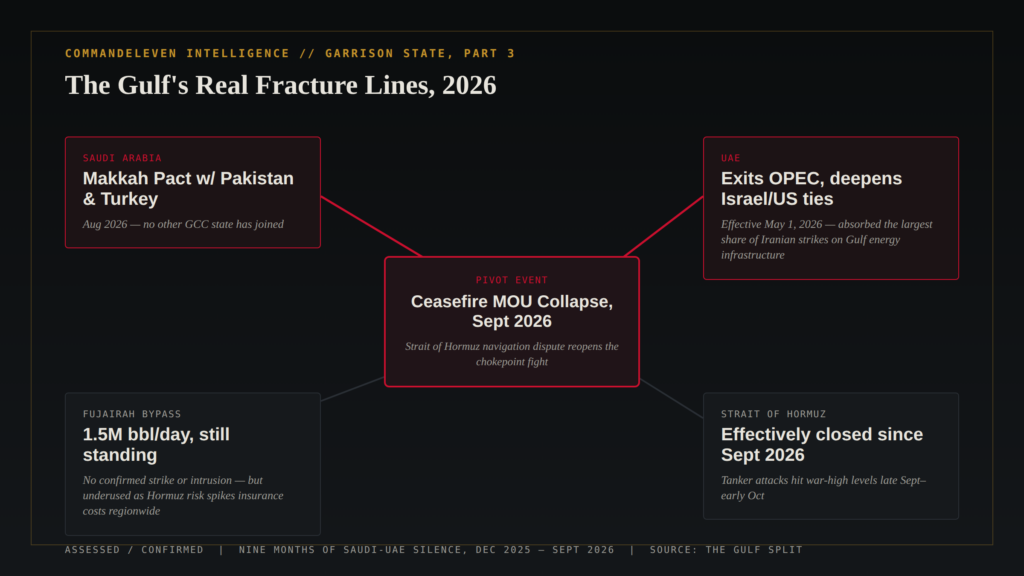
- CONFIRMED — The UAE’s Habshan-Fujairah pipeline moves up to 1.5 million barrels of crude per day directly to the Gulf of Oman, bypassing the Strait of Hormuz entirely. This is real, strategically significant infrastructure: it is the one substantial release valve on Iran’s chokepoint leverage.
- CONFIRMED — The UAE left OPEC and OPEC+ effective May 1, 2026, a move its energy minister said was not aimed at any state but which also freed Abu Dhabi to produce above its old quota, deepening its economic break from Riyadh.
- CONFIRMED — The Strait of Hormuz did not stay open. A US-Iran ceasefire memorandum of understanding from June 2026 collapsed in September over navigation rights in the Strait, which has remained effectively closed since; tanker attacks around Hormuz reached their highest weekly level of the war in late September and early October 2026.
- ASSESSED — The UAE absorbed the largest share of Iranian strikes on Gulf energy infrastructure during the war and took the hardest regional line against Tehran, reportedly revoking visas and freezing Iranian assets while deepening security ties with Israel and the United States.
- ASSESSED — The Garrison State’s wartime consolidation documented in Part 1 gave Tehran a coherent strategic motive to want Gulf bypass infrastructure like Fujairah neutralized — reducing any alternative to Hormuz raises the value of the chokepoint it still controls. That is a real strategic logic. It is not evidence that an operation against Fujairah occurred.
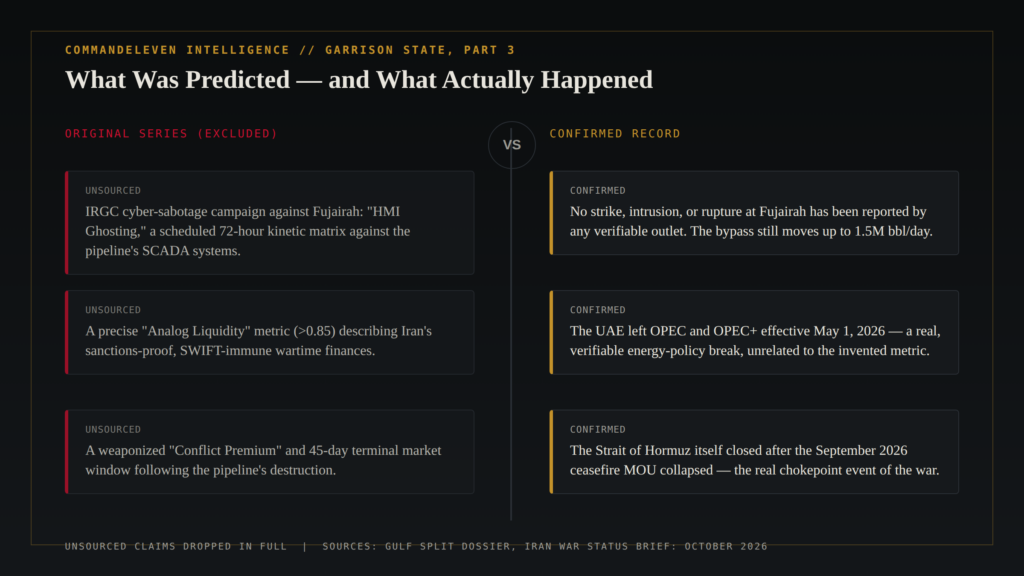
- EXCLUDED — The original Garrison State dossiers described a specific IRGC cyber-sabotage campaign against Fujairah (“HMI Ghosting,” a “72-Hour Kinetic Matrix,” an “Analog Liquidity” financial metric exceeding a precise 0.85 threshold, a weaponized “Conflict Premium,” a 45-day terminal market window). None of this is independently sourced. No rupture, strike, or confirmed cyber intrusion against the Fujairah terminal has been reported by any outlet CommandEleven can verify. It is dropped from this rewrite in full.
What Made Fujairah a Target on Paper
Iran’s core leverage over global energy markets has always rested on a single geographic fact: a large share of Gulf crude has nowhere to go except through the Strait of Hormuz, a chokepoint Tehran can threaten even when it cannot close it outright. The UAE’s Habshan-Fujairah pipeline is the one piece of regional infrastructure that meaningfully dilutes that leverage — 1.5 million barrels a day that reach the Gulf of Oman without transiting the Strait at all. Any actor with an interest in maximizing Hormuz’s chokepoint value has an obvious reason to see that bypass as a problem.
That is the real strategic logic behind the original series’ Fujairah thesis, and it is why this rewrite preserves the point rather than deleting it. Where the original dossiers went further than the evidence supports is in describing a specific, scheduled sabotage campaign against the pipeline — cyber intrusion into its control systems, a 72-hour attack sequence, a precise financial metric for Iran’s sanctions-proofing. CommandEleven has found no independent reporting of any such campaign, intrusion, or physical incident at Fujairah. The strategic interest is real and worth tracking. The campaign as described was not confirmed, and this rewrite does not carry it forward.
What Actually Reshaped the Gulf: The Saudi-UAE Rupture
The flashpoint that materialized in the Gulf wasn’t a covert IRGC strike on a pipeline. It was a rupture between Saudi Arabia and the UAE — the two states whose cooperation had underwritten Gulf energy security for a decade, and whose split CommandEleven has tracked in detail in The Gulf Split.
The break turned kinetic on December 30, 2025, when Saudi-led forces bombed a UAE shipment at Mukalla in Yemen and the UAE withdrew its forces; the two capitals then held no reported high-level bilateral meeting for roughly nine months. The Iran war widened rather than healed the rift. The UAE, absorbing the largest share of Iranian strikes on Gulf energy infrastructure, took the hardest line against Tehran and pulled closer to Washington and Israel; Saudi Arabia pressed for containment and signed its own collective-defense pact with Pakistan and Turkey in August 2026 — a pact no other GCC state has joined. The UAE’s OPEC exit, effective the same week it sent lower-level representation to a GCC summit in Jeddah, was as much a signal about where Abu Dhabi’s regional loyalties now sit as it was an energy-policy decision.
A tactical thaw followed in late September, when UAE Vice President Sheikh Mansour bin Zayed met Saudi Arabia’s crown prince in Riyadh — driven by a shared Houthi threat in Yemen rather than a resolution of the underlying dispute. Sudan, oil policy, Israel, and the Red Sea remain unresolved between the two states. This is the real Gulf flashpoint the Garrison State’s wartime consolidation ran alongside: not an Iranian cyber-sabotage campaign against a single pipeline, but the fracture of the Gulf’s own internal security architecture.
Hormuz, Not Fujairah, Is Where the War Actually Reached the Gulf
If there is a single chokepoint story from 2026, it is the Strait of Hormuz itself, not its bypass. A US-Iran ceasefire took effect in April, and a memorandum of understanding in June briefly raised hopes of a durable arrangement. It collapsed in September over navigation rights in the Strait, which has remained effectively closed since. Tanker attacks around Hormuz reached their highest weekly level of the war in late September and early October, tracked in CommandEleven’s Iran War Status Brief: October 2026. The UAE continues to move some oil through the Fujairah bypass, but not at the volumes it wants, precisely because the regional insurance and security environment the Strait closure has created makes full utilization difficult regardless of the pipeline’s own physical integrity.
In other words: Iran achieved a version of the chokepoint leverage the original dossiers predicted it would pursue through Fujairah — but by closing Hormuz itself through the collapse of the ceasefire framework, not through a covert campaign against the UAE’s bypass route. The mechanism was diplomatic and military escalation at the Strait, not cyber-physical sabotage at the pipeline.
What This Does and Doesn’t Establish
This is not a claim that Fujairah is irrelevant, or that Iran has no interest in the bypass’s vulnerability. The pipeline’s 1.5 million barrel-per-day capacity remains the one meaningful dilution of Hormuz’s chokepoint value, and that makes it a standing point of interest for any actor — Iranian or otherwise — invested in the Strait’s leverage. What the evidence does not support is the original series’ specific claim: a scheduled, named cyber-sabotage campaign against the terminal’s control systems, backed by an invented financial-resilience metric. No such campaign has been reported. What did happen — a Saudi-UAE rupture that fractured Gulf security cooperation, and a Hormuz closure that delivered Iran a version of the leverage the original dossiers anticipated, by a different route — is better evidenced, better sourced, and arguably more consequential for the region’s security architecture than the scenario it replaces.
Frequently Asked Questions
Did Iran attack the UAE’s Fujairah pipeline?
No confirmed strike, cyber intrusion, or rupture at the Fujairah terminal has been reported by any outlet CommandEleven can verify. Iran has a clear strategic motive to see the bypass neutralized, but motive is not evidence of an operation.
Why did the UAE leave OPEC?
The UAE left OPEC and OPEC+ effective May 1, 2026, citing its long-term strategic vision; the move also freed it to produce above its old quota and came amid its deepening break from Saudi Arabia.
Is the Strait of Hormuz open?
No. It has remained effectively closed since a US-Iran ceasefire memorandum of understanding collapsed in September 2026, with tanker attacks around the Strait reaching their highest weekly level of the war in late September and early October.
How does this relate to the Saudi-UAE split?
The two tracks ran in parallel rather than one causing the other. The Iran war widened an existing Saudi-UAE rift rather than healing it, and the UAE’s OPEC exit and tilt toward Washington and Israel happened against that backdrop. See CommandEleven’s The Gulf Split for the full account.
Sources
- The Gulf Split: How Saudi Arabia and the UAE Broke, and What It Means for the GCC, CommandEleven Intelligence
- Iran War Status Brief: October 2026, CommandEleven Intelligence
- Iran War Doctrine & Strategy: A Six-Part CommandEleven Intelligence Series
- The UAE is leaving OPEC on Friday, NPR, April 28, 2026
- Gulf leaders meet in Saudi Arabia for first time since start of war on Iran, Al Jazeera, April 28, 2026
- The Garrison State: How the IRGC Filled the Vacuum at the Top – Part 1
- The Garrison State: Succession and the Coup That Isn’t – Part 2