
Key Judgments
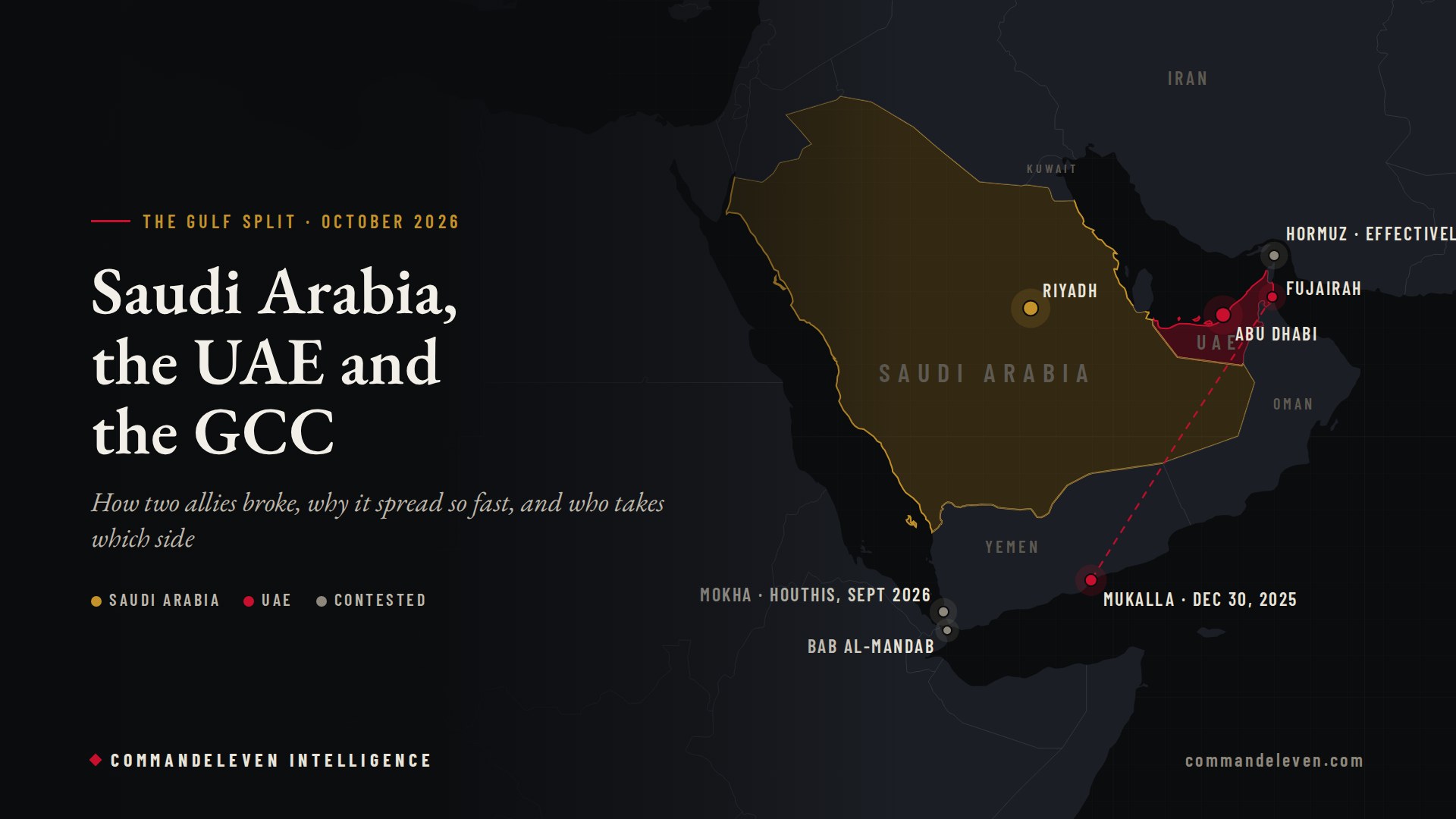
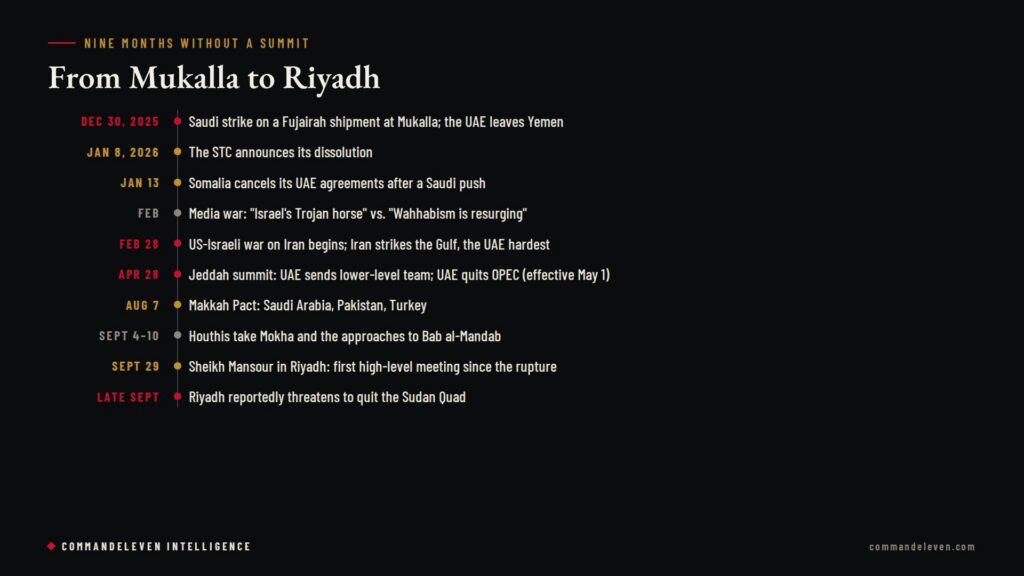
- [CONFIRMED] The Saudi-UAE rift became a military and diplomatic rupture on December 30, 2025, when Saudi-led forces bombed a shipment from the UAE’s port of Fujairah at Mukalla in Yemen. Riyadh called Emirati actions a “threat to the Kingdom’s national security,” and the UAE withdrew from Yemen. It was the first direct military clash between the two states. For about nine months after it, the two capitals held no reported high-level bilateral meeting.
- [ASSESSED] The rift is structural, not a quarrel over Yemen. It rests on competing economic models, opposite bets on political Islam, Israel and the Red Sea, and a personal rivalry between the two leaders that was reported as early as 2023. Yemen made it kinetic. Sudan made it public. The Iran war removed the shared threat that had held it together.
- [CONFIRMED] The split now runs through energy and security. The UAE left OPEC effective May 1, 2026, the same week it sent lower-level representation to a GCC summit in Jeddah. Saudi Arabia signed a collective defense pact with Pakistan and Turkey in August that no other GCC state has joined.
- [ASSESSED] The September 29 visit of UAE Vice President Sheikh Mansour bin Zayed to Riyadh is a tactical thaw, not a reconciliation. The Houthi seizure of Mokha and the war over Saudi airports pushed Riyadh to seek Emirati help in Yemen. The same week, Riyadh reportedly threatened to quit the US-led Sudan “Quad” over Washington’s handling of the UAE. Sudan, oil, Israel and the Red Sea remain unresolved.
- [ASSESSED] The GCC is heading toward managed division: a council that survives in form, with members lining up issue by issue rather than in two fixed camps. Qatar and Kuwait lean toward Riyadh. Bahrain shares Abu Dhabi’s line on Iran but depends on Saudi security. Oman keeps its distance from both and its channel to Tehran.
What Caused the Rift
The Public Causes
- Yemen. The two states entered Yemen together in 2015 and split there in 2025. In December, the UAE-backed Southern Transitional Council (STC) seized parts of Hadramawt and al-Mahra, provinces that border Saudi Arabia. Riyadh saw a bid for a southern state on its border as a red line. After warning strikes on December 27, it bombed the Mukalla shipment on December 30 and demanded that Emirati forces leave within 24 hours. The UAE said the cargo was vehicles for its own forces, coordinated with Riyadh, and that it “categorically rejects any attempt to implicate it.” It withdrew anyway. The STC announced its dissolution on January 8.
- Sudan. Riyadh backs the Sudanese army. A UN fact-finding mission found in September 2026 that a UAE-linked network supplied the Rapid Support Forces, without attributing it to the Emirati state; the UAE denies any role. CommandEleven Intelligence’s companion dossier on Sudan covers that war in full.
- Oil. The UAE fought its OPEC quota publicly in 2021. It is building toward 5 million barrels a day of capacity against a quota of about 3.4 million. Saudi Arabia, OPEC’s largest producer, resisted raising the quota.
- Israel. The UAE signed the Abraham Accords in 2020 and deepened its security ties with Israel after Iran’s attacks in 2026. Saudi Arabia has tied normalization to a credible path to a Palestinian state. Since the Gaza war, and especially after Israel’s September 2025 strike in Doha, Riyadh has come to see Israeli policy as a threat to regional stability.
- The Red Sea. Israel recognized Somaliland in late 2025. On January 13, 2026, after a Saudi diplomatic push, Somalia cancelled its security, defense and commercial agreements with the UAE.
The Less Public Causes
- Two economic models in one market. Since 2021, Saudi Arabia has required companies seeking government contracts to base their regional headquarters in the Kingdom. That rule takes direct aim at Dubai’s role. Riyadh Air is being built to compete with Emirates and Etihad. Emirati officials say the UAE declined Saudi requests to invest in Saudi megaprojects. [ASSESSED, Emirati-sourced]
- Political Islam. Abu Dhabi treats the Muslim Brotherhood and its affiliates as a primary threat. Riyadh has worked with Islamist-linked partners when it suited it, including Yemen’s Islah party and the Sudanese army’s camp. In March 2025, the UAE reportedly offered troops for a US-backed campaign against the Houthis on condition that Riyadh drop its support for Islah. The condition was not met, and the campaign never happened.
- Borders at sea. In March 2024, Saudi Arabia filed a complaint at the UN rejecting the UAE’s designation of the al-Yasat protected marine area as “contrary to international law.” [ASSESSED, single-source reporting of the UN filing]
- The leaders. In July 2023, the Wall Street Journal reported that Crown Prince Mohammed bin Salman had told Saudi journalists at an off-the-record briefing that the UAE “stabbed us in the back,” and warned: “They will see what I can do.” The rivalry between him and UAE President Mohammed bin Zayed, once his mentor, predates every dispute above.
- Washington. Saudi Arabia says the crown prince asked the Trump administration in November 2025 to sanction the RSF. Emirati officials believe he asked for sanctions on the UAE itself. [ASSESSED; competing accounts]
[ASSESSED] None of these disputes alone explains the rupture. Together they describe two states that want different regional orders. Riyadh wants stable, centralized neighbors and Saudi primacy in the Gulf. Abu Dhabi wants optionality: partners on both shores of the Red Sea, security ties with Israel and the US, and an economy that does not answer to Saudi rules. A former senior CIA officer put it in one line: the Saudis want alignment, the Emiratis “want optionality.”
How the Rift Spread So Fast
The rivalry was managed privately for years. In 2026 it moved from private irritation to open rupture in weeks, for five reasons.
- It went kinetic first. Most Gulf disputes stay in the media and the diplomatic channel. This one began with Saudi airstrikes on an Emirati shipment, which made de-escalation by quiet diplomacy much harder.
- It ran on several fronts at once. Yemen, Sudan, Somalia and the Red Sea were all live at the same time. Each front gave each side fresh evidence of the other’s intent.
- The Iran war split their responses. The US-Israeli war on Iran began on February 28, 2026, and Iran struck energy infrastructure across the Gulf. The UAE absorbed the largest share and took the hardest line: it reportedly revoked visas, froze Iranian assets and moved closer to Israel and the US. Saudi Arabia pressed for containment and de-escalation. Gulf military sources reportedly observed reduced radar and early-warning sharing between the two during the war. [ASSESSED, unnamed sources] The common enemy that had kept them together became a point of division.
- The media war turned personal. After the Mukalla strike, Saudi-aligned commentators cast the UAE as “Israel’s Trojan horse in the Arab world.” An Arab official cited research finding that 77 percent of Saudi comments after December 30 framed the UAE as Israel’s proxy. In February, Abdulkhaleq Abdulla, a UAE academic often described as close to the UAE president, wrote that “Wahhabism is resurging at its source,” and a Saudi-linked outlet ran a cartoon of an Emirati figure dodging arrows labeled Yemen, Somalia and Algeria. The dispute moved from policy to identity.
- No one could mediate it. The Trump administration offered to mediate, and both sides declined. One official said: “This is not something you mediate.”
The Silence
[CONFIRMED] From late December 2025 to late September 2026, there was no reported high-level bilateral meeting between Riyadh and Abu Dhabi. The two never formally severed ties, recalled ambassadors or closed borders. They simply stopped talking at the top, and the gaps showed elsewhere.
- The Jeddah summit, April 28. The first GCC leaders’ meeting since the Iran war began condemned Iran’s attacks but agreed on no joint command, no common negotiating position and no Hormuz security plan. Oman did not attend, and the UAE sent lower-level representation. The same day, the UAE announced it would leave OPEC and OPEC+, effective May 1. Its energy minister said the move was not aimed at any state.
- Abu Dhabi’s verdict on the GCC. Presidential adviser Anwar Gargash called the GCC’s stance in the war “the weakest in history.” Bloomberg reported that Sheikh Mohammed bin Zayed privately told European officials the GCC was dysfunctional and that the UAE would reinforce its ties with Israel and the US.
- Riyadh’s new alliance. On August 7, Saudi Arabia, Pakistan and Turkey signed the Makkah Joint Defence Agreement, under which an attack on one is “regarded as an attack against them all.” No other GCC state is a member.
- Lobbying third countries. Emirati officials say Saudi Arabia urged Kazakhstan, Syria and Jordan to skip the World Governments Summit in Dubai. [ASSESSED, Emirati-sourced]
[ASSESSED] The silence was the signature of this rift. In 2017, Saudi Arabia and the UAE blockaded Qatar openly, with demands and a list. In 2026 there were no demands and no list, and no channel through which either could have been delivered. That is harder to repair than an open dispute, because there is nothing formal to settle.
Where the Rift Stands Now
The War Around It
- Iran. A US-Iran ceasefire took effect on April 8, and a memorandum of understanding in June briefly raised hopes. It collapsed in September over navigation in the Strait of Hormuz, which remains effectively closed. President Trump has said the US will not strike Iran before the November 3 midterm elections. Meanwhile, attacks on tankers around Hormuz reached their highest weekly level of the war in late September and early October. The UAE still exports some oil through its pipeline to Fujairah, which bypasses the strait, but not at the volumes it wants.
- Yemen. In early September the Houthis took Mokha and the approaches to the Bab al-Mandab in a seven-day offensive. The defenders included forces built with Emirati support, now cut off from their patron. Riyadh asked Washington for military support on September 11 and was refused. On October 5 it launched Operation Yemen Dawn with backing from its Makkah Pact partners. Between October 6 and 12, Houthi strikes on Saudi airports killed at least 19 people and closed Riyadh’s main airport. CommandEleven Intelligence’s Makkah Pact Part 2 and October Iran War Status Brief track both fronts.
The Thaw
- September 29. UAE Vice President Sheikh Mansour bin Zayed met the crown prince and Defense Minister Prince Khalid bin Salman in Riyadh. It was the first high-level bilateral meeting since the rupture. Prince Khalid called Saudi Arabia Sheikh Mansour’s “second homeland.” Their talks reportedly covered the STC’s future role and the Islah party. Riyadh may accept a compromise in Yemen in return for Emirati military support. [ASSESSED]
- September 27. Two days earlier, Israeli Prime Minister Benjamin Netanyahu visited Abu Dhabi for six hours of talks with Sheikh Mohammed bin Zayed, focused on Iran. Israeli media reported that Saudi and other Arab officials attended an expanded meeting; the report was retracted, and a senior Saudi official denied any Saudi presence.
What Has Not Moved
- Sudan. In the same week as the Riyadh visit, Saudi Arabia reportedly threatened to quit the Sudan Quad, accusing US officials of favoring the UAE.
- Oil. The UAE is outside OPEC and plans to produce above its old quota.
- Israel. The UAE has deepened its Israeli security ties, while Riyadh’s public line has hardened.
- The Red Sea. The competition over Somaliland, Ethiopia and the ports remains open.
[ASSESSED] The thaw is real but narrow. It was driven by a Houthi threat that endangers both states. Everything that caused the rift is still in place, and nothing in the public record shows a channel for resolving it. CommandEleven Intelligence reads September 29 as the start of tactical cooperation on Yemen, not the end of the split.
The Future of the GCC: Who Takes Which Side
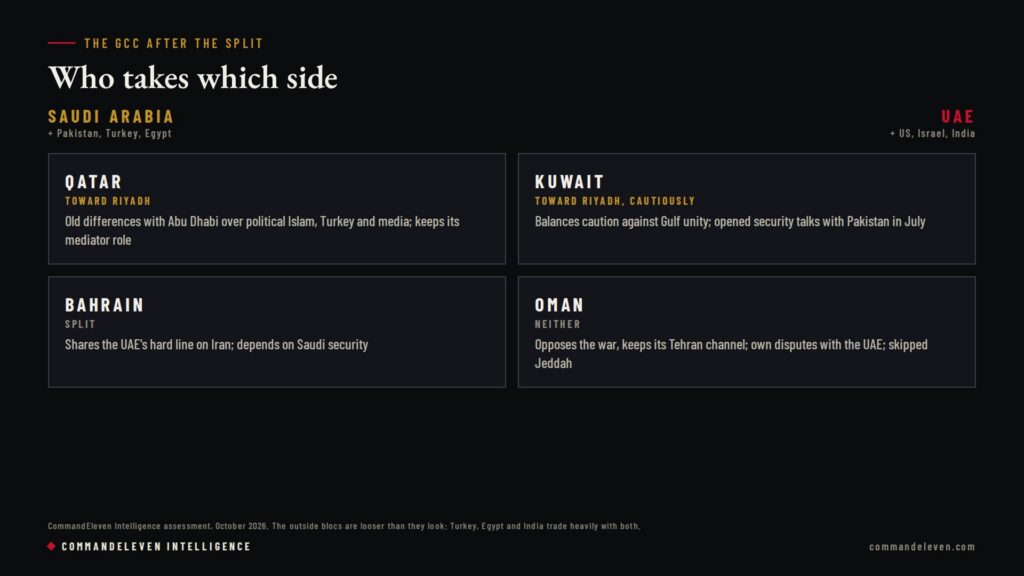
[ASSESSED] CommandEleven Intelligence’s reading of where each of the other four members stands:
| State | Leaning | Why |
|---|---|---|
| Qatar | Toward Riyadh | Its own differences with Abu Dhabi persisted under the 2021 Al-Ula reconciliation: political Islam, Turkey, Libya, the Horn of Africa and media. It keeps its mediator role with Iran and the US. |
| Kuwait | Toward Riyadh, cautiously | It balances domestic caution against pressure for Gulf unity, and it opened talks with Pakistan in July 2026 on a security arrangement. |
| Bahrain | Split | It shares Abu Dhabi’s hard line on Iran and is an Abraham Accords state, but its security depends on Saudi Arabia. It faces the hardest choice in the Council. |
| Oman | Neither | It opposes the war, keeps its channel to Tehran and has its own disputes with the UAE over Yemen, ports and Hormuz. It stayed away from Jeddah. |
[ASSESSED] The alignments outside the GCC are clearer than those inside it. Riyadh is building out with Turkey, Pakistan and Egypt. Egypt’s officials affirmed support for Riyadh’s views on Libya and Sudan after a visit by the Saudi foreign minister. Abu Dhabi is doubling down on the US, Israel and India, including a January gas deal and mid-May security agreements with New Delhi. Even these blocs are looser than they look: Turkey, Egypt and India all trade heavily with both.
[ASSESSED] Pakistan has made its choice. As a Makkah Pact member with forces in the Kingdom, Islamabad is now formally on Riyadh’s side of the line. The UAE’s reported visa restrictions on some Pakistanis during the Iran war show that the alignment has costs. [ASSESSED, single-source reporting on the visas]
Three Scenarios
- Limited restoration. The Yemen thaw widens into a frozen truce on Sudan and oil, managed by internal dialogue. This would take a leader-level meeting and a Sudan understanding, and neither is in sight.
- Managed division (the base case). The GCC survives in form while members align issue by issue, Saudi Arabia and the UAE cooperate where the Houthis and Iran force them to, and they compete everywhere else. One Gulf analyst calls it “undeclared estrangement.”
- Escalation. Renewed war with Iran, a new clash in Yemen or the Red Sea, or a unilateral security deal with Washington, Tel Aviv or Tehran that the other side reads as a threat reopens the rupture. A UAE exit from the GCC is unlikely in any scenario; Abu Dhabi gains more from shaping the Council from inside.
[ASSESSED] The rift matters beyond the Gulf. The GCC was the closest thing the region had to a security bloc. A Council that cannot agree on a joint command, a common position on Iran or the security of Hormuz leaves the Gulf more exposed to Iran, more dependent on outside powers and less able to settle the wars around it, in Yemen, Sudan and the Horn.
Indicators (Foresight Entry)
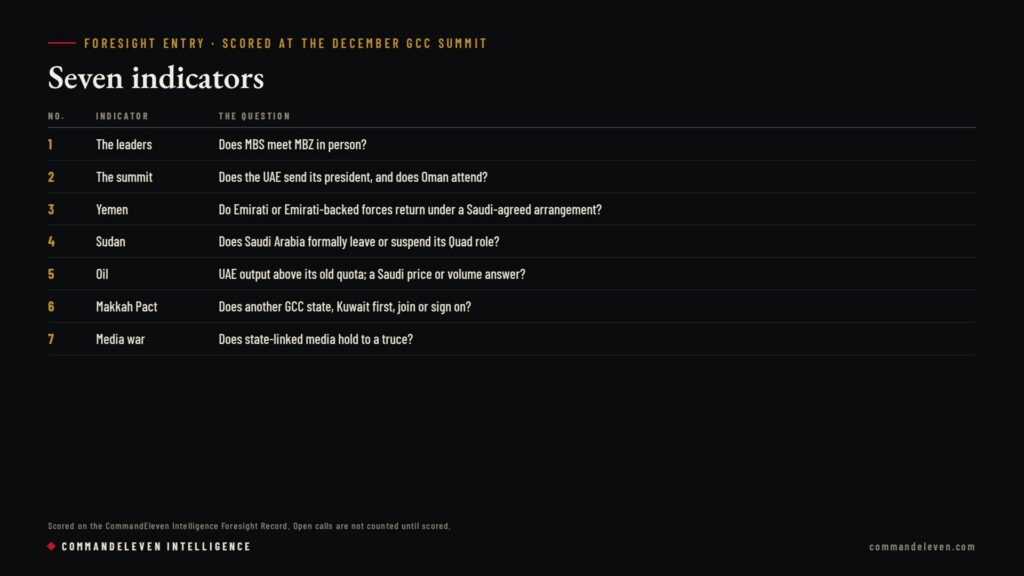
CommandEleven Intelligence will score these indicators on the Foresight Record at the GCC’s annual summit in December 2026:
- The leaders. Does Mohammed bin Salman meet Mohammed bin Zayed in person?
- The summit. Does the UAE send its president, and does Oman attend?
- Yemen. Do Emirati forces or Emirati-backed units return to the fight against the Houthis under a Saudi-agreed arrangement?
- Sudan. Does Saudi Arabia formally leave or suspend its role in the Quad?
- Oil. Does the UAE produce above its old OPEC quota, and does Saudi Arabia answer with a price or volume move?
- The Makkah Pact. Does any other GCC state, Kuwait first, join or sign a formal arrangement with it?
- The media war. Does state-linked media on either side hold to a truce?
Frequently Asked Questions
Why did Saudi Arabia and the UAE fall out?
Their rivalry was long-running, over oil, investment, political Islam, Israel and regional influence. It broke into the open in December 2025, when Saudi-led forces bombed a UAE shipment in Yemen and the UAE withdrew its forces.
Did Saudi Arabia and the UAE cut diplomatic ties?
No. They never formally severed ties, but there was no reported high-level bilateral meeting for about nine months, from late December 2025 until a visit by UAE Vice President Sheikh Mansour bin Zayed to Riyadh on September 29, 2026.
Why did the UAE leave OPEC?
The UAE announced on April 28, 2026 that it would leave OPEC and OPEC+, effective May 1. It cited its long-term strategic vision; the move also frees it to produce above its old quota.
Is the Saudi-UAE rift over?
No. A September thaw over Yemen has restored high-level contact, but the disputes over Sudan, oil, Israel and the Red Sea are unresolved.
What does the rift mean for the GCC?
CommandEleven Intelligence’s base case is managed division: the Council survives in form, while its members align issue by issue. Qatar and Kuwait lean toward Riyadh, Bahrain is split and Oman stays apart.
Sourcing Base (Confidence-Tiered, with Links)
CONFIRMED — Primary Record and Wire-Grade Reporting:
- Center for Strategic and International Studies, “Understanding the Saudi Reaction to the Escalation in Yemen,” December 31, 2025 (Saudi MOFA statement of December 30, 2025)
- Middle East Eye, “Saudi Arabia bombs UAE shipment in Yemen and calls out Emirati role,” December 30, 2025
- NPR, “The UAE is leaving OPEC on Friday,” April 28, 2026
- Al Jazeera, “Gulf leaders meet in Saudi Arabia for first time since start of war on Iran,” April 28, 2026
- Al-Monitor, “MBS hosts Sheikh Mansour as Saudi-UAE ties thaw,” September 2026
- Siasat (Reuters and Arab News), “Saudi Arabia denies representative met Netanyahu in UAE,” September 30, 2026
- Wikipedia, “Mecca Joint Defence Agreement” (signatories and terms)
ASSESSED — Credible Analysis and Reporting:
- The Gulf House for Studies and Publishing, “The Gulf States: From the GCC to the Edge of Rupture,” May 12, 2026
- Moshe Dayan Center, “The United Arab Emirates: Tension with Saudi Arabia, Going Its Own Way, and Doubling Down on Existing Alliances in the Wake of Iran’s Attacks,” June 4, 2026
- Foreign Policy, “The Saudi Arabia-UAE Dispute Is About More Than Just Yemen,” January 8, 2026
- Foreign Policy, report on the Saudi-UAE feud and US mediation, February 12, 2026
- The Soufan Center, “Saudi–UAE Strategic Friction and Regional Fragmentation,” January 6, 2026
- +972 Magazine, “In widening Saudi-UAE rift, Israel is at the heart of a narrative war,” February 19, 2026
- The New Arab, “MbZ ‘adviser’ attacks Wahhabism as Saudi-UAE rift deepens,” February 18, 2026
- House of Commons Library, “The UAE exits OPEC and Saudi-UAE tensions in 2026,” May 28, 2026
- Fortune, “From rift to rapprochement: Saudi-UAE reset over Yemen,” September 30, 2026
- Arab Center Washington DC, “Saudi Arabia’s Search for Allies in Yemen,” October 9, 2026
- New Lines Magazine, “The Seven-Day Lightning Offensive That Changed Yemen’s War,” September 2026
- Al Jazeera, “Trump-GCC Summit in New York: What does each side want?,” September 22, 2026
- The Wall Street Journal via Caixin Global, “The Best of Frenemies: Saudi Crown Prince Clashes With UAE President,” July 20, 2023
- Globeistan (The Cradle), “Troubled waters: Al-Yasat dispute reignites Saudi–Emirati contest” (Saudi UN complaint of March 28, 2024; single-source)
CommandEleven Intelligence Prior Work:
- Sudan’s Proxy War: The Pipeline to the RSF and the Rift It Exposed, October 2026
- Strong in the Air, Weak on the Ground: Why Riyadh Needs the Makkah Pact – Part 3, October 16, 2026
- The First Test, Tested: Riyadh’s Airport War and the Makkah Pact – Part 2, October 14, 2026
- The Makkah Pact’s First Test: Operation Yemen Dawn, Pakistan’s Role, and Iran’s Shrinking Map, October 2026
- Iran War Status Brief: October 2026, October 14, 2026
Excluded from this dossier: The retracted Israeli report that Saudi officials attended a meeting with Netanyahu in Abu Dhabi, which Saudi Arabia denies. Claims from unnamed sources about reduced radar sharing are reported as assessments, not findings. Social-media claims linking Gulf leaders to unrelated scandals are not reported.

