
Key Judgments
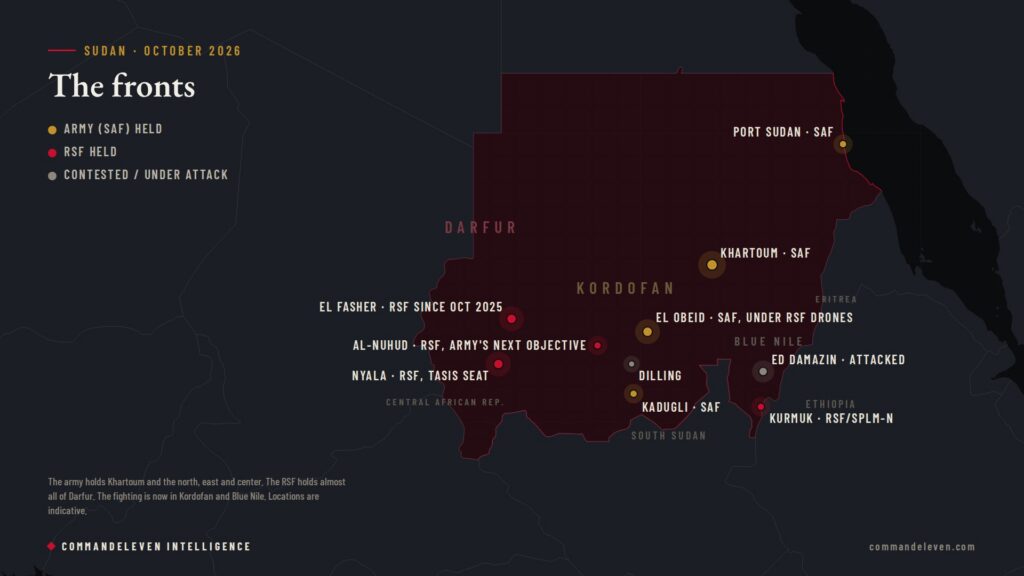
- [CONFIRMED] Sudan’s war, now in its fourth year, has hardened into an east-west partition. The Sudanese Armed Forces (SAF) hold Khartoum and the north, east and center. The Rapid Support Forces (RSF) hold almost all of Darfur, including El Fasher, which fell in October 2025, and parts of Kordofan. The active fronts are now Kordofan and Blue Nile.
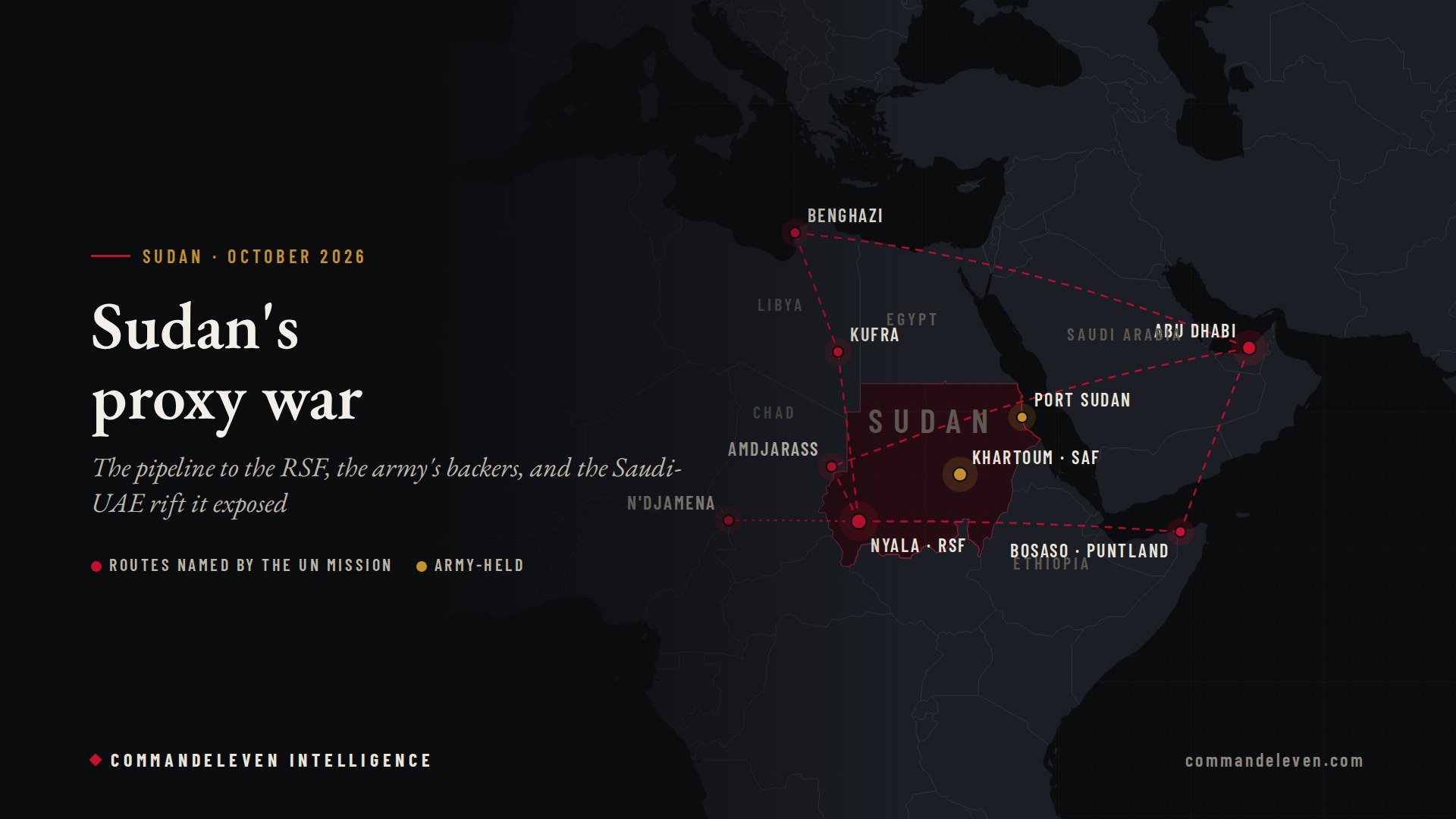
- [CONFIRMED] On September 3, 2026, the UN’s Independent International Fact-Finding Mission for the Sudan reported “reasonable grounds to believe” that a transnational network supplied the RSF with weapons, logistics, training and foreign fighters. The network ran through the United Arab Emirates, Chad, Libya, Puntland and Colombia, and persons and entities linked to the UAE played a “significant role.” The mission did not attribute that conduct to the Emirati state. The UAE denies supporting either side.
- [ASSESSED] Both sides are externally armed. The SAF draws on Egypt, Turkey, Iran (until mid-2026) and, by reports, Pakistan, with Saudi Arabia as its main Gulf patron. This is a proxy war with patrons on both sides, not a one-sponsor story.
- [ASSESSED] Sudan is where the Saudi-UAE split became a public, policy-level rupture. Riyadh backs the SAF and Abu Dhabi is accused of backing the RSF. What began as quiet disagreement inside the US-led “Quad” moved to a Saudi statement condemning foreign “mercenaries and foreign fighters” in February 2026, and to a reported Saudi threat to leave the Quad in September. CommandEleven Intelligence’s companion dossier on the Gulf split takes that thread further.
- [ASSESSED] No political settlement is in reach before 2027. The SAF has rejected the US 90-day truce plan and says the war ends militarily. The UN Security Council remains split over a nationwide arms embargo, and the external supply lines on both sides are intact.
The War in October 2026: Where the Lines Are
The war that began in Khartoum in April 2023 has spread to 13 of Sudan’s 18 states. The army recovered the capital after its early losses, and the RSF’s capture of El Fasher on October 26–27, 2025 took the army’s last major stronghold in Darfur. That left the country divided roughly along an east-west line, with the fighting now concentrated in the middle.
- Kordofan. This is the main front. The army reopened the Khartoum–El Obeid corridor in late July, and in early October it took al-Mazroub, which the army called “one of the RSF’s most important positions in North Kordofan.” Army units are reported to be pushing toward Al-Khuwai, with Al-Nuhud as the next objective. The RSF keeps striking El Obeid with drones. In the first week of October one strike hit a Kordofan University dormitory, killing five civilians and injuring 47.
- Blue Nile. This is the new front. The RSF and its ally, Abdelaziz al-Hilu’s SPLM-N, retook Kurmuk and Geissan in mid-August and attacked the state capital, Ed Damazin, on September 4. Fighting in early October came within about 50 to 60 kilometers of the Roseires Dam.
- Darfur. The RSF controls almost all of it and runs its parallel “Tasis” government from Nyala. The army’s allied Joint Forces still raid on the margins: they took Bir Saliba in West Darfur in early October.
[CONFIRMED] Drones now set the tempo on both sides. In early October the army shot down an RSF CH-95 drone, the same Chinese model the UN mission traced into the RSF’s supply chain. Both sides are hitting markets, aid convoys and fuel trucks.
The Pipeline to the RSF
The RSF began the war as a paramilitary force with light weapons and Land Cruisers. By 2026 it was fielding 155mm howitzers, air-defense systems and armed drones. The question every investigation since 2023 has tried to answer is how that equipment arrived. In September 2026 the UN’s own fact-finding mission gave its answer.
What the UN Mission Found
In its September 3 report, the Fact-Finding Mission said there were “reasonable grounds to believe” a transnational network supplied the RSF. Its findings:
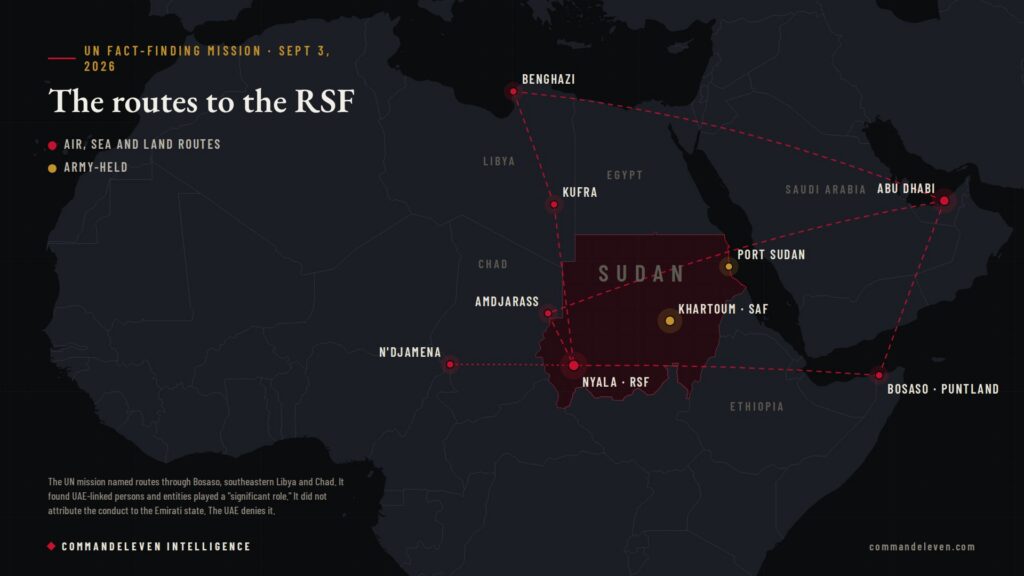
- Who. Companies, intermediaries and individuals operating in or through the UAE, Colombia, Chad, Libya and Somalia. Persons and entities linked to the UAE played a “significant role” in recruiting, financing and transporting contractors and in supporting the RSF.
- What. Chinese-made NORINCO AH-4 howitzers, FK-2000 air-defense systems, CH-95 reconnaissance and strike drones, radars, armored vehicles and large quantities of ammunition. Some of the materiel was consistent with equipment previously exported to the UAE.
- How. By air, sea and land through Bosaso in Somalia’s Puntland, southeastern Libya and Chad. Witnesses described recurring cargo flights from the UAE through Chad into RSF territory, and cargo aircraft landing at Nyala.
- Training. RSF fighters were reportedly trained on drones in Benghazi and Kufra in Libya, and fighters who attacked Zamzam camp were trained at Jufra.
- Fighters. Up to 2,000 former Colombian military personnel may have been recruited since August 2024, some trained at a facility in Ghayathi in the UAE. A contractor unit known as the “Desert Wolves” operated drones, artillery and air defenses around El Fasher.
The mission drew a line that matters for any fair reading. It did not attribute the network’s conduct to the Emirati state, and it made no finding of Colombian state responsibility. It urged the UAE to investigate and enforce against companies operating from its territory, and it urged the Security Council to extend the arms embargo from Darfur to all of Sudan.
[CONFIRMED] The UAE rejected the findings. It told the mission it had remained neutral and that its own inquiries found no link between entities under its jurisdiction and mercenary activity. It said in November 2025: “We categorically reject any claims of providing any form of support to either warring party.”
The Colombian Contractors
Human Rights Watch’s May 2026 report, From Bogotá to El Fasher, mapped the recruitment chain in more detail than the UN. Its findings:
- The recruiters. A Colombian agency, A4SI, recruited retired soldiers and was sanctioned by the US Treasury in December 2025. Its renamed successor was sanctioned in April 2026, and a Panama-based firm handled salaries.
- The hiring firm. HRW says the contractors appear to have been hired by Global Security Services Group (GSSG), an Abu Dhabi company founded by a senior official of the UAE Presidential Court. HRW does not claim that specific senior officials were involved in the deployment.
- The routes. One ran from Abu Dhabi to Benghazi and overland into Darfur. Another ran through Bosaso, the UAE and N’Djamena to Nyala.
- The fighting. Geolocated video shows Spanish-speaking contractors fighting alongside the RSF around El Fasher.
[ASSESSED] The UN mission and HRW reached the same picture independently, and the US Treasury and the UN Security Council have sanctioned parts of the recruitment chain. CommandEleven Intelligence therefore treats the existence of a UAE-linked supply and recruitment network as established. Whether the Emirati state directed it is still unproven in the public record. That distinction is the whole of the UAE’s defense, and it is the reason a political answer has stayed out of reach.
The Ethiopia Question
[DATA DEFICIT] In January 2026, Middle East Eye tracked at least four flights between Abu Dhabi and Ethiopia’s Harar Meda airbase by a UAE-operated An-124. It followed Somalia’s cancellation of defense agreements with the UAE. No cargo was confirmed. The Security Council’s October forecast notes “allegations” that Ethiopian territory is being used to supply RSF operations in Blue Nile. CommandEleven Intelligence treats an Ethiopian route as a hypothesis worth watching, not a finding.
The Army’s Suppliers
The army is not fighting on its own resources either. Its backers are different, and the public record on them is thinner.
- Egypt. Cairo is the army’s closest neighbor and ally. The New York Times reported in February 2026 that Turkish-made Akıncı drones fly against the RSF from a base at East Oweinat in Egypt’s desert. Egypt says its involvement concerns the Nile and border security. [ASSESSED, single-outlet sourcing on the base]
- Turkey. Baykar drones have been central to the army’s recovery of Khartoum and Gezira. One estimate puts covert Turkish supply above $120 million, but that figure comes from commentary rather than documents. [ASSESSED on the drones; SPECULATIVE on the figure]
- Iran. Iranian Mohajer-6 drones were seen at Wadi Sayyidna airbase in 2025. The army reportedly halted Iranian purchases in mid-2026 to improve its standing with Washington, and Iran’s own war has since drained its stocks. [ASSESSED]
- Pakistan. The Sudan Tribune reported deliveries of Mohafiz armored vehicles and Shahpar drones in mid-2026. A reported package of about $1.5 billion, including K-8 aircraft and more than 200 drones, is said to be financed by a third party, with Saudi Arabia credited with brokering it. [ASSESSED on deliveries; SPECULATIVE on the package and its financing]
- Saudi Arabia. Riyadh is the army’s principal Gulf patron, diplomatically and, by most accounts, financially. No public document sets out Saudi arms transfers to the army.
Gold. Gold pays for both sides. Chatham House estimated in 2025 that about 60 percent of the gold produced in army-held states is smuggled into Egypt, and RSF-held mines in Darfur and West Kordofan finance the other side. On September 16 the collapse of the al-Zara mine near Nuhud killed at least 82 people.
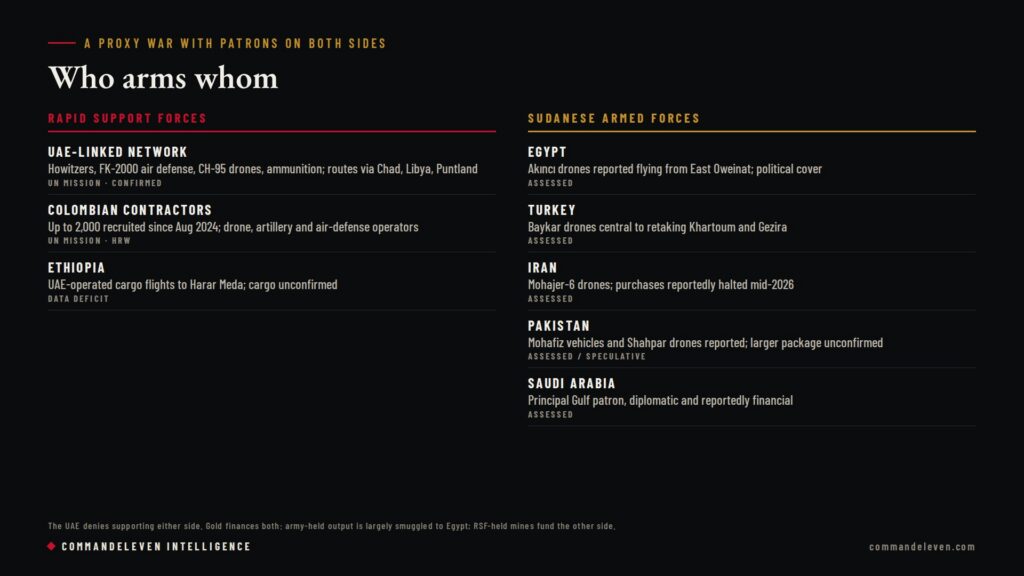
[ASSESSED] The record is uneven, and that unevenness is part of the story. The RSF’s supply chain has been investigated by a UN mission, a UN Panel of Experts, HRW and Amnesty, because it runs through third countries and private firms that leave paper trails. The army’s suppliers are mostly states selling to a recognized government, which leaves fewer trails and draws less scrutiny. Neither side could sustain the war at its current tempo without outside supply.
How Sudan Split the Gulf
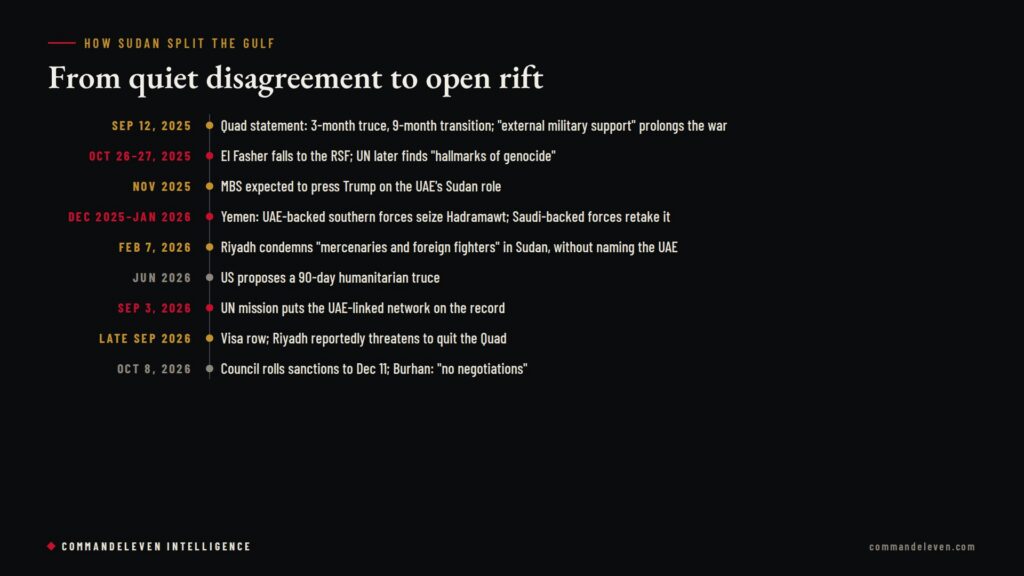
Saudi Arabia and the UAE have backed opposite sides in Sudan since 2023. For two years they managed that disagreement inside the Quad, alongside the United States and Egypt. In 2026 it became an open rupture.
- September 12, 2025. The Quad’s joint statement called for a three-month humanitarian truce and a nine-month transition. It said “external military support” prolongs the war. It also said Sudan’s future “cannot be dictated by violent extremist groups part of or evidently linked to the Muslim Brotherhood,” a line widely read as aimed at Islamists in the army’s camp.
- October 26–27, 2025. El Fasher fell. The UN later documented at least 6,000 killings in the first three days and found conduct with “the hallmarks of genocide.” The UAE condemned the killings and pledged aid.
- November 2025. Crown Prince Mohammed bin Salman was expected to press President Trump on the UAE’s role in Sudan during his White House visit, according to Middle East Eye’s Arab and Western sources.
- December 2025 to January 2026. The split went kinetic in Yemen. UAE-backed southern forces seized Hadramawt and al-Mahra, and Saudi-backed forces drove them back. The UAE withdrew its remaining troops from Yemen, saying it “supports Saudi Arabia’s security.”
- February 7, 2026. Saudi Arabia’s foreign ministry condemned RSF attacks in Kordofan and denounced “foreign interference” by “some parties,” citing the “continued influx of illegal weapons, mercenaries and foreign fighters.” It did not name the UAE. It did not need to.
- September 2026. The UN mission’s report put the UAE-linked network on the UN record. In late September, during the US-Sudan visa dispute, Riyadh reportedly threatened to quit the Quad, accusing US officials of “political blackmail” and of favoring the UAE by treating the army and the RSF as equals. The Saudi government has not confirmed the threat.
[ASSESSED] For Riyadh, the RSF is part of a pattern: UAE-backed non-state forces in Sudan, southern Yemen, Somaliland and eastern Libya, all on the Red Sea’s shores or approaches. For Abu Dhabi, the army’s camp contains Islamists it regards as a greater danger than the RSF. Each side reads the other’s Sudan policy as proof of a wider strategy. That is why Sudan, rather than Yemen, is the issue on which neither has been willing to give ground. CommandEleven Intelligence’s companion dossier on the Gulf split examines how the rift widened from here, and what it means for the GCC.
Diplomacy Stalled
- The US truce plan. Introduced in June 2026, it calls for an immediate 90-day humanitarian truce followed by talks toward a permanent ceasefire and a civilian-led transition. The army rejects its withdrawal terms. It wants the RSF out of every city it has taken since May 2023, while the plan asks for less.
- The visa dispute. In September the US reportedly withheld General Abdel Fattah al-Burhan’s visa for the UN General Assembly to press acceptance of the truce. The State Department said neither the army nor the RSF “represent legitimate, constitutional governance for Sudan.” The UN Secretary-General said he was “deeply concerned.”
- Burhan’s answer. In early October, after meeting US envoy Massad Boulos in Egypt, Burhan said “there will be no negotiations with the rebels or with any other party.” He vowed to take back “every inch” of RSF-held territory.
- The Security Council. In September and again on October 8, the Council could agree only on short technical rollovers of the Darfur sanctions regime. Resolution 2830 runs it to December 11. The US wants the arms embargo extended to all of Sudan, with explicit coverage of drones. Russia said it “will not allow even a hint of broadening” the regime. China, the African members and Pakistan prefer a Darfur-only renewal.
- Accountability. The UN Human Rights Council extended the Fact-Finding Mission’s mandate by one year in early October, over the Sudanese government’s objection.
[ASSESSED] The diplomatic map mirrors the battlefield. The army has Egypt, Saudi Arabia, Russia and China. The RSF has the UAE’s denials and the absence of a UN finding against the Emirati state. Washington is trying to treat both as illegitimate. None of the three tracks (the Quad, the Quintet and the Council) has the leverage to impose a truce on a side that believes it is winning.
The Human Cost
- [CONFIRMED] About 14 million people are displaced, the largest displacement crisis in the world.
- [CONFIRMED] WFP reported in September that 20 million people face acute hunger and 200,000 are in IPC Phase 5, the starvation level. WFP is about one-third funded compared with last year.
- [CONFIRMED] The UN documented at least 6,000 killings in El Fasher in the first three days after its fall. Local and independent estimates run from tens of thousands upward, and none has been verified.
- [CONFIRMED] The UN mission found reasonable grounds to believe repeated RSF drone strikes on El Obeid may amount to war crimes.
Outlook and Indicators (Foresight Entry)
[ASSESSED] The base case through early 2027 is continued war, with the army pressing west in Kordofan and the RSF opening pressure points in Blue Nile and on supply lines. Neither side can take the other’s core territory. The external supply lines are the variable that could change that, and they are the one thing the Security Council cannot agree to touch.
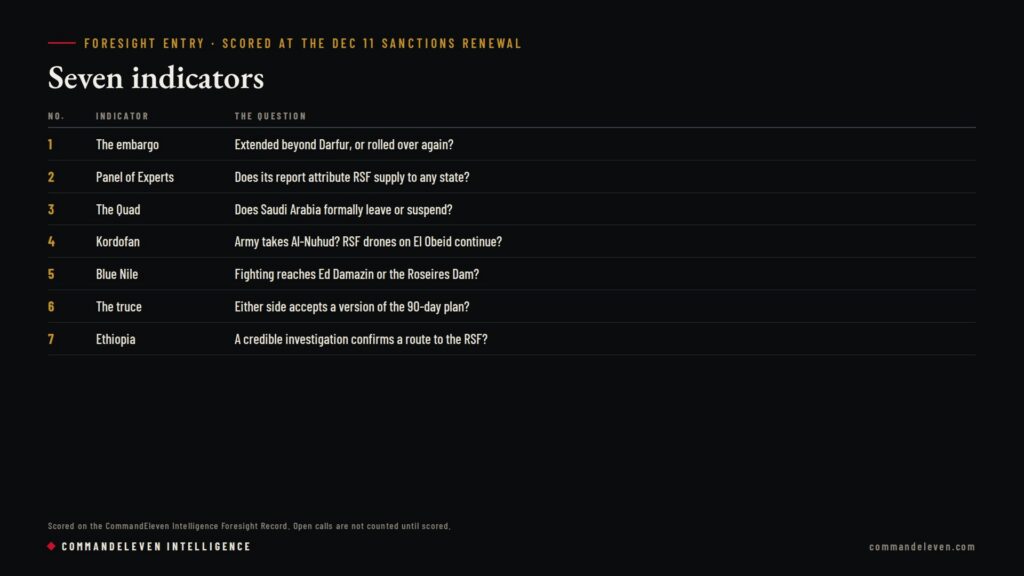
CommandEleven Intelligence will score these indicators on the Foresight Record at the Security Council’s December 11 sanctions renewal:
- The embargo. Does the Council extend the arms embargo beyond Darfur, or roll the regime over again?
- The Panel of Experts. Does its next report attribute RSF supply to any state? Its mandate runs to January 11, 2027.
- The Quad. Does Saudi Arabia formally leave or suspend its participation?
- Kordofan. Does the army take Al-Nuhud, and does the RSF’s drone campaign against El Obeid continue?
- Blue Nile. Does fighting reach Ed Damazin or the Roseires Dam?
- The truce. Does either side accept a version of the US 90-day plan?
- Ethiopia. Does any credible investigation confirm an Ethiopian supply route to the RSF?
Frequently Asked Questions
Who is fighting in Sudan?
The Sudanese Armed Forces, led by General Abdel Fattah al-Burhan, against the Rapid Support Forces, led by Mohamed Hamdan Dagalo (“Hemedti”). The war began in April 2023.
Is the UAE arming the RSF?
A UN fact-finding mission found in September 2026 that a network of UAE-linked companies and individuals supplied the RSF with weapons, drones and foreign fighters. It did not attribute that conduct to the Emirati state. The UAE denies supporting either side.
Who arms the Sudanese army?
Egypt, Turkey and, until mid-2026, Iran, with reported Pakistani deliveries and Saudi diplomatic and financial backing.
Why are Saudi Arabia and the UAE at odds over Sudan?
Riyadh backs the army and sees UAE-linked support for the RSF as part of a wider pattern of Emirati backing for non-state forces around the Red Sea. Abu Dhabi regards Islamists in the army’s camp as the greater threat.
Is there a ceasefire plan?
The US proposed a 90-day humanitarian truce in June 2026. The army has rejected it, and its leader said in October there would be no negotiations.
Sourcing Base (Confidence-Tiered, with Links)
CONFIRMED — UN and Institutional Record:
- Middle East Eye, UAE-linked networks supplying weapons and fighters for Sudan atrocities, UN finds, September 2026 (report of the Independent International Fact-Finding Mission for the Sudan, advance version A/HRC/63/23, September 3, 2026)
- The Maltese Herald, UN report confirms UAE-linked arms network supplying Sudan’s Rapid Support Forces, September 4, 2026
- Security Council Report, Sudan, October 2026 Monthly Forecast
- Security Council Report, Sudan Sanctions: Vote on a Draft Resolution Extending the Sanctions Regime, October 2026
- UN Press, Security Council Unanimously Adopts Resolution 2828 (2026), September 11, 2026
- US Department of State, Joint Statement on Restoring Peace and Security in Sudan, September 12, 2025 (Quad statement, via GlobalSecurity.org)
- Wikipedia, El Fasher massacre (compiled record of UN, WHO, Yale HRL and government statements)
CONFIRMED — Investigations:
- Human Rights Watch, From Bogotá to El Fasher: The UAE’s Role in the Deployment of Colombian Fighters and Other Backing to the Rapid Support Forces in Sudan, May 25, 2026
- Amnesty International, Sudan: Advanced Chinese Weapons Provided By UAE to RSF Militia, May 2025 (via allAfrica)
ASSESSED — Credible Reporting and Analysis:
- Al Jazeera, Is the Sudanese army gaining momentum against the RSF?, October 4, 2026
- Ayin Network via allAfrica, Sudan: Weekly News Briefs, October 2026
- The New Arab, Sudan war: Burhan rejects talks and vows to defeat RSF, October 8, 2026
- The New Arab, Saudi Arabia ‘threatens to quit Quad’ amid US-Sudan UN visa row, September 24, 2026
- Al Jazeera, Saudi Arabia denounces ‘foreign interference’ in Sudan after RSF attacks, February 8, 2026
- Middle East Eye, Mohammed bin Salman expected to lobby Trump over UAE role in Sudan, sources say, November 13, 2025
- Middle East Eye via Martin Plaut, Weapons tracked from the UAE to Sudan’s RSF via Ethiopia, January 21, 2026
- Foreign Policy, The Saudi Arabia-UAE Dispute Is About More Than Just Yemen, January 8, 2026
- The Soufan Center, Saudi–UAE Strategic Friction and Regional Fragmentation, January 6, 2026
- Eurasia Review, As Iran’s War Drains Its Arsenal, Egypt, Turkey And Pakistan Rearm Sudan’s Army, September 23, 2026 (op-ed; used only for the reporting it cites)
- Sudans Post, Rival de facto government in RSF territory deepens Sudan crisis, September 1, 2025
Excluded from this dossier: Any claim that the Emirati state directed the RSF supply network, which no UN body has found. The Ethiopian route is presented as unconfirmed. Death-toll estimates for El Fasher above the UN’s documented figure are reported as estimates, not adopted. The reported Pakistani package and its financing are treated as unconfirmed.

