CommandEleven Intelligence · Europe Desk. Rear-Area War series, status as of November 28, 2026. Criminal proceedings are active. Everything attributed to the prosecution is an allegation made in open court, and both defendants are presumed innocent. Both have indicated, through their lawyers, that they will plead not guilty.
The series: Part 1: RAF Fairford Terror Plot; Part 2: MacDill Breach & RAF Fairford Plot; Part 3: The Gig Economy of Terror; Part 4: RAF Fairford Charges. Part 5 is this post.
Bottom Line Up Front
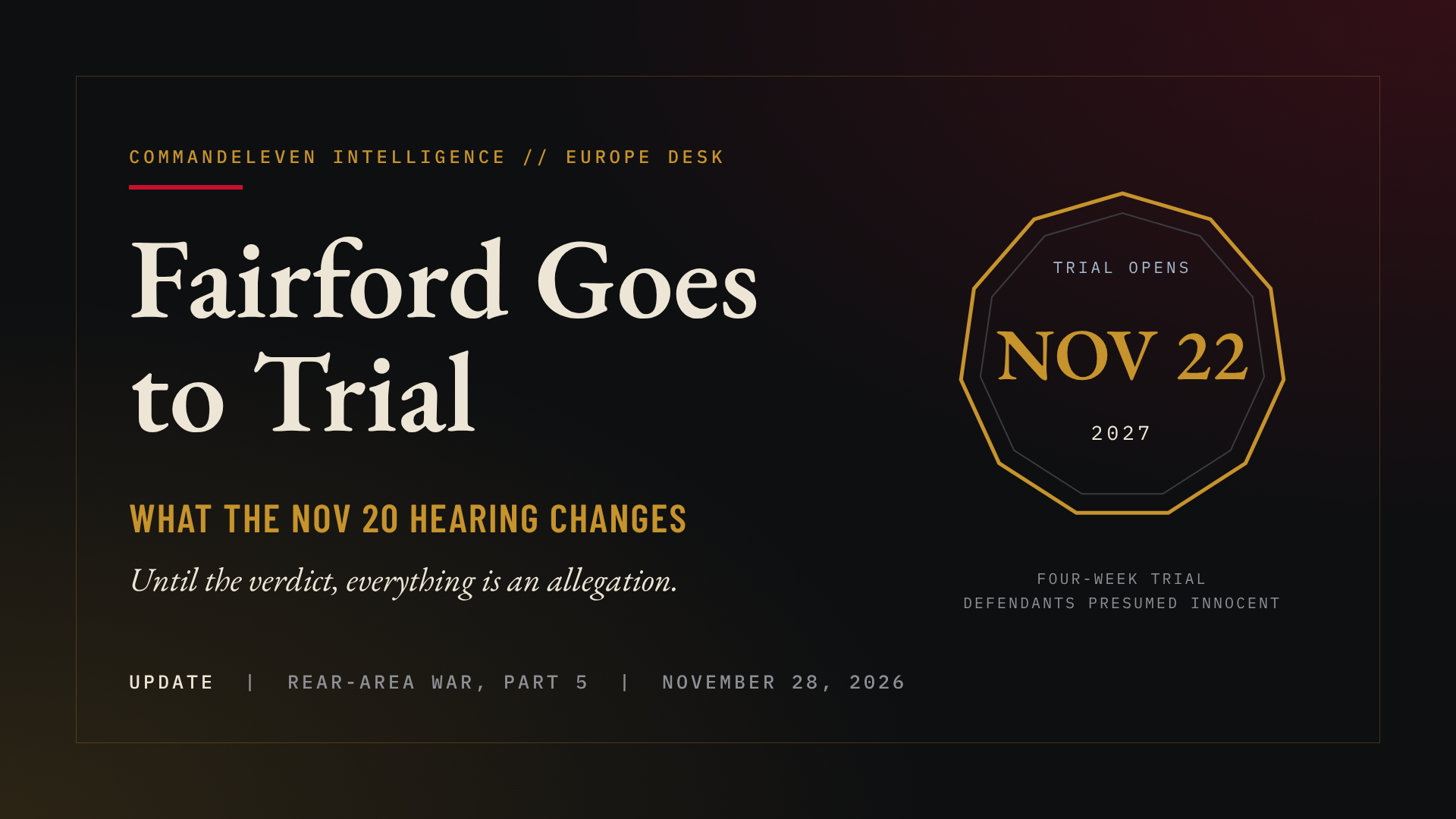
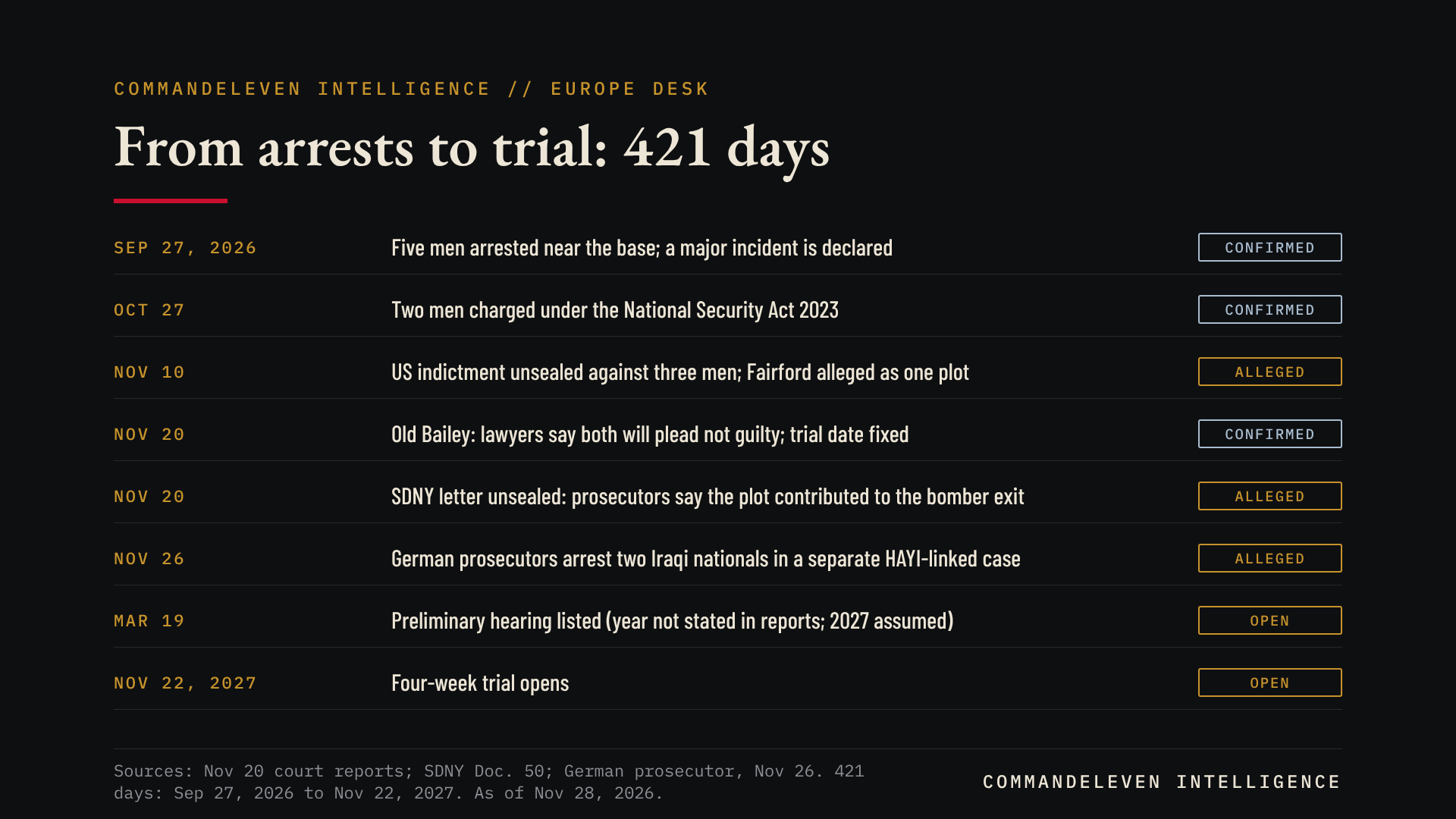
On November 20, 2026, ten days after the US indictment and 54 days after the arrests, the RAF Fairford case got a calendar. Mohmed Abdulkarim, 24, and Nouman Essghir, who is reported as 24 or 25, appeared by video link at the Old Bailey. Their lawyers said both will plead not guilty. A four-week trial is fixed to start on November 22, 2027. A further preliminary hearing is listed for March 19. The reports do not state the year, and we assume 2027.
That date matters more than any single new fact. For the next twelve months the public record on Fairford will be allegations, a US indictment and analysis. Nothing about who directed the operation, or why, will be tested until a jury hears it.
In the meantime, the public picture has widened. The UK has charged two men. The US has indicted three others. A CTC Sentinel analysis by Crispin Smith and Matthew Levitt (November/December 2026) ties Fairford to the same IRGC-linked network that ran the spring HAYI campaign. A US prosecutors’ letter in al-Saadi’s New York case, unsealed on November 20, says the plot contributed to the removal of US aircraft from the base. And on November 26 German federal prosecutors arrested two Iraqi nationals in a separate case that names HAYI and al-Saadi. We report each account as its author’s, and we label what rests on court allegations and what rests on anonymous officials.
[ASSESSED] Our Part 4 judgment holds: on the prosecution’s case, Fairford is a state-directed, paid, compartmented operation that stopped short of violence. What has changed is how much of that is now contested in the public record, including the size of the payments, and how much has to wait for a verdict.
Key Judgments
KJ1: The case now has a date, and it is a year away. Trial opens November 22, 2027, for four weeks. Both defendants are expected to deny the charges. [CONFIRMED as reported by two outlets; the venue and judge are reported inconsistently, see Corrections]
KJ2: Only one of the five men arrested at the base has been charged. Essghir, charged over the August 22 reconnaissance, is the only one of the five arrested near the base on September 27 to face a charge so far. Abdulkarim was arrested later in London. Six other people remain on police bail, four of them British nationals arrested outside the base. [CONFIRMED as reported by The National; ALLEGED as to the underlying facts]
KJ3: The payment figure is no longer settled. Reports of the October 27 hearing gave about £70,000 in several payments. The National’s account of November 20 attributes to prosecutors £65,300 in cash, collected over three visits to money exchanges. We cannot tell from public reporting whether the figure changed or whether outlets are describing different totals. Either number sits far above the few-hundred-euro payments seen in the HAYI arson wave. [REPORTED, outlets differ; our “above the gig tier” reading from Part 4 holds on either figure: ASSESSED]
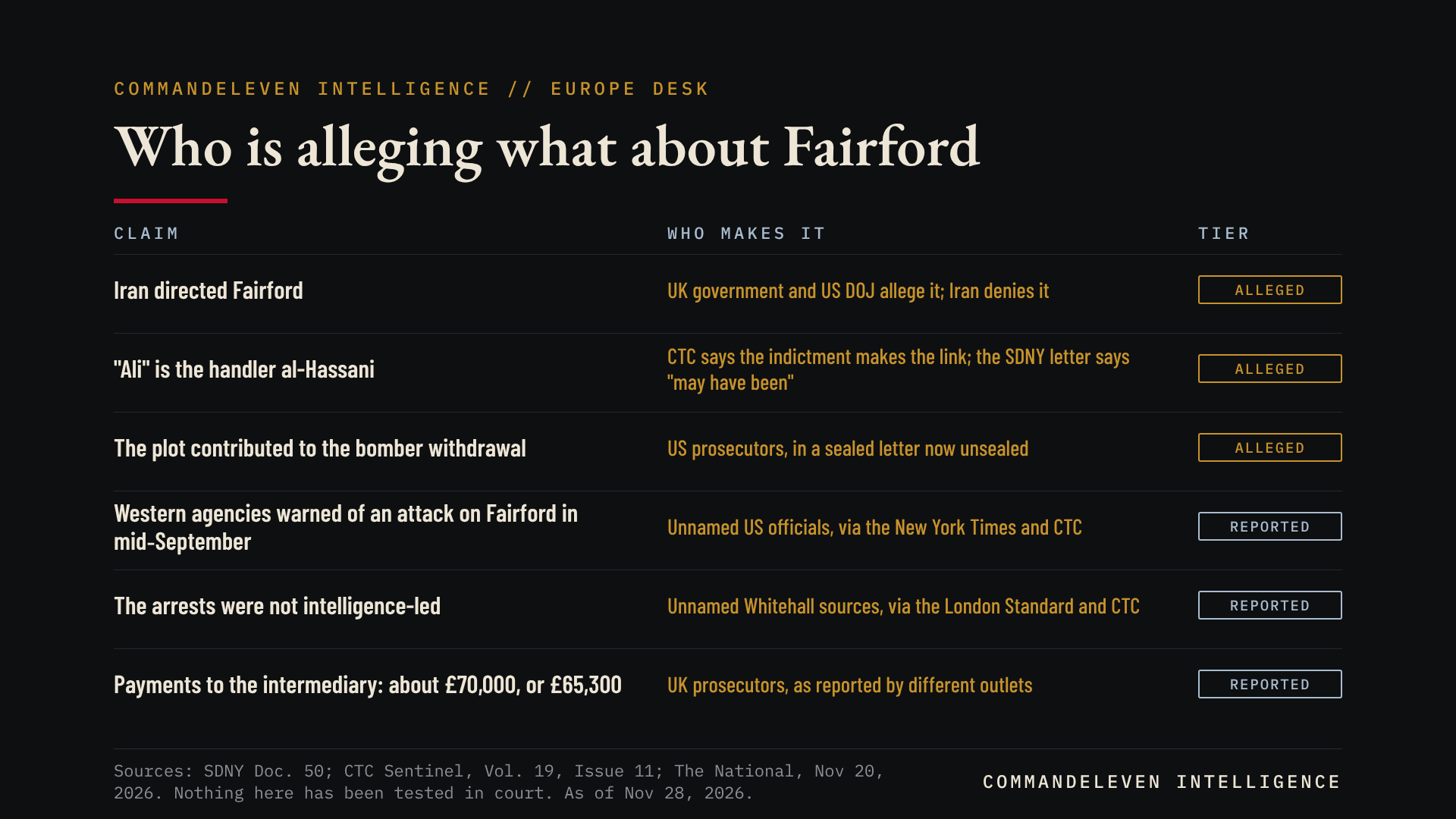
KJ4: Whether the authorities knew in advance remains reported, contested and open. The Smith–Levitt article says US officials told The New York Times that in mid-September American and other Western agencies warned that Fairford was a potential target, without a date or named plotters. It also notes that some Whitehall sources told the London Standard the arrests were not intelligence-led. Both claims rest on unnamed officials. [REPORTED; contested; no court has addressed it]
KJ5: The strategic effect is the story, and the bomber question has moved. Smith and Levitt argue that a cheap operation that fails on its face can still impose costs: a bomber redeployment, police resources, friction between allies and local pressure on hosting US forces. We agree the costs are real. On causation, the record has shifted since Part 4. US prosecutors, in a letter to the New York court, say the Fairford plot contributed to the removal of US aircraft from the base. We read “contributed” as one factor, not the whole cause: US officials also cited a separate drone concern in October (Part 4), and Smith and Levitt say only that the withdrawal was allegedly tied to Iranian threats. [ALLEGED by US prosecutors as a contributing cause; sole causation NOT established]
KJ6: The network is now European, not just Anglo-American. On November 26 German federal prosecutors arrested two Iraqi nationals on suspicion of membership in a terrorist organization they say al-Saadi helped found at the end of 2025, before HAYI emerged. The release says unknown perpetrators, presumably carrying explosives, visited synagogues in Cologne and one other European city on two nights in late March 2026, and that the attacks were not carried out. Nothing in the release mentions Fairford. [ALLEGED by German prosecutors; no Fairford link alleged]
What the Court Heard on November 20
Reports of the hearing, from The National and a second agency account, agree on the following. [ALLEGED throughout, except procedural facts]
- Pleas. Neither man has pleaded guilty. Lawyers for both said the charges will be denied. Both confirmed their identities by video link. [CONFIRMED]
- Trial. Four weeks, starting November 22, 2027. [CONFIRMED]
- The charges. Essghir: entering a prohibited place for a purpose prejudicial to the UK, over filming the Fairford perimeter on August 22 at Ali’s request. Abdulkarim: conduct likely to materially assist a foreign intelligence service, between August 31 and September 28 (per The National). Both are National Security Act 2023 offenses. [CONFIRMED as charged]
- The money. Prosecutor Julia Faure Walker, per The National, said Abdulkarim collected £65,300 in cash from Ali over three money-exchange visits. A second account of the same hearing repeats about £70,000. [REPORTED; discrepancy]
- The vans. The same report says Abdulkarim allegedly bought five vans. Police found three at the scene on September 27. Part 4 noted the DOJ describes three vans tasked and the UK account refers to five drivers. We do not know where the other two vans went, or whether “five” counts vehicles bought rather than vehicles used. [REPORTED; unresolved]
- Custody. One report says Essghir is remanded in custody and Abdulkarim remains on bail. The other does not say. [REPORTED]
- Ali. Prosecutors said both men were in contact with a handler abroad acting for Iran. [ALLEGED]
What the Smith–Levitt Analysis Adds
The CTC Sentinel piece, “Iran’s Shift from Soft to Hardened Targets,” is the most detailed single public account to date. It draws on official statements, the October 27 hearing, the US indictment, press reporting and the authors’ own interviews. Its core claim is that Fairford marks an expansion: Iran is using the same disposable criminal proxies it used against Jewish communities and dissidents, now against a military target. We summarize it here in our own words, and note where we differ.
1. The network, as alleged. The article ties the Fairford plot to three men named in the November 10 US indictment: Mohammad Baqer al-Saadi (dual Iraqi-Iranian, linked to the IRGC and Kataib Hezbollah, in US custody since April), Mohsen Mohajeri (an IRGC member since 2004) and Mohammad Ali al-Hassani, whom the article says the indictment identifies as “Ali.” It lists al-Hassani as Iraqi-born, a British citizen until the Home Office revoked his citizenship in October, and now in Iran. [ALLEGED by US prosecutors; the birth and citizenship details are REPORTED from The Times via the article]
Our line on Ali. In Part 4 we declined to say “Ali” and al-Hassani were the same man, because the BBC did not. The CTC article now states that the indictment makes the link, and we have confirmed that on the CTC page. We have not read the indictment itself. The one primary US document we hold on the point, the sealed letter described below, is more careful: it says only that prosecutors have reason to believe a prison-call reference to “Ali” may have meant al-Hassani. We therefore report the identification as ALLEGED, hedged by the prosecutors’ own wording, and note that UK prosecutors have not confirmed it in anything we have seen.
2. Two brothers, no Fairford link. ITV reported on November 11 that two brothers, Mustafa and Rassoul Alkyaui, with organized-crime links in the Netherlands, helped recruit local attackers for the HAYI wave. One was reported detained in Turkey. The article is explicit that no link to Fairford has been reported. We repeat that caveat. [REPORTED by ITV; no Fairford link alleged]
3. The attribution is to the IRGC, with the agency question left open. The authors point out that the Fairford pattern (overseas handler, local intermediary, cash, reconnaissance) matches IRGC-QF and IRGC-IO methods. They treat the question of which service is funding and directing which part as preliminary. We agree with that caution. [ASSESSED by the authors; ours: ASSESSED, low confidence on which service]
4. The strategic reading. The authors list four gains for Iran, none requiring a successful attack: the bomber withdrawal, the cost of investigating and prosecuting low-level recruits, Anglo-American friction and local discontent about US bases. Their conclusion is that such attempts are cheap, take many forms and need not succeed to matter. [ASSESSED by the authors]
5. The prescription. They recommend combined protective security and investigation, tracing networks back to sponsors with financial and diplomatic pressure, stronger deterrence against recruitment and, where legally justified, targeted military action against overseas handlers. That last point is the authors’ policy view. This dossier reports it and takes no position on it.
Where we differ. The authors describe the operation as inexpensive and the recruits as replaceable. Our Part 4 reading was that £65,000–£70,000 to a single intermediary puts Fairford above the gig tier. These are compatible: cheap relative to the political return, expensive relative to a street-level arson. But the framing matters for what comes next. If Iran treats Fairford as a good return on spend, the lesson Iran draws is to repeat it. If it treats the arrests as a failure, it moves up to more capable contractors. That is the scenario Part 3 named as highest consequence, and the trial may not tell us which lesson was drawn.
Three New Documents
1. The SDNY letter (United States v. al-Saadi, 26 Cr. 220, Document 50). This is a letter from the US Attorney’s office to Judge Colleen McMahon, dated October 21 and docketed on November 20. It was filed sealed and ex parte, in the dispute over the restrictions on al-Saadi’s prison contact. We read it as a primary US prosecution document, and it says the following. [ALLEGED; the letter states what prosecutors believe, not what a court has found]
- A magistrate judge authorized search warrants on October 13 for Google and Apple accounts belonging to Mohajeri and al-Hassani. Prosecutors say the investigation shows both conspired with al-Saadi on several of the European attacks, including in London.
- Prosecutors say al-Hassani was involved in orchestrating the Fairford plot, and that the plot contributed to the removal of US aircraft from the base.
- On a prison call around September 24, three days before Fairford, al-Saadi allegedly told his family to contact “Ali” and then to give him money “so we can do it.” Prosecutors say “Ali” may have meant al-Hassani, and that they are examining whether al-Saadi passed directives through prison calls. Earlier calls, they say, show him using family to relay messages and move money. Family calls have since been cut to one a month.
- Prosecutors say “Abbas, Abu Daniel” in earlier calls may refer to Mohajeri.
- In a footnote, they say they were weighing further charges against Mohajeri and al-Hassani. The November 10 indictment followed.
What it adds: a stated US government view on the bomber withdrawal, and a specific, dated prison-call allegation tying al-Saadi’s money instructions to the days before Fairford. What it does not do: it does not say the “Ali” on the call is the “Ali” named in the UK court, it hedges (“may have been”), and no court has tested any of it.
2. The German federal prosecutor’s release (November 26). The Federal Prosecutor General announced the arrests of two Iraqi nationals, named only as Mostafa Al-R. and Ameer J., in Heidelberg and Cologne, on warrants issued November 18. Searches took place at 17 properties with more than 250 officers. They are strongly suspected of membership in a terrorist organization under section 129a of the German Criminal Code. Prosecutors say Mostafa Al-R. knows al-Saadi, and that the two, with others including Ameer J., founded a separate organization at the end of 2025 to carry out attacks in Germany and Europe. The group allegedly raised funds and recruited people for bombings, and unknown perpetrators allegedly visited synagogues in Cologne and another European city on two nights in late March, presumably carrying explosives. The attacks were not carried out, for reasons not yet known. The case started from intelligence reports by Germany’s domestic intelligence service. [ALLEGED by German prosecutors; CONFIRMED that arrests were announced]
Three cautions. First, the release says al-Saadi is charged in the US, not that he is on trial, and we use “charged.” Second, “Mostafa Al-R.” is not necessarily “Mustafa Mter Rassoul Alkyaui,” the brother ITV reports detained in Turkey. The names are similar, the nationality is Iraqi in both, and the release does not give a full name, so we do not equate them. Third, nothing in the release links the two men to Fairford.
3. Treasury’s Operation Economic Outcast action (November 23). Treasury sanctioned more than two dozen Iranian exchange houses, front companies and officials in what it calls a shadow-banking network, citing Iran’s financial, metals and counter-terrorism sanctions authorities. The release does not mention Fairford, HAYI or any European plot. We include it for one reason. Smith and Levitt recommend tracing proxy networks to their sponsors with financial pressure, and Abdulkarim is alleged to have collected cash at money exchanges. Treasury’s action is the sanctions track of the same wider confrontation, not evidence in the Fairford case. [CONFIRMED as announced; no Fairford link alleged]
Corrections and Open Discrepancies
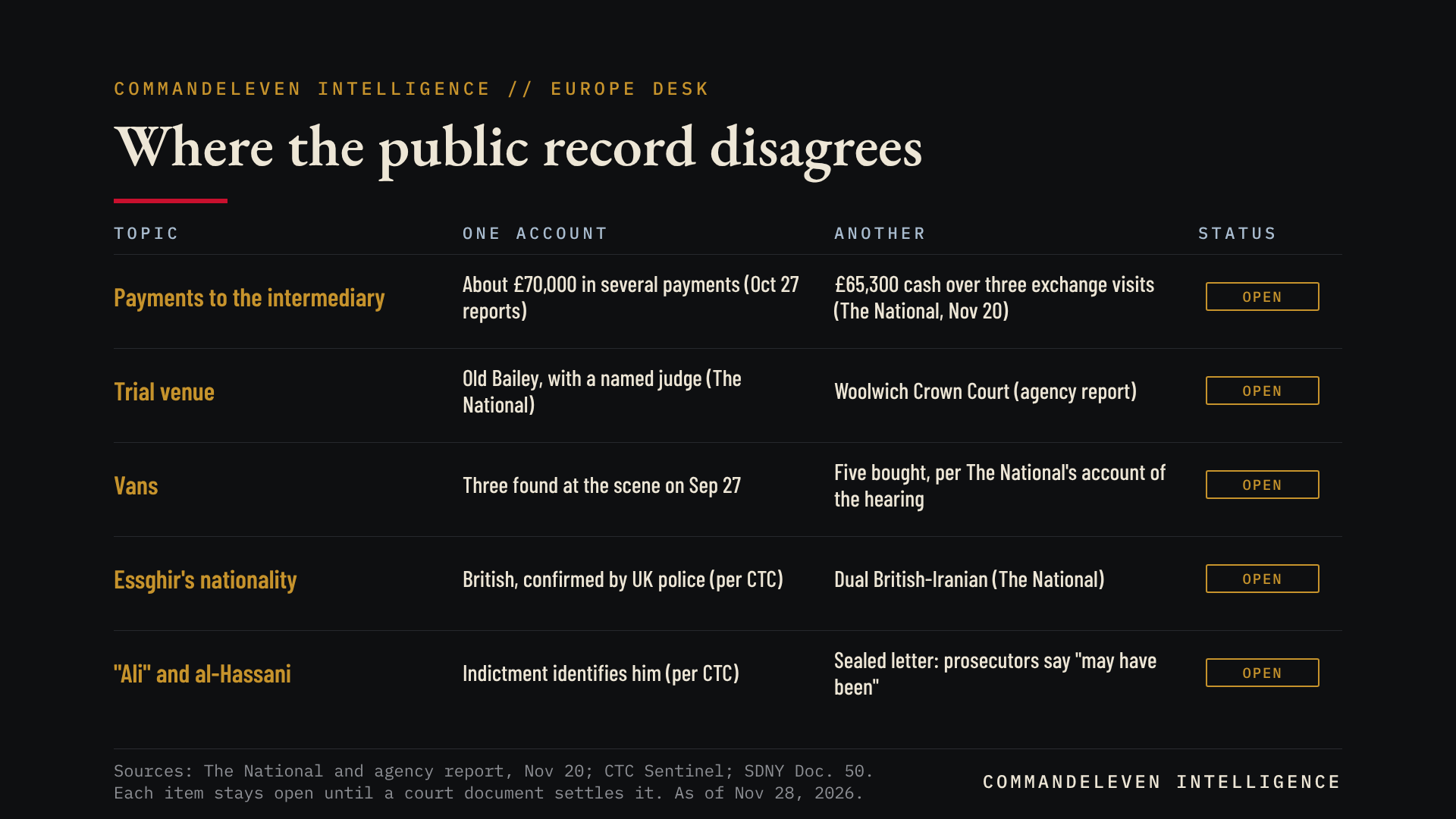
CommandEleven Intelligence logs where the public record disagrees with itself, and where our earlier posts need adjusting.
- £70,000 versus £65,300. Part 4 used “about £70,000,” as reported on October 27. The National’s report of November 20 gives £65,300 in cash over three exchange visits. We will use “about £65,000 to £70,000, depending on the report” until the prosecution’s papers are public. Part 4 is not changed, since it attributed the figure to the court reports of that date.
- Who is “Ali.” Part 4’s caution on whether Ali and al-Hassani are the same man is updated, as above. The identification rests on the US case, as relayed by CTC, and the SDNY letter’s own wording is hedged. It does not rest on a UK court statement.
- Bomber withdrawal. Part 4 said US officials tied the move to a separate drone concern. A US prosecutors’ letter now says the plot contributed to it. Part 4’s account stands as a report of what officials said, and this post adds the second statement.
- Essghir’s nationality and age. UK police have confirmed both defendants are British, per the Smith–Levitt table. The National adds that Essghir is a dual British-Iranian national. One report gives his age as 24 and another as 25. We treat the dual-nationality claim as single-source. [REPORTED]
- Venue and judge. The National places the hearing at the Old Bailey and names Judge Bobbie Cheema-Grubb. A second report places the four-week trial at Woolwich Crown Court. We will not state the trial venue until it is confirmed.
- Vans. Three vans were found at the scene. The National reports five were bought. See above.
- Part 4 dated call on Ali. See “Calls We Will Score” below.
- Al-Saadi’s status. Some summaries say he is on trial in the US. The German release says he is charged, and CTC says he is awaiting trial. We use “charged and awaiting trial.”
Foresight Audit: Where the Open Items Stand
The Fairford Foresight Audit scored FA-01 to FA-08 (4.5 of 8) and left FA-09 to FA-14 open. Nothing since October 27 is a verdict, so we are scoring none of them yet. We record only what the new material does to each.
| Item | What it asks | What changed | Proposed status |
|---|---|---|---|
| FA-09 | Threat intelligence specific to Fairford held before Sept 27 | Reported, from unnamed US officials, that Western agencies warned in mid-September; disputed by unnamed Whitehall sources | Open; leaning supported, REPORTED only |
| FA-10 | Which 999 call led to the arrests | Nothing new in the hearing | Open |
| FA-11 | Transatlantic link is ideological branding, not command and control | The indictment alleges direction and payments. The SDNY letter alleges a September 24 prison call telling family to contact “Ali” and give him money. The German release alleges al-Saadi helped found a separate bombing-focused group. All of it cuts against a “branding only” reading | Open; moving against us on allegations |
| FA-12 | MacDill and Fairford are coincidence | No link alleged in the indictment or the article | Open |
| FA-13 | Broadcast that “Iran is behind the plot” | Now alleged by UK government and US DOJ; tested by no court | Held for the verdict |
| FA-14 | Sept 29 on-air plan | Nothing new | Open |
FA-04 stays held to the verdict as before.
Calls We Will Score
Part 4 calls, revisited
- At least one more person is charged in the UK Fairford investigation by March 31, 2027. Still open. The US charged three others on November 10, but no one else has been charged in the UK since October 27. Six remain on bail.
- UK authorities do not publicly identify “Ali” by his real name, or sanction him, by June 30, 2027. Still open, scored on UK authorities only. The US case has named al-Hassani, but UK authorities have not.
- Deleted. Part 4’s call that neither defendant’s case would reach a verdict before June 30, 2027 is withdrawn, because the court has scheduled the trial for November 2027. It will not be scored.
New calls
- Neither defendant pleads guilty before the trial opens on November 22, 2027.
- The trial opens in 2027, with no adjournment into 2028.
- No US bomber deploys to RAF Fairford before June 30, 2027.
What to Watch
- March 19 hearing: Any change of plea, further charges, a trial venue confirmation, and whether the prosecution’s figure on payments is clarified.
- The six on bail. Whether any of the people arrested at the base are charged, and under which law.
- US proceedings. Filings and any extradition request touching al-Hassani and Mohajeri, both reportedly in Iran. Al-Saadi’s own trial in New York.
- UK sanctions and designations. Further listings of IRGC-IO or Quds Force figures, and any UK move on proscription.
- Germany. The detention hearings for Mostafa Al-R. and Ameer J., the third suspect targeted in Hürth, and whether prosecutors or the press link the case to Fairford or to the Alkyaui brothers.
- The US case. Whether the SDNY letter is unsealed in full, and whether al-Hassani’s and Mohajeri’s charges produce any filing that speaks to Fairford directly.
- Treasury. Whether Operation Economic Outcast lists any exchange house or facilitator tied to payments in the Fairford or HAYI cases. None is alleged now.
- The bombers. Whether B-1, B-52 or B-2 aircraft return to Fairford.
- The next incident. The authors expect more attempts. Look for reconnaissance or approaches at other US-used UK bases.
What This Dossier Does Not Claim
- It does not claim either defendant is guilty. Both are presumed innocent and expected to plead not guilty.
- It does not treat the prosecution’s account, the US indictment or the CTC Sentinel analysis as established fact.
- It does not claim that the three men indicted in the US directed Fairford. The US alleges it, and no court has ruled.
- It does not claim that the two men arrested in Germany had any role in Fairford, or that Mostafa Al-R. is the Alkyaui brother held in Turkey.
- It does not claim that Treasury’s November 23 sanctions are connected to Fairford or HAYI.
- It does not claim that the plot was the sole reason the bombers left Fairford. US prosecutors say it contributed.
- It does not claim that the five men who drove the vans knew what the operation was for.
- It does not claim that “Ali” is al-Hassani as a finding of fact. That is the US indictment’s allegation.
- It does not describe attack methods or how any material could have been used.
Frequently Asked Questions
When is the RAF Fairford trial?
A four-week trial is fixed to start on November 22, 2027. A preliminary hearing is listed for March 19. Reports differ on the trial venue.
Who is on trial?
Mohmed Abdulkarim, 24, charged with conduct likely to materially assist a foreign intelligence service, and Nouman Essghir, charged with entering a prohibited place for a purpose prejudicial to the UK. Both charges fall under the National Security Act 2023. Both are expected to plead not guilty.
How much was Abdulkarim allegedly paid?
Reports differ. October 27 coverage said about £70,000. The National’s account of November 20 says prosecutors alleged £65,300 in cash over three money-exchange visits.
Who is “Ali”?
The handler named in court, believed by police to be abroad and acting for Iran. CTC Sentinel says the US indictment identifies him as Mohammad Ali al-Hassani, an Iraqi-born former British citizen. A US prosecutors’ letter is more cautious and says only that a prison-call reference to “Ali” may have meant al-Hassani. UK prosecutors have not confirmed the identification in anything we have seen.
Is Iran behind RAF Fairford?
The UK government and the US Justice Department say so. Iran denies it. No court has ruled.
What does the CTC Sentinel article change?
It does not add court evidence. It joins the UK and US cases, sets Fairford inside Iran’s pattern of using criminal proxies, and argues that Fairford extends that pattern from civilian to military targets. Its factual claims are labeled in this post as allegations or as reported.
Is Germany involved?
German federal prosecutors arrested two Iraqi nationals on November 26 in a separate case tied to HAYI and al-Saadi, over alleged plans for bombings in Germany and Europe, including late-March visits to synagogues in Cologne and another city. The release does not mention Fairford.
Did the authorities know about the plot in advance?
Unnamed US officials say they had general warnings about Fairford in mid-September. Unnamed Whitehall sources say the arrests were not intelligence-led. Neither claim has been tested.
Related Reading
- RAF Fairford Terror Plot: Dossier on the Averted Attack – Part 1
- MacDill Breach and RAF Fairford Plot: Two Bases, One War – Part 2
- The Gig Economy of Terror: From Hatzola to Fairford – Part 3
- RAF Fairford Charges: The Handler, the Money and the Iran Case – Part 4
- RAF Fairford: U.S. Charges Three Iran-Backed Men and Names the HAYI Network
- The HAYI Network: How Seven Men Allegedly Ran Iran’s Attack Wave in Europe
- RAF Fairford Through October 27: Scoring Our Judgments Against the Charges
- Iran’s Underground Missile City
Sources
- U.S. Attorney’s Office, SDNY, Letter to Judge McMahon in United States v. al-Saadi, 26 Cr. 220, Document 50 (unsealed November 20, 2026)
- Generalbundesanwalt (German Federal Prosecutor General), Arrest of two suspected members of a pro-Iranian terrorist organization, November 26, 2026
- U.S. Department of the Treasury, Operation Economic Outcast Disrupts Iran’s Global Shadow Banking Networks, November 23, 2026
- CTC Sentinel (Combating Terrorism Center at West Point), Crispin Smith and Matthew Levitt, Iran’s Shift from Soft to Hardened Targets: Preliminary Observations from the RAF Fairford Incident, Volume 19, Issue 11
- The National, Two men to stand trial for alleged Iran-linked plot at RAF Fairford, November 20, 2026
- Yahoo News (agency report), Pair charged over RAF Fairford plot to face trial next November
- BBC News, Three Iran-backed suspects plotted attacks including RAF Fairford incident, US says, November 11, 2026
- ITV News, Seven men behind alleged Iranian terror network unmasked, November 11, 2026
- Part 4’s sources for the October 27 hearing (ITV News, PA, Al Jazeera, Iran International, The National)
The Rear-Area War Series
- The Rear-Area War: Series Introduction
- Part 1: RAF Fairford Terror Plot: Dossier on the Averted Attack
- Part 2: MacDill Breach and RAF Fairford Plot: Two Bases, One War
- Part 3: The Gig Economy of Terror: From Hatzola to Fairford
- Part 4: RAF Fairford Charges: The Handler, the Money and the Iran Case
- Part 5: RAF Fairford Goes to Trial (you are here)