Enhanced Interrogation is part of the CommandEleven Intelligence Special Report – The Warnings Reassessed
Terrorism and Crisis Desk · November 27, 2026
Bottom Line Up Front
Almost everything the public knows about what al Qaeda’s (al-Qa’ida’s) captured leaders said in CIA custody comes from people with a stake in the answer: the officers who ran the program, the agents who opposed it, and a Senate committee that investigated it. No one outside that circle has seen the interrogation record. This series reads what the detainees reportedly said about plots and doctrine, and it tests each statement against evidence from outside the interrogation room. Part 1 sets the ground rules. It asks who the witnesses are, what each one gains from a particular version of events, and how much weight a detainee’s statement can carry before something independent backs it up.
Our working rule is simple. A detainee’s statement is a lead, not a fact. It becomes a fact only when a court record, a foreign investigation, a seized document or an independent witness confirms it.
Key Judgments
- CONFIRMED. The main narrator of this series is also a paid insider. James Mitchell and Bruce Jessen, both former Air Force psychologists, helped design the techniques and then carried out interrogations. The Senate report (which uses the pseudonyms Grayson Swigert and Hammond Dunbar) says their company was paid more than $75 million by the CIA between 2005 and 2010, and that each also received payments as an individual (Executive Summary, pp. 168 to 169). The CIA’s own response says the firm was paid less than half of the contract’s $180 million ceiling, and it agrees the two should not have been asked to judge the effectiveness of techniques they had devised (CIA Response, Conclusion 17, supplied PDF pp. 72 to 73). Mitchell’s 2016 book, written with Bill Harlow, carries a CIA notice saying it was reviewed solely for classification (p. 4).
- REPORTED, DISPUTED. Whether the two psychologists were qualified is contested. The Senate majority says neither had experience as an interrogator, specialized knowledge of al Qaeda, or regional and language expertise (Executive Summary, p. 21). The CIA says that claim is wrong and points to their years in the Air Force resistance-training program and their research on resistance and “learned helplessness” (CIA Response, Conclusion 17). Both sides agree on the core fact: they were resistance-training psychologists, not career interrogators.
- CONFIRMED. The program was larger and messier than first described. The Senate counts at least 119 detainees and finds that at least 26 did not meet the standard for detention (Executive Summary, pp. 14 and 16). The CIA concedes errors but says the number of wrongful detentions was “far fewer” than 26 and does not give its own count (CIA Response, cited in Executive Summary, p. 17, footnote).
- ASSESSED. Abu Zubaydah was a well-connected facilitator whose rank was overstated before his capture. The Senate majority says the CIA’s early assessment “significantly overstated” his role in al Qaeda (Executive Summary, p. 21). A 2006 CIA analysis cited by both sides says al Qaeda rejected his 1993 request to join and that the camp he ran was not overseen by bin Laden’s organization. The Senate minority answers that the same man produced 766 sole-source intelligence reports, a number it takes from the Senate’s own count (Minority Views, supplied PDF pp. 563 and 577). Former CIA counterterrorism chief Jose Rodriguez argues that as a facilitator he knew the major players and was “perfectly placed” to answer the CIA’s questions (Hard Measures, p. 58). Our reading: he was not a founder-level leader, he knew a great deal, and both facts can be true.
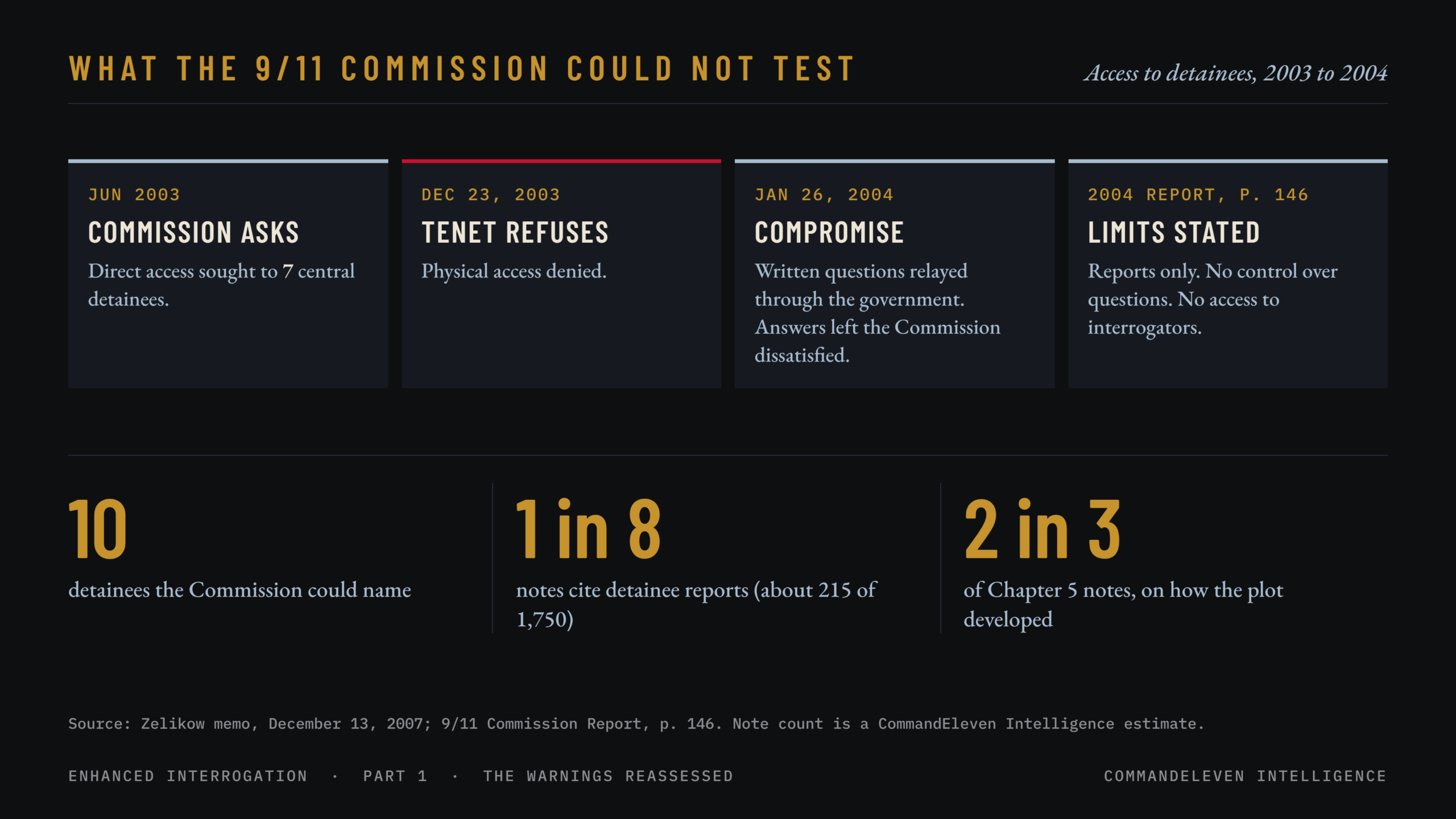
- CONFIRMED. The 9/11 Commission itself said it could not test the detainee reports it relied on. Its report states that its access was limited to intelligence reports, that it could not control what interrogators asked, and that it was not allowed to talk to the interrogators who could have helped it judge credibility (9/11 Commission Report, p. 146). Only ten detainees could be named, and Chapter 5, note 2 lists them: Khalid Sheikh Mohammed, Abu Zubaydah, Hambali, al-Nashiri, Khallad bin Attash, Ramzi bin al-Shibh, Mohamed al-Kahtani, Ahmad al-Ani, Ali al-Ghamdi (Abu Bakr al-Azdi) and Hassan Ghul.
- CONFIRMED. The Commission’s staff tried to get around that limit and failed. A December 2007 memo from its executive director, Philip Zelikow, to the two chairmen records that the Commission asked for direct access to seven central detainees, that CIA Director Tenet refused physical access in December 2003, and that the Commission settled for written follow-up questions relayed through the government (Zelikow memo, pp. 5 to 6). The memo adds that the Commission was dissatisfied with the answers it got, and that no official told it about reported recordings of the interrogations.
- ASSESSED. The 9/11 record leans heavily on detainees. By our rough count of the notes in the Commission’s report, about one note in eight cites interrogation reports or detainees (about 215 of roughly 1,750), but the reliance is concentrated: roughly two-thirds of the notes in Chapter 5, the chapter on how the plot developed, and close to half of those in Chapter 7. Readers will sometimes see a figure of “more than a quarter” for the whole report; it does not hold up in our count.
Why the Witnesses Matter
Every account of the program was written by someone with something to protect or to prove.
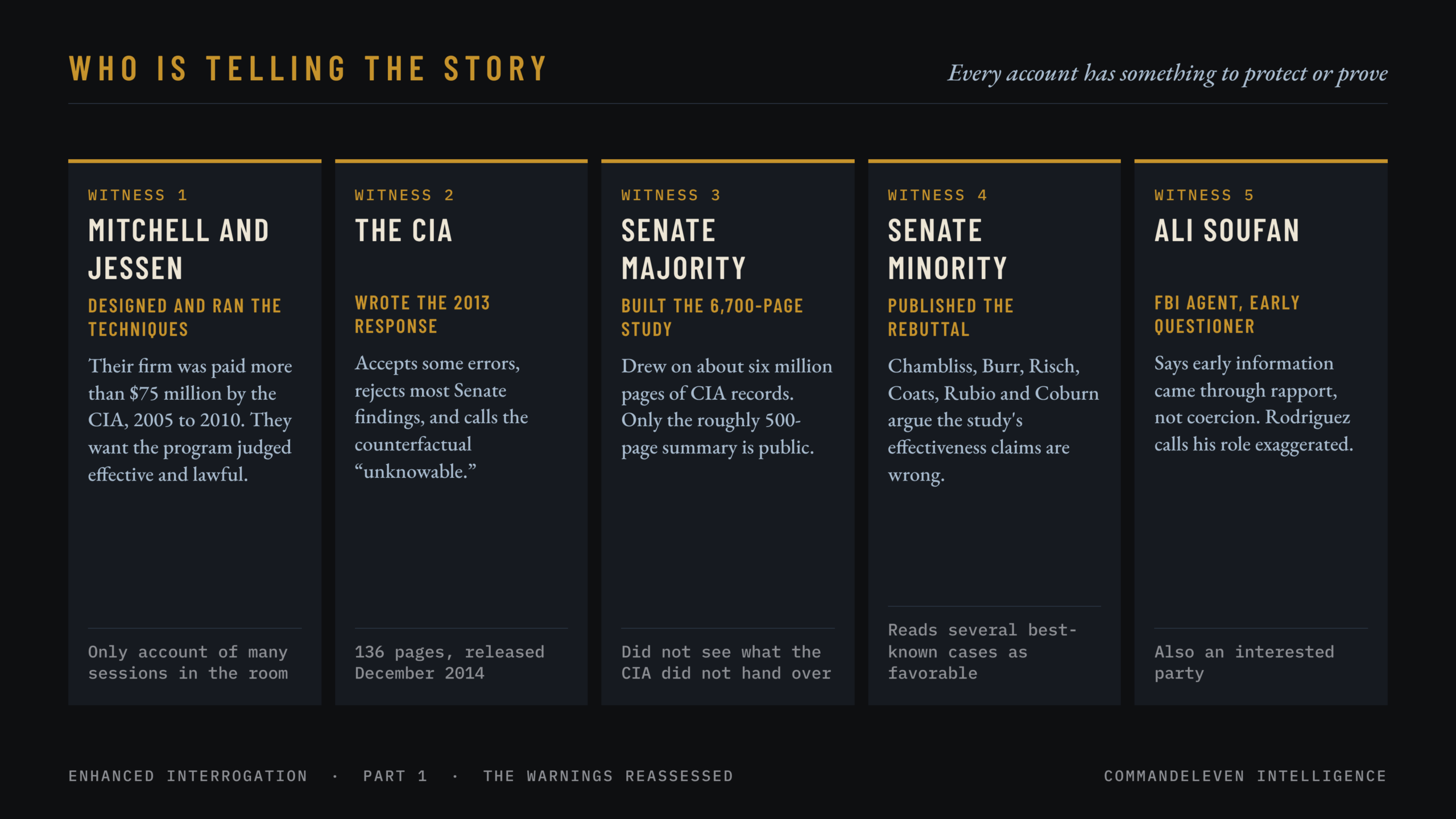
Mitchell and Jessen designed and ran the techniques and later formed a company that sold their services to the CIA. They have an interest in the program being judged effective and in their conduct being judged lawful. Their account is also the only one that records what happened in the room during many sessions. The book is useful for the second reason and must be read with the first in mind. The book’s co-writer, Bill Harlow, appears in the Senate report’s notes as the CIA’s director of public affairs in April 2002 (Executive Summary, p. 24, footnote). We note that as provenance, not as a charge.
The CIA wrote a 136-page response in June 2013, released in December 2014. It accepts some errors, rejects most of the Senate’s findings, and states plainly that it is “unknowable” whether other methods could have produced the same information (CIA Response, Conclusion 9, p. 23). That is a notable concession, and it appears in the CIA’s own words.
The Senate Intelligence Committee majority built a 6,700-page study from about six million pages of CIA records (Executive Summary, p. 225, footnote). Only the roughly 500-page summary and the findings are public. The full study remains classified, and the Senate itself says it did not see intelligence the CIA did not hand over, which limits what it can say about outside sources.
The Senate minority (Vice Chairman Chambliss, joined by Senators Burr, Risch, Coats, Rubio and Coburn) published a rebuttal arguing that the study’s central claims about effectiveness are wrong. It reads the record as favorable to the program on several of the best-known cases.
FBI agent Ali Soufan was among the first to question Abu Zubaydah and has said the key early information came through rapport-building, not coercion. Rodriguez calls his role exaggerated (Hard Measures, p. 175); Mitchell says it was a team effort (Enhanced Interrogation, p. 37). Soufan too is an interested party.
None of these sources is useless. The point is to find where they agree and to treat the places where they disagree as open questions.
What Detainees Are, as Witnesses
Even setting the program’s critics and defenders aside, a detainee is a hard witness. The book describes men who stalled to give colleagues time to move, answered only what they were asked, and hid inside true but vague statements (Part 3 will take this up). The Senate record and the CIA’s own cables describe the same behavior: KSM, for example, withheld threat information about Karachi until he saw capture photographs of two associates (Executive Summary, pp. 245 to 246). A detainee who is managing his interrogators produces statements that are partly true, partly strategic and partly invented. The CIA’s response and the Senate minority both stress that detainees who were not subjected to coercion also gave false information; the Senate majority finds that coerced detainees did as well. On that narrow point the two sides are closer than their rhetoric suggests: false statements came from all kinds of detainees.
How This Series Handles Evidence
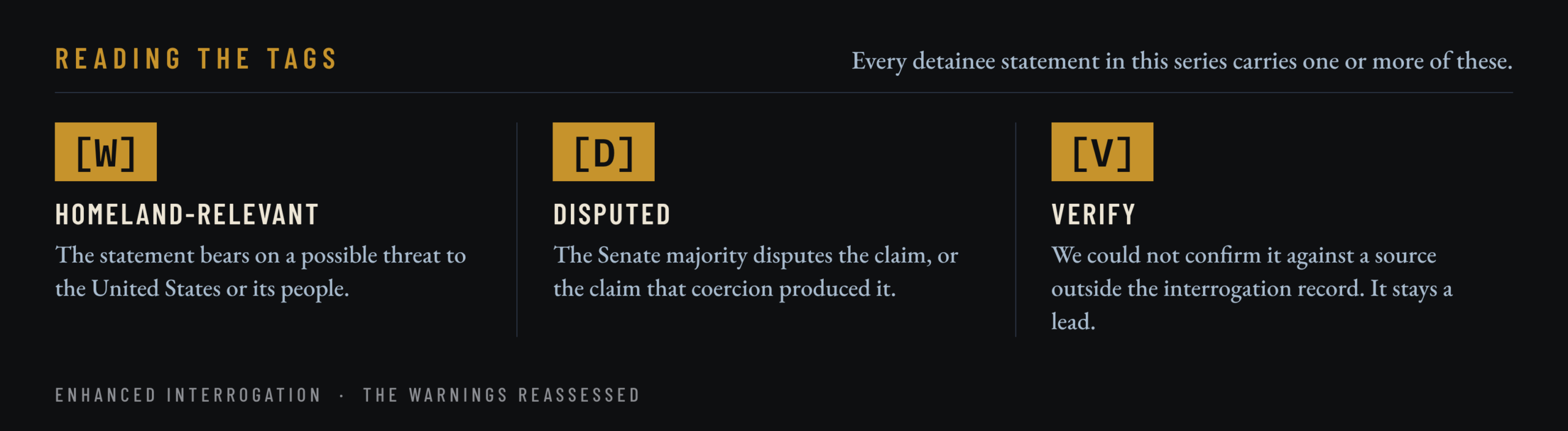
Each detainee statement in Parts 2 to 7 carries one or more tags.
- [W] The statement bears on a threat to the homeland.
- [D] The Senate majority disputes it, or the claim that it was produced by coercion.
- [V] We could not verify it against a source outside the interrogation record.
A statement that is [V] stays a lead. We quote only a few words and paraphrase the rest. Every claim that a warning was missed needs a source outside the book. When we describe what a detainee said about doctrine, we are reporting what KSM or Abu Zubaydah said about their own movement, not describing Muslims in general.
What We Do Not Know
- The recordings. The Zelikow memo says press reports in December 2007 described hundreds of hours of recorded interrogations of Abu Zubaydah and al-Nashiri, reportedly destroyed in November 2005. Whether they existed in full, and what they showed, is not public.
- The full Senate study. Only the summary and findings are released. The 6,700-page record behind them, including the detainee-by-detainee review, is not.
- Mitchell’s sessions. For many conversations in the book, we have no second record to compare against.
- The scale of wrongful detention. The CIA and the Senate differ and neither gives a full list.
- Which detainee statements the Commission weighted most. It said it corroborated where it could, but its notes do not say how much was independently confirmed.
What to Watch
- KSM’s trial. A military judge set the start of the trial on the merits for June 5, 2028, after a 2024 plea deal was revoked and an appeals court upheld the revocation (reported August 2026). Testimony and evidence rulings will show how much of the interrogation record survives scrutiny in a courtroom.
- Release of the full Senate study. Reporting as late as 2024 described it as still secret.
- Any new declassification on the interrogation recordings, the contractors’ contract or the 2013 CIA response.
Calls We Will Score
- The full Senate Intelligence Committee study of the CIA detention and interrogation program (about 6,700 pages) will not be publicly released in full by January 31, 2027.
- The military-commission trial of Khalid Sheikh Mohammed will not begin before December 31, 2027.
What This Assessment Does and Does Not Establish
It establishes that the main sources on detainee statements are interested parties, that the 9/11 Commission lacked access to test the reports it used, and that the two sides disagree on the contractors’ experience and Abu Zubaydah’s role in ways the record has not settled.
It does not establish that the techniques worked or failed, that any particular detainee statement was true or false, or that the program’s critics or defenders are right overall. Those questions are taken up case by case in Parts 2 to 7.
Frequently Asked Questions
Why use a book by the program’s designer at all?
Because he is the only source who reports what detainees said in the room across many sessions. We use it for what detainees reportedly said, and we hold every claim to the tags above.
Does this series say the program worked or did not work?
No. It maps what detainees said about threats, then checks what the record shows happened. Part 6 covers the dispute over effectiveness directly.
Is the Senate report neutral?
It is a majority report approved by the committee, with a published minority rebuttal and a CIA response. All three are cited here, and where they conflict we say so.
Why does the Commission’s note about access matter now?
Because the 9/11 narrative that most people treat as settled depends in part on detainee reports the Commission itself could not test. That is not a reason to discard them. It is a reason to ask what else supports each one.
Related Reading
- Enhanced Interrogation: What the Captured Said, and What Became of the Warnings
- Enhanced Interrogation, Part 2: Plots Named in Custody
- The Warnings Reassessed
- Al Qaeda Aviation Threat: What the FBI-DHS-TSA Warning Means for US Air Travel
Sources
- Senate Select Committee on Intelligence, Committee Study of the Central Intelligence Agency’s Detention and Interrogation Program: Executive Summary, approved December 13, 2012, declassification revisions December 3, 2014 (pages cited as printed, “Page N of 499”).
- Senate Select Committee on Intelligence, Minority Views of Vice Chairman Chambliss joined by Senators Burr, Risch, Coats, Rubio and Coburn (Senate Report 113-288; page numbers refer to the supplied PDF).
- Central Intelligence Agency, CIA Comments on the Senate Select Committee on Intelligence Report on the Rendition, Detention, and Interrogation Program, June 27, 2013 (released December 8, 2014).
- National Commission on Terrorist Attacks Upon the United States, The 9/11 Commission Report (2004), p. 146 and Chapter 5, note 2.
- Philip Zelikow, “Interrogations and Recordings: Relevant 9/11 Commission Requests and CIA Responses”, memorandum to Thomas Kean and Lee Hamilton, December 13, 2007.
- James E. Mitchell with Bill Harlow, Enhanced Interrogation (Crown Forum, 2016).
- Jose A. Rodriguez Jr., Hard Measures (Threshold Editions, 2012).
- Ali H. Soufan, The Black Banners (W. W. Norton, 2011).
- ABC13, “Alleged 9/11 mastermind’s long-awaited trial scheduled for 2028”, August 26, 2026.
- The Intercept, “More than 10 years later, the Senate torture report is still secret”, June 27, 2024.