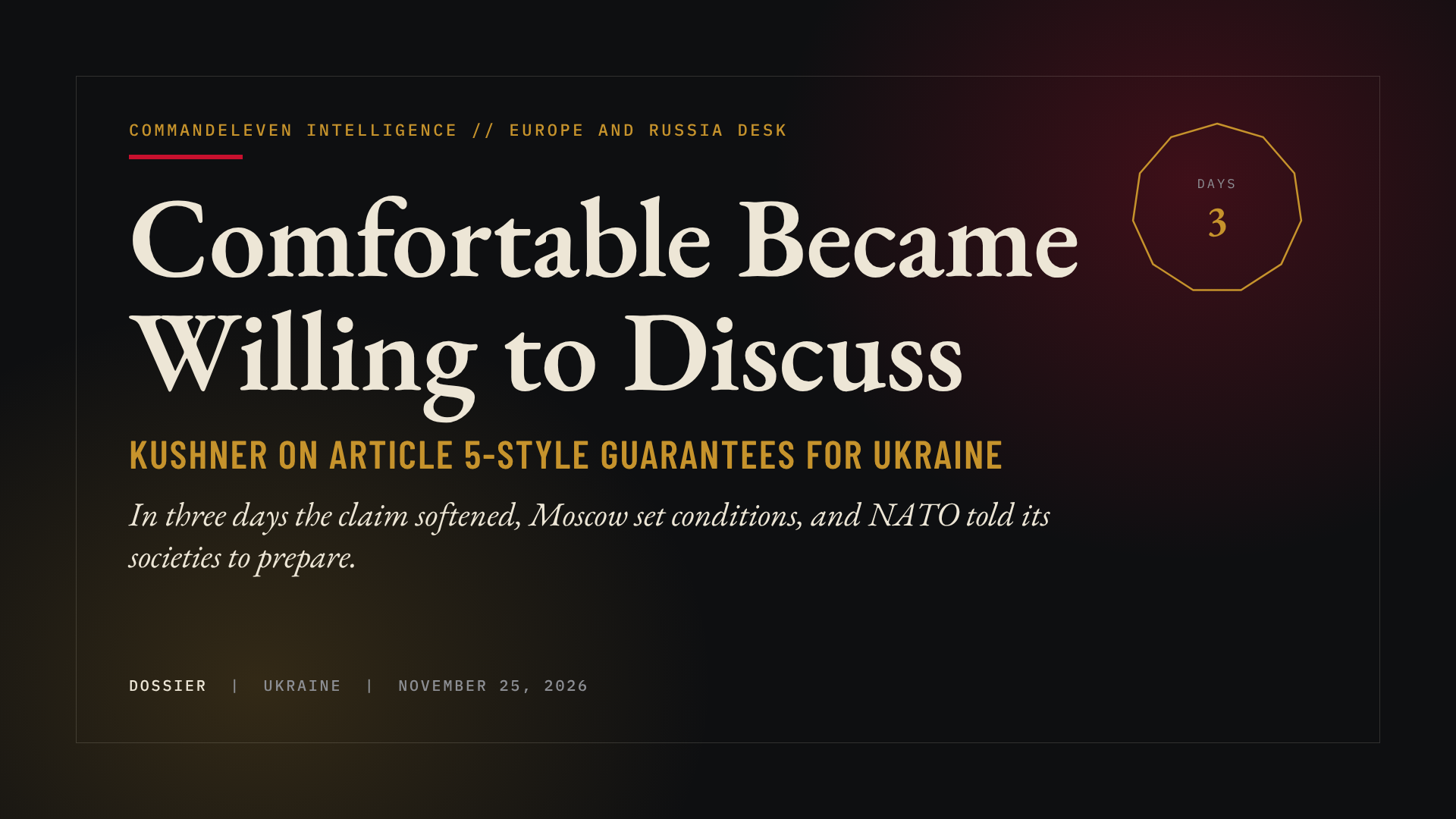
CommandEleven Intelligence Desk // Europe and Russia Desk, status as of November 25, 2026. This assessment rests on Kushner’s own published words, Russian and Ukrainian official statements, and press accounts of NATO’s Nov. 23 Berlin speech; we did not review that speech’s full text.
Bottom Line Up Front
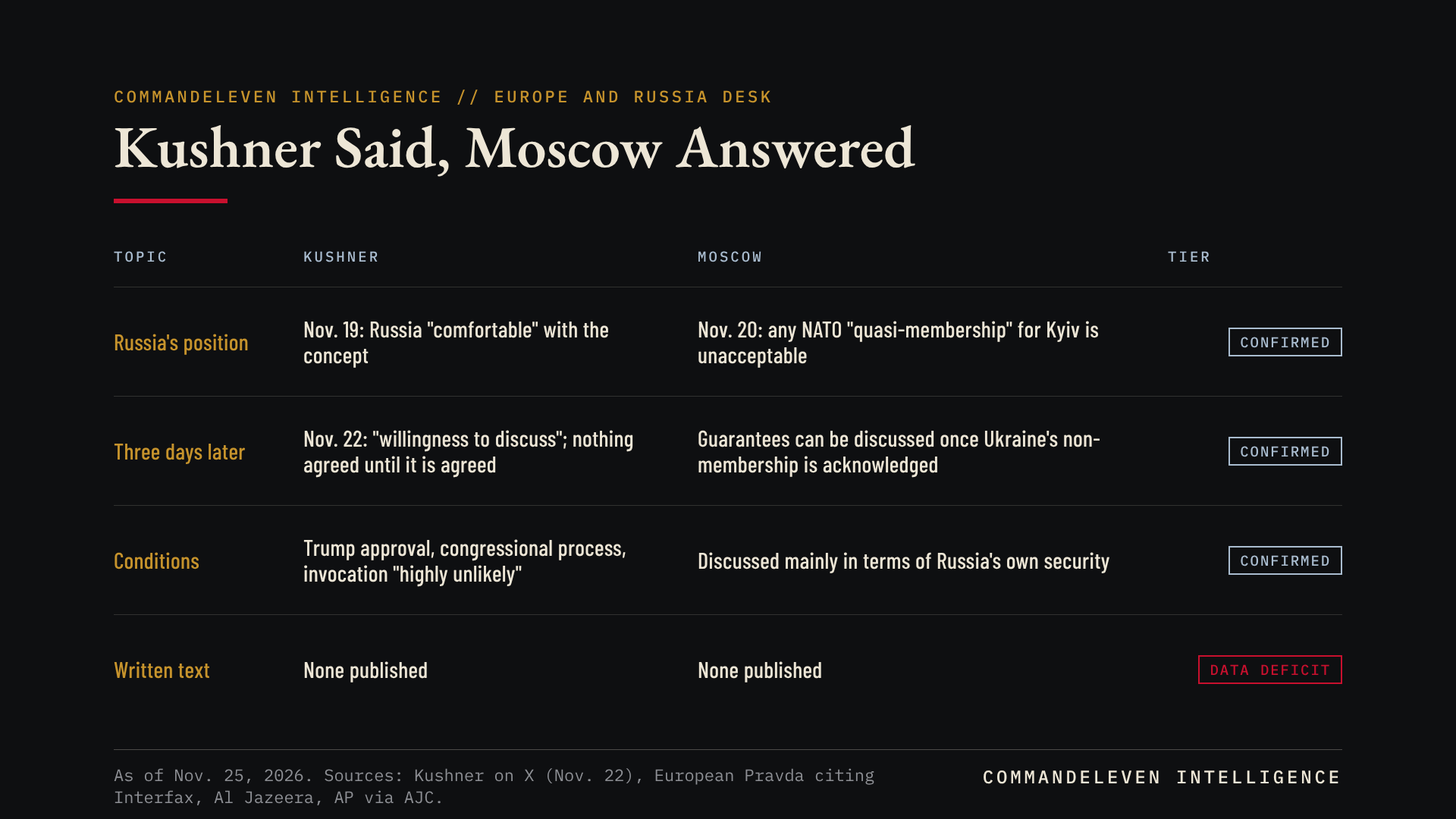
In Berlin on Nov. 19, U.S. envoy Jared Kushner said Washington had gotten Russia “comfortable” with the concept that any security guarantee for Ukraine would be based on Article 5. Three days later, in a long post on X, he used softer language: Russia’s “willingness to discuss” such guarantees, with “nothing agreed until it is agreed” [CONFIRMED, from his own words]. Russia’s Deputy Foreign Minister Sergei Ryabkov rejected any NATO “quasi-membership” for Kyiv on Nov. 20 but said guarantees could be discussed once Ukraine’s non-membership is acknowledged [CONFIRMED, per Interfax via European Pravda].
On Nov. 23, NATO Secretary General Mark Rutte told the alliance’s parliamentarians in Berlin to prepare whole societies for a possible war with Russia [CONFIRMED]. The timing, four days after the Shenzhen summit, invites a causal reading that the record does not support. No guarantee text, trigger or force commitment has been published [DATA DEFICIT].
Key Judgments
- CONFIRMED: Kushner’s claim shifted in wording between Nov. 19 and Nov. 22. In Berlin it was that Russia is comfortable with the concept. On X it was that Russia’s willingness to discuss guarantees is a major step forward and a potential sign it is serious about peace. The second is a much lower bar than the first.
- CONFIRMED: Kushner’s Nov. 22 post attaches conditions. Any guarantee would need Trump’s approval, subject to constitutional and congressional processes. Trump would take the step only if he believed it clearly served U.S. interests and the wider security arrangements made it highly unlikely the guarantee would ever be invoked. Guarantees cannot be finalized in isolation from postwar European security architecture, and the two must be considered together.
- CONFIRMED: Ryabkov called even the search for a formula of NATO “quasi-membership” for Kyiv an unacceptable option, said Russia discusses guarantees mainly in terms of its own security, and said that once Ukraine’s non-membership is acknowledged, guarantees can be discussed. He said Moscow is not closing itself off from dialogue, just not dialogue on accession. Russia’s position is therefore conditional, not a flat refusal.
- CONFIRMED: Zelenskyy said on Nov. 19 and 21 that he is not sure partners share one understanding of “Article 5-style,” asked whether it means partner forces on Ukrainian soil, and asked what it means for American soldiers. Kyiv’s stated position remains that NATO membership is the clearest guarantee.
- ASSESSED: “Article 5-style” is a political label, not a legal term. Article 5 itself leaves each ally to decide what action it deems necessary, and invocation is not automatic. A pledge modeled on it does not by definition mean a guaranteed military response, and the Kushner post’s condition that invocation be “highly unlikely” points to deterrence by architecture rather than by commitment.
- ASSESSED: The link Kushner draws between guarantees and a revised European security framework is the part to watch. Some European officials read it as sounding like Putin’s agenda. Chatham House’s Grégoire Roos warned in Politico of a “Trojan Horse” in which a vague guarantee comes with Ukrainian territorial concessions and limits on NATO’s eastern posture. That is one analyst’s concern, not a finding.
- CONFIRMED: On Nov. 23 Rutte told the NATO Parliamentary Assembly in Berlin that preparing for war is a task for civilians, businesses and public bodies as well as armies, and that Russia’s war machine will keep running after the Ukraine war ends. The reporting we reviewed says this is not an announcement of imminent war.
- ASSESSED: NATO’s war-planning push predates Shenzhen by weeks: the new SACEUR war plan was presented on Oct. 12, and the Wall Street Journal reported a revised defense plan on Nov. 4. The Berlin speech is best read as the next step in that push, landing in a week when Washington’s Russia policy had just become harder for Europeans to read. We find no evidence that Shenzhen caused it, and the timing alone cannot show that.
What Kushner Said in Berlin
After the Coalition of the Willing meeting on Nov. 19, Kushner said he thought the U.S. had gotten the Russians comfortable with the concept that any Ukraine guarantee would be based on Article 5, that Trump was open to it but it had to be in America’s interest, and that it would be part of a broader security package. Al Jazeera notes he did not specify how it would work [CONFIRMED]. The meeting followed the Shenzhen summit of Trump, Xi and Putin by hours.
What Kushner Wrote on X
The Nov. 22 post [CONFIRMED, primary text] calls Trump’s willingness to consider Article 5-like guarantees a critical feature of lasting peace and Russia’s willingness to discuss them a major step forward. It says a credible guarantee, backed by deterrence and deconfliction arrangements, could dramatically reduce the risk of another war, and that Zelenskyy is right that guarantees must be specific, credible and clearly documented. Kushner says he and Steve Witkoff are doing that work.
The post then widens the scope: permanent channels for consultation, crisis communication and military deconfliction, greater transparency and reciprocal measures; a Ukrainian prosperity plan; and talks “over the coming weeks” with Ukraine, European partners and Russia on this architecture. It closes with the line that nothing is agreed until it is agreed.
What Moscow Answered
Ryabkov spoke on Nov. 20, according to Interfax as relayed by European Pravda. He rejected any form of NATO “quasi-membership” for Kyiv, and said guarantees can be discussed once Ukraine’s non-NATO status is acknowledged. Putin, after Shenzhen, said Ukraine has a right to security, as Russia does, that Russia’s security is not being discussed, and that Ukraine’s NATO membership and the alliance’s guarantees would be unacceptable [CONFIRMED, per Al Jazeera]. Politico notes that Putin himself has not publicly rejected Kushner’s plan [REPORTED]. Reading these together, Moscow has not accepted what Kushner described, and has not closed the door to a differently built arrangement.
The European Position
Politico reports cautious optimism among European officials but wariness about the price and a lack of detail. A Macron aide said that if the U.S. gives Article 5-type guarantees it effectively means NATO membership [REPORTED, anonymous]. A joint European statement after Berlin described a possible framework with a U.S.-led ceasefire monitoring mechanism, a European-led multinational force and legally binding commitments to take measures to restore peace if Russia attacks again, according to Kyiv Post [REPORTED]. Politico expects the next U.S.-convened round, with Europeans at the table, in Abu Dhabi after Nov. 26, and notes a Jan. 3 date when a new Congress starts work.
NATO Tells Its Societies to Prepare: What Was Said
Rutte spoke on Monday, Nov. 23, at the 72nd annual session of the NATO Parliamentary Assembly in Berlin, according to Fox News. Per Fox and Ukrainian outlet UkrMedia, his main points were these [CONFIRMED, per press accounts; we did not review the full speech text]:
- Defending NATO requires civilian preparedness. Armed forces, citizens, businesses, police, medical and fire services and local government all have a role. He held up Norway, Sweden, Denmark and Finland as models for telling citizens what to do if war breaks out.
- Russia’s war machine is running at full speed. Its economy is oriented to military needs, and its cooperation with China, Iran and North Korea means the threat does not end with the war in Ukraine.
- He named sabotage, cyberattacks, undersea cable damage, airspace violations and attacks on transport infrastructure as particular threats, and said defense industry output must rise faster. UkrMedia reports NATO forecasts about four million artillery shells a year from its manufacturers by 2027, nearly double 2025.
- He cautioned against a separate European command structure alongside national militaries within NATO, saying competing structures could delay decisions in a crisis, and pointed to the single integrated U.S. military as a model.
- He argued that all allies are on the eastern flank, since Russian missiles reach Western European capitals only slightly later than eastern ones.
The speech came as Polish prosecutors said three Russian Kh-101 cruise missiles landed on Polish territory during strikes on Ukraine, and Polish Deputy Defense Minister Paweł Zalewski said NATO would deploy an AWACS aircraft to Poland, per Fox [REPORTED, Polish officials]. The same day, Rutte appeared with Chancellor Friedrich Merz in Berlin, where reporting says he was asked about a German media report that Russia may launch a nuclear-armed satellite before the end of 2026. He said NATO continuously assesses its deterrence across land, sea, air and space [REPORTED; we could not open the original report, and the claim is UNVERIFIED].
UkrMedia notes that the call to prepare does not mean NATO has announced an imminent war with Russia. Rutte’s own line on Sept. 30 was that there is no imminent threat to NATO territory, and nothing we found shows that NATO has since changed that assessment.
The Timing: Shenzhen, Berlin and NATO
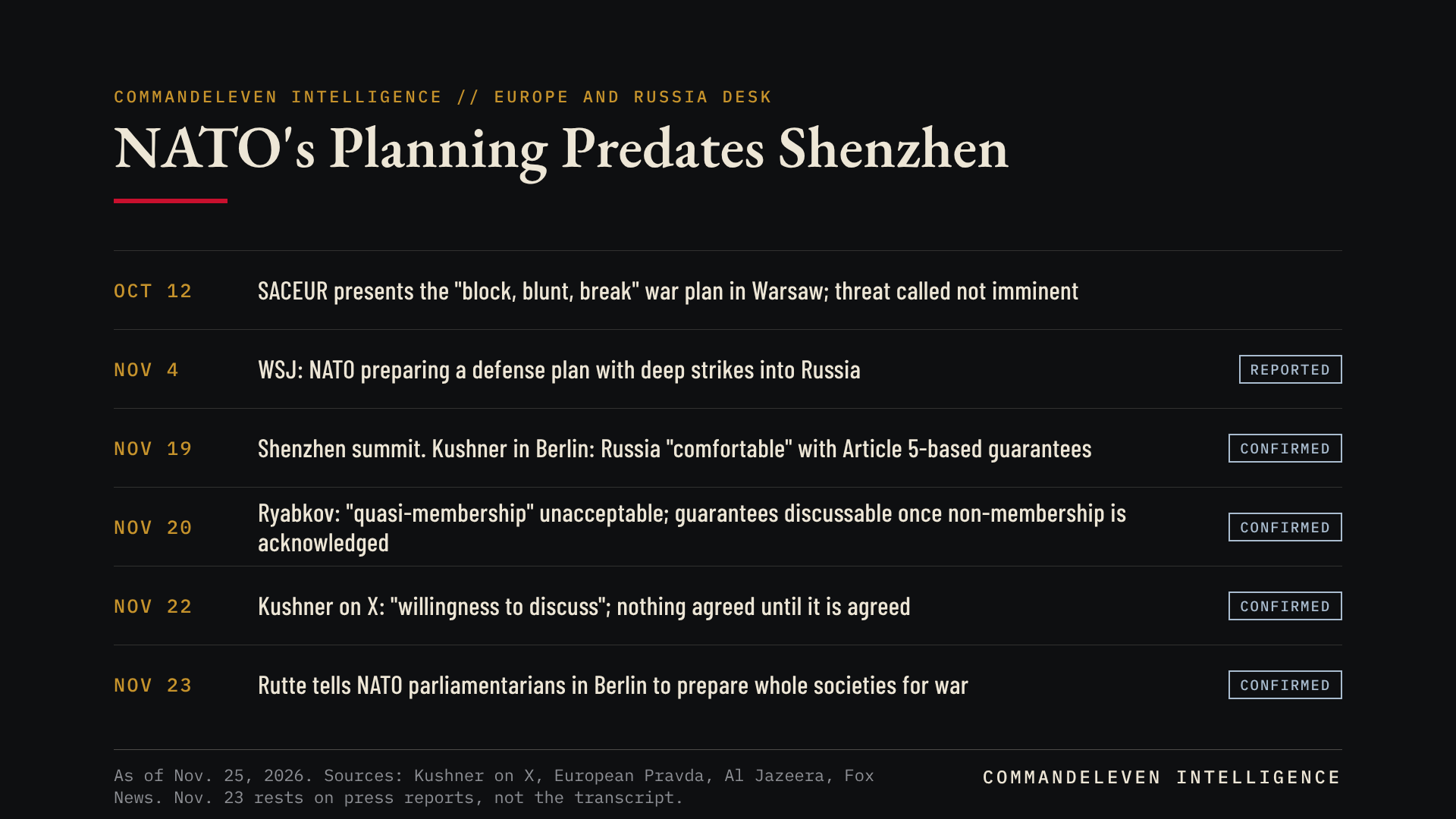
The sequence is documented. On Nov. 19, Trump, Xi and Putin met in Shenzhen and issued a joint declaration. Trump greeted Putin on camera as “my friend,” per Reuters. Hours later European leaders met in Berlin and rejected a peace decided over their heads. Polish Prime Minister Donald Tusk said Putin is not a friend. Trump, speaking from Air Force One, told the Berlin meeting that Putin wants peace and criticized the €70 billion in new European aid for Kyiv, per Protothema and, citing British press reports, Ara. On Nov. 23, four days after Shenzhen, Rutte gave the Berlin speech above.
The sequence is clear: a Russia-China-U.S. summit, then a rapid NATO push on war preparedness. Our assessment of cause is narrower, and we rate it ASSESSED, moderate confidence:
- The warnings are not new. Rutte said in December 2025 that Russia could be ready to use force against NATO within five years. SACEUR Gen. Alexus Grynkewich unveiled a new war plan, “block, blunt, break,” in Warsaw on Oct. 12, with Al Jazeera reporting he called the threat not imminent. The Wall Street Journal reported on Nov. 4 that NATO is preparing a new defense plan with deep strikes into Russia, and United24 reported on Nov. 10 on the alliance’s biggest planning shift in decades.
- What changed is the American signal. A U.S. president calling Putin a friend, questioning European aid, and discussing guarantees for Ukraine with an envoy while the Europeans hold their own summit gives Europeans a reason to move preparedness to the front of the agenda, and to say so publicly. This is our reading of motive and is not stated by any source we reviewed.
- The Kushner track and the Rutte track point in opposite directions. One is about a possible U.S. commitment to Ukraine and a wider security arrangement. The other is about preparing Europe for a war the U.S. may not fight alongside it. Both can be true at once: Washington explores guarantees while NATO plans as if guarantees will not come.
- Russia will use it either way. Moscow’s line that NATO is the aggressor is served by speeches about preparing for war, and Putin has said that Europeans expecting a Russian attack are preparing hostilities against Russia, per Al Jazeera. We do not endorse that framing. It is the reaction to expect.
We do not find evidence that the Shenzhen declaration triggered NATO’s posture, that NATO coordinated its Berlin message with anyone, or that the speech reflects new intelligence. Any of those would need sourcing we do not have.
What To Watch
- Any written guarantee text, or a statement of its trigger and force level.
- Whether Russian officials keep tying guarantees to Ukraine’s formal non-membership.
- The next U.S.-convened round with Europeans, expected in Abu Dhabi after Nov. 26.
- Any change in NATO’s “no imminent threat” language from the Secretary General or SACEUR.
Calls We Will Score
- By Thursday, December 31, 2026: No written Article 5-style guarantee text is published by the U.S., Ukraine or Russia. ASSESSED.
- By Sunday, January 31, 2027: No senior Russian official publicly accepts a U.S.-backed Article 5-style guarantee for Ukraine without conditioning it on a formal NATO non-membership commitment. ASSESSED.
- By Thursday, December 31, 2026: A U.S.-convened round of talks with Russian, Ukrainian and European negotiators takes place. ASSESSED.
- By Wednesday, March 31, 2027: The administration does not submit a Ukraine security commitment to Congress for approval. ASSESSED.
- By Sunday, January 31, 2027: NATO does not publicly raise its assessment from no imminent threat to NATO territory to an imminent one. ASSESSED.
What This Assessment Does and Does Not Establish
It establishes what Kushner, Ryabkov, Putin, Zelenskyy and Rutte each said and how the U.S. wording moved over three days. It does not establish that Russia has agreed to any guarantee, or the legal form, trigger or force level of any guarantee, or whether Congress would ratify or fund one. It does not establish what Kushner means by a revised European security framework, which he has not specified. It does not establish that NATO’s Nov. 23 message was a response to Shenzhen. The Rutte account rests on press reports of the speech, not the transcript.
Frequently Asked Questions
Did Russia agree to Article 5-style guarantees for Ukraine?
No public record shows that. Kushner said Russia was comfortable with the concept, then described only a willingness to discuss. Ryabkov said guarantees can be discussed once Ukraine’s non-membership is acknowledged.
Is “Article 5-style” the same as NATO membership?
No. It is a political label with no published legal text. Article 5 itself leaves each ally to choose its response.
Is NATO preparing for imminent war with Russia?
Rutte called for societies to prepare, but the reporting we reviewed says this is not an announcement of imminent war, and his Sept. 30 line was that no imminent threat exists.
Did the Shenzhen summit cause NATO’s Berlin message?
Not on the evidence we have. NATO’s war planning predates the summit, and the sequence alone does not show cause.
Related CommandEleven Intelligence Reading
- Shenzhen: What the Trump-Xi-Putin Declaration Says, and What It Does Not, the summit that preceded Berlin
- RAND’s 2030 War Scenario: A Russian Move on Estonia and the UK’s Readiness Gaps, the preparedness question behind Rutte’s message
Sources
- Jared Kushner on X, Nov. 22, 2026 (primary text)
- European Pravda, US envoy Kushner explains when Trump would approve Article 5-style security guarantees for Ukraine
- European Pravda, Russia calls US ideas for NATO-style security guarantees for Ukraine unacceptable
- Al Jazeera, Kushner says Russia OK with NATO-like security pact for Ukraine: Is it?
- Politico Europe, Europeans dare to believe Trump could deliver security for Ukraine
- Kyiv Post, Russia Rejects NATO-Style Security Guarantees for Ukraine
- Kyiv24, Kushner: Trump will consider guarantees for Ukraine based on NATO Article 5
- Associated Press via AJC, Kushner says Russia is comfortable with NATO-like security guarantees
- Fox News, NATO warns Putin could strike before European army responds
- UkrMedia, Rutte called on NATO countries to prepare for war with Russia
- The Statesman, Russia plans nuclear weapon deployment in space by 2026-end, German media report
- Reuters via TimesLIVE, Ukraine’s allies warn against Yalta-style carve-up
- Political.org, Ukraine’s European allies wary as Trump calls Putin friend at Shenzhen summit
- Protothema, Who will write the terms of peace? Trump wants to cut off aid to Ukraine
- Ara, Europe reaffirms support for Zelensky while Trump questions the cost of aid to Kyiv
- Al Jazeera, Block, blunt, break: What’s in NATO’s new Russia war plan?
- European Pravda, NATO prepares new defence plan foreseeing strikes deep inside Russian territory (citing WSJ)
- NATO, Remarks by the Secretary General at the Euronews Defence and Space Summit (Sept. 30, 2026)
- NATO, Keynote speech by Secretary General Mark Rutte, Berlin (Dec. 11, 2025)