CommandEleven Intelligence Desk // Geopolitics Desk, status as of November 24, 2026
Bottom Line Up Front
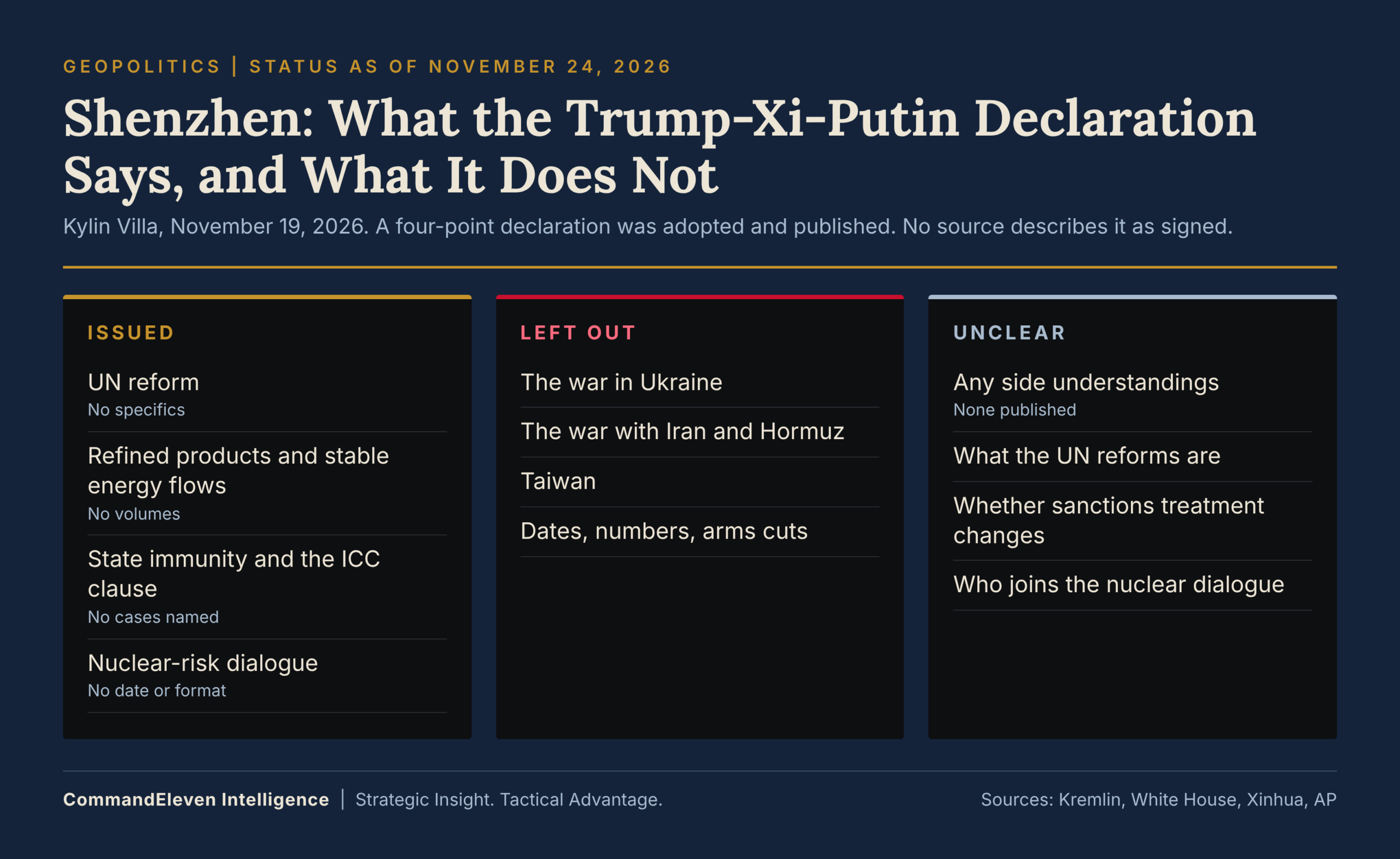
On November 19, 2026, the presidents of the United States, China and Russia met together for the first time, at Kylin Villa in Shenzhen on the sidelines of the APEC summit. At the end of the meeting a four-point “Heads of State Declaration toward Peace” was adopted and published. The Kremlin says it was adopted. The White House and Xinhua publish its text. None of the three describes it as signed, and it has no signature block. It contains no dated commitments, does not mention Ukraine, Iran or Taiwan, and sets no timeline for the nuclear-risk dialogue it announces. We assess it as a statement of shared positions, with the International Criminal Court clause the only point where all three governments already had a direct interest in common. The real tests come in the follow-through: whether the nuclear dialogue meets, whether refined-product supply changes, and whether the Strait of Hormuz reopens.
Key Judgments
- CONFIRMED. The three leaders met on November 19, 2026, at Kylin Villa in Shenzhen, and a declaration was adopted at the end of the meeting. The Kremlin, the White House and Xinhua each publish it.
- CONFIRMED. The text has four operative points: United Nations reform, increased supply of refined petroleum products and stable energy flows, state consent and immunities with an ICC clause, and a nuclear-risk statement with a dialogue.
- CONFIRMED. The declaration does not mention the war in Ukraine or the war with Iran. AP reports this, and the published text bears it out. Taiwan is also not addressed, per AP.
- CONFIRMED. The published text gives no date, venue, format or participants for the nuclear-risk dialogue, and does not specify what the UN reforms are.
- ASSESSED. The ICC clause is the substantive center of the document. Putin is the subject of an ICC arrest warrant, and the U.S. administration opposes the warrant against former Israeli Prime Minister Benjamin Netanyahu. Three governments with different grievances found one point of agreement.
- ASSESSED. Beijing’s role as host and drafter shaped the document: broad language, no named conflicts, no numbers. The summit’s main gain was the meeting itself, which Moscow and Beijing can use as evidence of standing.
- REPORTED. Dawn reports that Xi urged Trump to “do the right thing” on Taiwan. This is not in the AP account, the Kremlin transcript or the declaration, and we have no primary source for it. We hold it at REPORTED.
What Was Issued
The leaders met on Thursday, November 19, 2026. The Kremlin lists the start time as 11:30 in Shenzhen. AP says the talks lasted over an hour; Dawn puts it at about 80 minutes. The Kremlin lists who sat in the room. On the Russian side were Foreign Minister Sergei Lavrov, Finance Minister Anton Siluanov, Maxim Oreshkin, Yury Ushakov and Defence Minister Andrei Belousov. On the American side were Secretary of State and National Security Adviser Marco Rubio, Treasury Secretary Scott Bessent, Commerce Secretary Howard Lutnick, Chief of Staff Stephen Miller and Ambassador David Perdue. Xi’s delegation included Cai Qi and Wang Yi.
The declaration, in the order the White House and Xinhua publish it:
| # | Point | What the text says | What it leaves open |
|---|---|---|---|
| 1 | United Nations reform | As permanent members of the Security Council, the three commit to reforming the UN so it can respond more effectively to global challenges | Which reforms, by when, and who decides |
| 2 | Energy | The three plan to increase production and supply of refined petroleum products and reaffirm the importance of stable energy flows | Volumes, timing, sanctions treatment, and whether “supply” includes Russian and Iranian product |
| 3 | State consent and the ICC | State consent and immunities for state officials are of paramount importance; the ICC and similar bodies “must not abuse their jurisdiction” | Which cases, and what the three would do about them |
| 4 | Nuclear risk | A nuclear war “cannot be won and must never be fought”; the three will hold a dialogue on reducing nuclear risks and preventing proliferation | Date, venue, format, agenda, and whether it covers arsenals or only risk |
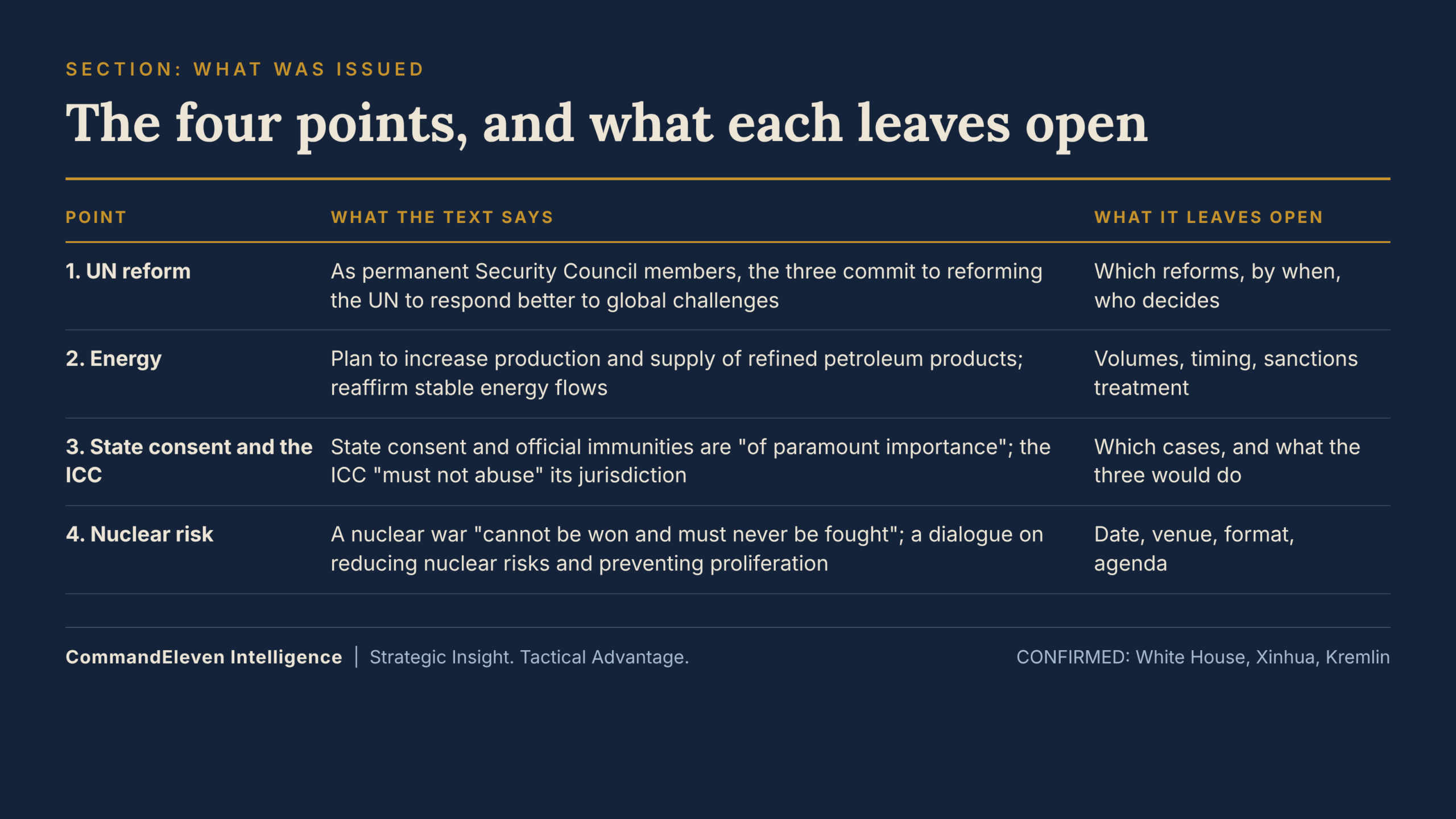
How to describe it. The Kremlin says the declaration “was adopted” at the end of the meeting. AP calls it a “peace declaration” released after the meeting. The White House page is titled “Declaration” and has no signature block. No source we have read says it was signed, and none calls it a joint statement. We describe it as a declaration adopted and published after the meeting.
Expected Versus Confirmed
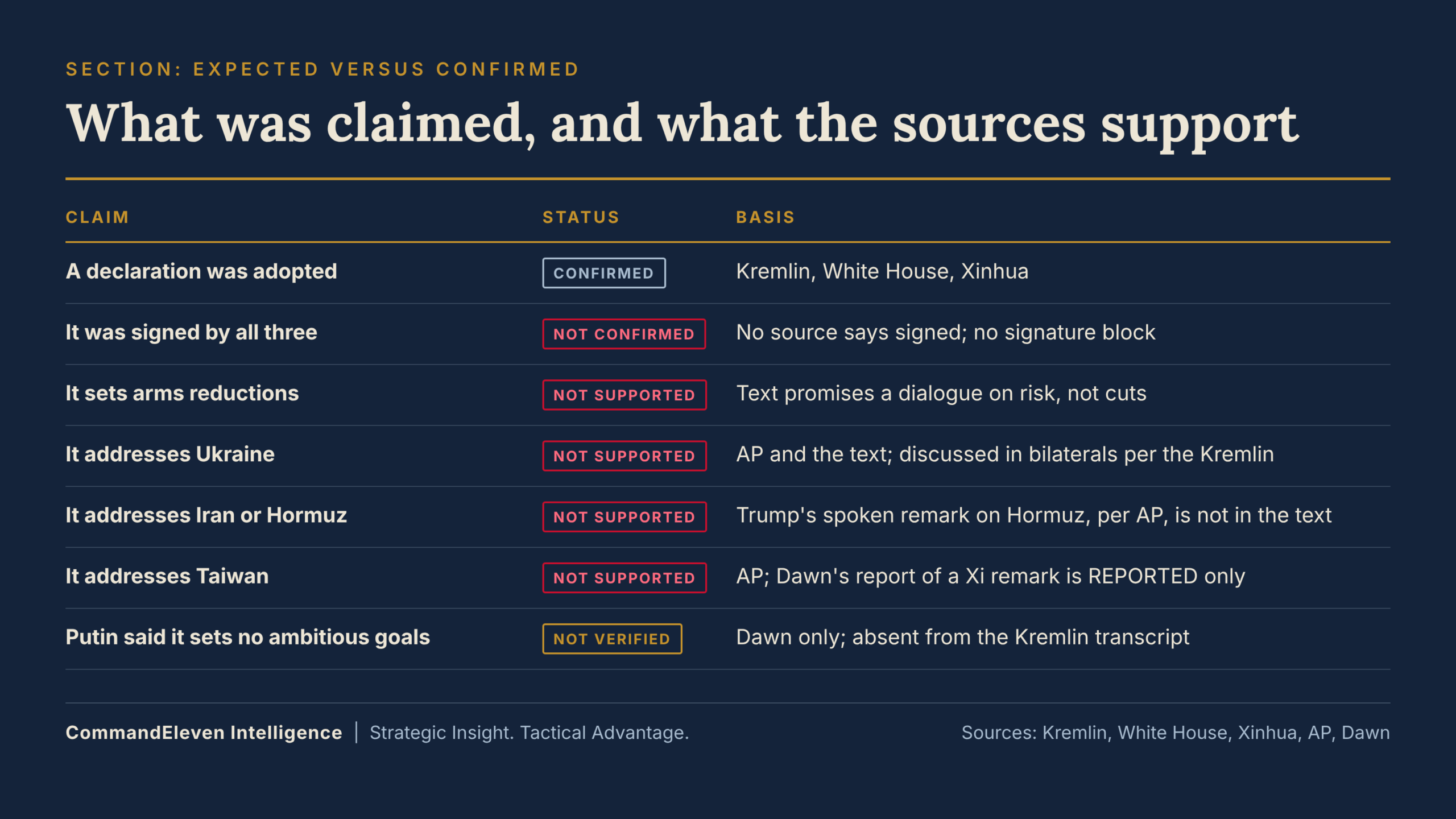
Before the meeting, the White House set low expectations, according to AP. Several claims circulated in the days after, mostly through Telegram compilations and social media. The table sorts them.
| Claim | Status | Basis |
|---|---|---|
| A declaration was adopted | CONFIRMED | Kremlin, White House, Xinhua |
| It was signed by all three | NOT CONFIRMED | No source says signed; no signature block |
| It sets arms reductions | NOT SUPPORTED | Text promises a dialogue on “reducing nuclear risks,” not cuts |
| It addresses Ukraine | NOT SUPPORTED | AP and the published text; Ukraine was discussed in bilaterals, per the Kremlin |
| It addresses Iran or Hormuz | NOT SUPPORTED in the text | Trump told reporters he and Xi agree Iran must reopen Hormuz, per AP, but this is a spoken statement, not part of the declaration |
| It addresses Taiwan | NOT SUPPORTED in the text | AP; Dawn’s report of a Xi remark to Trump is REPORTED only |
| Putin admitted the declaration sets no ambitious goals | NOT VERIFIED | Attributed to Putin by Dawn; absent from the Kremlin transcript |
What Each Leader Said
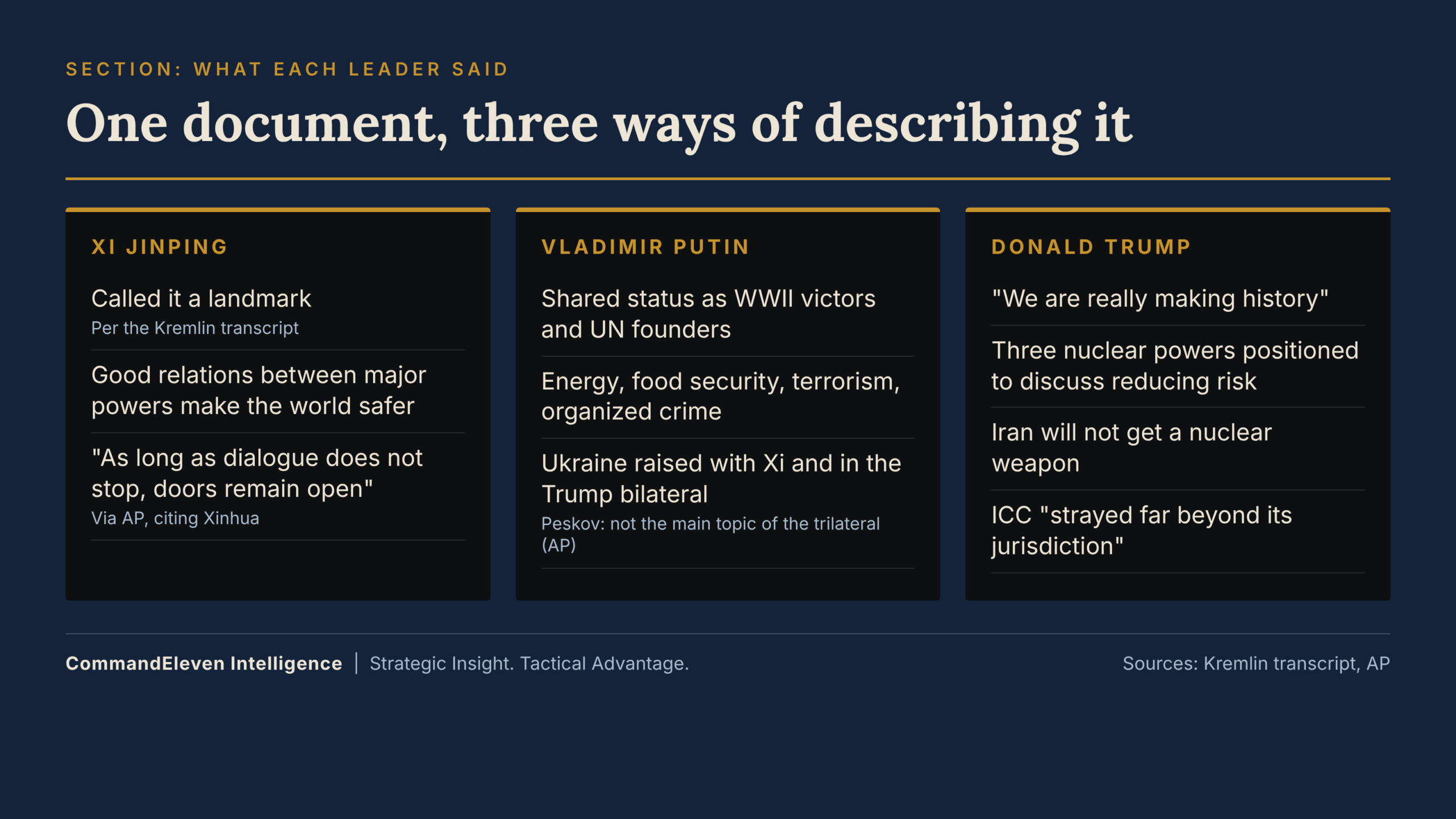
Xi Jinping opened by calling it a landmark and framing the topic as world peace and strategic stability among major powers. He said “good relations between major powers make the world a safer place.” Per Xinhua, he told the others that “as long as dialogue does not stop, doors remain open” (via AP).
Vladimir Putin stressed the three countries’ shared status as World War II victors and UN founders. He listed energy and food security, regional conflicts including Ukraine, and the fight against terrorism and transnational organized crime as common interests. He said Ukraine was raised with Xi the day before and, at Trump’s initiative, in his bilateral with Trump. Kremlin spokesman Dmitry Peskov said it was not the main topic of the trilateral, per AP.
Donald Trump called the meeting “history,” said the three are “uniquely positioned” to discuss reducing nuclear weapons and the risk of use, said the U.S. will not let Iran have a nuclear weapon, and said he would suggest ways to protect national sovereignty from the ICC, which he called “rogue globalist” and said had “strayed far beyond its jurisdiction.” Trump spoke by phone to a Berlin meeting of Ukraine’s supporters afterward, according to AP, citing envoy Steve Witkoff.
The statements show the three describing the same document in three different ways. Xi emphasized stability, Putin emphasized status and shared responsibility, and Trump emphasized nuclear risk and the ICC.
The ICC Clause: Where All Three Already Agreed
The third point is the clearest convergence. Putin is wanted by the ICC over alleged war crimes in Ukraine. The U.S. government opposes the court’s warrant against former Israeli Prime Minister Benjamin Netanyahu, per AP. Trump named the ICC in his remarks. For China, state immunity and non-interference are standing positions.
The text says state consent and immunities for officials are “of paramount importance” and that courts “must not abuse their jurisdiction.” It does not name any case, does not say what the three would do, and does not commit any of them to a specific act. ASSESSED: the clause is a statement of position, designed to be quoted in future arguments over arrest warrants and travel by officials. Its practical test will be the next country that has to decide whether to execute an ICC warrant against a visiting leader.
Energy, the Strait of Hormuz and the Missing Link
Point two commits the three to raise supply of refined petroleum products and “stable energy flows.” It does not mention the Strait of Hormuz or the Gulf. Outside the declaration, AP reports that Trump said he and Xi agree Iran must fully reopen the strait and that Iran cannot get a nuclear weapon, and notes there were no signs of agreement from Xi or Putin to help end the Iran conflict. That is a spoken claim by one participant, so REPORTED.
Why this matters: refined products and stable flows are exactly what the Hormuz disruption has hit. Our next dossier, on Hormuz, takes up the shipping data and what the declaration does and does not change.
Nuclear Risk: A Dialogue Without a Date
The fourth point repeats the formula that “a nuclear war cannot be won and must never be fought,” first used by the five nuclear-weapon states in January 2022. It adds a dialogue on reducing nuclear risks and preventing proliferation. The published texts give no date, place, format or agenda.
Context AP adds, labeled as reporting: just before the summit Russia sent two nuclear-capable Tu-95 bombers to Vietnam, and Russian TV showed an officer carrying the briefcase with the nuclear codes as Putin arrived. We do not draw conclusions from either. Both are signaling of the kind that often accompanies summits.
ASSESSED: without a date or a format, the dialogue is a placeholder. It becomes real when a delegation list, an agenda or a first round is announced.
Why the Document Is Broad
AP quotes Ruby Osman of the Tony Blair Institute for Global Change saying Beijing’s priority was steering the meeting away from specifics and being seen as “the adult in the room.” Dawn quotes Jonathan Eyal of the Royal United Services Institute saying Putin gained credibility and an escape from pariah status and Trump gained a photo opportunity. Dawn also reports Senate Democratic leader Chuck Schumer’s remark that Xi and Putin were playing Trump “like a cheap violin.” These are opinions by named people, REPORTED as such, not findings.
Our reading: a document that three governments with open disputes can all adopt has to be short on specifics. The value to each is separate. Beijing shows it can convene the other two. Moscow shows it is not isolated and is treated as an equal. Washington shows it will talk to both. The text itself changes little. The standing the meeting conferred is the real output.
What We Do Not Know
- Whether any side text, annex or classified understanding exists. The published declaration is all we have seen.
- What was said about Ukraine in the bilaterals beyond Putin’s general statement and Witkoff’s account that Trump spoke to both leaders about ending the war.
- Whether the nuclear-risk dialogue will include the other nuclear-armed states.
- Whether the refined-products language affects sanctions treatment.
What To Watch
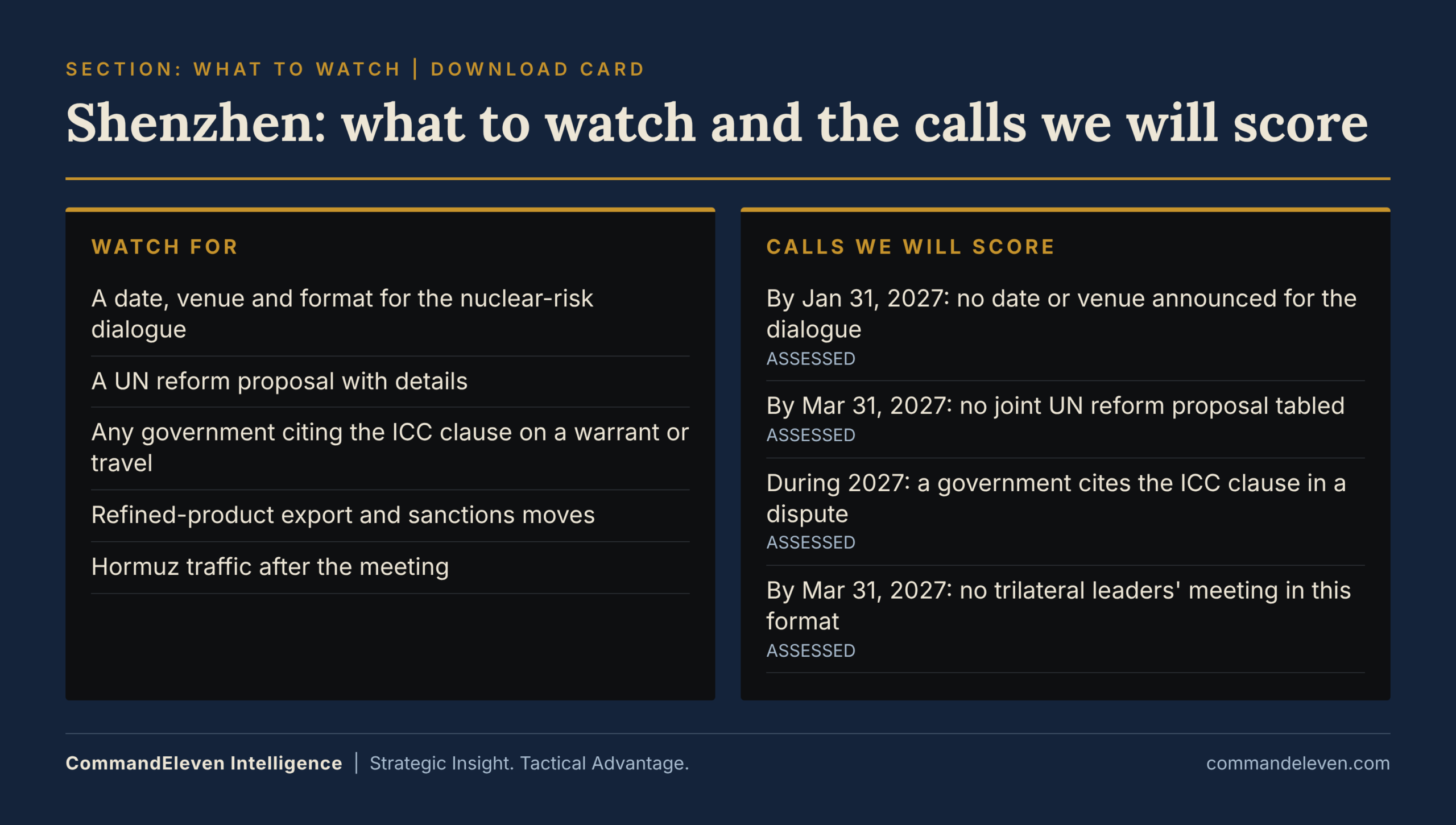
- An announcement of the date, venue and format of the nuclear-risk dialogue.
- Any Security Council reform proposal tabled by one of the three, with details.
- Whether any government cites the ICC clause when deciding on arrest warrants or leader travel.
- Refined-product export and sanctions moves by Russia, the U.S. and China.
- Whether Hormuz traffic changes after the meeting. See our Hormuz dossier.
- Whether the Ukraine security-guarantee talks (Kushner and Witkoff in Berlin, per AP) move after the summit.
Calls We Will Score
- By January 31, 2027: none of the three governments announces a date or venue for the nuclear-risk dialogue. ASSESSED.
- By March 31, 2027: no joint UN reform proposal is tabled by the three. ASSESSED.
- During 2027: at least one of the three governments publicly cites the declaration’s ICC clause in a dispute over a warrant or an official’s travel. ASSESSED.
- By March 31, 2027: no trilateral leaders’ meeting is held in the same format. ASSESSED.
What This Assessment Does and Does Not Establish
It establishes that a four-point declaration was adopted on November 19, 2026, what the published text says, what it leaves out, and how each government describes it.
It does not establish what was agreed privately, whether any commitment will be kept, or why any leader chose particular wording. The quotes from analysts and politicians are their views, not ours. We are not treating the speculative “spheres of influence” map circulating on social media as evidence of anything.
Frequently Asked Questions
Was anything signed?
No source we have read says so. The Kremlin says the declaration was adopted. The White House and Xinhua publish it as a declaration, and there is no signature block.
Was there a joint statement?
The declaration is the only text. There is no separate joint communiqué among the sources we have read.
Does it say anything about Ukraine or Iran?
No. AP reports the text makes no mention of either war. Both were discussed in meetings and in spoken remarks.
Did the three agree to cut nuclear weapons?
No. They agreed to hold a dialogue on reducing nuclear risks and preventing proliferation, with no date.
Why does the ICC clause matter?
Because it is the one point where all three governments have a direct interest, and because it can be cited later.
Related CommandEleven Intelligence Reading
- The Hormuz dossier (next)
- The Warnings Reassessed, the hub for our current run
- Our U.S.-Iran war coverage
- How CommandEleven Intelligence Thinks, the method behind every label in this dossier
Sources
- White House: U.S.-Russia-China Heads of State Declaration toward Peace (November 19, 2026)
- Kremlin: Meeting with President of China and President of the United States (November 19, 2026)
- People’s Daily/Xinhua: China-Russia-US declaration text (November 19, 2026)
- Chinese Ministry of Foreign Affairs: Trilateral meeting readout (November 19, 2026)
- Associated Press: Takeaways from the historic summit among Trump, Xi and Putin (updated November 20, 2026)
- Dawn: report on the Shenzhen meeting (November 2026)