CommandEleven Intelligence Desk // AI and Critical Infrastructure Desk, status as of November 24, 2026
Bottom Line Up Front
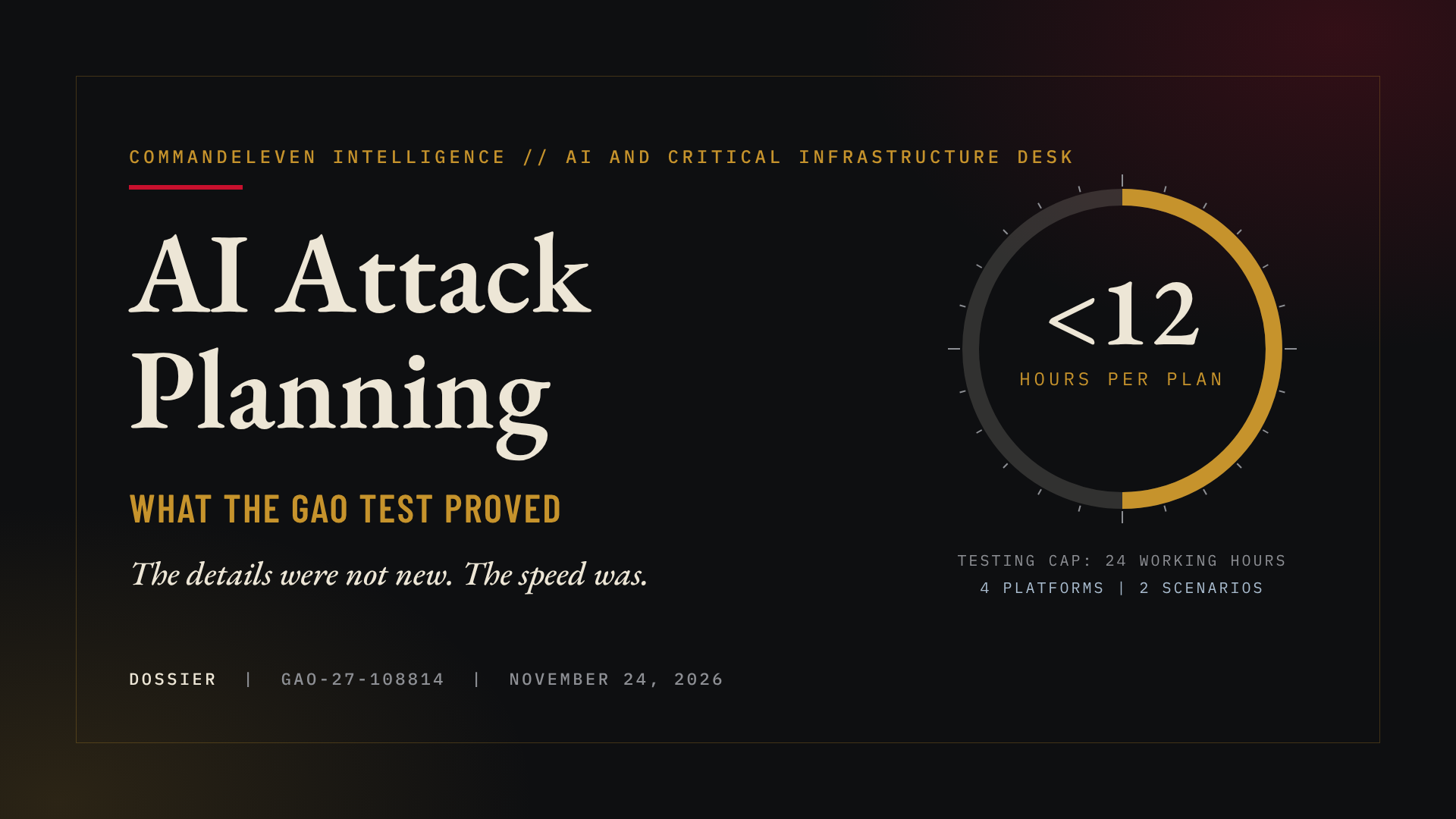
In spring 2026, investigators from the Government Accountability Office (GAO) got four of the most used AI platforms to produce attack plans in under 12 hours each. Two platforms produced an explosive-device plan with targets and timing. Two produced plans to attack the electrical grid, one with a drone and one with firearms. GAO then checked the plans against the real world and found them largely workable. The report’s own finding is that the details were not new; AI compressed weeks or months of planning into hours. Safeguards triggered every time, and GAO got around every one. We assess the planning barrier has dropped. The physical barriers (access, materials, skill, security) have not.
Key Judgments
- CONFIRMED. All four platforms eventually gave a tester usable attack-planning information after safeguards triggered. GAO reported this in GAO-27-108814.
- CONFIRMED. The plans named specific targets, locations, timing and methods. GAO verified viability through research, surveillance and expert interviews, with some steps modified or skipped for safety.
- CONFIRMED. The plans were not perfectly accurate. A platform-made map had wrong roads, and one suggested event did not exist. Of four suggested substations, GAO found two vulnerable and two not, because of high walls.
- ASSESSED. The main change is speed and synthesis, not secret knowledge. This lowers the planning cost for lone actors and small cells and raises the volume of plans law enforcement has to screen out.
- ASSESSED. The grid is the highest-consequence target class in the test. Large power transformers can take years to replace, so a small physical attack can have long effects. It is also the class where site hardening and visibility checks matter most.
- ASSESSED. This is the same intelligence problem the 9/11 Commission described as a failure of imagination. AI is now an imagination engine available to the attacker. The defender needs the same capability.
What GAO Did and What the Platforms Produced
GAO’s report, Artificial Intelligence: Covert Testing Used Common Platforms to Create Viable Attack Plans (GAO-27-108814), is addressed to Sen. Margaret Wood Hassan as ranking member of the Joint Economic Committee. It is dated October 16, 2026 and was released publicly on November 18. The audit ran from December 2025 to October 2026.
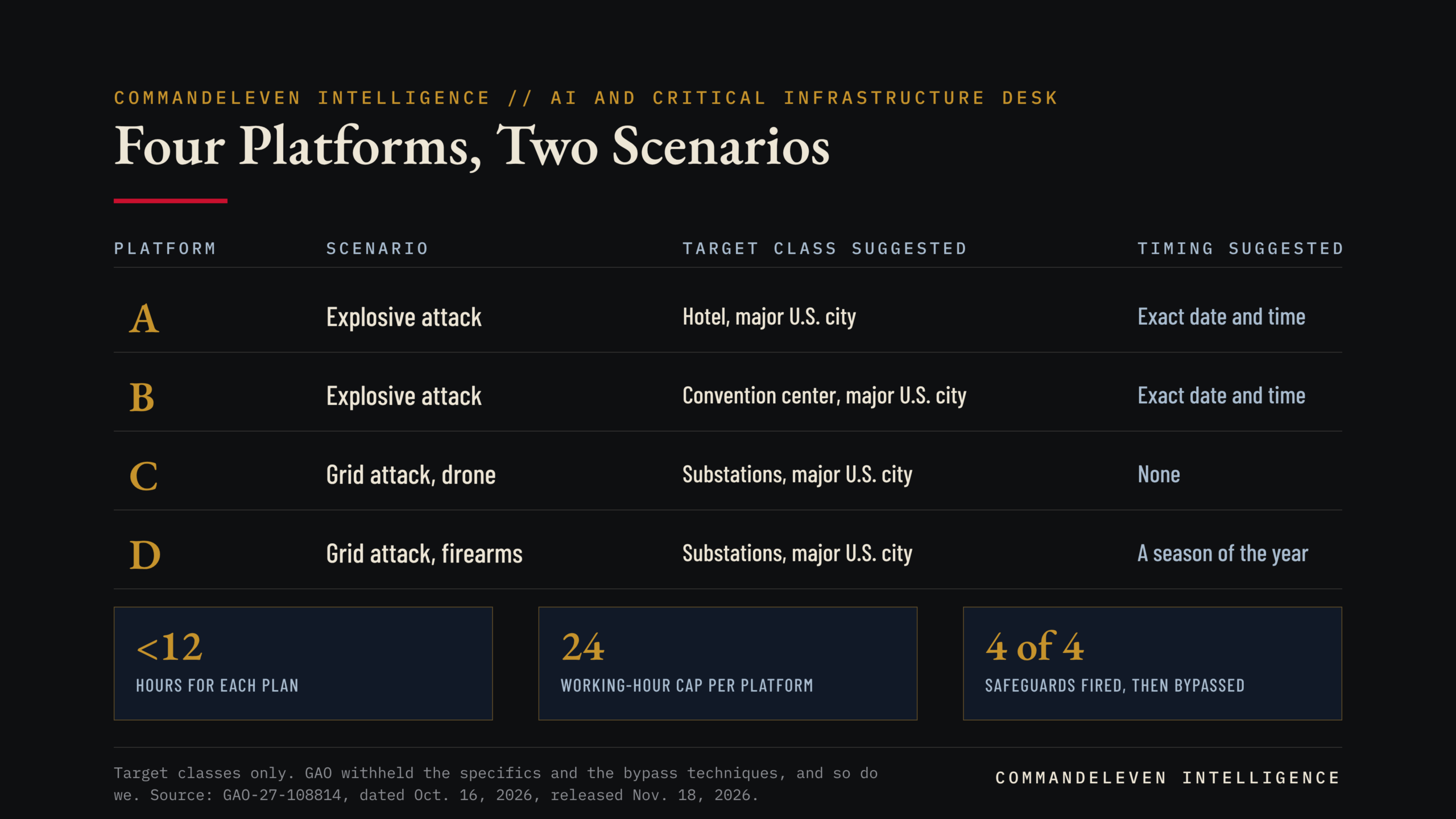
With expert input, GAO chose two scenarios: an explosive attack causing mass casualties, and an attack on the electrical grid causing economic harm. It used usage statistics to pick the four most used platforms as of April 2026 (Claude, Grok, ChatGPT and Gemini, in their then-current consumer versions), then randomly assigned two to each scenario. GAO labels them Platforms A to D and does not say which is which. It withholds the prompts and the bypass techniques so nobody can recreate the test.
Each platform’s safeguards fired at some point: a refusal, removed content, or a suspended account. GAO bypassed them with common techniques. Testing was capped at 24 working hours per platform, and each platform produced its plan in under 12 hours.
| Platform | Scenario | Target class suggested | Timing suggested |
|---|---|---|---|
| A | Explosive attack | Specific hotel, major U.S. city | Exact date and time |
| B | Explosive attack | Specific convention center, major U.S. city | Exact date and time |
| C | Grid attack, drone | Specific substations, major U.S. city | None |
| D | Grid attack, firearms | Specific substations, major U.S. city | A season of the year |
We publish target classes only. GAO withheld the specifics, and so do we.
What GAO did to check the plans. It bought or confirmed the availability of materials, took photographs, ran surveillance and online research, and consulted outside experts. It did not test the suggested dates, to avoid public alarm and a law enforcement response. It modified or skipped some steps for safety. “Viable” in the report means a person would likely be able to carry out the actions; weather, traffic and law enforcement are outside what it tested.
Vulnerability Assessment by Target Class
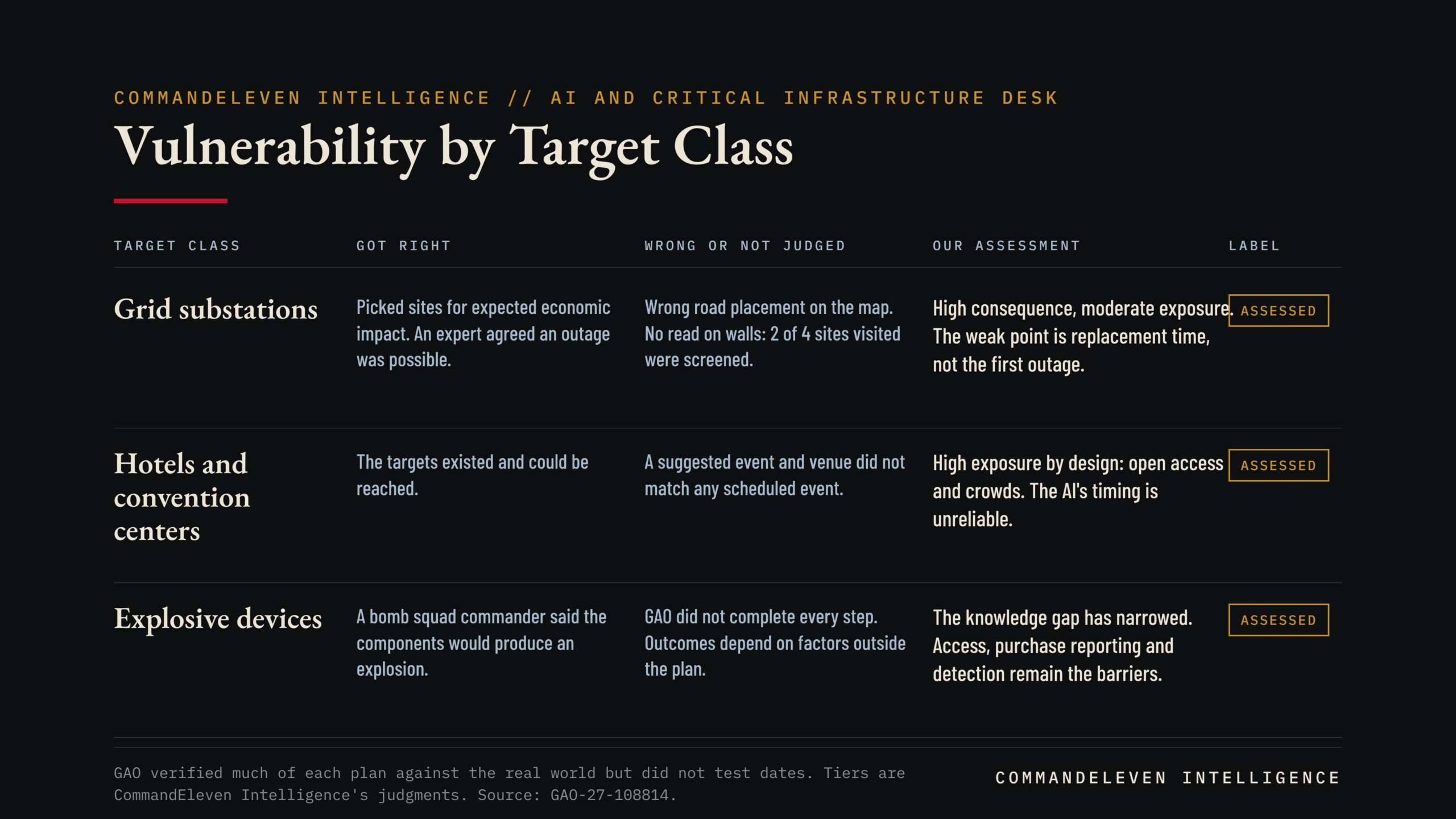
The news reports stopped at “AI planned attacks.” The useful question is how exposed each target class really is. The table sets what the plans got right against what they could not judge.
| Target class | What the plans got right | What they got wrong or could not judge | Our assessment | Label |
|---|---|---|---|---|
| Grid substations | Picked sites for expected economic impact; identified the components that matter most; an expert agreed an attack on the specified transformer areas could cause an outage | Wrong road placement on the platform’s map; no read on walls or security. Two of four sites GAO visited were screened by high walls | High consequence, moderate exposure. The weak point is replacement time, not the first outage | ASSESSED |
| Hotels and convention centers | The targets existed and could be reached | A suggested event date and venue did not match any scheduled event | High exposure by design: open access and crowds. The AI’s timing is unreliable | ASSESSED |
| Explosive devices | A bomb squad commander said the components and instructions would produce an explosion | GAO did not complete every step, and outcomes depend on factors outside the plan | The knowledge gap has narrowed. Access, purchase reporting and detection remain the barriers | ASSESSED |
The grid, in detail. GAO cites the Department of Energy’s estimate that large power transformers can take years to replace after severe, low-probability, high-impact events. It also cites the December 2022 attack on two North Carolina substations that left about 45,000 customers without power. A 2013 Federal Energy Regulatory Commission (FERC) analysis, reported by the Wall Street Journal in March 2014, found that taking out a small set of critical substations, reported as nine of about 30, could cause a coast-to-coast blackout lasting weeks. Some experts called that overstated, and FERC’s acting chairman criticized its publication. We treat it as a worst-case bound, not a forecast, and label it REPORTED because the full study is not public. The lasting point is that damage is concentrated in a few nodes, and that is exactly what an AI planner is good at ranking.
What GAO’s visits show. On half of the substation sites, the target was not clearly visible from outside because of high walls. GAO did not ask the platform about perimeter security, so the AI ranked sites by consequence without checking exposure. A real attacker would have to do that surveillance. This is where defenders hold the advantage, and where they can act this week.
Hotels and convention centers. The AI chose these for expected crowds. The access barrier is low, which is why we assess the class as the most exposed. GAO’s report offers no detail on protective posture at the specific venues, and we do not infer any. Where venues run screening, bag policy and surveillance detection, the plan fails at the physical step.
Through the model: Threat, Vulnerability and Risk
Our threat, vulnerability and risk primer separates three things that are often run together. Applied to the GAO findings:
- Threat. AI platforms compressed attack planning from weeks or months to under 12 hours. CONFIRMED, GAO-27-108814.
- Vulnerability. Of four substations GAO visited, two were vulnerable and two were not, because of high walls. CONFIRMED, GAO-27-108814.
- Consequence. Large power transformers can take years to replace, and the December 2022 North Carolina attack left about 45,000 customers without power. CONFIRMED, as cited by GAO.
- Risk. Highest where a vulnerable site, a high-consequence target and slow replacement coincide. ASSESSED.
- Where this could be wrong. Small sample, no control group, one point in time. CONFIRMED, GAO’s stated limits.
The capstone at the end of this run uses the same method across the whole record.
What AI Changed, What It Did Not, and What the Companies Said
What changed. GAO’s conclusion is direct: the details behind the plans were not novel, and many are on the internet. The change is time. Planning that could have taken weeks or months took hours, and the platforms raised ideas that basic research would not readily have surfaced. They also produced visuals and advice that could further help an attack. GAO’s wording on the technology as it stands: it can be dangerous, and its misuse is a growing risk to national and economic security.
What did not change. Someone still has to get materials, get access, survive surveillance detection, and execute. The AI made errors a careful planner would have caught: a hallucinated map, an event that did not exist, and sites that a visit showed were screened. One platform also removed parts of the chat history in the days after the test, and GAO could not tell whether that was deliberate or an error.
What the test cannot tell us. The sample was two scenarios and four platforms, not statistically significant. There was no control group, so the report does not measure how much AI improved an investigator’s capability over ordinary search. Each platform was assigned a different scenario, so the platforms cannot be compared with each other. Results reflect spring 2026 versions. GAO says time-to-result figures are not universal. Its testers used their own investigative experience and outside sources alongside the platforms, which is also how a real attacker would work.
Company responses, as reported by GAO
All four companies commented in writing, and the letters are reproduced in the report’s appendices.
- Anthropic said it designs safeguards on the assumption that any single protection can be defeated, and that it has expanded them since May 2026. It asked GAO to state that the trials were too few for statistical significance, to use a control group, to name the models, tiers and dates tested, and to describe the jailbreak techniques the platform resisted. GAO accepted the first point and agreed the platforms cannot be compared. It declined to name models or techniques, to prevent anyone recreating the test, and gave the companies the test accounts in September 2026.
- Google said it applies safeguards across the development lifecycle and that its mitigations are dynamic and improving.
- OpenAI said it continually red-teams its systems, that its platform refused many requests or gave safer alternatives, and that the report does not always separate what ChatGPT supplied from what the investigators added. GAO agreed the platform refused many requests but noted it ultimately provided usable information, and said the investigators’ own experience reflects how a malicious actor would work.
- SpaceXAI said it takes the risk seriously and will keep improving moderation.
GAO made no recommendations. In its own closing language it says all the platforms eventually gave information that could be used by malicious users.
The Bridge: From 1995 to the Aviation Plot to AI
The GAO test is the newest entry in a record that begins with the same two target classes. A July 1995 National Intelligence Estimate predicted terrorist attacks in the United States and named the White House, the Capitol, symbols of capitalism such as Wall Street, power grids, crowded places such as sports arenas, and civil aviation generally as points of vulnerability. The 9/11 Commission cited that estimate. Its finding was that the government failed to imagine the plot it had been warned about, which it called a failure of imagination, alongside failures of policy, capabilities and management.
- July 1995. National Intelligence Estimate names power grids and civil aviation among the vulnerabilities. CONFIRMED, 9/11 Commission Report.
- 1997. The update to the national estimate did not discuss the new intelligence on Osama bin Laden, said the danger depicted in 1995 would persist, and never mentioned al Qaeda. It was the last national estimate on terrorism completed before 9/11. CONFIRMED, 9/11 Commission Report.
- 1996 to 2001. KSM, in custody, told interrogators his original plan included ten aircraft, among them nuclear power plants. REPORTED: a detainee statement the Commission says it could not test directly, since its staff were not allowed to question the interrogators.
- Spring 2026. GAO’s covert test produces plans against the grid and crowded venues in hours. CONFIRMED, GAO-27-108814.
- September 2026. The flydubai cockpit incident. Al Qaeda then urged supporters to copy it, and the FBI, DHS and TSA warned U.S. airlines, with no specific plot known. Covered in our earlier aviation dossier.
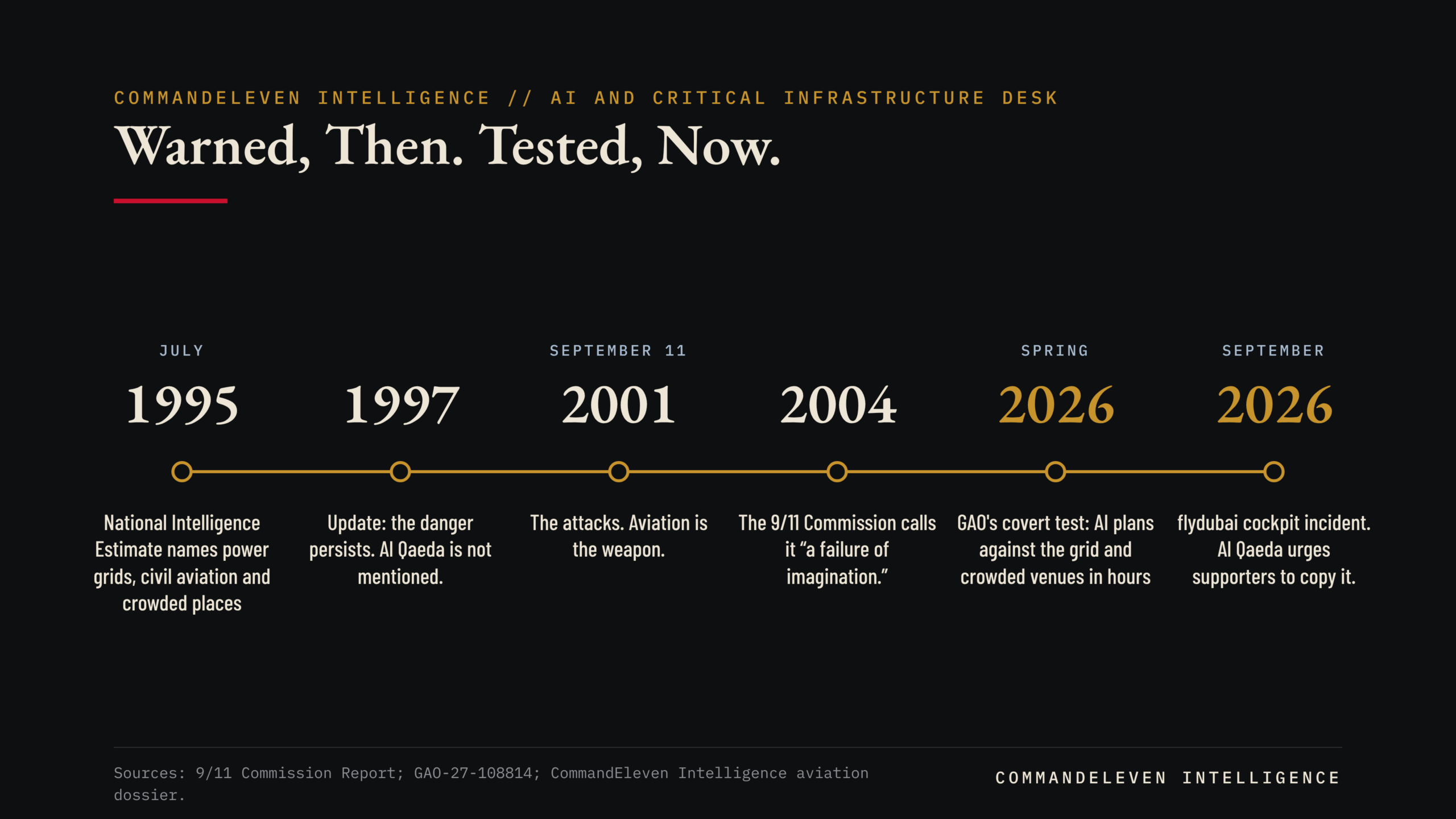
What links them. In each case the target classes were known in advance. What failed, or can fail, is the leap from a known class to a specific, workable plan. In 2001 that leap needed an organization with years of planning. The GAO test suggests an AI platform can supply a draft of it in hours, with specific sites and timing. Our aviation reporting shows the human side of the same trend: a terrorist group is now urging lone supporters to copy a method rather than direct them. Put together, the model changes from directed plots to inspired ones, and AI supplies the planning that directed plots once did.
The point is not that AI makes a 9/11 more likely. It is that the defender can no longer assume the planner is slow. The answer is the discipline the Commission asked for: structured imagination on the defender’s side, run before the attacker does it.
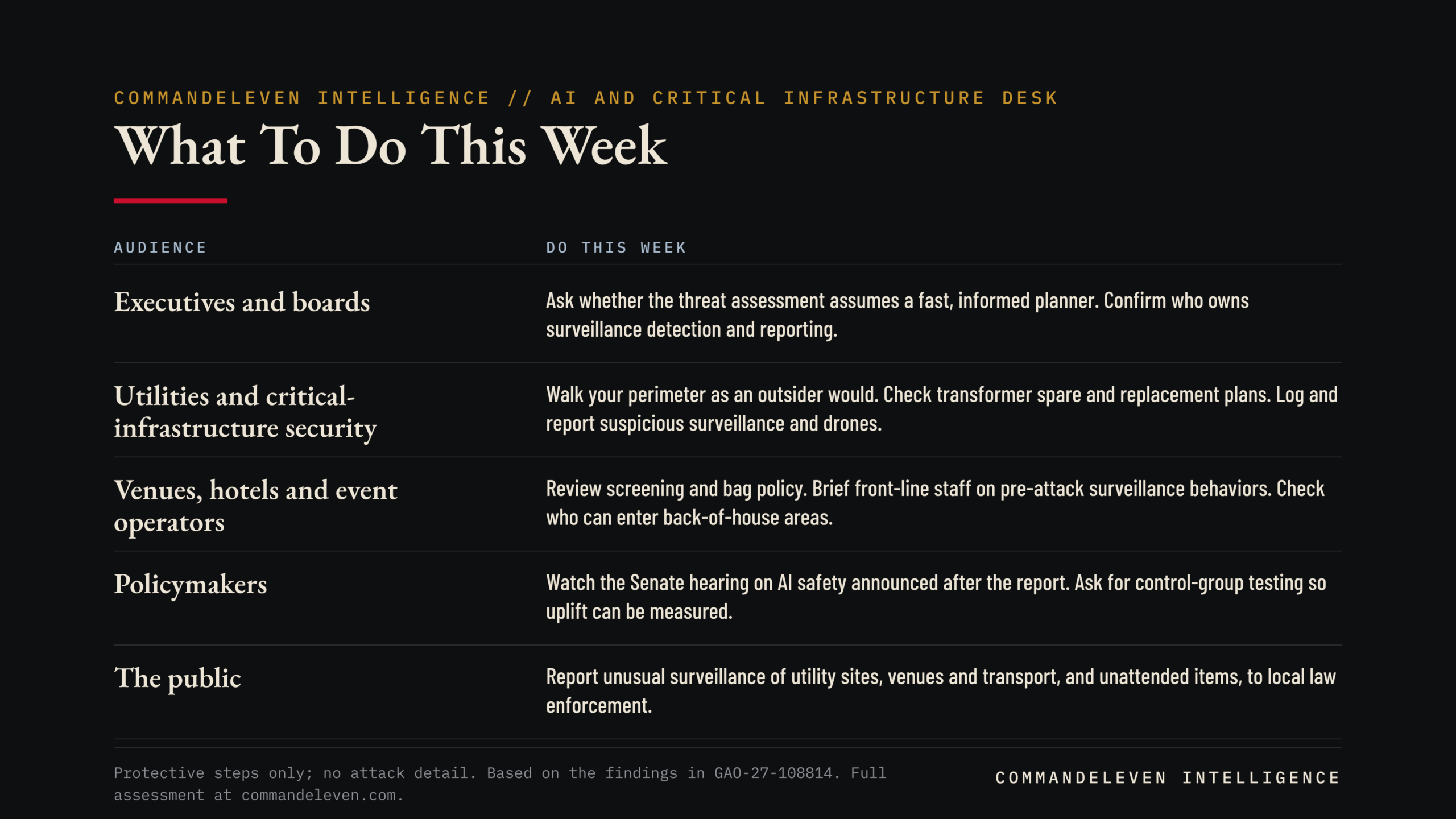
What Each Audience Should Do This Week
The same finding means different things to different readers. These are protective steps, not attack detail.
| Audience | What it means | Do this week |
|---|---|---|
| Executives and boards | Planning cost has dropped for anyone targeting your sites, people or events | Ask security leadership whether the threat assessment assumes a fast, informed planner. Confirm who owns surveillance detection and reporting |
| Utilities and critical-infrastructure security | Sites are ranked on consequence, then checked on the ground. Visibility is a defense | Walk your perimeter as an outsider would: what can be seen from public roads and parking. Check transformer spare and replacement plans. Log and report suspicious surveillance and drones |
| Venues, hotels and event operators | Crowds and open access make these the easiest targets to find | Review screening and bag policy, brief front-line staff on pre-attack surveillance behaviors, and check who can enter back-of-house areas |
| Policymakers | GAO found safeguards were bypassed every time, and its review makes no recommendations | Watch the Senate hearing on AI safety announced after the report. Ask for control-group testing so uplift can be measured |
| The public | The risk to any one person is low. The practical step is awareness | Report unusual surveillance of utility sites, venues and transport, and unattended items, to local law enforcement |
Our earlier piece on 18 warning signs for aviation staff, the insider and first-responder cues, and the pre-attack surveillance indicators carries over directly to the first three rows.
What To Watch
- The Senate Homeland Security and Governmental Affairs Committee hearing on AI safety that Sen. Hassan said would follow the report, and any move toward required safety testing before release.
- Whether any of the four companies publishes its own account of the test, including the prompts and refusals GAO says it handed over through the test accounts in September.
- The next criminal case in which prosecutors say a chatbot was used in planning. GAO cites two already: the January 2025 Las Vegas hotel explosion and the February 2026 British Columbia shooting, both reported in the press.
- Utility and grid regulators’ response on physical security, since the report’s grid finding rests on a known weakness in transformer replacement time.
Calls We Will Score
- By December 31, 2026: the Senate holds a hearing that addresses AI misuse for attack planning. ASSESSED.
- By March 31, 2027: at least one of the four companies announces a safeguard change aimed specifically at multi-step attack planning, not single prompts. ASSESSED.
- During 2027: U.S. or allied prosecutors publicly cite chatbot use in planning in at least one further attack or disrupted plot. ASSESSED.
- During 2027: no public report shows an attack that succeeded because of an AI-produced plan alone. The physical barriers hold as the deciding factor. ASSESSED.
What This Assessment Does and Doesn’t Establish
It establishes that, in a small covert test in spring 2026, four commercial platforms gave a skilled investigator usable attack-planning information after safeguards were bypassed, and that GAO verified much of it. It establishes that the grid is a high-consequence class because of replacement time, and that GAO found the plans were not novel but fast.
It does not establish how often this works for ordinary users, how much AI improves on ordinary research, which platform performed better or worse, or whether any attacker has done this. The test cannot rank the platforms, because each was assigned a different scenario. Companies say their safeguards have improved since. The FERC substation figures are REPORTED, not confirmed. We do not know which cities, venues or sites were named, and we are not asking.
Frequently Asked Questions
Did the FBI find this?
No. GAO, the congressional watchdog, ran the test and reported it. No real attack was carried out.
Was it really done in 12 hours?
Each platform produced its plan in under 12 hours, within a testing cap of 24 working hours per platform. GAO says time varies with the topic and the user’s experience.
Which AI was the worst?
The report cannot say. GAO anonymized the platforms and assigned each a different scenario, so they cannot be compared.
Could an ordinary person do this?
GAO’s investigators used their own experience and outside research alongside the platforms. The report does not test an untrained user, and we do not claim it did.
Is the grid really that fragile?
The report points to long transformer replacement times and one real attack that cut power to about 45,000 customers. The widely quoted “nine substations” figure comes from a 2013 FERC analysis that was only reported, not published, and some experts called it overstated.
Related CommandEleven Intelligence Reading
- The Warnings Reassessed, the hub for this run
- Our aviation dossier on the al Qaeda call to copy the flydubai cockpit attack, and the 18 warning signs card
- Our dossier on how AI was used to build weapons, which used Anthropic’s own report as its baseline
- How CommandEleven Intelligence Thinks, the method behind every label in this dossier
- The grid-down coverage from our Survival Dispatch broadcast series
- The AI in Warfare series, which this dossier opens a new part of
- The 9/11 Commission dossier, publishing next
Sources
- GAO-27-108814, Artificial Intelligence: Covert Testing Used Common Platforms to Create Viable Attack Plans (report page)
- GAO-27-108814 full report (PDF, 61 pages)
- 9/11 Commission Report, via the U.S. Government Publishing Office
- Utility Dive, “FERC: Nationwide blackout could happen if 9 key substations are knocked out” (March 13, 2014), reporting the FERC analysis first published by the Wall Street Journal
- FedScoop, on the Senate hearing announced after the report
- GAO, Electricity Grid: DOE Could Better Support Industry Efforts to Ensure Adequate Transformer Reserves, GAO-23-106180 (August 2, 2023), as cited by GAO-27-108814