CommandEleven Intelligence Desk // Europe Desk, status as of November 24, 2026. This dossier works from one peer-reviewed research note and from official data and published reporting cited alongside it. It contains no operational detail on recruitment or attack methods. Read the confidence tiers.
Bottom Line Up Front
Peter Neumann of King’s College London argues in a March 2026 research note that the way we sort terrorism in Europe, by ideology, no longer captures what has changed most. He identifies six trends that cut across jihadist, right-wing and left-wing violence: radicalization has moved online, attacks are mostly carried out by lone actors, mental health vulnerabilities are more common among attackers, ideologies are blended, attackers are younger, and the path to violence may be shorter. He says one of them, the move online, drives the rest. The result is what he calls a grey zone: lone attackers who radicalize largely online, belong to no clear ideological camp, and mix fragments of political ideas with personal grievance and psychological vulnerability.
What is CONFIRMED is what the note says and what the data it cites show. What is ASSESSED is how this should change the way we read an attack in its first days, and where it fits the cases we have already covered. What is a DATA DEFICIT is the sixth trend, shorter radicalization, which Neumann himself calls the least well supported of the six. The note is a research note, not a dataset, and it dates from March 2026, so it does not cover events since.
Key Judgments
- CONFIRMED: Neumann identifies six cross-cutting trends in European terrorism since the Madrid (2004) and London (2005) attacks: virtualization of radicalization and recruitment, the rise of lone actors, the growing salience of mental health issues, ideological hybridization, changing demographics (including more minors), and compressed radicalization trajectories. He concludes that they are interconnected and that digital technology, above all the move of radicalization online, is the most consequential driver.
- CONFIRMED: On the evidence he cites, lone actors have been the dominant share of terrorist attacks in Europe since the late 2010s. For several years in the 2020s, practically all major completed attacks in the EU were carried out by lone actors, typically with simple means such as knives or vehicles, and on average with fewer deaths than group attacks. He sources this to Europol’s TE-SAT reports and the RUSI and ICCT lone-actor project.
- CONFIRMED: Neumann cites a study by Emily Corner and Paul Gill finding that lone actors were more than thirteen times as likely as group-based terrorists to have identifiable mental health issues, and a literature review putting the prevalence among lone actors about 40 percent higher than among other terrorist populations. He is explicit that there is no direct causal link between mental illness and terrorism and that most people with mental disorders never turn to violence.
- ASSESSED: The practical consequence is a labeling problem, not only an academic one. Because these attacks look like terrorism in method, target and public impact, there is pressure to call them terrorism within hours, yet motive, intent and culpability can take months to establish. Neumann calls for communication that reassures the public while explaining the ambiguity. We treat an early label as provisional until investigators say what the attacker wrote and said.
- CONFIRMED (reported figure): Neumann reports that sabotage and other violence against European countries supporting Ukraine rose from fewer than ten incidents in 2022 to more than fifty by 2025, with several cases linked to Russia’s military intelligence service, the GRU, and that Iran’s Revolutionary Guard Corps has been linked to at least eleven attempted or partly executed attacks in Europe since 2018. He says attribution is complex. Both states, he writes, rely on criminal and disposable intermediaries recruited online for deniability.
- ASSESSED: The hostile-state finding and the grey zone finding meet in the same place. When a state hires a criminal or a teenager online for a single task, the executor looks like a lone actor with a muddled motive, and the sponsor is hidden. That is the pattern in the network we described in The HAYI Network, where the public record is charges and anonymous officials, not a settled account.
- DATA DEFICIT: Neumann writes that there are no sound longitudinal studies measuring how long radicalization takes or whether it has shortened. His support is interviews with law enforcement and intelligence officers in six European countries, who independently described processes that once took months now taking weeks, especially online and among very young people. That is professional judgment, not measurement. We hold it at this tier.
The Conventional View, and Its Limit
Neumann starts from the standard account, because it is still useful. Jihadism has been the most lethal form of terrorism in Europe since the early 2000s, arriving in waves tied to wars abroad: a first wave around the Iraq war that produced Madrid and London, and a second around the Islamic State’s 2014 caliphate that produced Paris, Brussels, Nice, Berlin, Manchester and Barcelona, among others. After the caliphate fell in 2019 many governments thought the threat was over. He writes that security services in nearly all European countries report an increase in jihadist plots and attempts since the October 7, 2023 attack and the Gaza war, but still well below the mid-2010s level and without a strong organizational base.
On the right, he dates the modern threat to Anders Breivik’s 2011 attack in Norway, which killed 77 people and set out the “replacement” worldview that later attackers adopted. Completed right-wing attacks have declined since the early 2020s, though plots are still regularly disrupted. He adds two threats that analysts expect to grow: left-wing violence, where agencies in Central and Northern Europe see a shift from militant protest and property damage toward arson and violence against people, and terrorism instigated or enabled by hostile states.
His objection is that this ideology-by-ideology map forces violence into categories that may not be as coherent as they look, and says little about the environment in which people radicalize. The six trends are his answer.
The Six Trends
Each trend below is Neumann’s finding, with his sources where they matter. The page numbers refer to the journal pagination (Perspectives on Terrorism, Volume XX, Issue 1, pages 109 to 120).
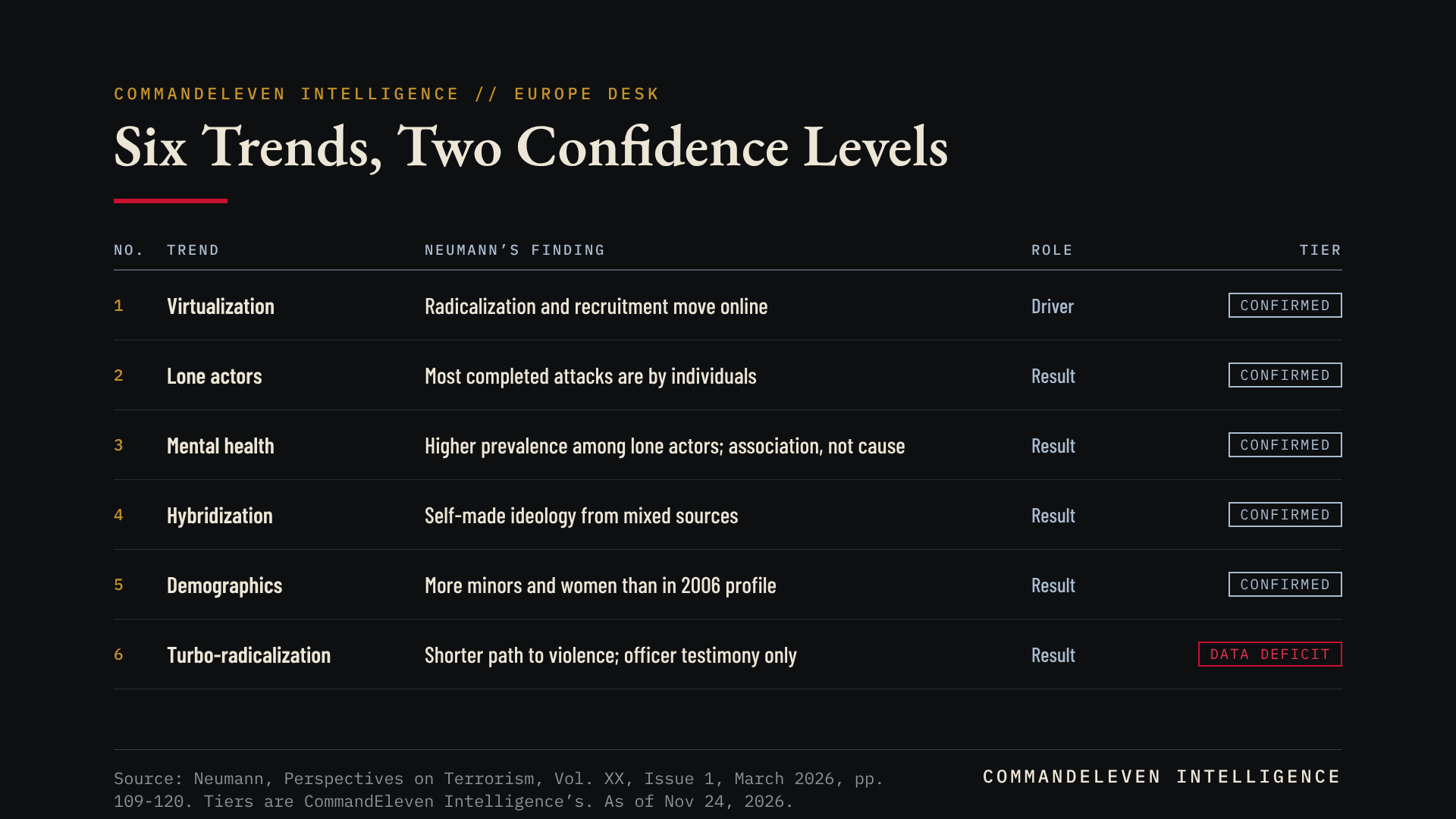
1. Virtualization of radicalization. At the time of Madrid and London, perpetrators’ paths could be reconstructed almost entirely without reference to the internet, and scholars such as Marc Sageman played down online radicalization. By now, he writes, the internet appears to be a radicalization environment in its own right, and both jihadist and right-wing trajectories increasingly play out entirely online. Sustained counter-terrorism pressure has made physical networks in Europe hard to build, so online mobilization is often the only workable route. He ranks this trend first (pages 112 and 117). CONFIRMED as the note’s finding. It rests on a literature review, and Neumann says important exceptions remain.
2. Lone actors. Twenty years ago terrorism was assumed to be a group activity. Two explanations are offered, and they are complementary: counter-terrorism success made organized cells hard to run, and jihadist groups, first al-Qaeda and later the Islamic State, promoted the “lone mujahid”; and the internet made it unnecessary to join a group, because indoctrination and operational guidance can be had online (page 113). CONFIRMED on Europol and RUSI-ICCT data.
3. Mental health. A widely cited 2005 consensus statement held that terrorists are psychologically normal. Since the early 2010s, European agencies have reported more suspects with personality disorders, depression and, in some cases, acute psychosis. Neumann stresses the caution above: association, not cause. The point that matters for analysis is attribution. In borderline cases it becomes hard to say whether an act is politically motivated terrorism or violence driven mainly by illness (page 114). CONFIRMED as the research finding; the borderline-case judgment is ASSESSED.
4. Ideological hybridization. Attackers now explain themselves in self-authored manifestos that combine ideas from different sources, the “salad bar” or “pick and mix” approach. Lone actors may blend elements of the Islamic State, al-Qaeda and Hamas, ignoring their differences, and online spaces let people move between subcultures, with visible overlap between far-right forums and the incel milieu (page 115). CONFIRMED.
5. Changing demographics. A 2006 study of 242 jihadists in Europe found 98 percent were male, with an average age of 27. That profile has shifted in two ways. Women made up as much as 40 percent of those leaving European countries for Syria and Iraq at points in the mid-2010s, and online spaces lowered barriers for them. And teenagers aged 13 to 19 were a substantial number of those radicalized on boards such as 4chan, 8chan and Iron March in the late 2010s; in some countries, young people now make up a majority of those arrested for attempted or completed attacks, some as young as 13 or 14. Neumann cites platform algorithms and encrypted apps as explanations (pages 115 and 116). CONFIRMED. We take up the 2026 arrest data in Youth Radicalization in 2026 and do not repeat it here.
6. Turbo-radicalization. Neumann is candid that this is the least empirically robust trend. He gives three reasons to think paths have shortened: constant online exposure; the removal of social checks on lone actors, who need no one’s approval; and the impulsiveness of younger recruits. He adds that, according to officers in six countries, radicalization among the young now often leads “straight into jihad,” bypassing a long ideological build-up (pages 116 and 117). DATA DEFICIT. The EU counter-terrorism coordinator’s statement that young people can radicalize within weeks, quoted in our youth dossier, rests on the same kind of professional testimony.
The Grey Zone
Neumann’s central claim is that the trends reinforce each other. Virtualization makes lone actors possible, lone actors are linked to mental health vulnerability, and both feed hybridization; the arrival of younger attackers follows from the move online; and compressed paths follow from all of them. Some trends are drivers, others downstream effects, and technology sits at the top (page 117).
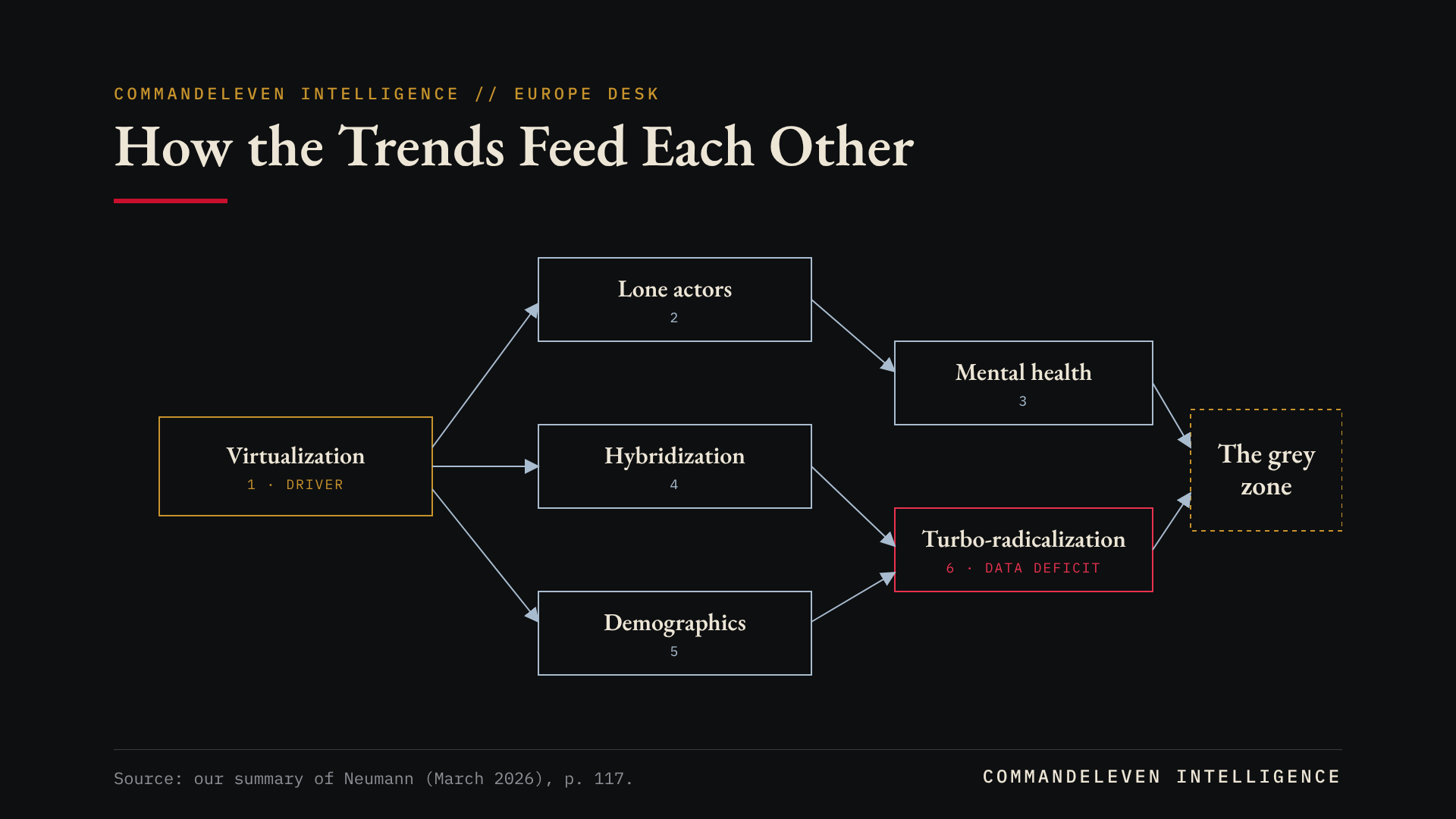
The product is what he calls the grey zone: violence that still meets the usual criteria for terrorism in target, method, symbolism and public impact, but is driven increasingly by idiosyncratic issues. He rejects the popular labels “nihilistic terrorism” and “terrorism without ideology.” Under the definition most legal and academic sources use, terrorism is politically or ideologically motivated, so it cannot also be non-ideological. The right description, he argues, is fragmented and individualized ideology fused with personal and psychological factors, not no ideology (page 119).
ASSESSED: this is useful for the first hours after an attack. A rule of thumb that follows from the note: until investigators publish what the attacker wrote or said, treat the ideological label as provisional, and record separately what is known about method, target, online history and any mental health findings. We do not treat a late or contested label as a sign that nothing political was involved.
Where Our Own Record Fits
The note supports a pattern we have already scored. In GCTA Foresight Audit, Part 7: Europe and North America, the coordinated World Cup and July 4 strike wave we had warned of did not happen, while the lone-actor pattern did. That is the direction Neumann describes: the threat arrived as individuals, not as a campaign. ASSESSED.
It also frames our coverage of state-run networks. The RAF Fairford indictment and the HAYI network reporting concern people recruited for individual tasks, which fits the criminal-intermediary model Neumann describes for Iran. What is established there is what has been charged. We do not extend his count of eleven attempted or partly executed IRGC-linked attacks beyond the cases he cites, and we do not claim that every recent incident is state-directed.
And it links to the AI question. Neumann writes that extremist movements have been early adopters of each new technology and that artificial intelligence may be used not only for propaganda but for radicalization, social interaction and community-building. That is a forecast, not a finding. For what the 2026 record shows, see Terrorist Use of AI and the Younger Recruit, and for the series this belongs to, Information Warfare and Radicalization in the AI Era.
What We Do Not Know
- How long radicalization takes now compared with 2005. There is no longitudinal measure, as Neumann states.
- How the lone-actor share is distributed by ideology in 2026. Europol’s 2026 report gives attack totals, and we have not found a breakdown by perpetrator type in the material we reviewed.
- The basis for the Russian sabotage count. Neumann cites academic and think-tank tallies and says attribution is complex. We have not reviewed those tallies ourselves.
- How far the grey-zone pattern applies outside Europe. The note covers Europe only, and we do not carry its findings to the United States without separate evidence.
- Whether the picture has moved since March 2026.
What To Watch
- Europol’s TE-SAT 2027 (expected mid-2027): the number of arrests, and whether it reports completed attacks by perpetrator type.
- The next Russian-linked and Iranian-linked prosecutions in Europe where the accused was recruited online for a single task.
- Court and prosecutor decisions in cases where a suspect’s mental health or the mix of ideas is central to whether the act is terrorism.
- Any longitudinal study of radicalization duration, which would settle the sixth trend.
- Government and agency wording in the first 48 hours after the next major attack in Europe, and how often it later changes.
Calls We Will Score
- By July 31, 2027: Europol’s TE-SAT 2027 will report at least as many terrorism-related arrests for 2026 as the 486 it reported for 2025. If Europol changes how it counts, we will say that the comparison cannot be made. ASSESSED.
- By July 31, 2027: If TE-SAT 2027 reports completed attacks by perpetrator type, lone actors will account for a majority of the completed attacks in 2026. If the report gives no such breakdown, the call is not scored. ASSESSED.
- By March 31, 2027: At least two further arrests or charges in separate European countries will be publicly tied to Russia or Iran, in cases where the suspect was recruited online to carry out a single act of sabotage or violence. ASSESSED.
What This Assessment Does and Does Not Establish
It establishes what Neumann’s March 2026 research note argues, which trends he identifies, which he rates as strongly or weakly supported, and how it fits cases we have already covered.
It does not establish that any single recent attack belongs in the grey zone, that mental illness causes terrorism (the note says it does not), that radicalization has in fact become faster, or that the Russian and Iranian figures are complete. It relies on the note and the sources it cites, not on any information from our own field sources.
Frequently Asked Questions
What is the “grey zone” in terrorism?
Neumann’s term for violence by lone attackers who radicalize mainly online, do not fit a single ideology, and combine fragments of political ideas with psychological vulnerabilities and personal grievances. It sits between clearly political terrorism and violence driven mainly by other factors.
Is this “nihilistic terrorism”?
Neumann says that label is misleading. In his view terrorism is politically or ideologically motivated by definition, and grey-zone attackers do draw on political fragments. What is distinctive is that the ideology is fragmented and individualized, not that it is absent.
Does mental illness cause terrorism?
No. The note says there is no direct or causal link and that most people with mental disorders never engage in terrorism. It reports a strong statistical association between mental health issues and lone-actor terrorism, which complicates how an incident is classified.
Has radicalization really become faster?
It may have, but this is the least well-supported trend in the note. There are no longitudinal studies. The evidence is the shared view of officers in six countries that processes once taking months now often take weeks, especially online and among the very young.
Is Russia behind attacks in Europe?
The note reports that incidents of sabotage and violence against countries supporting Ukraine rose from fewer than ten in 2022 to more than fifty by 2025, with several linked to Russian military intelligence. It says attribution is complex, and that Russia relies on disposable agents recruited online.
Related CommandEleven Intelligence Reading
- Youth Radicalization in 2026: One Pattern Across San Diego, Europe and the Com Networks, the 2026 arrest data on minors that this note’s fifth trend predicts
- Terrorist Use of AI and the Younger Recruit, on the technology driver Neumann places at the center
- Information Warfare and Radicalization in the AI Era: A CommandEleven Intelligence Series, the series this note supports
- GCTA Foresight Audit, Part 7: Europe and North America, where the lone-actor pattern held and the coordinated strike wave did not
- The HAYI Network: How Seven Men Allegedly Ran Iran’s Attack Wave in Europe, on the criminal-intermediary model
- RAF Fairford: U.S. Charges Three Iran-Backed Men and Names the HAYI Network, on what has been charged
- The 2026 U.S. Counterterrorism Strategy: What It Names, What It Leaves Out, on what prevention capacity the grey zone demands
Sources
- Peter R. Neumann, “The New Grey Zone: How Terrorism in Europe Has Changed,” Perspectives on Terrorism, Volume XX, Issue 1, March 2026, pages 109 to 120
- EU Terrorism Situation and Trend Report 2026 (Europol, July 13, 2026), for the 2025 arrest total
- Sources cited by Neumann and relied on here only through his note: Petter Nesser, Jihadi Plots in Europe Dataset (Journal of Peace Research, 2024); Emily Corner and Paul Gill, “A False Dichotomy? Mental Illness and Lone-actor Terrorism” (Law and Human Behavior, 2015); Bart Schuurman, “Russian Operations against Europe since the 2022 Invasion of Ukraine” (Leiden University, 2025); Charlie Edwards and Nate Seidenstein, “The Scale of Russian Sabotage Operations against Europe’s Critical Infrastructure” (IISS, August 2025); RUSI Countering Lone-Actor Terrorism project