CommandEleven Intelligence Desk // Strategy and Policy Desk, status as of November 16, 2026. This is an institutional analysis of the strategy’s text and of the capacity it relies on. It takes no side in U.S. domestic politics, and it does not assess the strategy’s account of earlier administrations. Read the confidence tiers.
Bottom Line Up Front
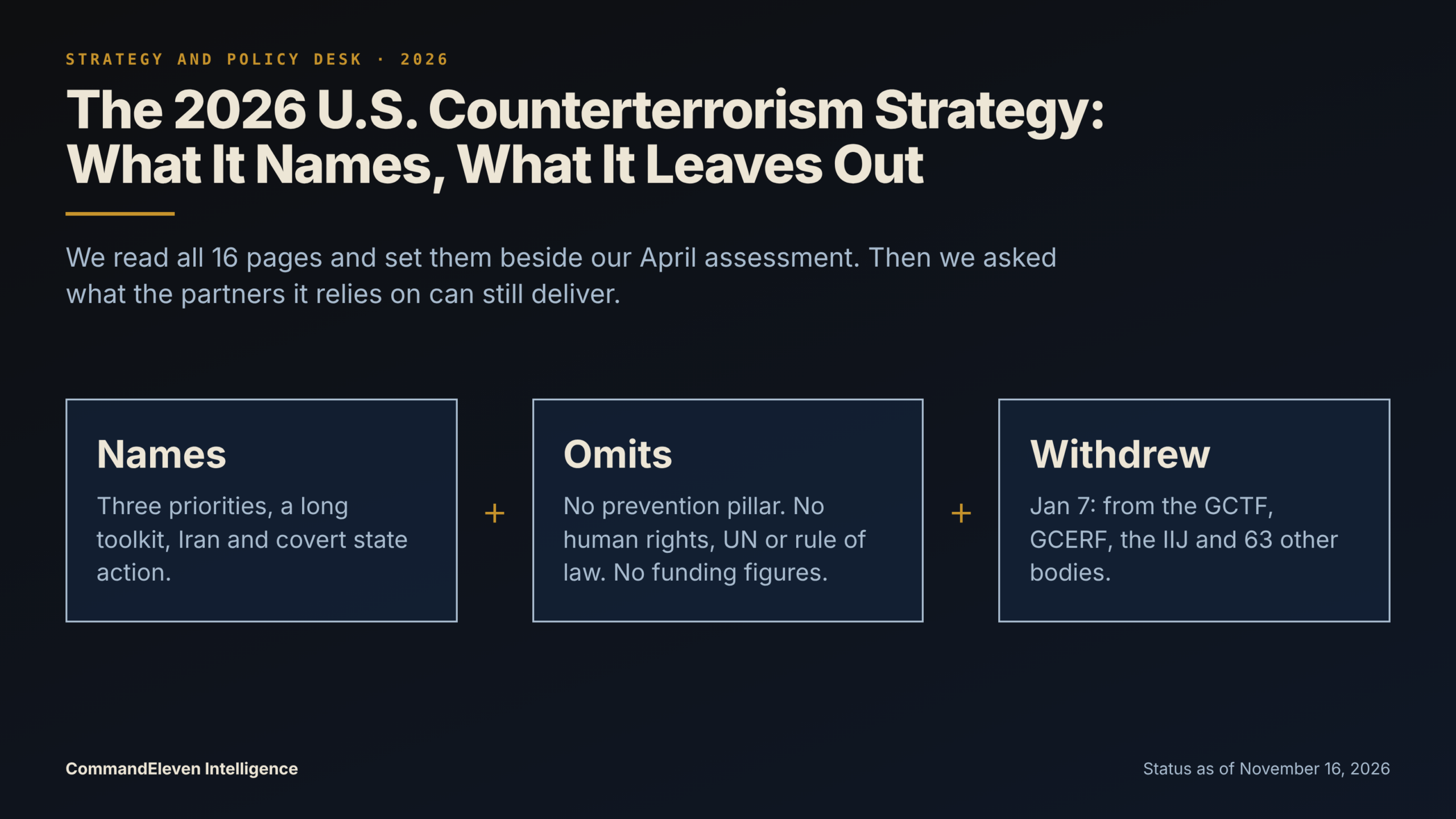
The White House released the United States Counterterrorism Strategy on May 6, 2026. It is 16 pages long. It sets three priorities (cartels and transnational gangs, “legacy” Islamist terrorists, and violent left-wing extremists), a list of tools (designations, sanctions, strikes, cyber operations and information operations), and a regional section that asks partners in Europe, Africa and Asia to carry more of the burden. Its threat picture overlaps with ours on Iran and its proxies, on jihadist groups, on cartel financing and on state-backed covert action. What the text does not contain is a prevention or community-resilience pillar, any reference to human rights, the rule of law, international law or the United Nations, and any funding figure, target or deadline. In January 2026, before the strategy, a presidential memorandum withdrew the United States from the Global Counterterrorism Forum, the Global Community Engagement and Resilience Fund (GCERF), the International Institute for Justice and the Rule of Law and 63 other bodies. The strategy then asks partners to take on more of the work, while the institutions that built partner capacity lose their largest funder. That is a gap between the plan and the means, and it is our subject here. We also set the strategy beside our own April 2026 2026 Global Counter-Terrorism Assessment (GCTA), which was published before it. The two share a view of the threat but not of the response: the GCTA builds its playbook around community-based prevention, threat-stage-specific tactics and online interdiction, and the strategy contains none of the three.
Key Judgments
- CONFIRMED: The strategy text names three types of terror group: narcoterrorists and transnational gangs, legacy Islamist terrorists, and violent left-wing extremists “including anarchists and anti-fascists.” It sets cartels as the first priority and the top five Islamist groups, starting with al-Qaeda in the Arabian Peninsula and ISIS-Khorasan, as the second. It states that Iran is the greatest threat to the United States from the Middle East. It also names state-linked covert action, including sabotage and assassination plots, as a category the United States will work on with European partners.
- CONFIRMED: The strategy contains no prevention, community-resilience or countering-violent-extremism pillar. The word “deradicalization” appears once, inside a quotation from the 2025 National Security Strategy warning that counterterrorism powers must never be abused “under the guise of” it. We read that as a caution about misuse, not a statement that such programs will end. It is nonetheless the only mention.
- CONFIRMED: The strategy does not mention human rights, the rule of law, international law, multilateral bodies or the United Nations. A text search of the 16 pages and a full read found none of these. It does not name the Global Counterterrorism Forum, GCERF or the International Institute for Justice and the Rule of Law.
- CONFIRMED: The strategy names no racially or ethnically motivated or right-wing violent extremism category. The International Centre for Counter-Terrorism (ICCT) makes the same observation. We take no position on which categories belong in a national strategy. The practical point is that the European services in ICCT’s “In Their Eyes” review rank jihadism first, with right-wing extremism implied second, so a threat taxonomy that differs from partners’ makes shared case files harder to line up.
- CONFIRMED: The strategy describes Europe as “both a terror target and an incubator of terror threats,” and says wealthy NATO allies “can serve as financial, logistical, and recruitment hubs.” It also commits the United States to work closely with European partners against covert state action that “looks like terrorism,” which is the pattern in the Fairford and HAYI cases.
- CONFIRMED: A White House memorandum of January 7, 2026 announced the withdrawal from the Global Counterterrorism Forum, GCERF, the International Institute for Justice and the Rule of Law and 63 other international bodies, according to ICCT’s Georgia Holmer. Reuters reported the withdrawal from GCERF, whose annual budget is $50 million, on January 10, and described the memorandum as covering 35 international agencies and 31 UN entities.
- ASSESSED: The strategy’s burden-shifting language and the January withdrawals pull in opposite directions. The text says that in Africa the United States will “maintain a light military footprint” and expect regional and nearby partners to “accept a greater portion of the CT burden,” and that it will “burdenshare and burdenshift” in South and Central Asia. Those partners’ capacity was built in part by the programs and forums that the United States has now left. We assess that this widens the gap between what the strategy expects of partners and what they can deliver.
- ASSESSED (single analyst source): Prevention programs in the Sahel, the Horn of Africa and Central Asia, where U.S. funding has been most active, lose coordination and support. Holmer reaches this conclusion. We have found no public figure for U.S. prevention funding by region, so we cannot size the loss.
- DATA DEFICIT: What replaces the withdrawn U.S. funding, if anything. No U.S. or European source we found announces a replacement line.
- CONFIRMED: Compared side by side, the strategy and our April 2026 GCTA both keep kinetic tools, both name Iran and its proxies, jihadist groups and cartel financing, and both are silent on human rights, the rule of law, international law and the United Nations. They differ on the response. The GCTA calls for a community-based prevention model, separate playbooks for “Hot Zone” and “Expansion Zone” regions, and interdiction of online radicalization. The strategy text has no prevention pillar, no regional differentiation by threat stage and no discussion of online radicalization. It adds a left-wing extremism category that the GCTA does not use. The GCTA, for its part, names far-right accelerationism as one element of the hybrid threat, which the strategy does not.
What the Strategy Says
The document has a foreword, an introduction, a threat section, principles and priorities, a resources section, five regional sections (the Western Hemisphere, the Middle East, Europe, Africa and Asia) and a section on weapons of mass destruction. We read it in full and set aside its comparisons with earlier administrations and its characterization of domestic political actors, which are outside this assessment.
The three goals are to identify terror actors and plots before they happen, to cut off their arms, funding and recruiting streams, and to destroy established groups. The tools it names are foreign terrorist organization designations (which it says unlock extra intelligence authorities and financial measures), “high-intensity but short” campaigns against the five Islamist groups it ranks as most capable of external operations, sanctions, shadow-fleet interdiction, covert operations, offensive cyber operations and information operations. On weapons of mass destruction, it commits to maintaining a crisis-response capability and to track emerging technologies, including artificial intelligence.
On the three regions where partners matter most:
- Europe. The strategy calls European states “preeminent and long-term counterterrorism partners,” and says Europe must increase its own counterterrorism efforts and share threat intelligence more actively.
- Africa. It names West Africa, the Sahel, the Lake Chad Basin, Mozambique, Sudan and Somalia, sets a goal of denying jihadist groups a base for external operations, and relies on a light U.S. footprint.
- Asia. It says it will work with South and Central Asian partners to “burdenshare and burdenshift” counterterrorism efforts.
The document sets no budget, metric or deadline for any of this.
What It Does Not Contain
The strategy is a government policy document. Our GCTA, released in April 2026, is an independent threat assessment with a recommended playbook. They have different jobs, so this section does not score one against the other. It sets what the strategy text contains beside what the GCTA recommended, so a reader can see where the two playbooks diverge and where they share the same blind spots. Every entry in the strategy column was checked against the 16-page text, and every entry in the GCTA column against the published assessment.
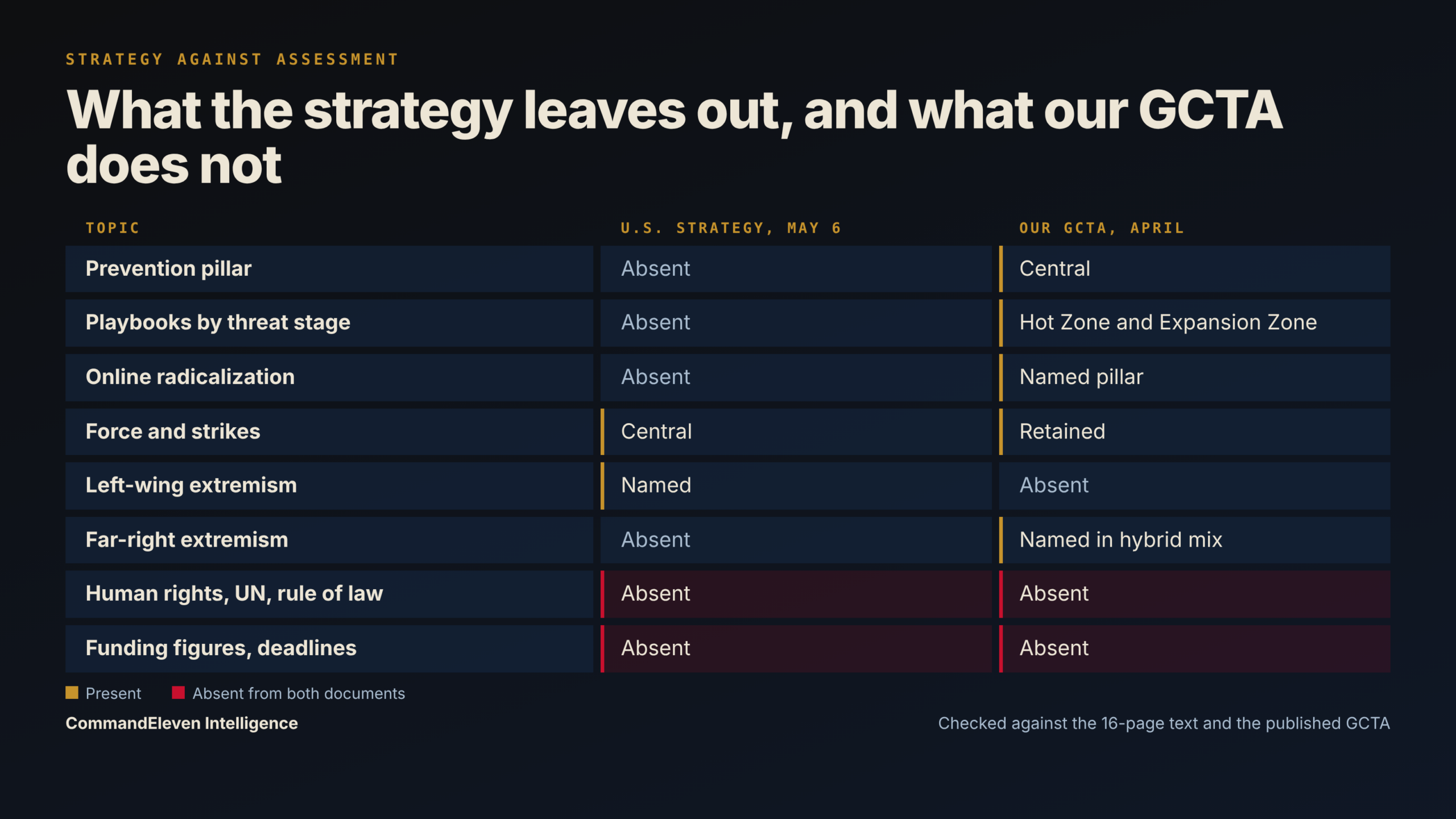
| Topic | 2026 U.S. strategy (May 6) | CommandEleven GCTA (April) |
|---|---|---|
| Prevention and community resilience | No pillar. “Deradicalization” appears once, in a quotation warning about misuse of powers (pp. 4 to 5). | Central. Calls for a shift from a military-intelligence-centered model to a “Community-Based De-radicalization” model, with Social Cohesion Grants, health and education seats at the National Counterterrorism Center, and a funding shift toward “interrupt the intent” (pp. 81 to 82). |
| Different tactics for different regions | Regional sections set goals by geography but no distinction by stage of threat. | “Prevention must be tailored to the Contagion Stage of the region.” A Hot Zone playbook (Sahel, Khorasan, Badiya) and an Expansion Zone playbook (Western Europe, North America, Southeast Asia, Gulf) (p. 81). |
| Force and strikes | Central. “High-intensity but short” campaigns against five ranked Islamist groups, plus covert and offensive cyber operations. | Also retained. “Surgical Overmatch,” counter-drone swarms and multinational hunt teams in Hot Zones (p. 80). The GCTA argues force alone has reached its ceiling against digitally radicalized lone actors (p. 82). |
| Online radicalization and platforms | Not addressed. The text has no discussion of online radicalization, gaming spaces or platform duties. | A named pillar. Interdiction APIs for gaming platforms, a joint EU-US-GCC “Algorithmic Firewall,” and “Digital Intervention” teams (pp. 80 to 81). |
| Terror financing | Designations, sanctions, shadow-fleet interdiction and disruption of cartel and terrorist funding streams. | Concentrates on informal and crypto channels: hawala and hundi networks and the move to Monero and Tether, with FATF pressure noted as a driver in South Asia. |
| Cartels and organized crime | The first priority. | Treated as part of a crime-terror nexus and as a vehicle for state-outsourced violence, not as a separate priority. |
| Left-wing extremism | The third named type, including “anarchists and anti-fascists.” | No category. |
| Right-wing and far-right extremism | No category. | Named as one element of blended “hybrid” ideologies, such as far-right accelerationism mixed with jihadist imagery. Not treated as a top-line threat. |
| Human rights, rule of law, international law | Not mentioned. | Not mentioned. |
| United Nations, multilateral bodies, GCTF, GCERF, IIJ | Not mentioned. | Not mentioned. The GCTA proposes joint initiatives and multinational teams but does not name these bodies. |
| Funding figures, metrics, deadlines | None. | Proposes funding shifts and “community-based preventative metrics,” but does not cost them. |
Two points follow from the table.
First, the divergence is in the response, not the threat picture. On Iran and its proxies, jihadist groups, cartel financing and state-linked covert action, the two documents describe much the same landscape. Where they part is on what to do about it. The strategy keeps force at the center, the model the GCTA argues has reached its ceiling against digitally radicalized lone actors, and adds new targets. The GCTA recommends moving upstream, to the stage before an attacker is tasked.
Second, the shared silences matter as much as the differences. Neither document addresses human rights, the rule of law or international law, and neither names the United Nations or the forums and funds the January memorandum withdrew from. A reader should not conclude that those omissions mark where our playbook beat the strategy. They are gaps in both, and the second one is the more consequential for partner governments, because a prevention model of the kind the GCTA recommends depends on the community-facing, rule-of-law-based programs that GCERF and the International Institute for Justice and the Rule of Law fund. We return to that below.
What Partners Lose, and What the Strategy Assumes They Have
Three of the bodies the January memorandum names show what the strategy depends on.
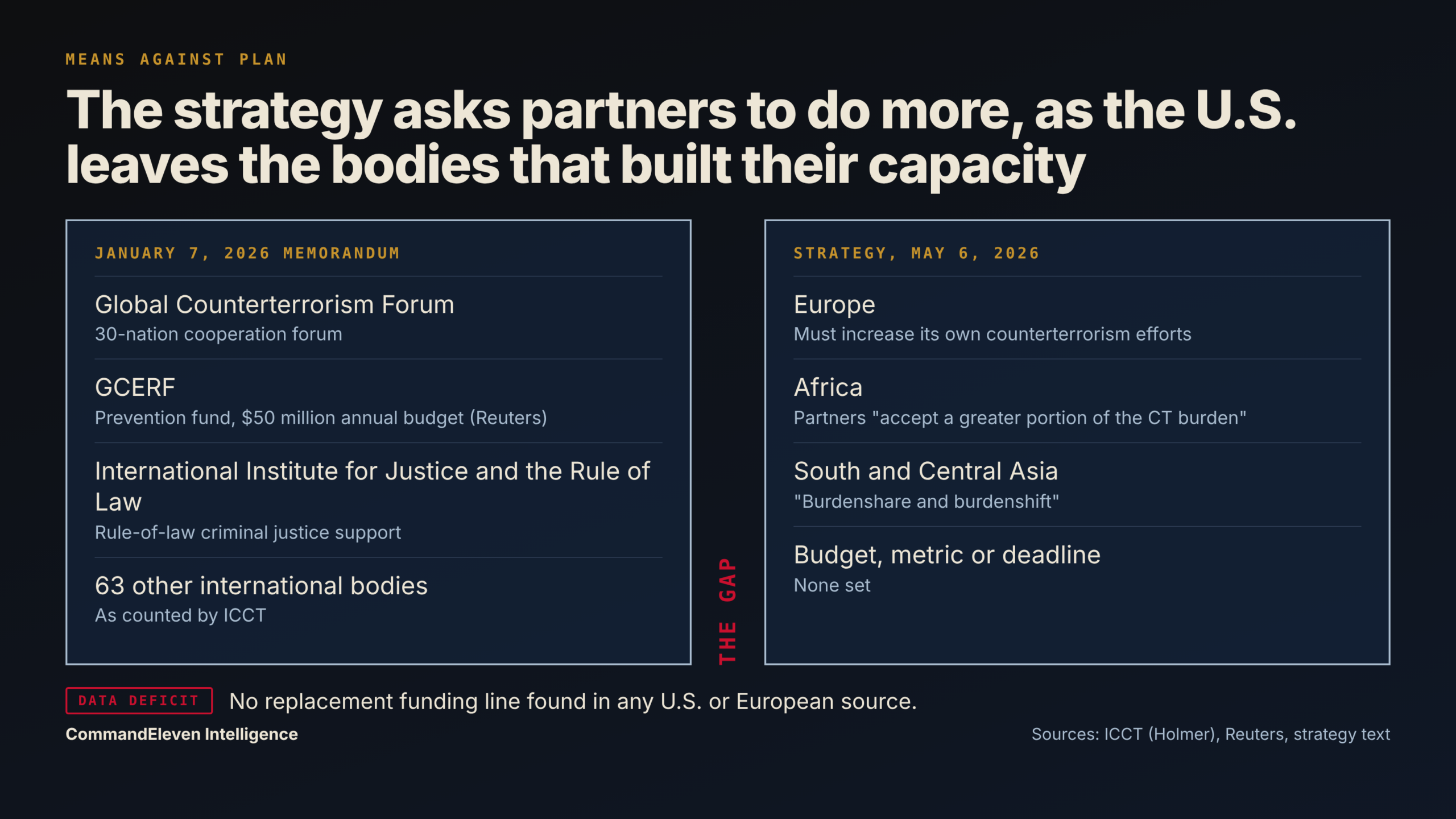
- The Global Counterterrorism Forum is a 30-nation forum for counterterrorism cooperation. The European Union remains active in it, according to ICCT.
- GCERF funds prevention programs in dozens of countries whose communities are vulnerable to extremism. The United States helped establish its program in northeast Syria, which supports the reintegration of families from former Islamic State circles.
- The International Institute for Justice and the Rule of Law supports rule-of-law-based criminal justice responses to terrorism.
The strategy asks partners to do more of exactly the work these bodies supported: investigation, prosecution, border and financial controls, and local counter-recruitment. It also asks European partners to confront state-backed covert action. The ICCT’s September review shows what that costs them. European services report that state-linked hybrid terrorism is growing, that countries charge the same wave of attacks differently (the Dutch and French as terrorism, the British mostly as ordinary crime), and that EU security structures built around jihadist and far-right threats may be less ready for state-backed operations.
Where This Meets Our Earlier Work
Our own position needs to be stated plainly, because it has two parts.
First, on threat identification, the strategy and our reporting overlap. Our Survival Dispatch broadcast of May 27 covered where the strategy matches our threat warning, and the broadcast of May 29 turned to what the document leaves out. This paper is the written version of the second point.
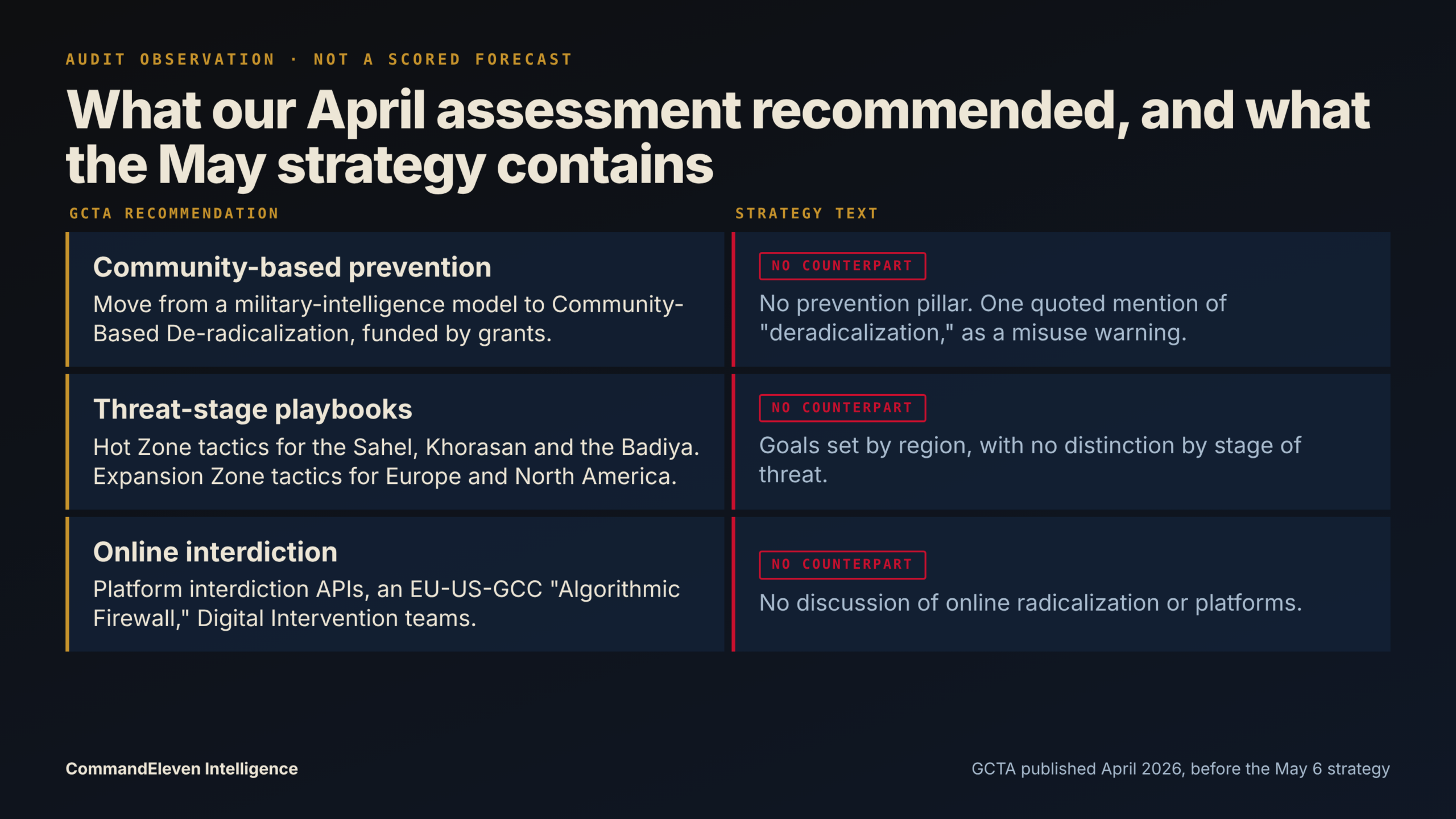
Second, the April 2026 Global Counter-Terrorism Assessment (GCTA) called for a shift from a military-intelligence-centered model to a community-based, cognitive-response framework, and our September white paper, “Fighting 2026 Terrorism Using the 2000 Playbook,” argued that the post-9/11 architecture does not match the 2026 threat. That paper critiqued the architecture and did not analyze the May strategy’s text. We find that the strategy contains no pillar corresponding to the GCTA’s community-based recommendation, and no counterpart to its threat-stage playbooks or its online-interdiction pillar. This is not a scored forecast. It is a gap between a framework we recommended and the policy the United States adopted, and we record it as an audit observation.
What To Watch
- Any reversal of, or exception to, the January 7 withdrawals.
- Reports from GCERF, the European Union or national donors about programs closed, scaled back or taken over in the Sahel, the Horn of Africa and Central Asia.
- Any U.S. budget request, State Department program notice or announcement that creates a new prevention or partner-capacity line.
- European or UN announcements of new funding intended to cover the gap, and the outcome of the UN’s Ninth Review of the Global Counter-Terrorism Strategy, which ICCT says is under way.
- Whether U.S. and European agencies align their threat categories in joint cases, especially for state-linked plots.
Calls We Will Score
- By June 30, 2027: The United States will not rejoin the Global Counterterrorism Forum, GCERF or the International Institute for Justice and the Rule of Law, and no U.S. exception restoring support for any of the three will be announced.
- By March 31, 2027: GCERF or another named funder will publicly report closing, scaling back or transferring at least one prevention program in the Sahel, the Horn of Africa or Central Asia, and will cite a loss of U.S. support as a reason.
- By June 30, 2027: The European Union or at least one European government will announce new funding for multilateral counterterrorism or prevention work that it describes as covering the withdrawal of U.S. support.
What This Assessment Does and Doesn’t Establish
It establishes what the 16-page strategy text contains and omits, what the January 2026 memorandum withdrew the United States from, and that the strategy’s burden-shifting depends on partner capacity that those institutions helped build.
It does not establish that the strategy is right or wrong on its own terms, that any specific program has closed, how much the United States spent on prevention in any region, or that the omissions were deliberate. It does not rely on anything from our own field sources. It does not assess the strategy’s characterization of earlier administrations or of any domestic political group.
Frequently Asked Questions
When was the strategy released, and how long is it?
The White House released it on May 6, 2026. The copy we reviewed, from the White House, is 16 pages.
Does the strategy mention prevention or deradicalization?
It has no prevention pillar. The word “deradicalization” appears once, in a quoted warning that counterterrorism powers must not be abused under that heading.
What did the January 2026 memorandum do?
According to ICCT, it announced the U.S. withdrawal from the Global Counterterrorism Forum, GCERF, the International Institute for Justice and the Rule of Law and 63 other bodies. Reuters, in reporting the GCERF withdrawal, described it as covering 35 international agencies and 31 UN entities.
Does this assessment take a political side?
No. It reads what the text includes and omits and what that does to partner capacity. Its subject is institutions and funding, not political parties or candidates.
How does the strategy compare with CommandEleven’s GCTA?
Both keep kinetic tools and both describe a similar set of threats. The GCTA, published in April 2026, adds a community-based prevention model, separate playbooks for Hot Zone and Expansion Zone regions and online interdiction. The strategy has none of these. Neither document mentions human rights, the rule of law or the United Nations. The full comparison is in the table above.
Where does it differ from ICCT’s reading?
ICCT’s Georgia Holmer reads the strategy partly as domestic political messaging and calls the cartel designations an overreach. We take no position on either point. We use ICCT for the withdrawals and the regional prevention effects, and we checked each claim about the strategy’s contents against the text.
Related CommandEleven Intelligence Reading
- 2026 Global Counter-Terrorism Assessment (GCTA)
- Fighting 2026 Terrorism Using the 2000 Playbook: A Foresight Audit
- GCTA Foresight Audit, Part 7: Europe and North America
- Europe as the Leading Indicator: Testing the Transatlantic Terror Thesis – Part 4
- The HAYI Network: How Seven Men Allegedly Ran Iran’s Attack Wave in Europe
- Survival Dispatch: The U.S. Counterterrorism Strategy for 2026 Just Confirmed Our Exact Threat Warning (May 27, 2026)
- Survival Dispatch: Why Is Washington Ignoring These Major Security Threats and What It Means for Your Safety (May 29, 2026)
Sources
- 2026 United States Counterterrorism Strategy, White House, May 2026
- CommandEleven Intelligence, 2026 Global Counter-Terrorism Assessment, April 2026
- ICCT, Georgia Holmer, “The New US Counter-Terrorism Strategy: Selective Amnesia,” May 28, 2026
- Arab News, reporting Reuters, “US quits global organization dedicated to preventing violent extremism,” January 2026
- Lawfare, “Trump Administration Releases 2026 Counterterrorism Strategy,” May 7, 2026
- ICCT, In Their Eyes: How European Security Services Look at Terrorism and Counter-Terrorism, 2026 Edition, September 18, 2026