CommandEleven Intelligence Desk // Cyber and Insider Risk Desk, status as of November 16, 2026
Bottom Line Up Front
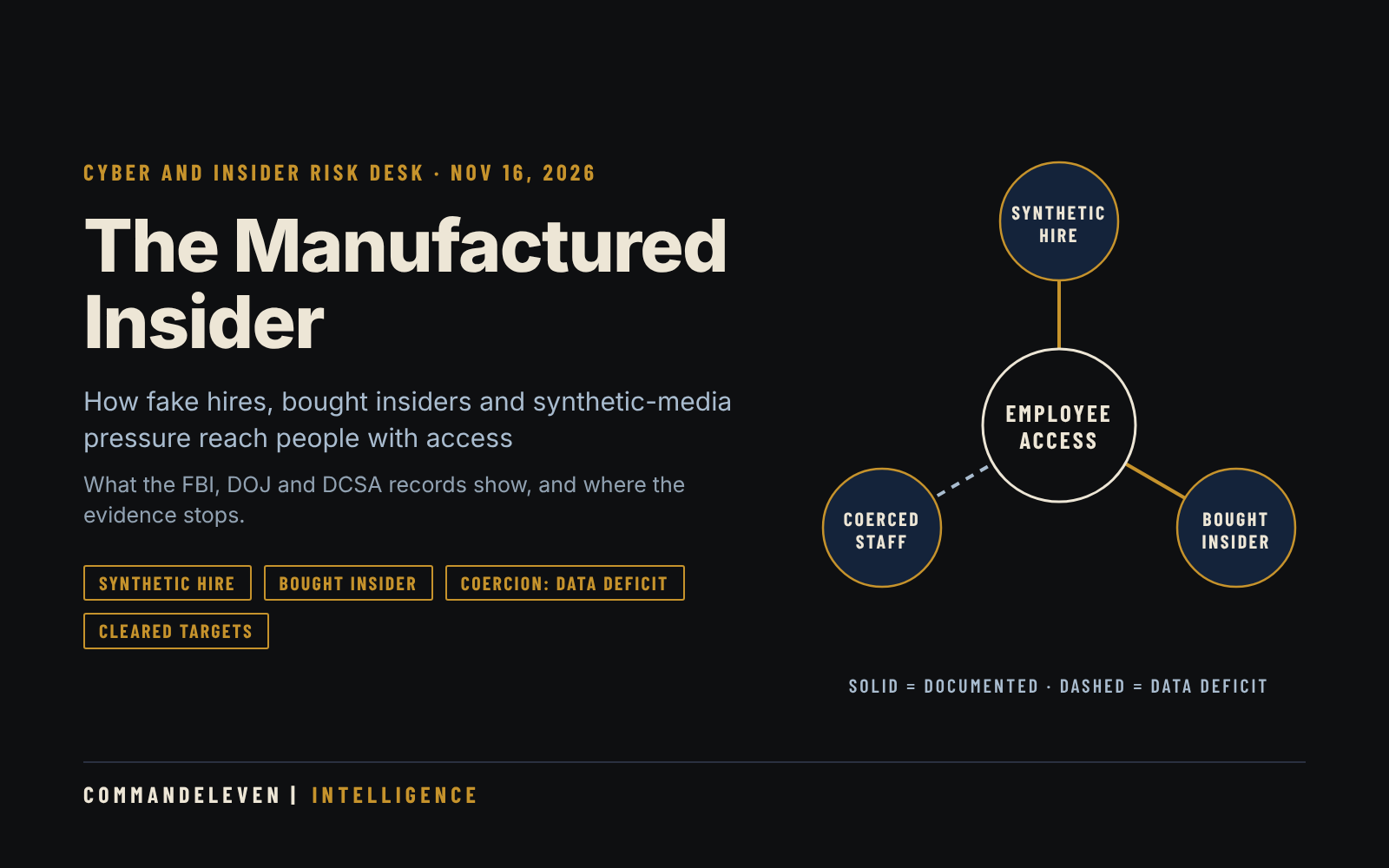
“Insider threat” now covers three different problems, and the public record supports each to a different degree. The synthetic hire is documented at scale: a fake or borrowed identity passes hiring, and a US facilitator often hosts the laptop. The bought insider is documented in company disclosures: a real employee is paid to hand over access or data. The coerced insider is documented only in part. Threats and extortion appear in the FBI’s October 2026 alert on North Korean IT workers, but we found no public case in which a deepfake was used to coerce an employee into giving access. We treat that gap as a data deficit, not as evidence that it has not happened.
For business, the practical point is that verification must not depend on judging a face or a voice on a call. For counterintelligence teams, the DCSA data on résumé submissions points to the hiring channel as a collection route against cleared industry.
Key Judgments
KJ1: The synthetic hire is the best-documented path, and it is an identity problem before it is a deepfake problem. [CONFIRMED that DOJ has charged facilitators and identity fraud in multiple cases; ASSESSED that deepfakes are an emerging supplement] The FBI’s October 2026 alert and DOJ’s Lonestar Roundup release describe stolen or fabricated identities, interview stand-ins and facilitators, and neither mentions deepfakes. Skadden, citing an FBI alert of January 2025, reports that North Korea-linked workers used AI and face-swapping in video interviews.
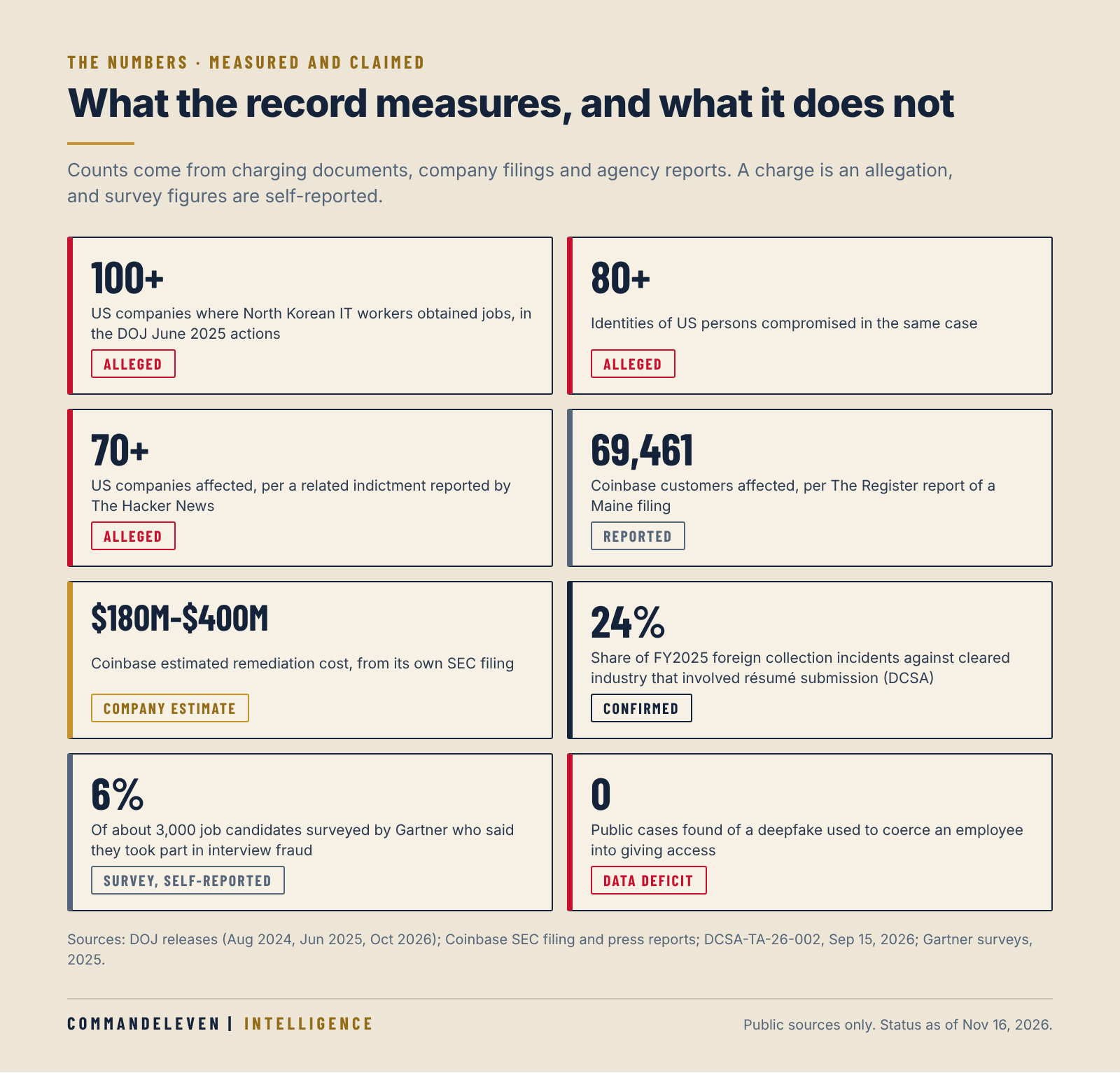
KJ2: The bought insider needs no synthetic media and is already costly. [CONFIRMED] Coinbase disclosed that overseas support staff were bribed, with a remediation estimate of $180 million to $400 million in its SEC filing. The Register reported a Maine filing listing 69,461 customers. CrowdStrike fired an insider after screenshots leaked on Telegram.
KJ3: Coercion is documented, but the deepfake link to employees is not. [CONFIRMED for threats and extortion by North Korean IT workers per the FBI; DATA DEFICIT for deepfake-enabled coercion of employees] The FBI’s 2023 warning on synthetic explicit images concerns individual victims and does not tie the technique to workplace access.
KJ4: The barrier to building a fake candidate is low. [ASSESSED] Palo Alto Networks Unit 42 reported that one researcher with no image-manipulation experience and limited deepfake knowledge built a synthetic interview identity in about 70 minutes on a five-year-old computer using free tools. That demonstrates feasibility. It does not measure how often it happens.
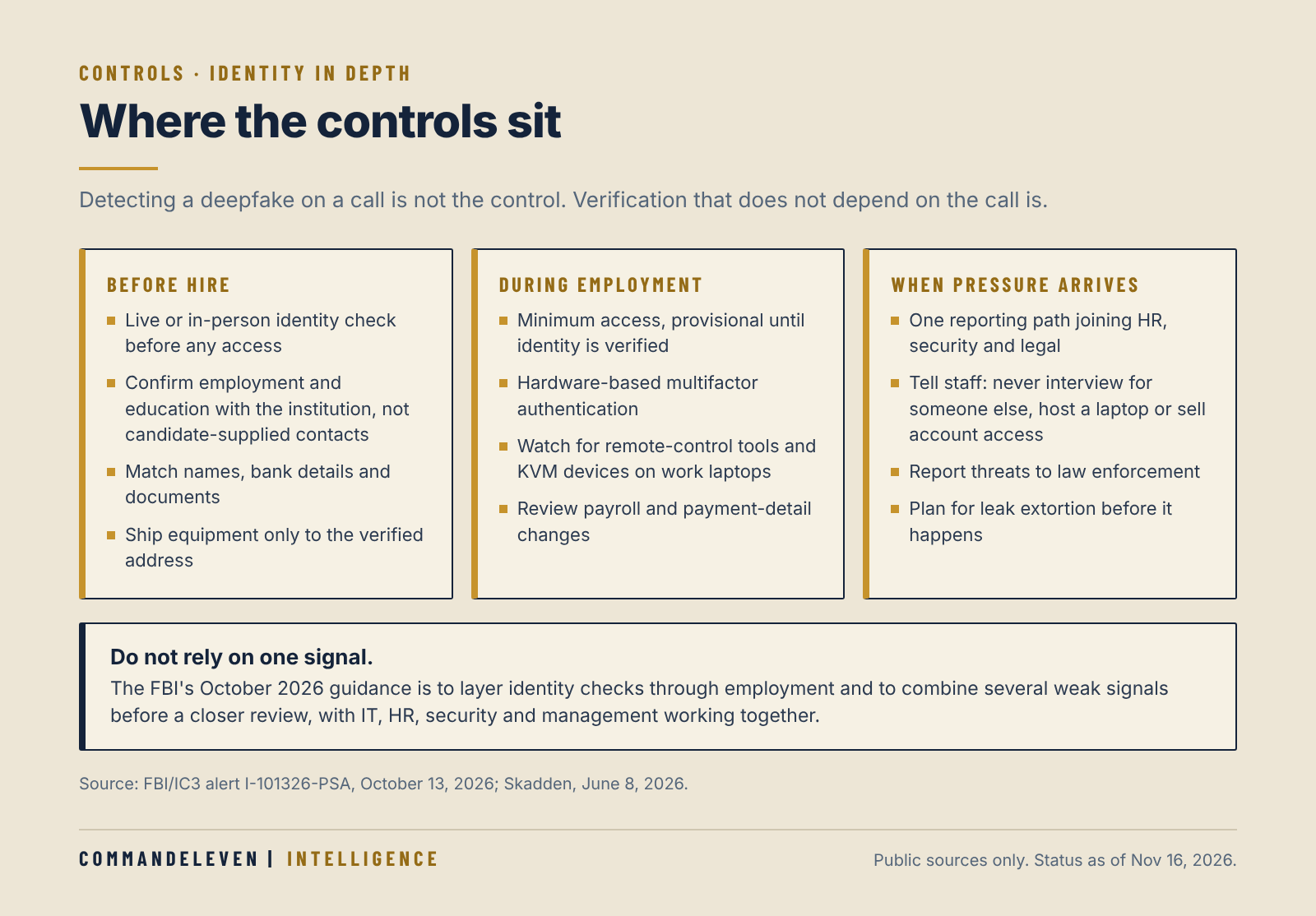
KJ5: The control that works is identity in depth, applied before hire, during employment and when pressure arrives. [ASSESSED] This follows the FBI’s October 2026 mitigation guidance: layer checks, combine weak signals, and bring HR, IT, security and management together.
Three Paths to an Insider
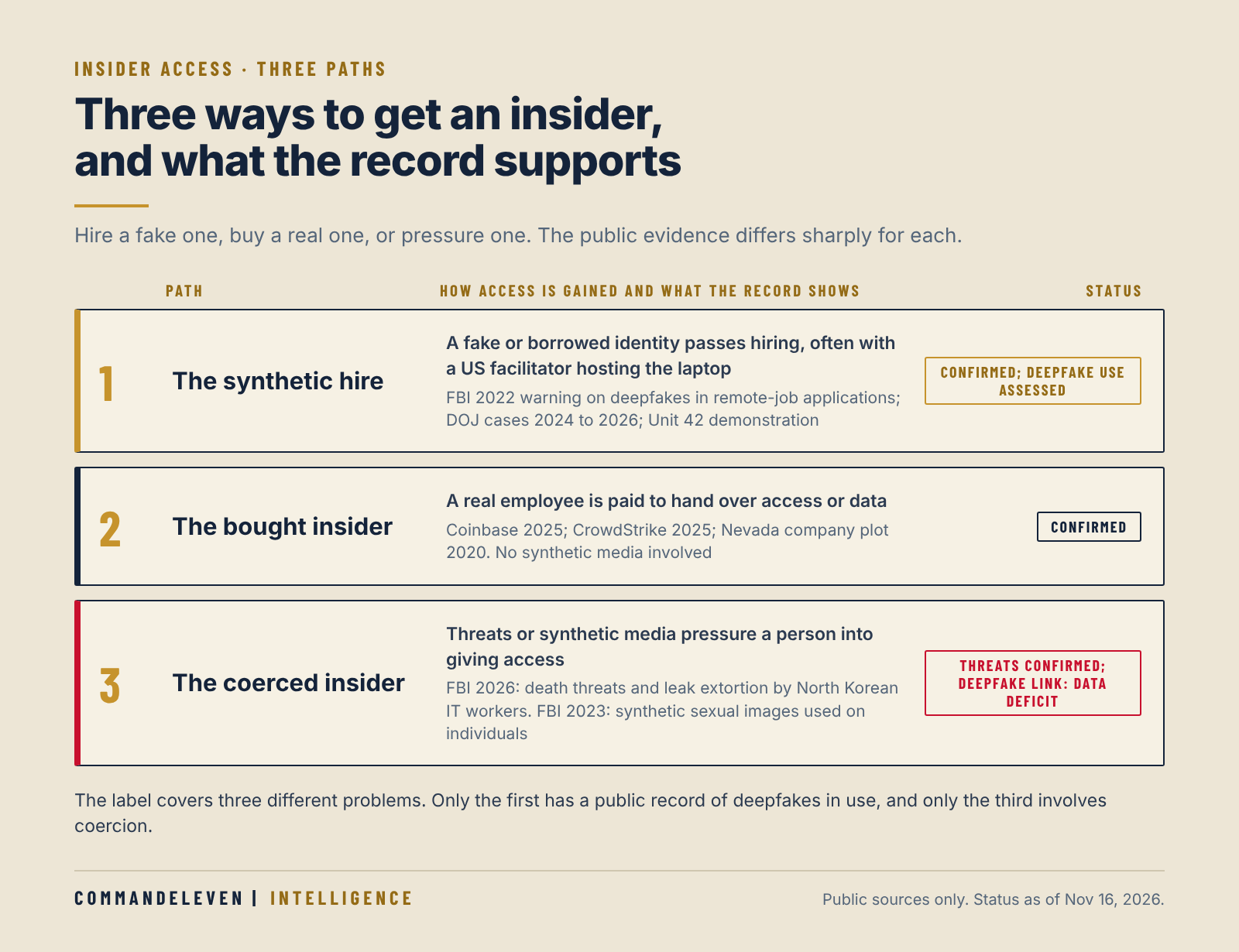
The three paths differ in who the insider is. In the first the insider is invented or borrowed. In the second the insider is real and willing. In the third the insider is real and unwilling. The table sets out what the public record shows for each.
Path One: The Synthetic Hire
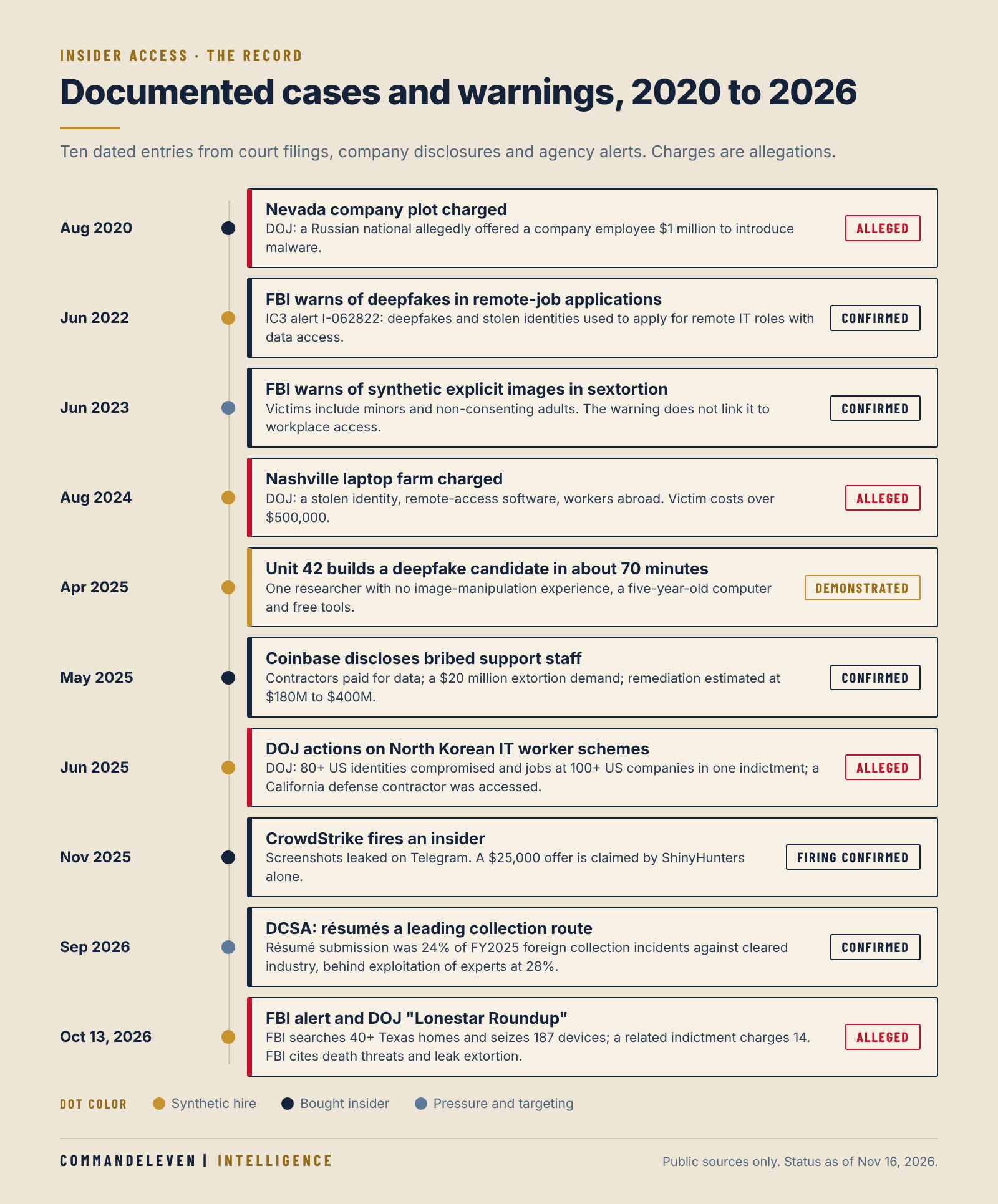
In June 2022 the FBI’s Internet Crime Complaint Center warned of complaints about deepfakes and stolen personal information used to apply for remote jobs, including IT, programming, database and software roles with access to sensitive data. Its listed red flags were voice spoofing and lip movements that did not match the audio.
Court records since then describe a scheme that leans on identity fraud and local help more than on synthetic video. In August 2024 DOJ announced charges against Matthew Isaac Knoot of Nashville, alleged to have run a laptop farm from July 2022 to August 2023 for overseas workers using a stolen identity. DOJ said the overseas workers were each paid over $250,000, much of it reported under the name of the real person whose identity was stolen, and that victim companies incurred more than $500,000 in costs to audit and remediate their systems. In June 2025 DOJ announced further actions in which facilitators allegedly compromised more than 80 US identities, and workers obtained jobs at more than 100 US companies, many of them on the Fortune 500. DOJ said the facilitators received at least $696,000 and that victim losses were at least $3 million. A California defense contractor developing AI-powered equipment was among those accessed, and data marked as controlled under ITAR was taken. Charges and allegations are not findings unless a conviction is stated.
On October 13, 2026, DOJ announced what it called the Lonestar Roundup. DOJ’s Northern District of Texas release says the FBI searched more than 40 Texas residences and seized 187 laptops and KVM devices, about 100 of them in North Texas, and that each laptop seized “potentially represents one company that has hired a DPRK IT worker.” The Hacker News reports that a related indictment charges 14 people, affects more than 70 US companies and covers a scheme running from about 2019 to July 2025. The same day the FBI issued alert I-101326-PSA. It says facilitators are paid to appear on camera or sit in interviews, verify identities and share accounts, that some work is subcontracted to freelancers in Pakistan, India and Nigeria, and that workers may buy accounts or licenses from identity-verification providers. Neither the alert nor the DOJ release mentions deepfakes. Skadden’s June 2026 note, citing a January 2025 FBI alert on data extortion, says the FBI has warned that North Korea-linked workers used AI and face-swapping technology in video interviews.
Palo Alto Networks Unit 42 showed in April 2025 how little a convincing candidate needs. One researcher with no image-manipulation experience and limited deepfake knowledge built a synthetic interview identity in about 70 minutes on a five-year-old computer with free tools. The weak points it listed were temporal consistency, occlusion, lighting adaptation and audio-visual sync. Gartner has predicted that by 2028 one in four candidate profiles will be fake, and in a survey of about 3,000 candidates 6% admitted to interview fraud. The prediction is a forecast and the survey is self-reported.
Path Two: The Bought Insider
The older route needs no synthetic media. In August 2020 DOJ charged a Russian national, Egor Kriuchkov, with conspiring to recruit an employee of a Nevada company to introduce malware, extract data and extort a ransom. He allegedly promised the employee $1 million. A complaint is an accusation.
Coinbase disclosed in May 2025 that overseas support staff had been bribed. In its SEC filing the company said an unknown actor paid multiple contractors or employees in overseas support roles to collect data from internal systems, that it had not paid the extortion demand ($20 million, per its blog post), and that it estimated expenses of about $180 million to $400 million. It also offered a $20 million reward. The Register reported that a Maine Attorney General filing listed 69,461 affected customers; we have not seen that filing.
In November 2025 CrowdStrike said an insider had shared screen photos that appeared on Telegram. It said the insider was fired and referred to law enforcement, and that its systems were not compromised. The group ShinyHunters claimed it paid $25,000 for the access. That figure comes from the group and we have not seen it confirmed.
Path Three: The Coerced Insider
The FBI’s October 2026 alert describes pressure on people. It reports death threats to former managers and their families, threats to leak data or source code unless lump sums are paid, reputational threats, and in-person intimidation by US facilitators. That is coercion of employers and former employers by workers who already hold access.
The synthetic-media element is documented elsewhere. In June 2023 the FBI warned that extortionists turn ordinary photos into explicit images or video to pressure victims, who include minors and non-consenting adults. The warning gives no counts and does not describe workplace access.
Data deficit. We searched for a public case, from a court document or a government or company statement, in which a deepfake was used to pressure an employee into giving access. We found none. Absence from public sources does not show that it has not happened. It means the claim cannot be scored today, which is why this assessment sets a call on it (MI-02).
The Cleared-Personnel Angle
For counterintelligence teams, the relevant dataset is DCSA’s report on foreign collection against cleared industry, product DCSA-TA-26-002, published September 15, 2026 and covering fiscal year 2025 (October 2024 to September 2025). DCSA received more than 22,000 suspicious contact reports and identified roughly 2,900 incidents involving foreign entities. The leading method of operation was exploitation of experts (28%), followed by résumé submission (24%) and exploitation of business activities (18%). The leading methods of contact were email (30%), academic résumés (15%) and web forms (14%), with professional résumés at 9%. East Asia and the Pacific accounted for 48% of reporting. The report describes hiring as one route to cleared industry, and it includes a case in which multiple personas applied between December 2024 and March 2025 for senior software-engineering roles at a cybersecurity company, with different names and addresses but shared technical identifiers and, in some cases, identities linked to deceased individuals. DCSA says this suggests stolen or fabricated identities. The report does not mention deepfakes. DCSA’s January 28, 2026 release gave different percentages, so we use the September report and cite it by product number.
The FBI alert adds that North Korean IT workers seek cleared positions and target active-duty military personnel to host laptops.
What Works
The FBI’s guidance is “identity in depth”: combine weak signals rather than rely on one, avoid depending on ban lists, add verification friction such as E-Verify, passport checks and live verification, and have HR, IT, security and management act together. Skadden’s June 2026 note, which counts more than 40 people charged by DOJ and no DOJ or OFAC enforcement against companies that unknowingly hired such workers, recommends in-person or live identity verification and minimum, provisional access.
The FBI lists indicators that are technical rather than visual: remote-desktop tools, KVM-over-IP hardware, and rotating bank accounts and addresses. The strategic point is that none of these depends on spotting a synthetic face.
What This Means for Business
- Security, HR and legal: treat hiring as part of the access perimeter. Verify identity independently of the interview, ship equipment only to a verified address, and keep access provisional until checks clear.
- Employee policy: state plainly that staff must not interview for someone else, host a laptop for an outside party or sell account access, and give them one reporting route that joins HR, security and legal.
- Extortion readiness: plan for a threat to leak data or code before it arrives, including who calls law enforcement and who speaks to staff.
- Counterintelligence and cleared contractors: treat unsolicited résumé and recruiting contact as a reportable collection route, as the DCSA data suggests.
What to Watch
- Whether a US government document describes deepfake or face-swap use in a job interview by a North Korea-linked worker or facilitator.
- Whether any government or company document alleges a deepfake used to coerce an employee.
- Further company disclosures of employees or contractors paid by outside groups for access.
- The next DCSA annual report and whether résumé submissions remain among the top collection methods.
Calls We Will Score
| ID | Call | Resolves | What counts |
|---|---|---|---|
| MI-01 | A US government document published after November 16, 2026 describes deepfake or face-swap use in a job interview by a North Korea-linked worker or facilitator. [ASSESSED] | June 30, 2027 | An FBI, DOJ or other US agency alert, charging document or press release that says so directly. |
| MI-02 | No US or allied government document alleges that a deepfake was used to coerce an employee into giving access. [ASSESSED] | June 30, 2027 | Any such allegation in an official document before the date resolves the call against us. |
| MI-03 | At least one further company- or government-confirmed case of an employee or contractor paid by an outside group for access. [ASSESSED] | March 31, 2027 | A company disclosure, regulatory filing or charging document naming the payment. |
| MI-04 | DCSA’s next annual report on foreign collection against cleared industry again lists résumé submission among its top three methods of operation. [ASSESSED] | September 30, 2027 | The published report’s ranking of methods of operation. FY2025 ranking: exploitation of experts 28%, résumé submission 24%, business activities 18%. |
What This Assessment Does and Doesn’t Establish
It establishes what public government records, company filings and research publications state. It does not establish how many insiders exist, how often deepfakes are used in hiring, or whether coercion by synthetic media has occurred in the workplace. Charges are allegations unless a conviction is stated. Figures from surveys, from a single press account or from a group claiming credit are labeled as such. We have not seen non-public reporting.
Frequently Asked Questions
Are deepfakes being used to get fake employees hired?
The FBI warned in June 2022 of deepfakes and stolen identities in remote-job applications, and Skadden, citing a January 2025 FBI alert, reports face-swapping in video interviews. The large DOJ cases describe stolen identities, stand-in interviewers and facilitators more than synthetic video, so the scale of deepfake use is not established.
Has a deepfake been used to force an employee to give up access?
We found no public case. The FBI documents threats and extortion in the North Korean IT worker cases and warns of synthetic images used to pressure individuals, but it does not connect the two.
What is a laptop farm?
It is a US location where company-issued laptops are hosted so that overseas workers can connect remotely while appearing to work from the United States.
What is the cheapest control for a business?
Independent identity verification before access, with access kept to the minimum until it clears. It does not depend on judging a face or voice.
Related CommandEleven Intelligence Reading
- Deepfake CEO Fraud: what the alleged $129 million case shows about voice-clone impersonation
- State-Backed Hacktivist Groups and Hired Fronts
- The Air-Gap Myth
Sources
- FBI IC3, public service announcement I-062822-PSA, June 28, 2022
- FBI IC3, public service announcement PSA230605, June 5, 2023
- FBI IC3, alert I-101326-PSA, “North Korean IT Workers Expanding Use of Facilitators, Broadening Recruitment,” October 13, 2026
- US Department of Justice, “Russian National Arrested for Conspiracy to Introduce Malware into a Nevada Company’s Computer Network,” August 25, 2020
- US Department of Justice, “Justice Department Disrupts North Korean Remote IT Worker Fraud Schemes Through Charges and Arrest of Nashville Facilitator,” August 8, 2024
- US Department of Justice, coordinated nationwide actions against North Korean remote IT worker schemes, June 30, 2025
- US Attorney’s Office, Northern District of Texas, “Operation Lonestar Roundup dismantles North Korean IT worker network used to penetrate U.S. companies in Texas,” October 13, 2026
- The Hacker News, “U.S. Shuts Down Over 40 Laptop Farms, Charges 14 in North Korean IT Worker Fraud,” October 14, 2026
- Palo Alto Networks Unit 42, research on North Korean synthetic identity creation, April 2025
- DCSA, Targeting U.S. Technologies: A Report of Threats to Cleared Industry, product DCSA-TA-26-002, published September 15, 2026 (copy of the PDF)
- Skadden, “North Korean Remote IT Worker Fraud: Managing Insider Threat, Sanctions and Employment Risk,” June 8, 2026
- Coinbase Global, Form 8-K, Item 1.05, May 2025
- The Register, “Coinbase extorted for $20M. Support staff bribed,” May 15, 2025
- Security Affairs, “CrowdStrike denies breach after insider sent internal screenshots to hackers,” November 21, 2025
- Personnel Today, “By 2028 one in four candidate profiles will be fake,” August 1, 2025