Middle East Desk | Status as of November 15, 2026 | CommandEleven Intelligence Desk
Bottom Line Up Front
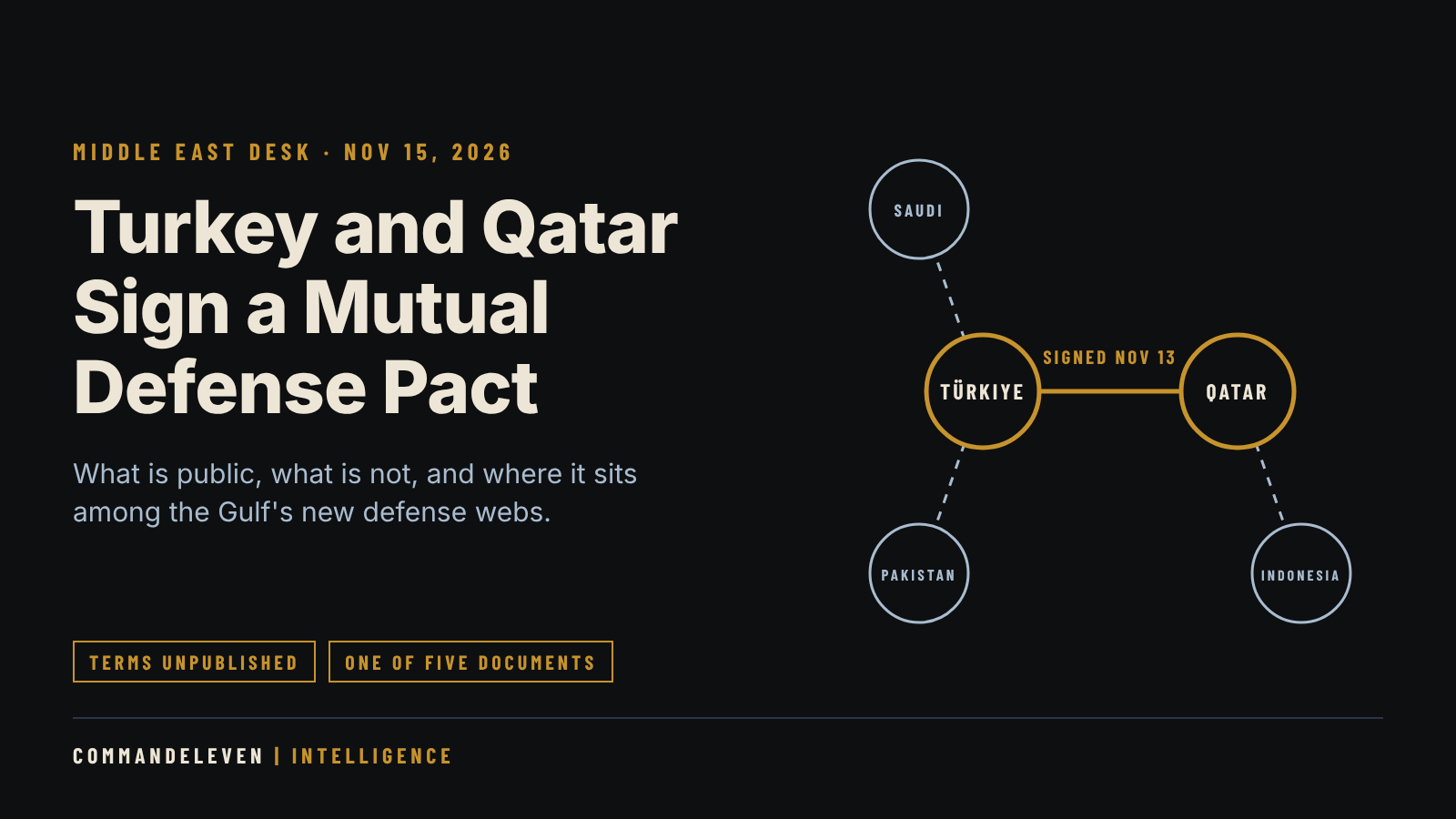
Türkiye and Qatar signed a defense agreement on Friday, November 13, 2026 in Istanbul. The Turkish presidency says it commits the two countries to a “unified stance against external armed attacks on either country.” The text has not been published, and the details were “not immediately clear” in the reporting we reviewed. What is public is a political signal. What is not public is whether it contains an automatic defense obligation, and that is the question that decides how much it changes.
Key Judgments
- High confidence: The agreement was signed by President Erdoğan and Emir Tamim at the 12th Türkiye–Qatar Supreme Strategic Committee at Dolmabahçe, one of five documents signed that day.
- High confidence: It builds on an existing relationship. Türkiye already has a military base and several defense agreements with Qatar, with agreements dating to 2017 according to Middle East Eye.
- Moderate confidence: The pact adds Qatar to a growing set of Türkiye-linked defense arrangements alongside the Makkah pact and the Badr memorandum.
- Low confidence: Whether the text creates a binding mutual-defense clause, and what Doha and Ankara would do under it, cannot be determined until the text or an official summary is released.
What Is Public
- Five documents: a defense agreement, an education agreement, a consumer-protection and market-surveillance memorandum, a peace, reconciliation and conflict-resolution memorandum, and a joint declaration.
- Defense terms (per the Turkish presidency, via Gulf News): a unified stance against external armed attacks on either country, consultation on security threats, expanded exercises, defense-industry cooperation and training.
- Erdoğan’s framing: the pact adds “a new dimension,” is meant to prevent a renewed war in the Gulf, and sits alongside diplomacy and an energy partnership with Qatar to be developed and diversified.
What Is Not Public
The text is unpublished. We do not know whether “unified stance” means a mutual-assistance obligation, a consultation duty, or a political declaration. We found no third-party reactions in the sources we reviewed. Analyst Yusuf Alabarda told Al Jazeera that Gulf states doubt U.S. guarantees and that Turkish weapons and air defenses “might be deployed.” That is his speculation, not a reported term of the agreement.
Where It Sits
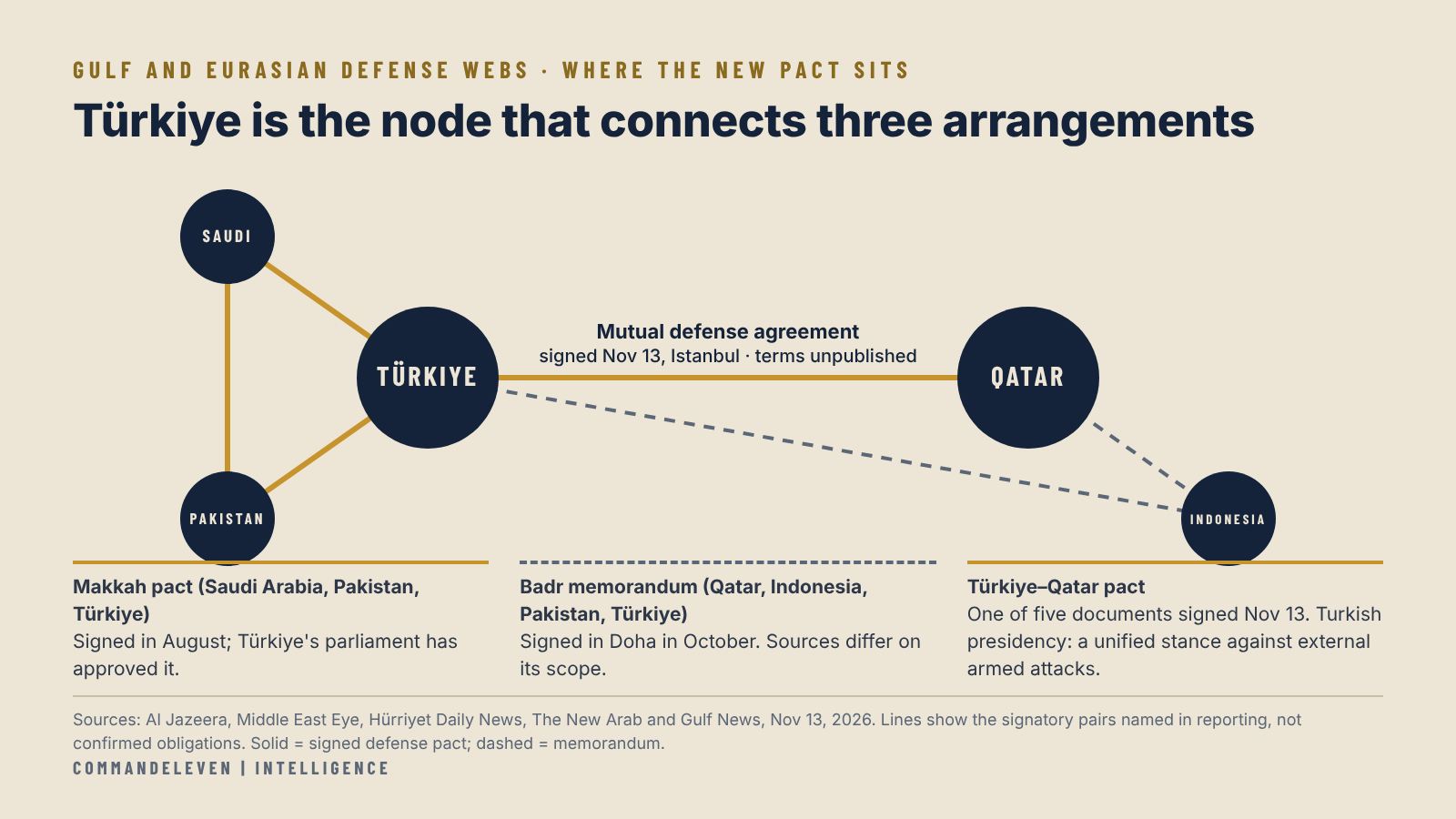
Three arrangements now run through Ankara. The Makkah pact links Türkiye, Pakistan and Saudi Arabia; it was signed in August, and Türkiye’s parliament approved it the week before this signing. The Badr memorandum, signed in Doha in October by Qatar, Indonesia, Pakistan and Türkiye, is described by Al Jazeera as a multilateral defense cooperation memorandum, while a related Middle East Eye headline refers to joint weapons production, so the sources differ on its scope. The Türkiye–Qatar agreement is bilateral and public in outline only. See our series on the Makkah pact, including Diamond versus Hexagon and the coalition question.
Qatar is not at the table in the US–Iran track as a party; in our Tehran talks analysis, Qatar and Pakistan are mediating indirect talks. A defense pact with Türkiye gives Doha a second security partner beyond the United States while it holds that mediating role.
What We Are Watching
- Publication of the text or an official summary, and whether it contains an assistance clause.
- Any link between the pact and the Badr memorandum or the Makkah pact, including Qatari participation in either.
- Deployments, exercises or air-defense transfers announced under the agreement.
- Reactions from Riyadh, Abu Dhabi, Tehran and Washington.
- Energy partnership details Erdoğan said would be developed and diversified.
Calls We Will Score
- By December 31: the full text or an official detailed summary of the defense agreement is published.
- By December 31: a joint Türkiye–Qatar exercise or deployment is announced under the agreement.
- By December 31: no other Gulf state signs a comparable bilateral defense agreement with Türkiye.
What This Assessment Does and Does Not Establish
It establishes what the Turkish presidency and press reports say was signed. It does not establish the legal force of the agreement, any operational commitment, or how other governments will respond. Figures and descriptions are as reported as of November 15, 2026.
Frequently Asked Questions
What did Türkiye and Qatar sign?
A defense agreement, one of five documents signed on November 13, 2026 in Istanbul, alongside education, consumer-protection and conflict-resolution documents and a joint declaration.
Is it a mutual defense treaty?
The Turkish presidency describes a unified stance against external armed attacks on either country. The text is not public, so whether it is binding is not established.
Did Türkiye already have forces in Qatar?
Yes. Türkiye already has a military base and several defense agreements with Qatar.
Related Reading
- The Makkah pact series
- Makkah pact: Tehran talks
- Makkah pact: coalition, Typhoons, Syria and Egypt
- UAE, the Houthis and Yemen
Sources
- Gulf News, reporting the Turkish presidency statement, November 13 to 14, 2026
- Al Jazeera, analysis including Yusuf Alabarda and the Badr memorandum
- Middle East Eye, background on Türkiye–Qatar agreements and the Badr memorandum