This is Part 5 of CommandEleven Intelligence’s coverage of the Makkah Pact. Part 3 argued that Saudi Arabia is strong in the air and weak on the ground, and set indicators for the next six months. Three weeks later, several of them are already moving. This part takes stock of who is now helping Riyadh, on what terms, and what is still only reported.
Bottom Line Up Front
Riyadh is building a coalition, and almost all of it is defensive. Britain is sending Typhoons to fly air defense over Saudi cities and has ruled out strikes on the Houthis. France has sent troops and air defenses to the Yanbu oil hub. Pakistan’s forces are in the Kingdom under the Makkah Pact and say they will not cross into Yemen. Egypt’s president has asked parliament for air defense and logistics forces, and the vote is set for October 26. Türkiye has not yet ratified the pact.
The one contribution that would change the ground war is the least certain. Saudi Arabia has asked Syria for troops. Damascus is considering it and publicly denies any deployment. A single Lebanese report claims about 1,500 Syrian fighters are already in the Kingdom; no second source supports it.
The pattern matches what Part 3 predicted: Riyadh is closing its air defense gap with foreign help much faster than its ground gap.
Key Judgments
KJ1: Britain has moved from support to air defense, and only air defense. The UK Ministry of Defence announced on October 20 that RAF Typhoons will fly “defensive counter air missions” over Saudi Arabia and “will not conduct offensive strikes against the Houthis.” [CONFIRMED]
KJ2: The coalition is filling Saudi Arabia’s air defense gap, not its ground gap. The British, French, Pakistani, Turkish and proposed Egyptian contributions are all framed as defending Saudi territory and infrastructure. None of them is a commitment to fight inside Yemen. [CONFIRMED on stated terms; ASSESSED on effect]
KJ3: Syria is the only potential ground contribution, and it is unconfirmed. Axios reported on October 7, citing three US officials, that Riyadh asked Damascus for 10,000 to 20,000 troops and that President Ahmed al-Sharaa was seriously considering it. Damascus denies any deployment. The claim that about 1,500 Syrian fighters are already in Saudi Arabia rests on one Lebanese outlet, Al-Modon, and is unconfirmed. [CONFIRMED that the request was reported; SINGLE-SOURCE on any arrival]
KJ4: Egypt’s parliament is likely to approve a limited mandate. CommandEleven Intelligence assesses that if parliament votes on October 26, it will authorize air defense and logistics support restricted to Saudi territory, with no combat role inside Yemen. [ASSESSED, dated call]
KJ5: Pakistan is defending Saudi Arabia while talking to Tehran. Pakistani forces are in the Kingdom under the Makkah Pact, while Field Marshal Asim Munir has traveled to Tehran on a Pakistani-Qatari proposal to release frozen Iranian funds. Islamabad is positioning itself as both Saudi Arabia’s shield and a channel to Iran. [CONFIRMED on the visit; ASSESSED on intent]
The Coalition Ledger
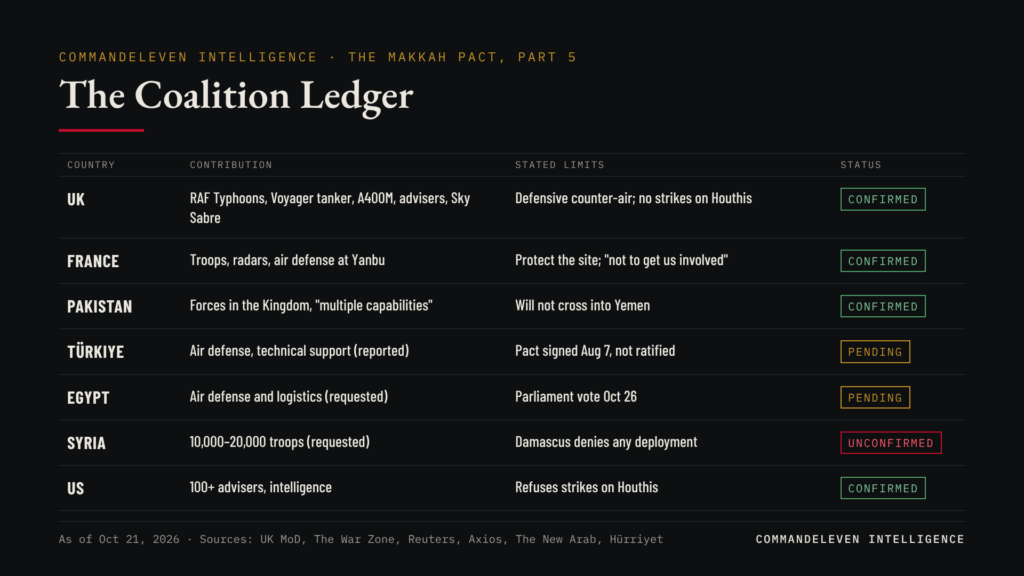
United Kingdom. The October 20 package adds RAF Typhoons to an RAF Voyager tanker that has refueled Saudi jets since September, an A400M transport, British military advisers working with Saudi forces, and Sky Sabre air defense systems shipped to protect the Typhoons. The number of jets and their base have not been announced. Defence Secretary Wes Streeting called the Houthi attacks “absolutely despicable.” The Houthis claim one of their rockets exploded near a Typhoon inside Yemen earlier in October. That claim is the Houthis’ own and is unverified. [CONFIRMED except where stated]
France. President Emmanuel Macron announced on September 24 that France would send “soldiers, radar systems and defense systems” to protect the Yanbu energy hub on the Red Sea, with the aim of protecting the site “not to get us involved in any conflicts.” Numbers and equipment were not disclosed. [CONFIRMED]
Pakistan. Pakistan’s military spokesman confirmed on October 8 that Pakistani forces “are already there” in the Kingdom in “multiple capabilities and domains.” Defence Minister Khawaja Asif has described Pakistani and Turkish forces as playing “a supporting role,” mainly reconnaissance, while Saudi forces fight. Pakistan’s Foreign Office has said its forces will not cross into Yemen. [CONFIRMED]
Türkiye. Türkiye signed the Makkah Joint Defence Agreement on August 7 but has not ratified it. President Erdoğan said on October 12 that it would go to parliament “in the coming days.” Turkish law gives parliament authority over sending troops abroad, and Ankara has not publicly confirmed a deployment. Reported contributions are defensive and technical, centered on air defense. [CONFIRMED on status]
Egypt. President Abdel Fattah el-Sisi has asked parliament to authorize air defense forces and logistical support to help Saudi Arabia counter Houthi missiles and drones. Parliament delayed the vote twice and set it for October 26. Several parties want the mission limited to defending Saudi territory, and one has told its members to abstain. Al-Azhar’s Grand Imam has called for mediation. Separate reports of Egyptian military transports landing at Prince Sultan Air Base are unverified. [CONFIRMED on the request and the delay]
Syria. See the next section. [REPORTED; UNCONFIRMED]
United States. Washington has refused Saudi requests to strike the Houthis, but more than 100 US military advisers are providing intelligence support in the Kingdom, and a third US carrier, the USS Theodore Roosevelt, is expected in the region by the end of November. The carrier deployment is tied to the Iran war, not announced as support for Riyadh. [CONFIRMED]
The Syria Question
Syria is the coalition’s wild card because it is the only candidate that could supply what Part 3 identified as Riyadh’s real shortfall: ground troops willing to fight in Yemen.
What is established:
- The request. Axios reported on October 7, citing three US officials, that Saudi Arabia and Syria were discussing a deployment of 10,000 to 20,000 Syrian troops and that al-Sharaa was seriously considering it. One official said he was highly likely to accept. Riyadh reportedly values Syrian troops’ training and their experience with Turkish drones.
- The options. Reuters reported that the options include either a defensive role protecting Saudi Arabia or an offensive one.
- The visits. Senior Syrian commanders reportedly spent four days touring sites in Najran and Asir provinces, on the Yemeni border.
- The denial. Syria’s Information Ministry said its regional policy is based on “stability, peace and cooperation, not on opening new fronts,” and that any cooperation would go through official channels. A defense ministry source said there is “currently no movement” of Syrian forces toward Yemen.
What is not established:
- The 1,500 figure. Al-Modon, a Lebanese site, reported that about 1,500 Syrian fighters had already been sent to Saudi Arabia. No other outlet has confirmed it, and the outlet that relayed it calls it unconfirmed.
- Aden and drone operators. Claims circulating on social media that Syrian drone operators are already based in Aden do not appear in any sourced reporting we reviewed. CommandEleven Intelligence does not treat them as established.
- An earlier false start. In September, Al-Akhbar reported “hundreds” of Syrian fighters in southern Saudi Arabia. Analysts doubted it, and some of the “evidence” circulated online at the time proved false.
The risks for Damascus are real. US officials have reportedly raised concern about a sectarian dimension to Syrian forces fighting the Zaydi Houthis, and Syria previously declined a US request to help against Hezbollah for that reason. Sending troops abroad while the country is rebuilding would also be unpopular at home. [ASSESSED]
Part 3’s Indicators, Three Weeks In
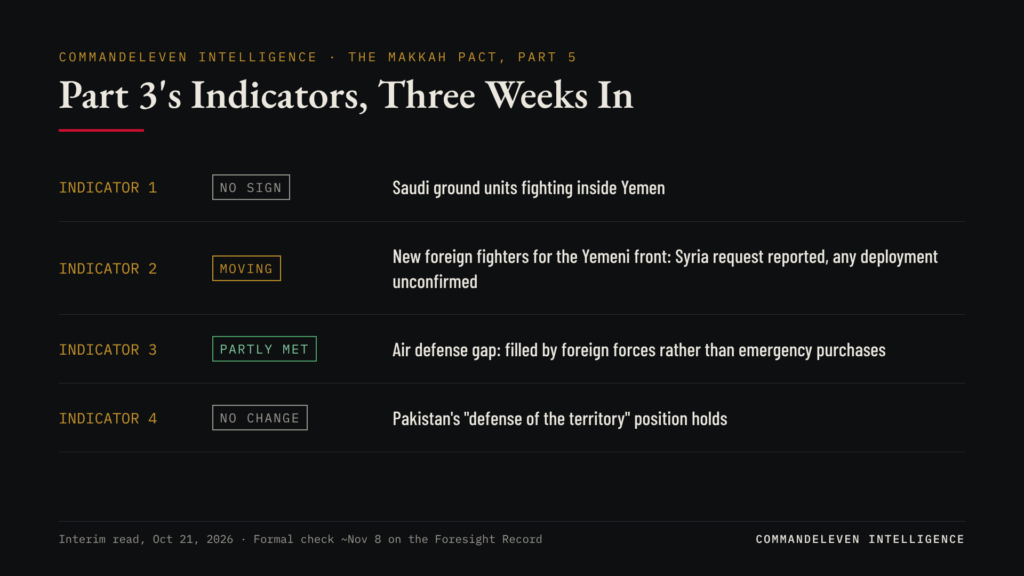
Part 3 set four indicators for its six-month outlook. This is an early read; the formal check is on the Foresight Record’s Audit Calendar for around November 8.
| Indicator | Read as of October 21 |
|---|---|
| Saudi ground units fighting inside Yemen | No sign. The ground offensive is still carried by Yemeni government forces. |
| New recruitment of foreign fighters for the Yemeni front | Moving. The Syrian troop request is reported by US officials; any deployment is unconfirmed. |
| Saudi emergency purchases of short-range air defense and counter-drone systems | Partly met, by a different route. Instead of purchases, Riyadh is getting foreign air defense forces: British, French, Pakistani and possibly Egyptian. |
| A shift in Pakistan’s “defense of the territory” position | No change. Pakistan says its forces will not cross into Yemen. |
Part 3’s “most likely” path, a long, grinding standoff, still fits the evidence. The Houthis claimed new strikes on October 19 against an Aramco site in Yanbu, the Shaybah oilfield, and the Riyadh and Abha airports; Saudi Arabia had not confirmed them. Officials on both sides describe negotiation as off the table.
Dated Calls
These calls are registered on the Foresight Record and will be scored on the dates given.
- Egypt, by October 31, 2026. Parliament authorizes air defense and logistics support for Saudi Arabia, limited to Saudi territory, with no combat role inside Yemen. [ASSESSED]
- United Kingdom, through December 31, 2026. British aircraft do not conduct offensive strikes on Houthi targets in Yemen. [ASSESSED]
- Syria, through December 31, 2026. Damascus does not officially announce a combat deployment of Syrian forces inside Yemen. If a Syrian presence is confirmed, it is first in a defensive, training or border role on Saudi territory. [ASSESSED]
- Türkiye, by December 31, 2026. The Turkish parliament ratifies the Makkah Joint Defence Agreement. [ASSESSED]
What This Dossier Does Not Claim
- It does not claim any Syrian forces are in Saudi Arabia or Yemen.
- It does not claim British, French, Pakistani or Turkish forces are fighting inside Yemen.
- It does not claim the coalition is coordinated under a single command. Each contribution was announced separately, on its own terms.
- It does not treat Houthi or coalition battlefield claims as verified.
Frequently Asked Questions
Is Britain at war with the Houthis?
No. The UK says its Typhoons will fly defensive missions over Saudi Arabia and will not strike the Houthis.
Has Syria sent troops to Saudi Arabia?
Not on the confirmed record. US officials told Axios that Riyadh asked and Damascus was considering it. Syria denies any deployment, and the only report of troops already in the Kingdom is single-source.
What is Egypt voting on?
Whether to authorize President Sisi to send air defense forces and logistical support to help Saudi Arabia against Houthi missiles and drones. The vote is set for October 26.
Is the Makkah Pact in force for Türkiye?
Türkiye signed it on August 7 but has not ratified it. President Erdoğan said it would go to parliament soon.
Sources
- The National, UK mission to defend Saudi Arabia adds Typhoon jets
- Al Jazeera, UK to deploy Typhoon jets to help defend Saudi Arabia from Houthi attacks
- The War Zone, France sending forces to help defend Saudi Arabia’s Red Sea oil facilities
- Arab News (Reuters), Pakistan military confirms deployment of forces to Saudi Arabia under Makkah pact
- Al Jazeera, Pakistan, Türkiye and Saudi deterrence against Houthis: What that means
- Hürriyet Daily News, Türkiye moving to ratify Mecca defense pact: Erdoğan
- The New Arab, Egypt postpones Sisi’s Saudi troop deployment vote to next week
- Axios, Syria considering sending troops to Yemen to fight Houthis
- The New Arab, Syria denies troops will be sent to Yemen
- Türkiye Today, Syria denies joining Yemen war amid reports it may send troops against Houthis
- JFeed, Syria preparing to send 10,000 fighters to fight Houthis
- The New Arab, Is Saudi Arabia recruiting Syrian fighters to fight the Houthis?
- IOL (The Washington Post), Saudis and Houthis see war as only path ahead
- The Times of Israel, Yemen’s Houthis claim attacks on Saudi Aramco site, airports and military targets
- Israel Hayom, Third US aircraft carrier heads to Middle East as oil prices surge, Iran weighs compromise deal
The Makkah Pact Series
Series Introduction: The Makkah Pact
- The Makkah Pact’s First Test: Operation Yemen Dawn, Pakistan’s Role, and Iran’s Shrinking Map – Part 1
- The First Test, Tested: Riyadh’s Airport War and the Makkah Pact – Part 2
- Strong in the Air, Weak on the Ground: Why Riyadh Needs the Makkah Pact – Part 3
- Diamond vs. Hexagon: Where Pakistan Sits on Netanyahu’s Map – Part 4
- The Coalition Forms: Typhoons, Syrian Troops and Egypt’s Vote – Part 5 (you are here)