CommandEleven Intelligence · Middle East and Pakistan Desks. Makkah Pact series, status as of October 27, 2026.
This is Part 6 of CommandEleven Intelligence’s coverage of the Makkah Pact. Part 5 set out who was helping Riyadh and on what terms. Six days later, the pact’s members went to Tehran.
Bottom Line Up Front
On October 26, the three signatories of the Makkah Pact sat down with Iran’s leadership in Tehran. Saudi Defense Minister Prince Khalid bin Salman, Pakistan’s Field Marshal Asim Munir and Türkiye’s intelligence chief Ibrahim Kalın met President Masoud Pezeshkian, Foreign Minister Abbas Araghchi and security chief Mohsen Rezaei. It was the first high-level meeting between the pact and Iran since the war spread to Saudi Arabia and Yemen.
The meeting produced a statement and nothing more: the four countries agreed to keep talking. There was no ceasefire, no date for a second round and no mechanism. Within hours, the Houthis fired another missile at Riyadh and the Saudi-led coalition struck Houthi missile sites.
Since then, a report has spread online that a “Sana’a-Riyadh Agreement” has ended the war. It has not. No government has announced it, the Houthis’ own leadership is still demanding a Saudi withdrawal, and both sides were firing on each other the day it supposedly emerged. Egypt’s parliament, meanwhile, has authorized military support for Saudi Arabia, and the United States has warned its citizens about travel to 13 countries in the region.
Key Judgments
KJ1: The Tehran meeting opened a channel, not a settlement. The four countries agreed only to continue talks on regional security. No ceasefire, timetable or follow-up meeting was announced. [CONFIRMED]
KJ2: Riyadh went to Tehran because it believes Iran holds the key to the Houthis. Saudi officials framed the visit as de-escalation and support for Qatari and Pakistani mediation. A source in Tehran told The National that Prince Khalid carried a clear mandate from both the King and the Crown Prince. [CONFIRMED on the framing; ASSESSED on motive]
KJ3: The “Sana’a-Riyadh Agreement” is not real on the evidence available. The earliest version we found is an unsourced aggregator article published the morning after the Tehran meeting. No party has confirmed it, and the Houthis’ public position contradicts it. [ASSESSED, high confidence]
KJ4: Pakistan is now the pact’s main bridge to Iran. Munir visited Tehran the week before, and Iranian officials say the idea for the four-way meeting came up during that visit. Pakistan is defending Saudi territory and mediating with Iran at the same time. [CONFIRMED on the visits; ASSESSED on role]
KJ5: Egypt’s mandate is broad on paper and narrow in practice. Parliament authorized President Sisi to take “necessary measures” to support Saudi Arabia. The limits, defensive support and no combat in Yemen, come from Sisi and officials, not from the mandate itself. [CONFIRMED]
The Tehran Meeting
Who was there.
| Country | Delegation |
|---|---|
| Saudi Arabia | Defense Minister Prince Khalid bin Salman, his first visit to Tehran since April 2025 |
| Pakistan | Field Marshal Asim Munir, Chief of Defence Forces, with Interior Minister Mohsin Naqvi |
| Türkiye | Ibrahim Kalın, head of the National Intelligence Organization (MIT) |
| Iran (host) | President Masoud Pezeshkian, Foreign Minister Abbas Araghchi, Supreme National Security Council Secretary Mohsen Rezaei |
How it came about. Iran’s deputy security chief, Ali Bagheri Kani, said Pakistan, Saudi Arabia and Türkiye met first without Iran and then proposed holding the meeting in Tehran. Dawn reported that Iran says the idea came up during Munir’s visit to Tehran the previous week. [CONFIRMED as Iran’s account]
What Riyadh said. The Saudi Foreign Ministry said the visit was part of the Makkah Agreement states’ efforts to “de-escalate between the parties to the current crisis” and to encourage diplomatic solutions. Deputy Minister for Public Diplomacy Rayed Krimly said it also supported the mediation by Qatar and Pakistan. [CONFIRMED]
What Tehran said. Pezeshkian called for regional unity and said Iran was “ready to take steps” toward regional cooperation and the settlement of disputes. Rezaei told state television: “I feel that a new atmosphere is emerging in the region.” Iranian officials framed the meeting as “endogenous security,” meaning security built by the region without outside powers. [CONFIRMED]
What came out of it. The four countries agreed to continue talks on strengthening cooperation on regional peace and security. The statement set no timetable and no format for a next round. [CONFIRMED]
Where Qatar fits. Qatar was not at the table. Qatari media reported a Qatari delegation in Tehran on October 25, and on October 26 Qatar’s Prime Minister phoned the Saudi and Egyptian foreign ministers about de-escalation. Araghchi confirmed that indirect talks with Washington are still running through Pakistan and Qatar. [CONFIRMED on the calls and the channel; SINGLE-SOURCE on the October 25 visit]
What the meeting did not change. Hours after the talks, Saudi air defenses intercepted a ballistic missile fired at Riyadh. The Houthis claimed a hit on King Khalid International Airport and drone strikes on oil pumping stations; neither claim is confirmed. The coalition said it destroyed four ballistic missile launchers and five missile storage tunnels. [CONFIRMED on the interception and the coalition statement; Houthi claims unconfirmed]
The “Sana’a-Riyadh Agreement”: What the Record Shows
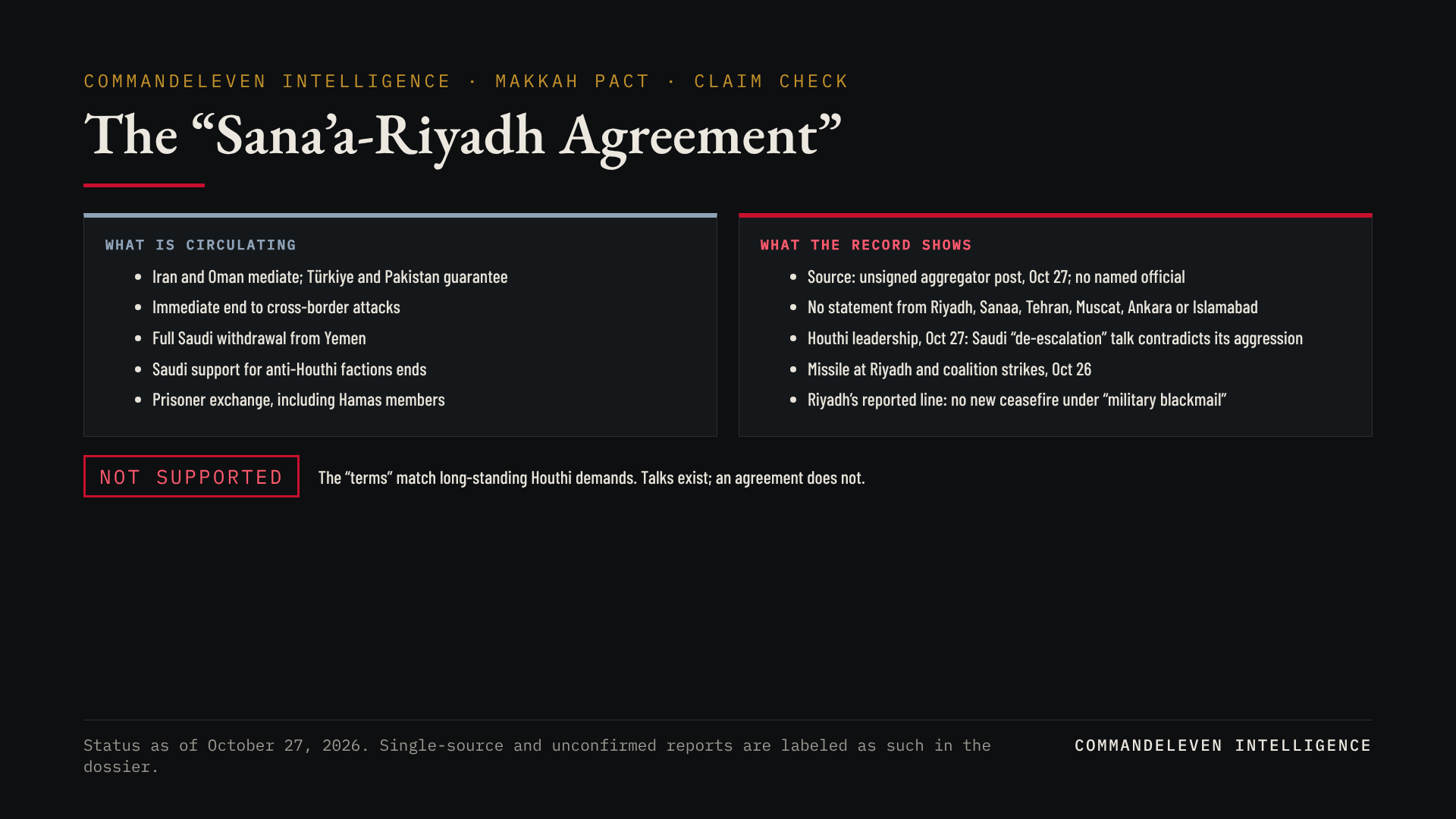
The claim. On October 27, reports spread online that a “landmark Sana’a-Riyadh Agreement” had ended the war. The terms in circulation:
- Iran and Oman as mediators, with Türkiye and Pakistan as guarantors.
- An immediate end to cross-border attacks in both directions.
- A full Saudi military withdrawal from Yemen and an end to Saudi support for Yemeni factions opposed to the Houthis.
- Reopened airports and ports.
- A prisoner exchange that includes members of Hamas held by Sanaa.
Where it came from. The earliest version we found was published on the morning of October 27 by a Nigeria-based news aggregator. It names no source, quotes no official and describes the document as “proposed.” [CONFIRMED]
Why we assess it is not real.
- No party has announced it. There is no statement from the Saudi government, the Saudi Press Agency, the Houthis’ Saba news agency, Iran, Oman, Türkiye or Pakistan.
- The Houthis contradict it. On October 27, Mohammed Ali al-Houthi of the Supreme Political Council told Saba that Saudi talk of de-escalation “contradicts” Saudi Arabia’s continuing aggression, and demanded withdrawal and compensation. That is not the language of a side that has just signed a peace deal.
- The fighting continued. Both sides were striking each other on October 26.
- Riyadh’s stated position is the opposite. Saudi Arabia’s position, as reported, is that it rejects a new ceasefire and will not give in to “military blackmail.”
- The terms are a wish list. Withdrawal, an end to Saudi support for Yemeni factions and a prisoner release are long-standing Houthi demands, presented as agreed terms.
[ASSESSED, high confidence] The “agreement” is the Houthi demand list circulated as a done deal, riding on the Tehran meeting. It may reflect a real negotiating text; if so, it has not been agreed.
What is real. Talks about a Saudi-Houthi arrangement have existed for weeks. In September, Lebanon’s Al Akhbar, which is close to Hezbollah, reported a Saudi proposal sent through Oman for a two-week truce followed by direct talks. Saudi Arabia did not confirm it. On October 26, Israel Hayom reported, citing anonymous Gulf diplomatic sources, that Riyadh had offered the Houthis $1 billion through Iran in exchange for a ceasefire; a Saudi official did not confirm it, and a Saudi denial has since been reported. [SINGLE-SOURCE in each case]
The Airport War Continues
The Houthi campaign against Saudi airports that Part 2 described has not stopped.
- October 6 to 12. Repeated missile and drone attacks on King Khalid International Airport in Riyadh, Abha and Dammam killed about 20 people and wounded more than 370. The October 10 strike on Riyadh’s terminals killed 13 and wounded more than 300. [CONFIRMED]
- October 26. Riyadh’s airport partially reopened after about two weeks: Terminal 1 for domestic flights and Terminal 2 for international flights by Saudi carriers. Full capacity has not been announced. Houthi military spokesman Yahya Saree warned airlines and passengers that the airport remains “a military target.” [CONFIRMED]
- October 26. A ballistic missile aimed at Riyadh was intercepted the same day. [CONFIRMED]
Egypt Votes
Egypt’s House of Representatives voted on October 26 to authorize President Abdel Fattah el-Sisi to take “necessary measures” to support Saudi Arabia in defending its territory and sovereignty. The vote was held behind closed doors and no count was released. The opposition Egyptian Social Democratic Party’s 11-member bloc abstained, citing a lack of information on duration, scope, cost and risk. [CONFIRMED]
A regional official said Egypt will deploy air defense systems and aircraft to help repel missiles and drones, and that there will be no ground troops in Yemen. Sisi said Egypt is not engaged in cooperation aimed at “combat operations beyond the borders.” [CONFIRMED]
Scoring Part 5’s Egypt call. Part 5 forecast that parliament would authorize “air defense and logistics support for Saudi Arabia, limited to Saudi territory, with no combat role inside Yemen.” The vote happened, the support is defensive and air defense is named, and no combat role in Yemen is planned. But the mandate itself is broad: the limits come from Sisi and officials, not the text, and logistics support has not been specified. Score: PARTIALLY CONFIRMED. It is added to the Foresight Record.
Washington Warns, and Israel’s Iran Question
US travel warnings. On October 21, the State Department ordered non-emergency staff and families to leave Saudi Arabia, citing the Houthi threat. On October 24, it updated its travel advisories for 13 countries: Saudi Arabia, Bahrain, Iran, Iraq, Jordan, Lebanon, Kuwait, Oman, the UAE, Qatar, Syria, Yemen and Israel. The Saudi advisory warns that Houthi attacks “have the potential to escalate rapidly beyond that immediate area.” [CONFIRMED]
The Netanyahu-Zamir report. On October 25, Israel’s Channel 12 reported a tense confrontation between Prime Minister Benjamin Netanyahu and IDF Chief of Staff Lt. Gen. Eyal Zamir over orders for an operation that could escalate quickly with Iran. According to the report, Zamir asked for a full discussion, legal authorization and formal signatures before acting, and military officials worried the Iran issue was being used for political purposes before the October 27 election. Netanyahu denied it: “There is no clash.” Government officials called the report “an outright lie.” The directive at the center of the report has not been disclosed. [REPORTED and DENIED; unresolved]
Strikes in Iraq. Separately, Asharq Al-Awsat reported that Iraqi authorities suspect airstrikes hit two facilities in eastern Iraq storing Iranian-supplied air defense systems for pro-Iranian militias. No one has claimed them, and the report has not been confirmed. [SINGLE-SOURCE]
[ASSESSED] These items matter for the Makkah Pact because any new US or Israeli strike on Iran changes the Houthis’ calculations and the pressure on Riyadh. Our standing call, set out in The Strike Clock and Iran’s ‘Dead Hand’, is that no joint US-Israeli strike on Iran takes place before November 3.
What It Means
[ASSESSED] The Tehran meeting was the pact’s first attempt to use diplomacy to protect Saudi Arabia, alongside the air defense forces that Part 5 described. The question it puts to Iran is whether it can, or will, rein in the Houthis. Iran says it favors regional security without outside powers, but its influence over the Houthis is real and not absolute.
For Pakistan, the meeting confirms a dual role: Pakistani forces defend Saudi territory under the pact, while Munir carries messages between Riyadh, Tehran and, with Qatar, Washington. That role carries risk if the mediation fails or if strikes on Iran resume after November 3.
Dated Calls
These calls are registered on the Foresight Record and will be scored on the dates given.
- By November 30, 2026. No Saudi-Houthi ceasefire or agreement is announced jointly, or separately by both Riyadh and Sanaa. [ASSESSED]
- By December 31, 2026. The four countries meet again in the Tehran format, at minister or chief-of-staff level. [ASSESSED]
- By November 30, 2026. Egyptian air defense forces are publicly confirmed as deployed in Saudi Arabia, by Cairo, Riyadh or a major outlet citing officials. [ASSESSED]
What This Dossier Does Not Claim
- It does not claim the Tehran meeting produced any agreement beyond continued talks.
- It does not claim Saudi Arabia offered or paid the Houthis any money.
- It does not claim the Netanyahu-Zamir confrontation took place; it reports that it was reported and denied.
- It does not treat Houthi or coalition battlefield claims as verified.
Frequently Asked Questions
Has the war between Saudi Arabia and the Houthis ended?
No. Reports of a “Sana’a-Riyadh Agreement” are not supported by any government statement, and both sides were still attacking each other on October 26.
Who attended the Tehran meeting on October 26, 2026?
Saudi Defense Minister Prince Khalid bin Salman, Pakistan’s Field Marshal Asim Munir and Interior Minister Mohsin Naqvi, and Türkiye’s intelligence chief Ibrahim Kalın, with Iran’s President Pezeshkian, Foreign Minister Araghchi and security chief Rezaei.
What did the Tehran meeting agree?
Only to continue talks on regional security cooperation. No ceasefire, timetable or mechanism was announced.
Is Egypt sending troops to Yemen?
No. Parliament authorized support for Saudi Arabia’s defense, and Egyptian officials say there will be no ground troops in Yemen.
Sources
- The National, Saudi Defence Minister leads Makkah pact delegation to Tehran in major diplomatic push
- Al Jazeera, Mecca defence alliance members in Tehran to defuse Iran-US, Yemen tensions
- Dawn, Pezeshkian urges ‘regional unity’ in meeting with Makkah pact countries in Tehran
- TRT World, Türkiye, Saudi Arabia, Pakistan and Iran agree to continue regional security talks
- Arab News, Makkah pact countries push for peace in Tehran as Saudi defense minister meets Pezeshkian
- Press TV, Tehran quadrilateral meeting fruit of Iranian nation’s resistance: Bagheri Kani
- Al Jazeera, Saudi-led coalition says it struck Houthi missile facilities
- Yemen Press Agency (Saba), Al-Houthi: Saudi de-escalation rhetoric contradicts continued aggression against Yemen
- Starconnect Media, Landmark Sana’a-Riyadh Agreement paves way for complete Saudi withdrawal (the unsourced claim reviewed here)
- Israel Hayom, Saudi Arabia reportedly offers Houthis $1 billion in Iran-brokered deal to halt attacks
- The Jerusalem Post, Saudi Arabia reaches out to Houthis through Oman for ceasefire, direct negotiations
- Middle East Monitor, Riyadh airport partially resumes flights after Houthi attacks
- Al Jazeera, Saudi Arabia says 12 killed, 300 wounded in Houthi attack on Riyadh airport
- AP via WSLS, Egypt’s parliament authorizes military support for Saudi Arabia to defend against Houthi attacks
- Al Jazeera, Egyptian parliament authorises military aid for Saudi Arabia
- The National, US warns citizens that Houthi attacks ‘have potential to escalate rapidly’
- Israel Hayom, Political uproar over reported clash between Netanyahu and IDF chief
- Ynet, Netanyahu denies clash with IDF chief over Iran as mystery Iraq strikes raise tensions
The Makkah Pact Series
Series Introduction: The Makkah Pact
- The Makkah Pact’s First Test: Operation Yemen Dawn, Pakistan’s Role, and Iran’s Shrinking Map – Part 1
- The First Test, Tested: Riyadh’s Airport War and the Makkah Pact – Part 2
- Strong in the Air, Weak on the Ground: Why Riyadh Needs the Makkah Pact – Part 3
- Diamond vs. Hexagon: Where Pakistan Sits on Netanyahu’s Map – Part 4
- The Coalition Forms: Typhoons, Syrian Troops and Egypt’s Vote – Part 5
- The Pact Goes to Tehran: Talks, a Phantom Peace Deal and Egypt’s Vote – Part 6 (you are here)