CommandEleven Intelligence · Middle East Desk. Flash Assessment, status as of October 28, 2026. This assessment is built on a single outlet’s anonymous sourcing. It will be updated as confirmation arrives or fails to.
Bottom Line Up Front
On October 27, Drop Site News reported that the United Arab Emirates has been quietly helping the Houthis (Ansarallah) fight Saudi-backed forces in Yemen. According to the report, Yemeni forces loyal to the UAE have passed targeting information to the Houthis while Abu Dhabi looked the other way, and two sources say the UAE itself shared intelligence used to target Saudi-backed forces. Some sources limit the help to targets inside Yemen, not Saudi territory.
As of this morning, no other outlet has independently reported the claim. The UAE has not responded. The Houthis deny receiving any Emirati support but concede an “alignment of interests.” The Southern Transitional Council (STC), the separatist movement the UAE built and backed, denies any contact with the Houthis.
The public record points the other way. On October 17, the UAE reportedly agreed to resume paying the Yemeni forces it once backed, with Saudi Arabia providing air cover, and on October 18 Saudi Defense Minister Prince Khalid bin Salman met UAE President Mohammed bin Zayed in Abu Dhabi. On paper, the UAE is coming back into the war on Riyadh’s side.
CommandEleven Intelligence is publishing this as an information piece, not a finding. The claim is unconfirmed, but it is credible enough to track. It comes from an experienced reporting team, it fits a motive that is a matter of record, and it fits a pattern of Emirati conduct in Sudan. If it is true, it changes how the Makkah Pact’s first war should be read.
Key Judgments
KJ1: The central claim is unconfirmed. It rests on four anonymous sources, two of whom describe the arrangement directly. No documents have been published, and no second outlet has matched the reporting. [REPORTED, single outlet, anonymous sources]
KJ2: The motive is real. Saudi Arabia expelled the UAE from Yemen in December 2025, after bombing an Emirati shipment at Mukalla, and Riyadh’s continued work with Islah, the Muslim Brotherhood-linked party Abu Dhabi treats as a primary threat, remains a core grievance. [CONFIRMED on the events; ASSESSED on motive]
KJ3: The claim and the public record can both be true. A UAE that pays anti-Houthi forces in public while tolerating, or enabling, leaks to the Houthis in private would be hedging, not switching sides. That is consistent with the “optionality” CommandEleven Intelligence identified as Abu Dhabi’s strategy in The Gulf Split. [ASSESSED, low confidence]
KJ4: Sudan is precedent, not proof. A UN fact-finding mission found in September 2026 that a UAE-linked network supplied Sudan’s Rapid Support Forces against the army Riyadh backs; the UAE denies any role. That shows Abu Dhabi will back the opposite side of a Saudi-aligned war through deniable channels. It does not show that it has done so in Yemen. [CONFIRMED on the UN finding; ASSESSED on relevance]
KJ5: Nothing in this assessment is registered on the Foresight Record. CommandEleven Intelligence will not set dated calls on this claim until a second outlet confirms it independently, or until US or Saudi officials comment on it. [METHOD]
What Drop Site Reported
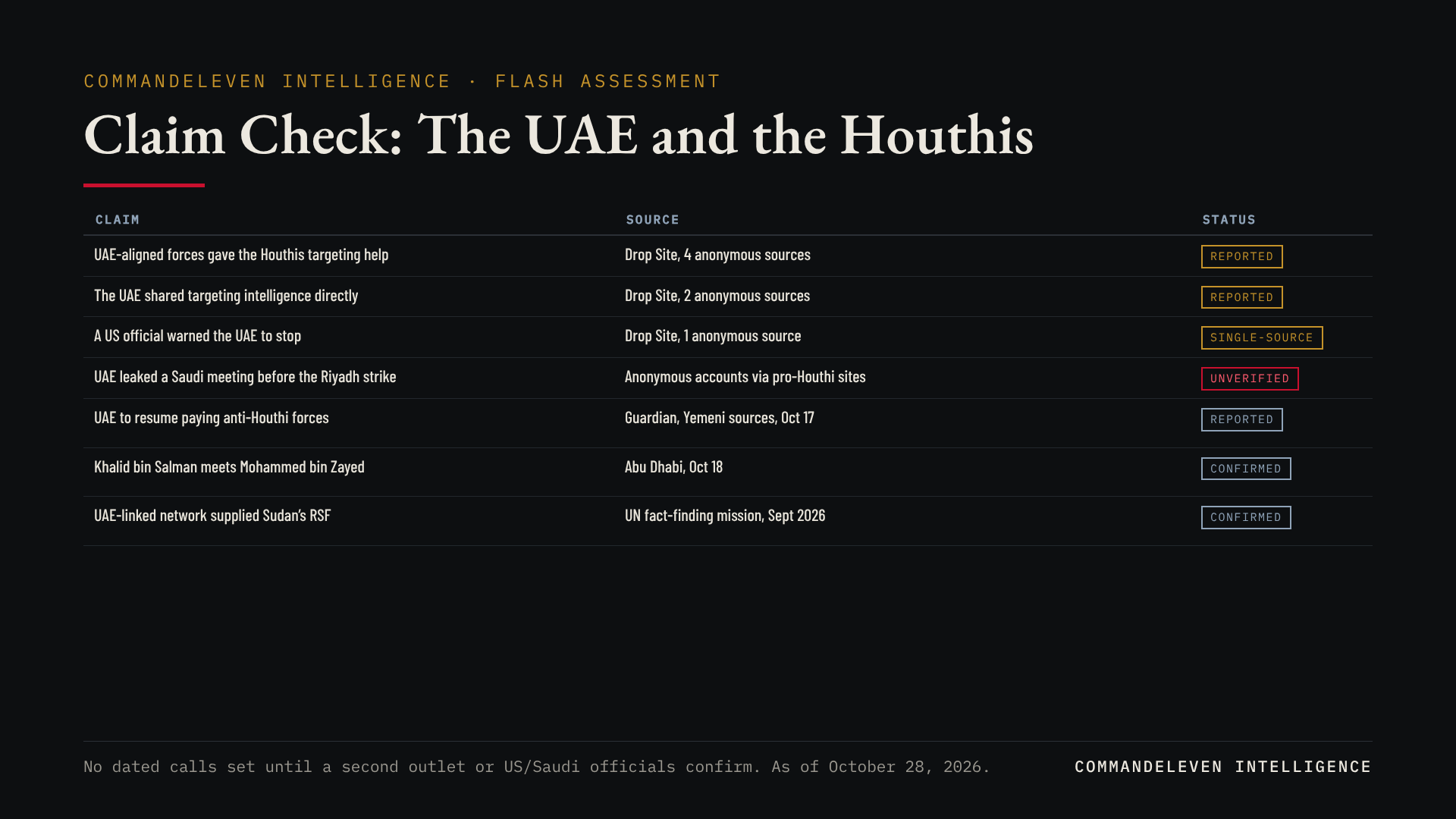
The report, by Ryan Grim and Iona Craig, makes these claims. [REPORTED throughout]
- Targeting help from UAE-aligned forces. Yemeni forces loyal to the UAE have provided targeting assistance to the Houthis against Saudi-backed forces, with Abu Dhabi’s knowledge.
- Direct Emirati intelligence. Two sources say the UAE itself shared intelligence for targeting Saudi-backed forces. A Yemeni source familiar with the Houthi backchannel said the UAE “has passed a significant amount of intelligence” to Sanaa and that the line remains open.
- A US warning. One source says a senior American official warned the UAE that Washington knew of the help and urged it to stop. Another says the help is continuing.
- Commanders who do not fight. A Yemeni source says Giants Brigades commanders have abandoned positions without fighting, deceiving the Saudi-backed forces beside them.
- STC channels. A Yemeni source describes Houthi channels to UAE-loyal commanders, including through a senior STC figure in al-Dhale. Asked which UAE-funded groups might share intelligence, a source close to the STC said: “probably all of them.”
The report sets these claims against the Houthis’ September Red Sea coast offensive, which routed Saudi-backed forces and took the Bab al-Mandab, and against precision strikes on October 2 and 7 on a coalition base west of Aden that damaged a Saudi commander’s office. It does not claim that UAE intelligence enabled those specific strikes.
The denials. Senior Houthi official Mohammed al-Bukhaiti said the UAE has supported neither side, has stayed neutral and has refused to rejoin the Saudi-led coalition. He called reports of an Emirati alliance “entirely baseless” but acknowledged an “alignment of interests.” A UAE-based STC official said the STC “has no channels of communication with the Houthis.” STC representative Amr al-Beidh said the STC will not fight in the north but will resist any Houthi advance into the south. The UAE’s ambassador in Washington, the White House and the Saudi-led coalition did not respond to Drop Site.
What Is Confirmed
The context around the claim is on the record. [CONFIRMED]
- The rupture. On December 30, 2025, Saudi-led forces bombed an Emirati shipment at Mukalla and gave the UAE 24 hours to leave Yemen. The UAE withdrew, and the STC was routed. STC leader Aidarous al-Zubaidi fled to the UAE in January; Saudi Arabia accused Abu Dhabi of helping him escape.
- The thaw. On September 29, UAE Vice President Sheikh Mansour bin Zayed met the crown prince in Riyadh, the first high-level meeting since the rupture.
- The UAE’s return. On October 17, the Guardian reported, citing Yemeni sources, that the UAE had agreed to resume salary payments to government-aligned forces fighting the Houthis, most likely the Giants Brigades, in return for Saudi air support. On October 18, Prince Khalid bin Salman met Sheikh Mohammed bin Zayed in Abu Dhabi.
- The precedent of 2019. In August 2019, UAE aircraft struck Yemeni government forces near Aden during the STC’s fight with the government; the UAE said it had targeted “terrorist militias.” Riyadh and Abu Dhabi were then backing opposite sides of a local war inside the coalition they both led.
What Cuts Against It
- The public deal. Paying the Giants Brigades to fight the Houthis under Saudi air cover is the opposite of helping the Houthis. If the October 17 arrangement holds, Emirati money is now on Riyadh’s side of the line.
- The source mix. The direct claims come from anonymous Yemeni sources in a war in which every faction has reason to discredit another. Drop Site does not say which side its sources sit on.
- The Houthi denial. The Houthis have every incentive to split the coalition, yet their senior official denied Emirati support on the record. That denial is not proof, but it is not what a side boasting of a new partner would say.
- No corroboration. A claim of this weight, involving a US warning to Abu Dhabi, would be expected to draw at least a “no comment” from Washington or Riyadh within days. As of publication, there has been none.
A Parallel Accusation, Labeled for What It Is
On October 26, the Houthi-aligned outlets Al-Khabar al-Yemeni and Daily Yemen reported that “platforms run by Saudi intelligence on social media” were accusing the UAE of leaking the location of a meeting led by Prince Khalid bin Salman before the Houthi missile strike on the Saudi Defense Ministry in Riyadh. The Houthis claimed that strike on October 22; Saudi Arabia did not confirm it. The same accounts have previously claimed that Abu Dhabi passed Chinese missile technology to the Houthis. [UNVERIFIED; anonymous social-media accounts, relayed by pro-Houthi outlets]
This does not corroborate Drop Site. The outlets carrying it have an interest in splitting the coalition, and the accounts are unnamed. It shows only that the accusation was already circulating in the Saudi information space before the report was published.
Sudan: The Pattern Behind the Question
The UAE’s conduct in Sudan is why this report deserves attention rather than dismissal.
In Sudan, Saudi Arabia backs the army. A UN fact-finding mission found in September 2026 that a UAE-linked network supplied the army’s enemy, the Rapid Support Forces, without attributing it to the Emirati state. The UAE denies any role. In the same week as the September thaw, Saudi Arabia reportedly threatened to leave the US-led Sudan “Quad,” accusing American officials of favoring the UAE. Egypt has reportedly briefed Riyadh on Emirati support for armed and separatist groups in Sudan, Yemen and Somaliland. CommandEleven Intelligence’s Sudan dossier covers that war in full. [CONFIRMED on the UN finding; REPORTED on the Quad and Egypt]
[ASSESSED] The pattern is an Emirati willingness to back the other side of a Saudi-aligned war through deniable intermediaries, while keeping formal relations with Riyadh intact. Sudan does not prove the UAE is doing this in Yemen. It removes the argument that Abu Dhabi would never do it.
Why It Matters to Us
CommandEleven Intelligence is highlighting this report because, if it is true, it changes the picture our Makkah Pact series has been building.
- Pakistan’s exposure. Pakistani forces are in Saudi Arabia under the Makkah Pact, defending a Saudi campaign against the Houthis. If a Gulf partner is quietly undercutting that campaign, Pakistan is underwriting a war that one of the region’s most capable players is working against from inside the coalition.
- The battlefield. Houthi capability and Iranian support explain much of the September offensive, the fall of the Bab al-Mandab and the precision of the October strikes near Aden. Leaks from inside the anti-Houthi camp would explain more of it, and would mean the coalition’s problem is partly internal.
- The Tehran channel. The same week the report appeared, Field Marshal Asim Munir and Prince Khalid bin Salman sat with Iran’s leadership in Tehran, as Part 6 set out. If the UAE has its own line to the Houthis, the pact’s diplomacy through Tehran is not the only channel shaping the war.
- The Gulf split. The Gulf Split dossier assessed the September thaw as tactical cooperation on Yemen, “not the end of the split,” and noted unnamed reports of reduced radar and early-warning sharing between the two states during the Iran war. Its December indicators include whether Emirati-backed units return to the fight under a Saudi-agreed arrangement. The October 17 deal moves that indicator toward yes on paper. This report, if confirmed, would mean the answer is yes in form and no in substance.
What Would Confirm or Kill It
Toward confirmation:
- A second outlet independently reporting UAE or UAE-aligned intelligence passed to the Houthis.
- Any US or Saudi official comment, on or off the record, including a refusal to deny.
- Saudi action against Giants Brigades or STC commanders: arrests, dismissals, a halt to the new payments or a public rebuke.
- A collapse of the October 17 arrangement, or Saudi air cover withdrawn from Emirati-backed units.
Toward dismissal:
- Giants Brigades forces taking and holding ground against the Houthis around the Bab al-Mandab under Saudi air cover.
- Joint Saudi-Emirati statements or operations in Yemen that go beyond payments.
- No further reporting, and no official reaction, over the coming weeks.
What This Assessment Does and Doesn’t Establish
This assessment establishes that a credible outlet has reported, on anonymous sourcing, that the UAE and forces loyal to it have helped the Houthis against Saudi-backed forces, and that the claim has not been confirmed or matched elsewhere. It establishes the confirmed context: the December 2025 rupture, the September thaw, the October 17 payments arrangement and the UAE’s record in Sudan.
It does not establish that the UAE has shared intelligence with the Houthis, that any UAE-aligned commander has done so, that the United States warned the UAE, or that any specific Houthi strike was enabled by Emirati information. It does not treat the Houthi denial, or the anonymous social-media accusation, as evidence either way. No dated calls are set, and nothing here is counted on the Foresight Record.
Frequently Asked Questions
Is the UAE helping the Houthis?
It has been reported, not confirmed. Drop Site News reported on October 27, citing anonymous sources, that UAE-aligned forces and the UAE itself have shared targeting intelligence with the Houthis. No other outlet has confirmed it, and the UAE has not responded.
Hasn’t the UAE rejoined the fight against the Houthis?
Publicly, yes. The UAE reportedly agreed on October 17 to resume paying anti-Houthi forces, with Saudi air cover. The report suggests it may be hedging behind that arrangement.
What do the Houthis say?
Senior official Mohammed al-Bukhaiti denied any UAE support and said the UAE is neutral, while acknowledging an “alignment of interests.”
Why mention Sudan?
Because a UN fact-finding mission found that a UAE-linked network supplied the side fighting Saudi Arabia’s partner in Sudan. That makes a similar hedge in Yemen plausible, though it does not prove it.
Will CommandEleven Intelligence score this?
Not yet. No dated calls will be set until a second outlet confirms the claim independently, or US or Saudi officials comment on it.
Sources
- Drop Site News, The UAE Is Secretly Helping Ansarallah Fight Saudi Arabia in Yemen
- Critical Threats Project, Iran Update, October 18, 2026 (summarizing the Guardian’s October 17 report and the October 18 Abu Dhabi meeting)
- Democracy Now, Houthis Strike Military Training Camp as UAE Joins Saudi-Led Attacks on Yemen
- Middle East Eye, Egypt shared intelligence with Saudi Arabia on UAE activities in Yemen, sources say
- Middle East Eye, Saudi Arabia turns to UAE “white horse” as it gears up to battle Yemen’s Houthis
- Daily Yemen, Saudi Arabia Renews Its Accusation Against the UAE of Orchestrating the “Houthis'” Targeting of Bin Salman at the Ministry of Defense (the unverified accusation reviewed here)
- Keystone-SDA (via bluewin), Houthis: We attacked the Ministry of Defense in Riyadh
- Al Jazeera, After Saudi Arabia’s Yemen strike, UAE rejects support for separatists
- NBC News, Saudi Arabia alleges UAE smuggled wanted Yemen separatist leader out of the country
- Inquirer (AFP), UAE confirms Aden air strikes on “terrorist militias”
Related CommandEleven Intelligence Reporting
- The Gulf Split: How Saudi Arabia and the UAE Broke, and What It Means for the GCC
- Sudan’s Proxy War: The Pipeline to the RSF and the Rift It Exposed
- The Houthi Arsenal Goes Local: Chinese Parts and an Iranian Design
- Iran’s ‘Dead Hand’ Is a Chain of Command, Not a Machine
The Makkah Pact Series
- Series Introduction: The Makkah Pact
- The Makkah Pact’s First Test: Operation Yemen Dawn, Pakistan’s Role, and Iran’s Shrinking Map – Part 1
- The First Test, Tested: Riyadh’s Airport War and the Makkah Pact – Part 2
- Strong in the Air, Weak on the Ground: Why Riyadh Needs the Makkah Pact – Part 3
- Diamond vs. Hexagon: Where Pakistan Sits on Netanyahu’s Map – Part 4
- The Coalition Forms: Typhoons, Syrian Troops and Egypt’s Vote – Part 5
- The Pact Goes to Tehran: Talks, a Phantom Peace Deal and Egypt’s Vote – Part 6