CommandEleven Intelligence Desk // Cyber and Infrastructure Desk, status as of November 16, 2026
Read these first. This assessment builds on three earlier reports: Who Hacked Europe’s Freezers? France Names Iran, Pro-Russian Hackers Claim a Wave, Critical Infrastructure at Risk: Water Systems – Part 1, and GCTA Foresight Audit, Part 10: Cyber-Kinetic Convergence.
Bottom Line Up Front
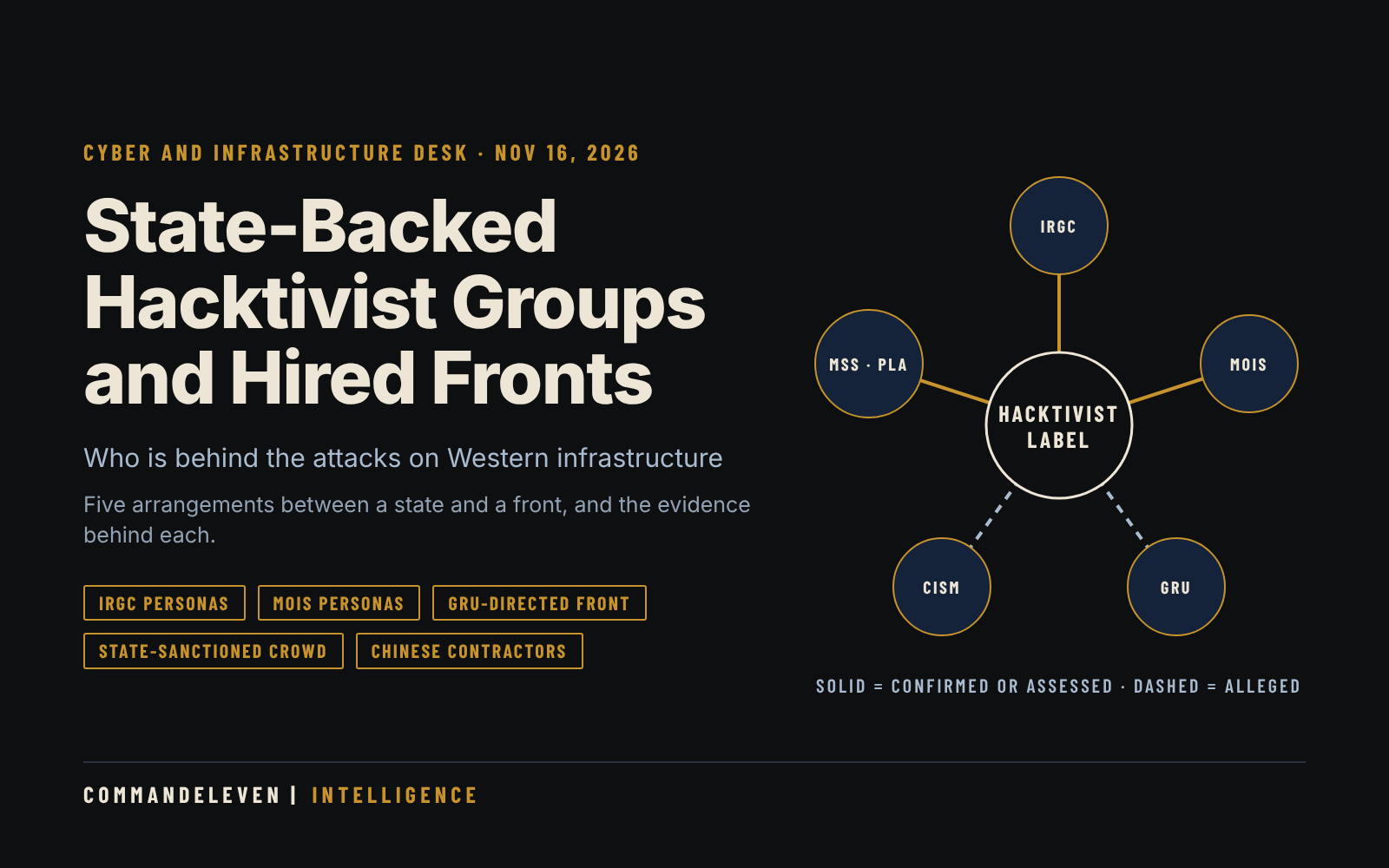
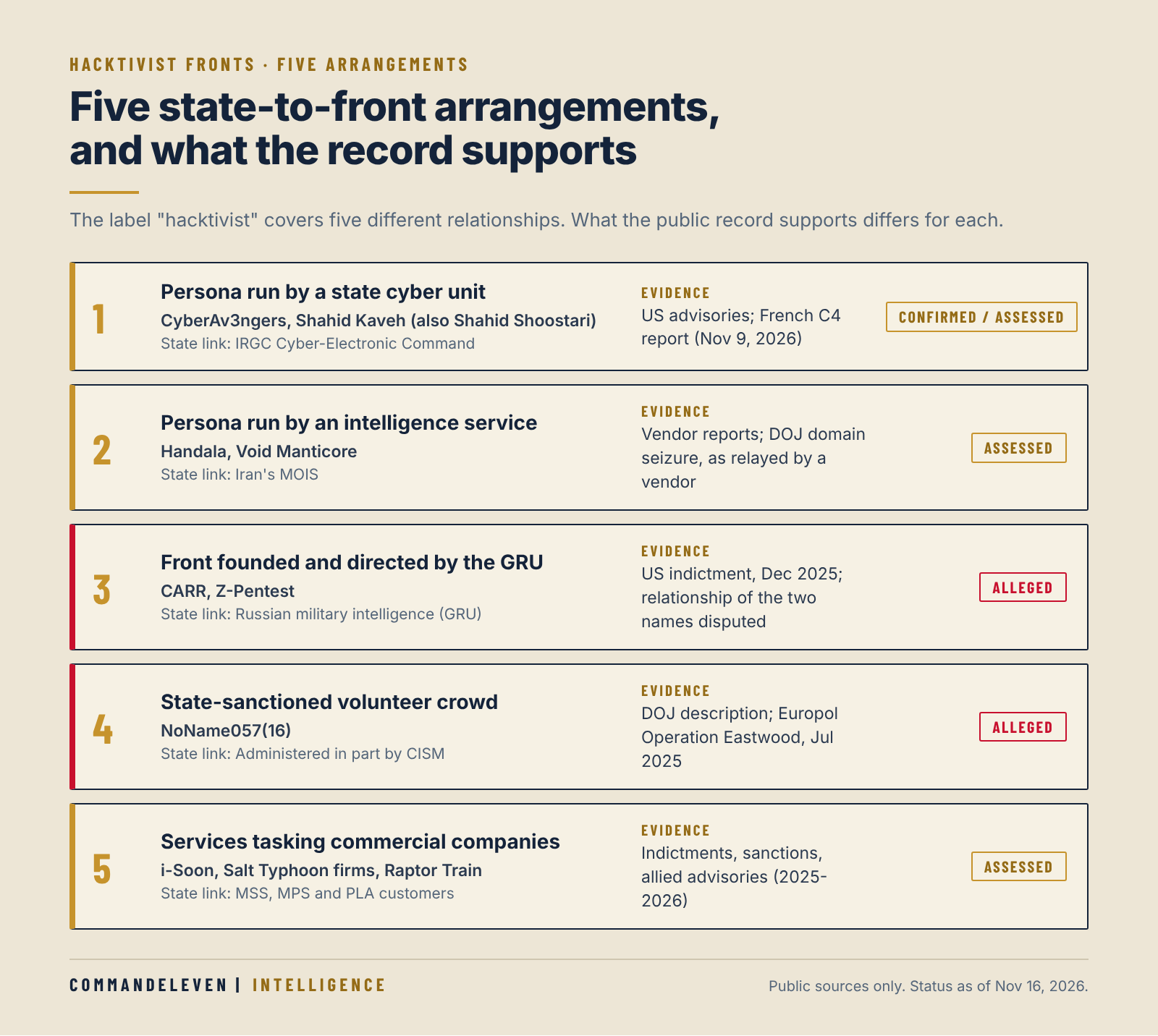
The groups that claim attacks on Western water, energy, retail and health systems are not one kind of actor. Government records in the public domain support five different arrangements between a state and a front: a persona run by a unit of Iran’s Revolutionary Guard (IRGC), a persona run by a unit of Iran’s Ministry of Intelligence and Security (MOIS), a “hacktivist” group founded and directed by Russian military intelligence (Cyber Army of Russia Reborn, or CARR), a state-sanctioned crowd of volunteers (Russia’s NoName057(16)), and, in China, a different model with no persona at all, in which intelligence services task commercial companies and fronts. On top of these sits a layer of claims that no government has verified. [CONFIRMED that US and French authorities make these attributions; ASSESSED that they are accurate]
The label “hacktivist” is therefore a poor guide to who is responsible, how capable they are, or what they will do next. Effects have moved from defacement and spilled water to wiped devices and refrigeration fires, and no source we reviewed reports a death. Claims by the personas themselves are not evidence, and several recent ones are unverified. [ASSESSED]
Key Judgments
KJ1: The public record supports five state-to-front arrangements, not a single network. US and French authorities describe a persona run by an IRGC unit, a persona run by an MOIS unit, a front founded and directed by the GRU, a state-sanctioned volunteer project, and (in China) commercial companies tasked by intelligence services. The IRGC, GRU and volunteer-project attributions rest on government statements and indictments that have not been tested in court. [CONFIRMED that the allegations were made; ASSESSED on accuracy]
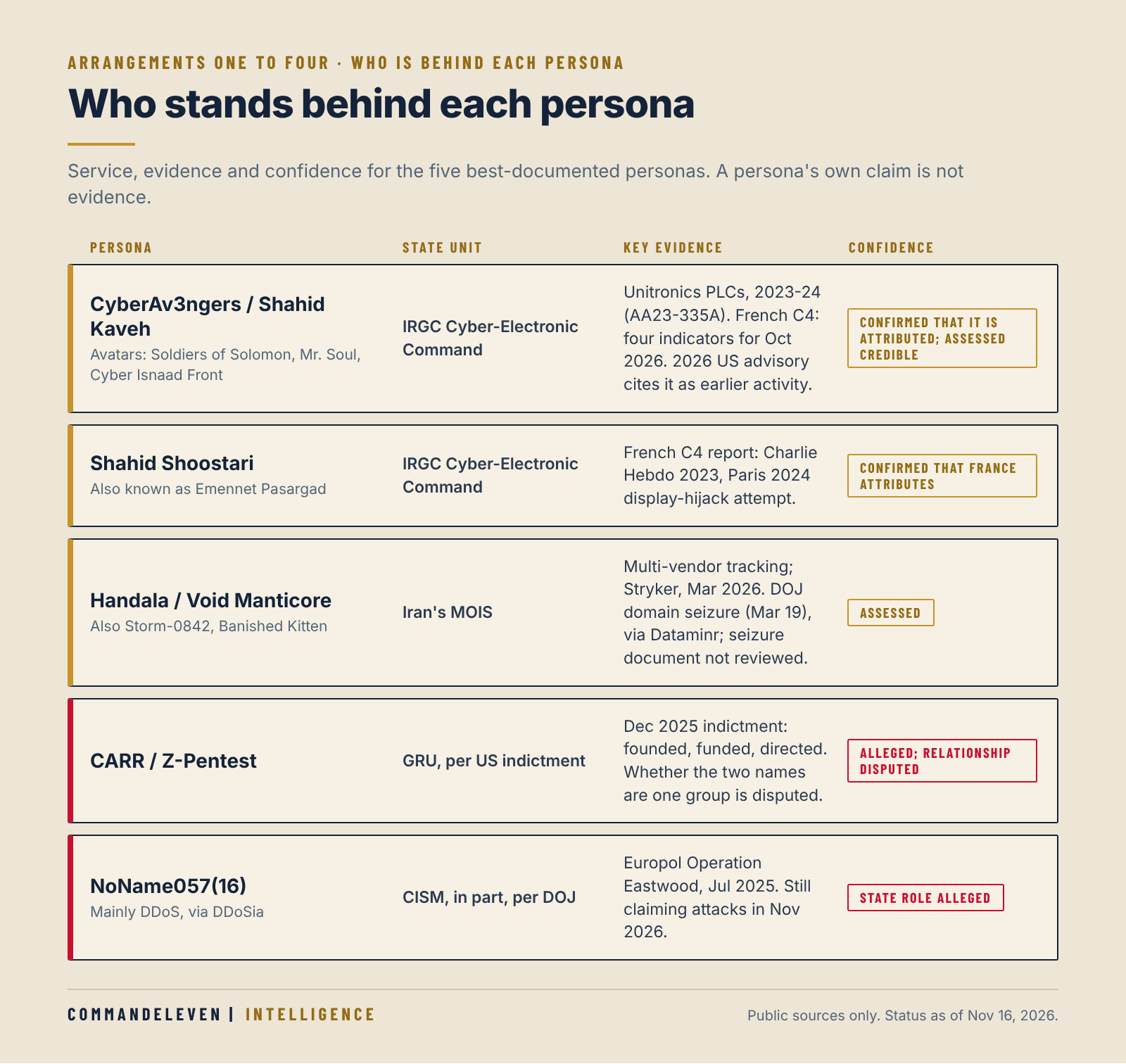
KJ2: Iran runs its personas from at least two services, and France names two IRGC units. US advisories and the French C4 report tie CyberAv3ngers and Shahid Kaveh to the IRGC Cyber-Electronic Command, and France adds a second IRGC unit, Shahid Shoostari (also known as Emennet Pasargad). Multiple vendors tie Handala to the Ministry of Intelligence and Security (MOIS). [CONFIRMED that France and the US make the IRGC attributions; ASSESSED on accuracy. The MOIS link rests on vendor reporting and a Justice Department action we have not seen directly]
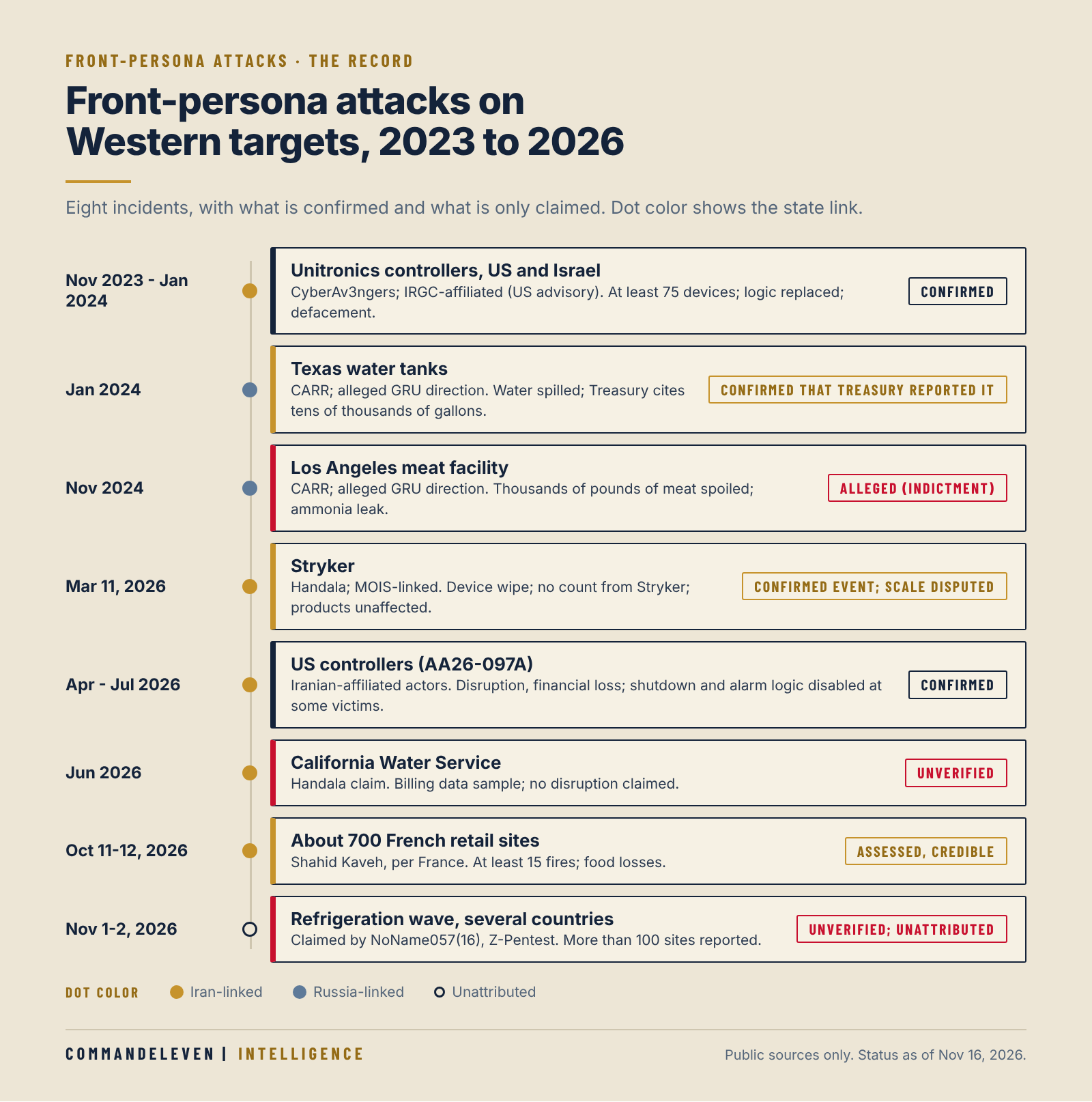
KJ3: Effects are escalating but have stayed short of harm to people. The record runs from defaced controllers (2023) to a device wipe at a medical technology company (March 2026) to about 700 French retail sites with at least 15 fires (October 2026). The July 2026 update to the US controller advisory adds that logic changes at some victims disabled shutdown and alarm functions. We found no report of a death. [CONFIRMED that France reported these effects; ASSESSED on the trend]
KJ4: Russian-aligned fronts have caused real but limited damage. The Treasury said in 2024 that major damage was avoided because of the group’s lack of sophistication, and an outside analysis argues they exaggerate their effects. [ASSESSED]
KJ5: A persona’s claim is not evidence. The November 1–2 refrigeration wave is claimed by pro-Russian groups but unattributed by any government. Handala’s claim against a California water utility is unconfirmed by the utility in the reports we reviewed. Stryker’s own statement gives no device count for the wipe, and published figures run from tens of thousands to more than 200,000. [CONFIRMED that the claims were made; UNVERIFIED on their content]
KJ6: Enforcement has not ended the activity. Europol disrupted NoName057(16) in July 2025, and the same name appears in November 2026 as a claimant. [REPORTED; ASSESSED that disruption has not stopped it]
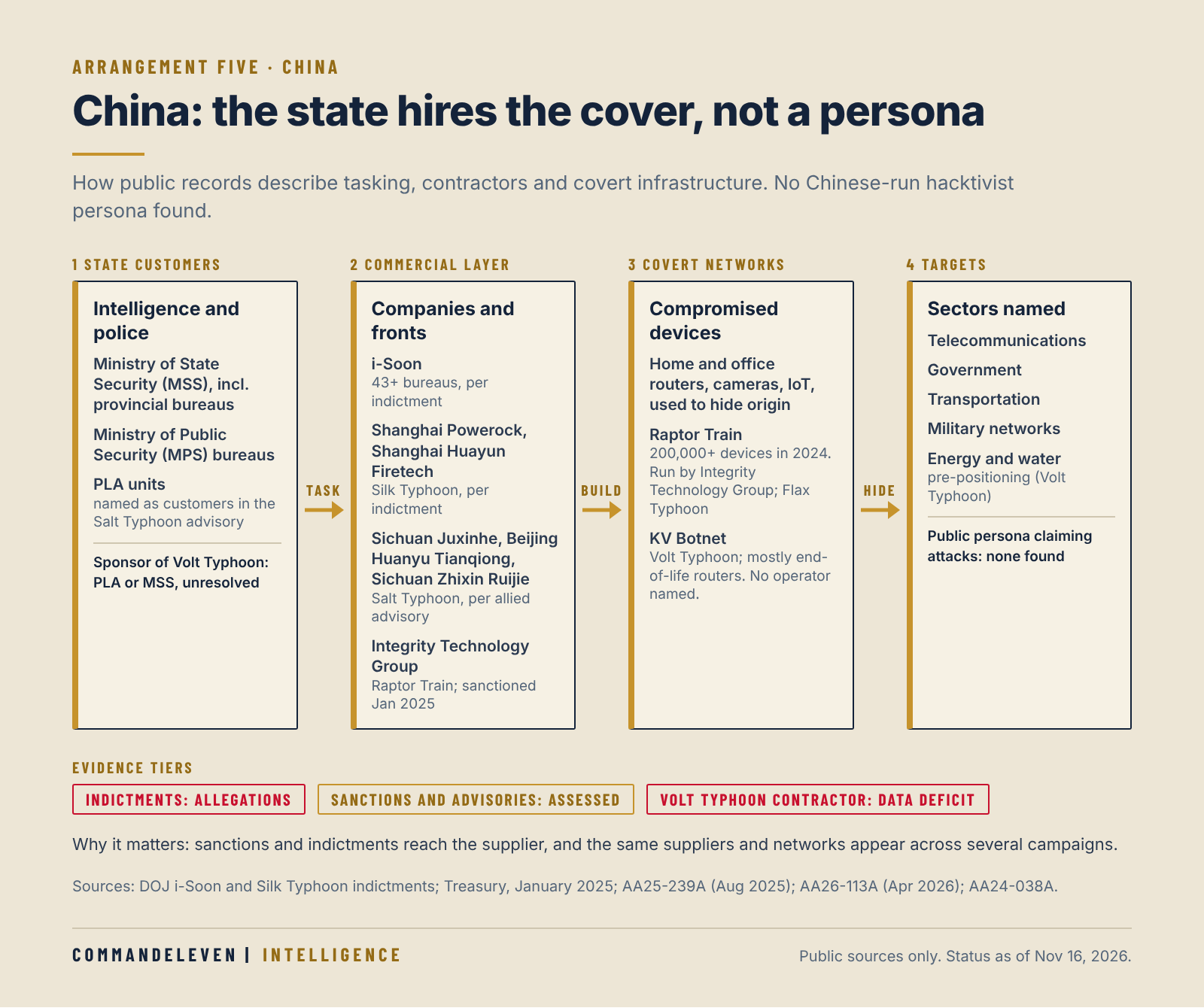
KJ7: China uses companies, not personas. US and allied agencies describe Chinese intelligence services (the Ministry of State Security, MSS, and in some cases the PLA and the Ministry of Public Security, MPS) buying or tasking intrusion work from commercial companies, some of them fronts. The deniability comes from the corporate cover, so there is no public persona claiming attacks. A 2026 allied advisory adds that the covert networks of compromised devices these actors use to hide their traffic are, in at least one documented case, built and run by a Chinese security company. We found no government attribution of a Chinese-run hacktivist persona comparable to Handala or CARR. [CONFIRMED that the allegations and sanctions exist; ASSESSED on accuracy; DATA DEFICIT on Chinese-run personas]
Why the Label Misleads
“Hacktivist” implies an independent activist with a cause. In the cases below, the cause is stated by the persona and the control sits with a state. A French intelligence view, relayed by Al Jazeera, is that the IRGC-linked unit works through front groups that pose as vigilante hackers. Treat the persona name as a branding choice rather than an organization chart.
This is why attribution timing matters. France named Shahid Kaveh on November 9 for an attack that took place on October 11–12, four weeks earlier. For those four weeks, the only public voices were the personas and the vendors.
Arrangement One: A Persona Run by a State Cyber Unit (Iran)
CyberAv3ngers and Shahid Kaveh. The US joint advisory AA23-335A describes CyberAv3ngers as an Iranian persona affiliated with the IRGC. It reports at least 75 Unitronics controllers compromised between November 2023 and January 2024, at least 34 of them in US water and wastewater systems, with control logic replaced and a defacement message left on the display. The advisory page does not name a specific IRGC unit. The 2026 advisory (AA26-097A) later describes CyberAv3ngers, also called the Shahid Kaveh Group, as affiliated with the IRGC Cyber Electronic Command. [CONFIRMED]
France’s attribution is more specific, and we have now read the original C4 report (CERTFR-2026-CTI-009, marked TLP:CLEAR). It attributes the October 11–12 sabotage of refrigeration controllers at about 700 retail sites to Shahid Kaveh, which it places within the IRGC Cyber-Electronic Center, and says defrost settings were pushed to high temperatures, causing major losses and at least 15 fires. It says the unit is mainly known through hacktivist avatars (CyberAveng3rs, Soldiers of Solomon, Mr. Soul and Cyber Isnaad Front) and an outlet called CyberbanNews, and that the avatars publicly claim some of its attacks. It also says the unit has held scripts to scan and control Schneider Electric, Siemens and Rockwell industrial equipment since at least June 2024. The case rests on four indicators: infrastructure shared with Schneider reconnaissance, use of the FOFA scanning tool, a relay on CyberbanNews from October 13, and Farsi traces in the attack infrastructure. The report lists no October IP addresses or file hashes. [CONFIRMED that France attributed; ASSESSED on accuracy, since no October indicators are public]
The same report attributes operations against French interests since 2020 to a second IRGC-CEC unit, Shahid Shoostari (also known as Emennet Pasargad). These include the targeting of Charlie Hebdo, with a January 2023 defacement of its online store, and a July 2024 attempt to hijack video displays during the Paris Olympics. That makes at least two IRGC units with persona-based or deniable operations. A June 2025 US joint fact sheet also lists an FBI notice titled as describing Emennet Pasargad hack-and-leak operations using false-flag personas. [CONFIRMED on the French attribution; the false-flag point is REPORTED from that notice’s title, which we have not opened]
The 2026 controller campaign. The joint advisory AA26-097A was first issued April 7 and updated July 22. The FBI, CISA, NSA, EPA, Department of Energy, Cyber Command’s Cyber National Mission Force and the Treasury Department are the authoring agencies. The agencies assess that a group of Iranian-affiliated actors is exploiting internet-exposed programmable logic controllers to cause disruption in the US, with activity identified since at least March 2026 across government facilities, water and wastewater, and energy. It names Rockwell Automation/Allen-Bradley, Schneider Electric and Siemens equipment and reports operational disruption and financial loss in a few cases. The July update says the actors modified or deleted controller logic and that the changes disabled critical shutdown and alarm logic, allowing systems to enter unsafe conditions without alerting operators. At one victim, the FBI saw a malicious project file add logic that overrode instructions keeping the process within safe parameters. The advisory does not name CyberAv3ngers as the 2026 actor. It cites CyberAv3ngers, also called the Shahid Kaveh Group, as earlier similar activity. We therefore describe the actor as Iranian-affiliated and the persona link as assessed. The overlap with the French account is notable, since the French report says Shahid Kaveh has held scripts for the same three vendors since June 2024. [CONFIRMED on the advisory; the link to Shahid Kaveh is ASSESSED]
Our water systems dossier assesses the July 2026 campaign across at least 12 states as Iran-linked, with the US government not yet attributing it formally at that time. [ASSESSED]
Arrangement Two: A Persona Run by an Intelligence Service (Iran’s MOIS)
Handala. Palo Alto’s Unit 42 assesses Handala as one of several personas maintained by Void Manticore, an actor affiliated with Iran’s Ministry of Intelligence and Security. A Dataminr brief dated July 2 says the Justice Department seized four domains on March 19, 2026, including a Handala domain, and described them as MOIS-controlled. The FBI’s own Iran page lists a March 19, 2026 Justice Department action disrupting Iranian cyber-enabled psychological operations, which matches the date, although that page does not mention Handala, domain seizures or MOIS. Stryker’s statement also says the government seized domains linked to the threat actors. We have not reviewed the seizure document. [ASSESSED; the Justice Department finding is REPORTED by a vendor and consistent with two primary pages]
The Stryker wipe. Stryker confirmed that the attack occurred on March 11 and described a global disruption to its Microsoft environment. It said its products were unaffected and that it was fully operational across its global manufacturing network by April 1, although some patient-specific cases were rescheduled because of shipping delays. Its statement does not name the attacker and gives no device count. Handala claimed more than 200,000 devices and 50 terabytes of data, figures The Record called unverified. Other reports range from tens of thousands to about 80,000, and Dataminr’s brief repeats the 200,000 figure. Reporting based on anonymous sources describes the abuse of Stryker’s own Microsoft Intune device-management platform through a compromised administrator account, with no malware. [CONFIRMED that the attack occurred; method REPORTED; scale DISPUTED]
The California water claim. On June 11–12, Handala claimed a breach of California Water Service and published a 5 GB sample, framing it as retaliation for a US strike on water infrastructure in Sirik, Iran, and saying it chose not to disrupt supply. Dataminr’s analysis found customer billing data in the sample. Reports note that no utility had confirmed the breach and that operational impact was unverified. [REPORTED; the claim is UNVERIFIED]
Arrangement Three: A Front Founded and Directed by the GRU (CARR and Z-Pentest)
On December 9, 2025, the Justice Department announced indictments in two cases. It alleges that CARR, also called Z-Pentest, was founded, funded and directed by the GRU, and that a persona associated with at least one GRU officer told CARR leaders which victims to target and paid for its access to criminal services. The reported effects include damaged controls at public water systems in several states, with hundreds of thousands of gallons spilled, and a November 2024 attack on a Los Angeles meat processing facility that spoiled thousands of pounds of meat and caused an ammonia leak. [CONFIRMED that the Justice Department alleges this; the indictments are allegations]
The defendant in both cases, a Ukrainian national extradited to the US in 2025, pleaded not guilty. The Justice Department release lists trial dates of February 3 and April 7, 2026, and neither it nor The Record’s report on it gives an outcome. [CONFIRMED that the dates were listed; the outcome is UNKNOWN to us]
Sources differ on how CARR and Z-Pentest relate. The Justice Department treats them as one group. An analysis in Lawfare, citing CISA, says CARR’s administrators split off around September 2024 over dissatisfaction with GRU funding, forming Z-Pentest to focus on operational technology. In July 2026 the EU sanctioned Z-Pentest. [DISPUTED on the relationship; CONFIRMED on the sanctions per our earlier report]
The Treasury sanctioned two CARR members in July 2024, saying major damage was avoided because the group lacked technical sophistication. Lawfare’s analysis calls the groups unskilled and says they often change values more or less at random. It cites CISA’s view that such groups exaggerate their impact. [ASSESSED]
Arrangement Four: A State-Sanctioned Crowd (NoName057(16))
The Justice Department describes NoName057(16) as a state-sanctioned project, administered in part by CISM, an IT organization created by presidential order in 2018, rather than as an entity founded and directed by the GRU. The group mainly runs denial-of-service attacks using a tool called DDoSia, recruits volunteers worldwide, and pays the top ones in cryptocurrency. Europol describes the people acting for it as mainly Russian-speaking sympathizers using automated tools. [CONFIRMED that these descriptions were published; the state role is ALLEGED]
In July 2025, Operation Eastwood took more than 100 systems offline across 12 countries. It produced two arrests (France and Spain), seven arrest warrants, and 24 house searches. Reporting on the operation cited more than 4,000 people involved in the campaigns. NoName057(16) and Z-Pentest then claimed the November 2026 refrigeration wave, which no government has confirmed. [CONFIRMED on Eastwood; the November claim is UNVERIFIED]
Arrangement Five: Intelligence Services Tasking Commercial Companies (China)
This arrangement differs from the other four. There is no persona and no public claim of responsibility. The state’s cover is a registered company. Three bodies of public record describe it.
i-Soon. In March 2025 the Justice Department unsealed indictments charging eight employees of Anxun Information Technology (i-Soon) and two officers of China’s Ministry of Public Security (MPS), alongside two members of the APT27 group. The indictment alleges that i-Soon’s main customers were MSS and MPS bureaus, that it worked with at least 43 bureaus across at least 31 provinces and municipalities, and that it charged roughly $10,000 to $75,000 for each email inbox it successfully hacked. Some intrusions were done at a bureau’s direct request, others on i-Soon’s own initiative, with the stolen data then offered for sale. The Department also seized the company’s primary domain, and the State Department’s Rewards for Justice program offered up to $10 million for information. These are allegations; the indictment does not say any defendant is in custody. [CONFIRMED that the allegations were made; ASSESSED on accuracy]
Silk Typhoon (Hafnium). A July 2025 indictment alleges that two men, Xu Zewei and Zhang Yu, worked for Shanghai Powerock and Shanghai Huayun Firetech under the direction of the Shanghai State Security Bureau, in connection with the 2021 Exchange Server intrusions. Security researchers who read the indictment found at least 16 patents for offensive tools filed by the two companies between 2014 and 2020. One outlet reports that Xu has since been extradited; we have not confirmed the date. [CONFIRMED that the allegations were made; ASSESSED on accuracy; extradition REPORTED]
Salt Typhoon. In January 2025 Treasury sanctioned Sichuan Juxinhe Network Technology and an individual, Yin Kecheng, for involvement in Salt Typhoon, and said the MSS maintains strong ties with multiple computer network exploitation companies. In August 2025 agencies from more than a dozen countries published a joint advisory (AA25-239A) naming three companies, Sichuan Juxinhe, Beijing Huanyu Tianqiong and Sichuan Zhixin Ruijie, as providing cyber products and services to Chinese intelligence services. The advisory describes activity since at least 2021 against telecommunications, government, transportation, lodging and military networks. The FBI’s cyber chief told the Wall Street Journal that more than 80 countries were affected. Treasury also sanctioned Integrity Technology Group in January 2025 for supplying infrastructure used by Flax Typhoon. [CONFIRMED that these sanctions and the advisory exist; ASSESSED on accuracy]
Where critical infrastructure sits. Volt Typhoon is the case most relevant to this dossier’s theme. The February 2024 US advisory (AA24-038A) says PRC state-sponsored actors compromised the IT environments of critical infrastructure organizations in communications, energy, transportation and water, and assesses that they were pre-positioning for disruption. Published sources we reviewed describe the sponsor as the PLA or the MSS without settling which. A joint advisory led by the UK’s NCSC and published on April 23, 2026 (AA26-113A, co-sealed by agencies from the US, Australia, Canada, Germany, Japan, the Netherlands, New Zealand, Spain and Sweden) adds a link to this arrangement. It says Volt Typhoon used a covert network of compromised devices to pre-position offensive capabilities on critical national infrastructure, and that there is evidence such networks are created and maintained by Chinese information security companies. Its one named example is Raptor Train, which infected more than 200,000 devices in 2024 and was controlled by Integrity Technology Group, the company the FBI assessed to be responsible for the Flax Typhoon intrusions. The advisory does not name a company behind Volt Typhoon’s own network, which it describes as built mainly from end-of-life Cisco and NetGear routers. It also says the NCSC believes most China-nexus actors now use such networks, that one network may serve several actors, and that static IP blocklists work less well as a result. [CONFIRMED on both advisories; sponsoring service for Volt Typhoon UNRESOLVED; a named contractor behind Volt Typhoon DATA DEFICIT; the Integrity Technology Group link to Flax Typhoon CONFIRMED as the advisory’s statement]
The FBI has described the pattern in general terms: Chinese intelligence and police agencies task companies that advertise legitimate security services to also break into victim networks. [REPORTED, via a news article quoting the FBI] The business implication is that the supplier, not a persona name, is the unit that sanctions and indictments reach, and the same suppliers appear across multiple campaigns.
The Layer Underneath: Hosting, Tools and Contractors
A March 2026 Chatham House paper maps Russia’s cyber proxies into five relationship types: actors commissioned by intelligence services, state-tolerated criminal groups, mercenary and contractor groups, ideologically aligned hacktivists (it lists NoName057(16) and CARR here), and commercial enablers such as bulletproof hosting, VPN services, IT contractors and cryptocurrency services. It argues that proxies give a state calibrated deniability, that disrupted proxies often reconstitute quickly, and that responses often miss the hosting, payment and technology suppliers they depend on. [CONFIRMED that the paper says this; ASSESSED as a framework]
The Iran record shows the same layer. AA26-097A says the actors used leased, third-party hosted infrastructure to reach controllers and to move project files out of victim networks, and it advises organizations to check logs for traffic from foreign hosting providers and to block unauthorized addresses such as those tied to hosting providers. The persona name can change in a day, and the hosting changes more slowly, which makes it the more practical handle for defenders. The Chinese equivalent is the covert network, which AA26-113A says defenders should track as an actor in its own right. [CONFIRMED on the advisory; ASSESSED on the implication]
What the Record Shows
| Date | Incident | Persona and state link | Reported effect | Tier |
|---|---|---|---|---|
| Nov 2023–Jan 2024 | Unitronics controllers, US and Israel | CyberAv3ngers, IRGC-affiliated (US advisory) | At least 75 devices; logic replaced; defacement | CONFIRMED |
| Jan 2024 | Texas water tanks | CARR, alleged GRU-directed | Water spilled; Treasury says tens of thousands of gallons | CONFIRMED that Treasury reported it |
| Nov 2024 | Los Angeles meat facility | CARR, alleged GRU-directed | Thousands of pounds of meat spoiled; ammonia leak | ALLEGED (indictment) |
| Mar 11, 2026 | Stryker | Handala, MOIS-linked | Device wipe; Stryker gave no count, claims and reports differ; products unaffected | CONFIRMED event; scale DISPUTED |
| Apr–Jul 2026 | US controllers (AA26-097A) | Iranian-affiliated | Operational disruption and financial loss; shutdown and alarm logic disabled at some victims | CONFIRMED |
| Jun 2026 | California Water Service | Handala claim | Billing data sample; no disruption claimed | UNVERIFIED |
| Oct 11–12, 2026 | About 700 French retail sites | Shahid Kaveh, per France | At least 15 fires; food losses | ASSESSED, credible |
| Nov 1–2, 2026 | Refrigeration wave, several countries | Claimed by NoName057(16) and Z-Pentest | More than 100 sites reported | UNVERIFIED; unattributed |
| Jan 2025–2026 | Telecom and other networks worldwide (Salt Typhoon) | MSS-linked contractors named by allied agencies | Long-term access; at least 200 US organizations reported compromised | CONFIRMED that agencies attribute; ASSESSED on accuracy |
What This Means for Business
Executive Suite
- Treat a persona’s claim as an unverified claim. Before any public statement, ask which of the arrangements above a claim fits and what is actually documented.
- Plan for disruption, not only data theft. The record now includes wiped devices and spoiled stock, and a plant that cannot run manually has no fallback.
- Expect pressure campaigns. Fronts publish data samples and threats to create public alarm, and a prepared communications plan for unverified leak claims saves time.
Security and Risk Compliance
- Inventory internet-facing control equipment and remote-management platforms, and close what does not need to be reachable. The US advisories call for this.
- Limit who can issue mass commands through device-management and administrator tools, and treat those accounts as critical assets.
- Keep billing and corporate systems separate from operations, and rehearse manual operation.
- Follow vendor and agency advisories for the specific equipment in use, since the 2026 campaigns hit named equipment families.
This is general guidance and not a tailored plan.
What to Watch
- Publication of October indicators from France or a vendor, which would test the Shahid Kaveh attribution.
- A government or national CERT statement on the November 1–2 wave.
- A US indictment, sanction or reward naming individuals tied to Handala or Void Manticore.
- A government statement settling which Chinese service sponsors Volt Typhoon, or naming a contractor behind it.
- New allied sanctions, indictments or advisories naming further Chinese companies.
- Outcomes of the Justice Department cases against the defendant in the CARR and NoName indictments. Trials were listed for February 3 and April 7, 2026, and the release and The Record’s report give no outcome.
- Stryker’s own count of affected devices, and any utility confirmation of the California claim.
- A further update to the AA26-097A advisory, or a formal federal attribution of the July water campaign.
Calls We Will Score
These calls rest on public reporting only and will be registered on the Foresight Record at publication.
| ID | Call | Resolves | What counts |
|---|---|---|---|
| PX-01 | A new US government action published after November 16, 2026 (indictment, sanctions designation or reward offer) publicly names individuals tied to Handala or Void Manticore. [ASSESSED] | March 31, 2027 | a published Justice Department, Treasury or State Department release. Statements by France or the EU, and earlier actions against CyberAv3ngers, do not count. |
| PX-02 | Another physical-world disruption caused by a persona-attributed attack on a Western operator is publicly confirmed by the operator or a government, beyond the October 2026 French case. [ASSESSED] | June 30, 2027 | confirmed disruption of operations, not data theft or defacement. |
| PX-03 | No government or affected operator in the US or EU reports a death caused by a persona-attributed cyberattack. [ASSESSED] | June 30, 2027 | an official statement or a charging document. |
| PX-04 | A US or allied government (indictment, sanctions designation or joint advisory published after November 16, 2026) names at least one additional PRC company or individual as a contractor or front for MSS, PLA or MPS cyber operations, beyond i-Soon, Shanghai Powerock, Shanghai Huayun Firetech, Sichuan Juxinhe, Beijing Huanyu Tianqiong, Sichuan Zhixin Ruijie, Integrity Technology Group and Sichuan Silence. [ASSESSED] | June 30, 2027 | a published government release. Vendor reports alone do not count. |
What This Assessment Does and Doesn’t Establish
- It establishes that US and French authorities attribute attacks on Western infrastructure to state-linked personas, and that they describe different arrangements.
- It does not establish that any attribution cited here has been independently verified or tested in court.
- It does not establish who carried out the November 1–2 refrigeration wave.
- It does not establish the scale of the Stryker wipe or the California claim.
- It is built from public sources only. It does not draw on CommandEleven Intelligence’s own collection.
- It does not show that these fronts are a single coordinated network, and we found no public evidence that they are.
- It does not establish who sponsors Volt Typhoon, or that a Chinese contractor ran its intrusions. The only contractor tie we found is to the infrastructure of a related group, Flax Typhoon. It does not show that China runs hacktivist personas, and it does not map China’s ecosystem beyond the cases cited. Chatham House, which focuses on Russia, describes China’s cyber ecosystem as a web of overlapping actors in which proxies are core enablers of the state.
Frequently Asked Questions
Are hacktivist groups really independent?
Not always. A US indictment alleges that CARR was founded, funded and directed by Russia’s GRU, and France says the persona behind the French freezer attack is run by an IRGC unit. Other groups, such as NoName057(16), are described as state-sanctioned volunteer projects. These are allegations and attributions, not court findings.
Does China use hacktivist fronts like Iran and Russia?
We found no government attribution of a Chinese-run hacktivist persona. The public record describes a different model: intelligence services buying or tasking intrusion work from commercial companies, some of which US authorities call fronts. [ASSESSED; DATA DEFICIT on personas]
Is Handala an Iranian government group?
Multiple security vendors assess that Handala is a persona of Void Manticore, which is affiliated with Iran’s Ministry of Intelligence and Security. One vendor reports that a March 2026 US Justice Department domain seizure says the same, and the FBI’s Iran page lists a Justice Department action of that date against Iranian psychological operations. We have not reviewed the seizure document, and the FBI page does not name Handala.
Did hackers cause the French supermarket fridge failures?
France says so, naming an IRGC-linked unit called Shahid Kaveh for the October 11–12 attack. Iran denies it. The November 1–2 wave in other countries is claimed by pro-Russian groups but is not attributed by any government.
Has law enforcement stopped these groups?
Not entirely. Europol’s July 2025 operation disrupted NoName057(16), and the US has sanctioned and indicted members of CARR. Both names still appear in 2026 reporting.
Related CommandEleven Intelligence Reading
- Who Hacked Europe’s Freezers? France Names Iran, Pro-Russian Hackers Claim a Wave
- Critical Infrastructure at Risk: Water Systems – Part 1
- Critical Infrastructure at Risk: The Cold Chain – Part 7
- GCTA Foresight Audit, Part 10: Cyber-Kinetic Convergence
- Chinese Cyber-Attacks Against Western Critical Infrastructure – Part 7
Sources
- IRGC-Affiliated Cyber Actors Exploit PLCs in Multiple Sectors, Including US Water and Wastewater Systems Facilities (AA23-335A), CISA and partner agencies
- Justice Department Announces Actions to Combat Two Russian State-Sponsored Cyber Criminal Groups, US Department of Justice, December 9, 2025
- Dumb and Dumber: Russia’s State-Backed “Hacktivists”, Lawfare
- US sanctions two members of Russian “Cyber Army” hacktivist group, The Record
- Europol disrupts pro-Russian NoName057(16) DDoS hacktivist group, BleepingComputer
- Global crackdown hits pro-Russian cybercrime, 100+ systems taken down worldwide, Help Net Security
- Europol cripples pro-Russia cybercrime network, Computing
- France blames Iranian hackers for supermarket attacks that sparked fires, BleepingComputer, November 9, 2026
- What is Shahid Kaveh, the Iran cyberunit tied to France’s fridge hacking?, Al Jazeera, November 10, 2026
- France blames Iran for fridge cyberattacks, The Record
- Activités cyber offensives menées par des acteurs iraniens liés au CGRI, C4 report, November 9, 2026
- Iran-linked PLC attacks cause real-world disruption at critical US infrastructure sites, CSO Online
- CyberAv3ngers Reprised: Inside the Ongoing IOCONTROL Campaign Against US PLCs, Securonix
- Cyber Intel Brief: Handala Hack: Confirmed Iran MOIS Attribution and Unverified Command Claims, Dataminr, July 2, 2026
- Iran-Linked Hacktivist Group Hits Stryker in Destructive Wiper Attack, SecureWorld, March 12, 2026
- Iran-Nexus Update: Handala, Void Manticore, Banished Kitten, Deepwatch
- When Water Becomes a Weapon: The Cal Water Hack, Handala and the Global OT Security Gap, Cyberdelegate
- Iran-linked group Handala claims to steal Cal Water customer info, SC World
- Iran-linked hackers claim breach of California water systems in retaliation for Sirik strike, Free Press Journal
- EU targets Russian-linked cyber attackers, asset freezes coordinated with UK, Brussels Times, July 14, 2026
- Iranian-Affiliated Cyber Actors Exploit Programmable Logic Controllers Across US Critical Infrastructure (AA26-097A), CISA and partner agencies, updated July 22, 2026
- Iranian Cyber Actors May Target Vulnerable US Networks and Entities of Interest, CISA, FBI, DC3 and NSA, June 30, 2025
- Cyber Threat Overview: Iran, FBI
- A Message to Our Customers, Stryker, March 2026
- Stryker cyberattack: Iran-linked Handala claims responsibility, The Record, March 11, 2026
- The Stryker Attack: When Your Own Device Management Becomes the Weapon, Netsec Group
- US extradites member of Russian hacking groups, The Record, December 10, 2025
- Justice Department Announces Actions to Combat Two Russian State-Sponsored Cyber Criminal Groups, US Attorney’s Office, Central District of California, December 9, 2025
- Holding State-Sponsored Hackers and Other Cyber Proxies to Account, Chatham House, March 25, 2026
- Indictment of i-Soon employees and MPS officers, US Department of Justice, March 2025
- DOJ charges Chinese nationals over i-Soon hacking, The Record
- Treasury Sanctions Company Associated with Salt Typhoon and Hacker Associated with Treasury Compromise, US Treasury, January 2025
- UK and allies expose China tech companies enabling cyber campaign, UK NCSC, August 2025
- Countering Chinese State-Sponsored Actors Compromise of Networks Worldwide to Feed Global Espionage System (AA25-239A), joint advisory, August 2025
- Silk Typhoon Linked to Powerful Offensive Tools, PRC-Backed Companies, Dark Reading
- China-backed Volt Typhoon hackers have lurked inside US critical infrastructure for at least five years, TechCrunch
- Defending Against China-Nexus Covert Networks of Compromised Devices (AA26-113A), NCSC-UK and international partners, April 23, 2026
- Honey trap: How China’s MSS used affair to infiltrate U.S. tech giant, The Washington Times, November 12, 2026 (quotes the FBI statement on tasking security companies)
- Who Hacked Europe’s Freezers?, CommandEleven Intelligence
- Critical Infrastructure at Risk: Water Systems – Part 1, CommandEleven Intelligence