CommandEleven Intelligence Desk // Africa and Terrorist Financing Desk, status as of November 16, 2026. The payment system described below rests on one research source and ex-fighter accounts. Read the confidence tiers.
Bottom Line Up Front
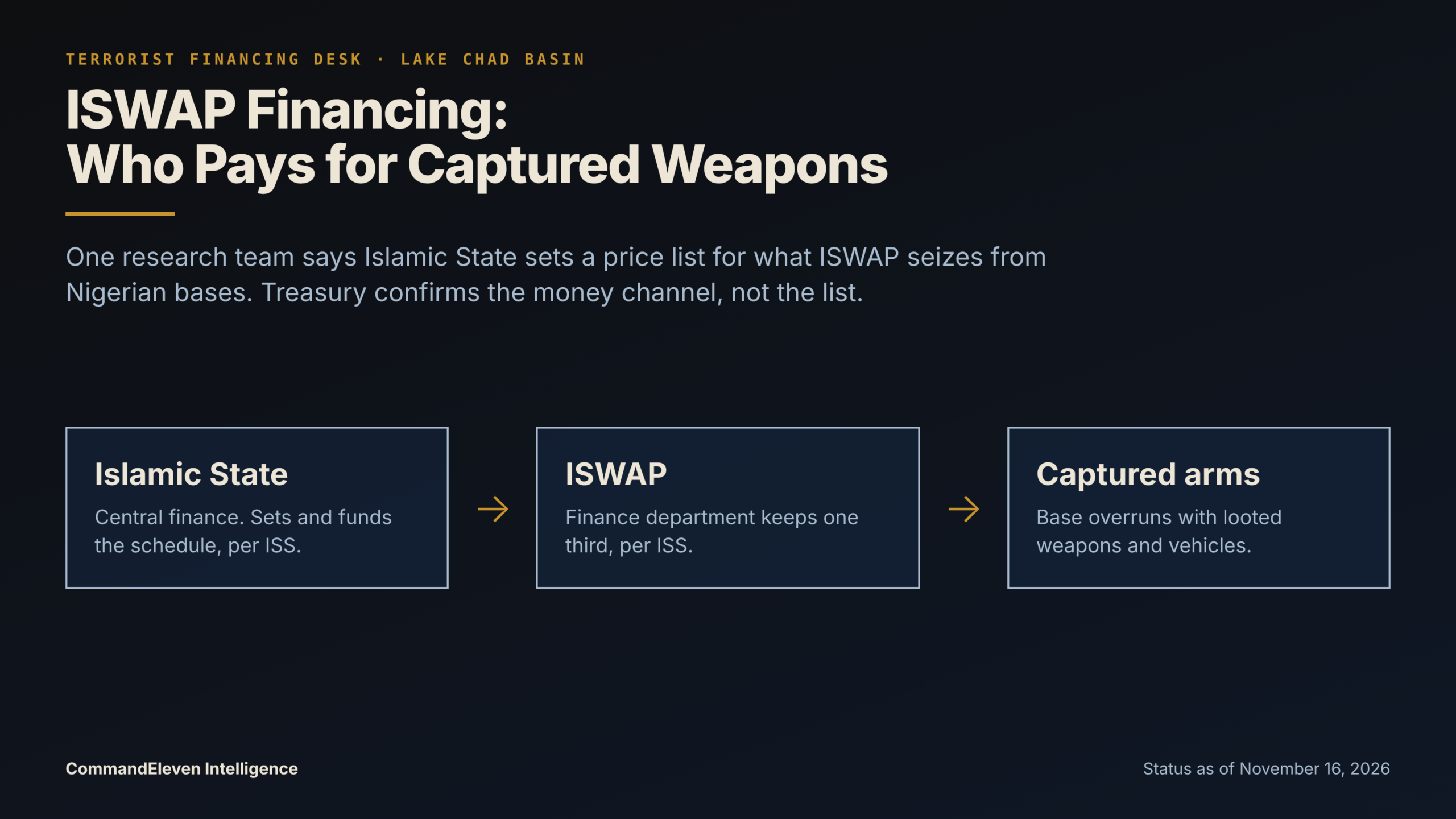
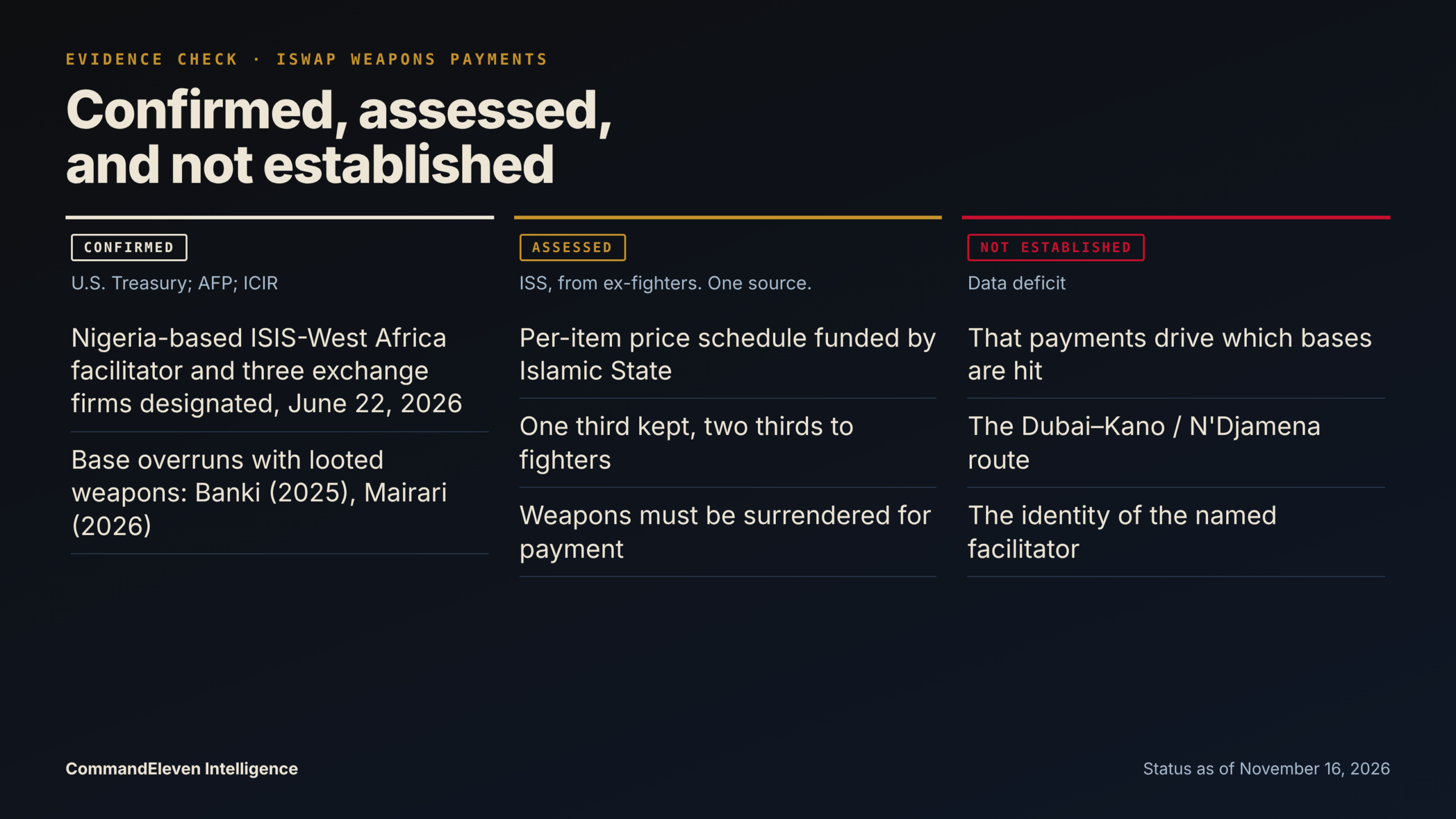
The Institute for Security Studies (ISS) reports that Islamic State pays ISWAP, its West Africa province, a fixed price for weapons and vehicles its fighters capture in attacks on military bases. If that is right, it helps explain why ISWAP keeps returning to garrisons with stockpiles instead of fighting only opportunistic ambushes. The payment system itself is ASSESSED: it comes from ex-fighters interviewed by one research team, with no second source. The money channel behind it is better documented: on June 22, 2026, the U.S. Treasury designated a Nigeria-based ISIS-West Africa financial facilitator and three Nigerian currency exchange firms. The base overruns are documented too, including Mairari in October 2026. What is not documented is the link between the two.
Key Judgments
- ASSESSED: Islamic State sets and funds a price schedule for captured weapons, ammunition and vehicles, and ISWAP pays fighters from it. Source: ISS, based on ex-fighters. No second source.
- CONFIRMED: On June 22, 2026, Treasury (OFAC) designated Mukhtar Adamu Muhammad, a Nigeria-based ISIS-West Africa financial facilitator, and three firms he controls: Nine to Nine Exchange Bureau de Change, Manhattan Bureau de Change and Generation Currency Bureau de Change. The release gives no dollar amounts and no routes.
- CONFIRMED (events), ASSESSED (motive): Base overruns with looting recur. In the Mairari attack in Borno State in October 2026, attackers looted weapons and burned vehicles, and troops withdrew. Whether the payment system explains target selection is an assessment. Resupply need, garrison weakness and propaganda value are competing explanations, and the sources do not separate them.
- ASSESSED: The system also works as a control mechanism. According to ISS, fighters must surrender captured weapons to receive payment, which reduces diversion.
- DATA DEFICIT: The route from Dubai to Kano or N’Djamena and on to Lake Chad island camps rests on ISS ex-fighter accounts. The Treasury release does not name those places. ISS could not confirm that the facilitator it names, “Alhaji Surajo,” is the Surajo Mohammed convicted in the UAE.
- SPECULATIVE: ISS also reports a 50% rise in ISWAP’s livestock and fishing taxes and a lower recruitment age (15). If ISWAP is short of local cash, an external payment stream would matter more to it. No source ties these facts together.
What the Payment System Reportedly Looks Like
ISS describes a finance department that accounts for captured spoils. ISWAP reportedly keeps one third. The rest goes to the fighters who took part, paid in naira. The same research says ISWAP also pays some fighters a salary of ₦75,000 a month, slightly above Nigeria’s ₦70,000 minimum wage.
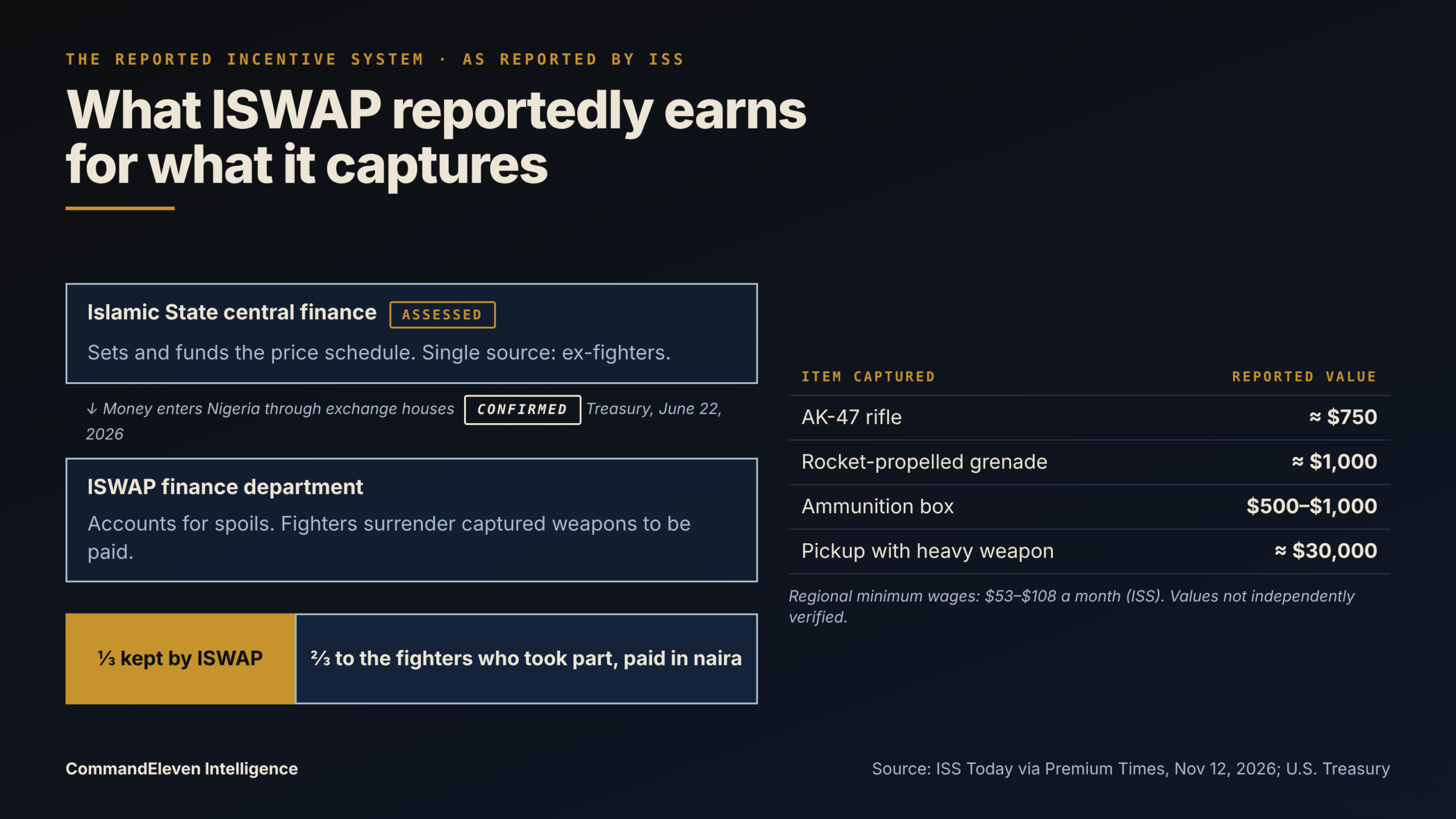
| Item captured | Reported value |
|---|---|
| AK-47 rifle | about $750 |
| Rocket-propelled grenade | about $1,000 |
| Ammunition box | $500 to $1,000, by caliber |
| Pickup truck with a heavy weapon | about $30,000 |
Values are as reported by ISS from ex-fighter accounts. We have not independently verified them.
For context, ISS puts monthly minimum wages across Cameroon, Chad, Nigeria and Niger at $53 to $108. A single captured rifle is worth many months of that. That comparison is why the incentive, if real, would draw and hold recruits.
The Money Channel: What Is Confirmed
The Treasury action of June 22, 2026 is the firm part of this picture. OFAC designated four individuals and six entities across Europe, the Middle East, Türkiye and Nigeria. In West Africa, it named Muhammad and his three exchange firms as handling transfers for ISIS-West Africa. Treasury Secretary Scott Bessent said that ISIS “continues to seek new methods and tools to finance terrorist attacks.”
Two limits apply. The release gives no amounts and reports no seizures. It also does not say what the money paid for, so it cannot confirm the weapons-payment system. What it does show is that Islamic State had working money-transfer channels into Nigeria through licensed exchange houses, which is the kind of channel ISS describes.
The Treasury release also records that Abu-Bilal al-Minuki, described as ISIS’s number two official and head of its General Directorate of Provinces, was killed on May 16, 2026, in a coordinated U.S.-Nigeria operation. That matters here because the Directorate of Provinces is the part of Islamic State that manages its affiliates.
The Target Pattern
The record of base attacks fits the claim without proving it.
- Mairari, Borno State (October 2026): According to AFP reporting, 15 soldiers and five civilian militia members were killed. Attackers looted weapons, burned vehicles and razed the base, and surviving troops withdrew toward Monguno. No group claimed it. Sources suspected ISWAP.
- Banki, Borno State (September 19, 2025): Per the ICIR timeline, insurgents seized ammunition and weapons from the barracks, forcing troops to retreat.
- January to March 2026: The same ICIR timeline lists six attacks on bases or forward operating bases in Borno and Yobe, at Malam-Fatori, Kawuri, Mayanti, the Konduga, Mainok, Jakana and Marte cluster, Kukawa and Goniri. Several describe vehicles destroyed or parts of bases burned. We could not date the Malam-Fatori entry with certainty, so we do not rely on it for casualty figures.
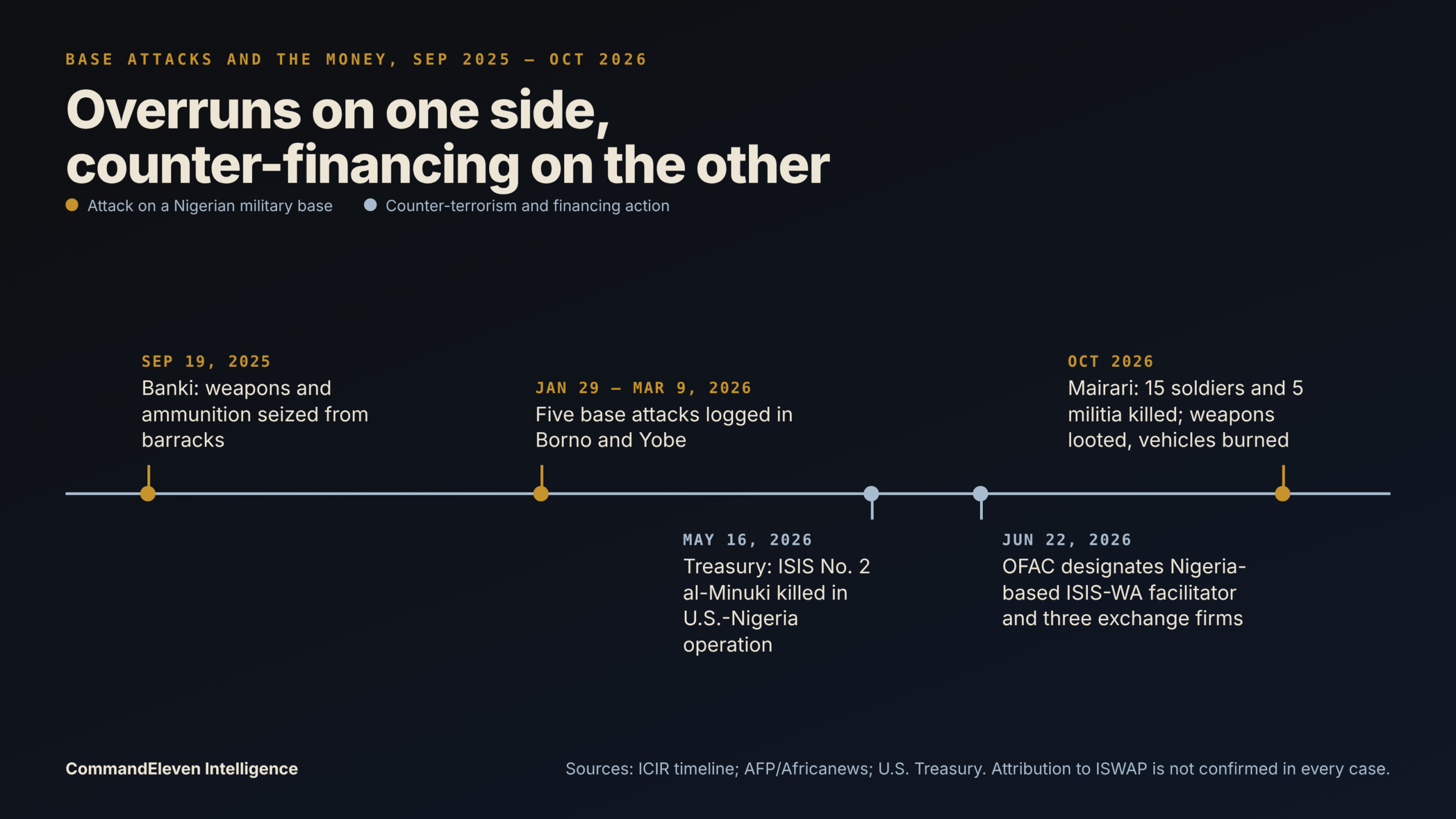
The pattern is consistent with a force that values stockpiles. It is equally consistent with a force that needs resupply and wants to humiliate the Nigerian Army. Both can be true.
How This Connects to the Wider ISWAP Picture
ISS’s July 27, 2026 analysis puts ISWAP at the center of a wider network. It reports that ISWAP helped Islamic State Sahel Province carry out the January 2026 attacks on Niger’s Diori Hamani International Airport and Air Base 101. It reports a Shura Council decision to send about 100 fighters to reinforce the Sahel Province in Ménaka, and about 50 to Nasarawa, Nigeria. It also reports ten trainers from Iraq, Chechnya and Libya arriving in July 2026 to train fighters on anti-aircraft weapons “reportedly newly acquired from Sudan.” These are ISS findings and we treat them as ASSESSED.
Taken together with the payment system, the picture is of a province tied closely to Islamic State’s central financing and moving fighters and weapons across borders. That is the same convergence logic our Transcontinental Convergence series follows: financing, weapons and fighters move on the same corridors.
What Defenders Can Do About It
The measures follow from the financing channel and the target pattern, and they stay at the policy level.
- Follow the money, not only the fighters. ISS recommends that financial intelligence units monitor recurring transactions and suspicious currency exchange activity on the UAE-to-Kano and UAE-to-N’Djamena corridors. The June 2026 designations suggest that approach is already producing targets.
- Treat stockpile security as counter-financing. If captured arms are currency, every depot, forward base and convoy is a payment instrument. Stronger bases and faster response reduce the incentive. ISS makes the same recommendation.
- Count what is lost. Public figures on equipment lost in each overrun are scarce. A published loss record would let analysts test the incentive claim against attack data. For now, that is a DATA DEFICIT.
What To Watch
- New OFAC or Nigerian designations and arrests tied to ISWAP money transfers, especially involving exchange houses.
- Whether the next overrun of a Borno or Yobe base again involves looted arms and vehicles, and whether troops report equipment losses.
- Any second source for the payment schedule, such as the next UN Monitoring Team report on ISIL and al-Qaeda or further ISS work.
- Whether ISWAP’s local tax pressure and recruitment lowering continue, or ease.
- Fighter and weapon movements toward Ménaka and Nasarawa.
Calls We Will Score
- By December 31, 2026: ISWAP or an unattributed Islamic State-aligned force will overrun at least one more Nigerian military base or forward operating base in Borno or Yobe State, and public reporting will describe looted weapons or burned vehicles.
- By March 31, 2027: The U.S. Treasury, the UK or Nigeria will announce at least one further designation, freeze or arrest tied to ISWAP or ISIS-West Africa financing, involving a currency exchange business or money transfer network.
- By July 31, 2027: A UN Monitoring Team report, a second research organization or an official Nigerian or Lake Chad Basin source will corroborate a per-item payment system for captured weapons. If none does, the payment system stays at ASSESSED and we will say so in the score.
What This Assessment Does and Doesn’t Establish
It establishes that Islamic State moved money into Nigeria through licensed exchange houses, as the Treasury action shows. It establishes that ISWAP has repeatedly overrun bases and looted equipment.
It does not establish that ISWAP is paid per captured item. That rests on one research source and ex-fighter accounts. It does not establish that the payment system drives target selection. It does not establish any specific route through Dubai, Kano or N’Djamena, or the identity of the facilitator ISS calls “Alhaji Surajo.” It does not rely on any information from our own field sources.
Frequently Asked Questions
What is ISWAP?
The Islamic State West Africa Province is Islamic State’s affiliate in the Lake Chad Basin, mainly northeastern Nigeria. It split from Boko Haram in 2016 and is distinct from the rival faction Jama’atu Ahlis Sunna Lidda’awati wal-Jihad (JAS), which ISS says mainly targets civilians.
Who says Islamic State pays ISWAP for captured weapons?
The Institute for Security Studies, in an analysis by researcher Taiwo Adebayo republished by Premium Times on November 12, 2026. It is based on interviews with sources who had direct knowledge of ISWAP’s finances, including ex-fighters. No second source has confirmed it.
Has the U.S. confirmed the payment system?
No. The Treasury designations of June 22, 2026 confirm a financing channel through Nigerian currency exchange firms. They do not describe what the money paid for.
Why does it matter if fighters are paid per captured weapon?
Because it would give the group a financial reason to attack garrisons with stockpiles, and it would give defenders a way to disrupt that incentive, through financial monitoring and through harder bases.
Is this the same as the Mali and Sahel stockpile problem?
Related, not identical. ISS links ISWAP to Islamic State’s Sahel Province and reports fighter and weapon movements between the Lake Chad Basin and the Sahel. We do not claim the payment system operates in the Sahel.
Related CommandEleven Intelligence Reading
- Transcontinental Convergence: A CommandEleven Intelligence Series (series introduction)
- The Money: How Terrorist and Criminal Finance Share the Same Rails – Part II
- The Corridors: Where Terrorist and Criminal Supply Routes Overlap, and Where They Do Not – Part III
- The Convergence Ledger: Every Link We Graded, and What the Record Supports
- The Criminal-Terror Nexus: How Insurgencies Monetize Instability – Part 1 (opens that line of coverage)
- Terrorist Financing: Hawala, Crypto, and the Coordination Gap
- Russia’s Sahel Playbook
Sources
- Islamic State is incentivising ISWAP to target military stockpiles in Nigeria, others (Premium Times, from ISS Today, November 12, 2026)
- Treasury Targets ISIS Facilitators and Disrupts Terrorist Financial Networks (U.S. Department of the Treasury, June 22, 2026)
- Nigeria’s army chief of staff visits troops in Borno after deaths of 15 soldiers (Africanews/AFP, October 18, 2026)
- Timeline: Boko Haram, ISWAP attacks on Nigerian military bases since 2025 (ICIR)
- Fragmented security allows terrorists cross-mobility across Lake Chad and the Sahel (ISS Today, July 27, 2026)