CommandEleven Intelligence Desk · Transnational Threats Desk, status as of November 12, 2026
Update, November 12, 2026: We have now read the UN Panel of Experts on Yemen’s final report, S/2025/650. The Houthi and al-Shabaab finding below is upgraded from REPORTED to CONFIRMED as a UN Panel finding. The Panel’s detailed case rests on official sources and the confession of one detained al-Shabaab liaison, and it has not been tested in court. All other tiers are unchanged.
Bottom Line Up Front
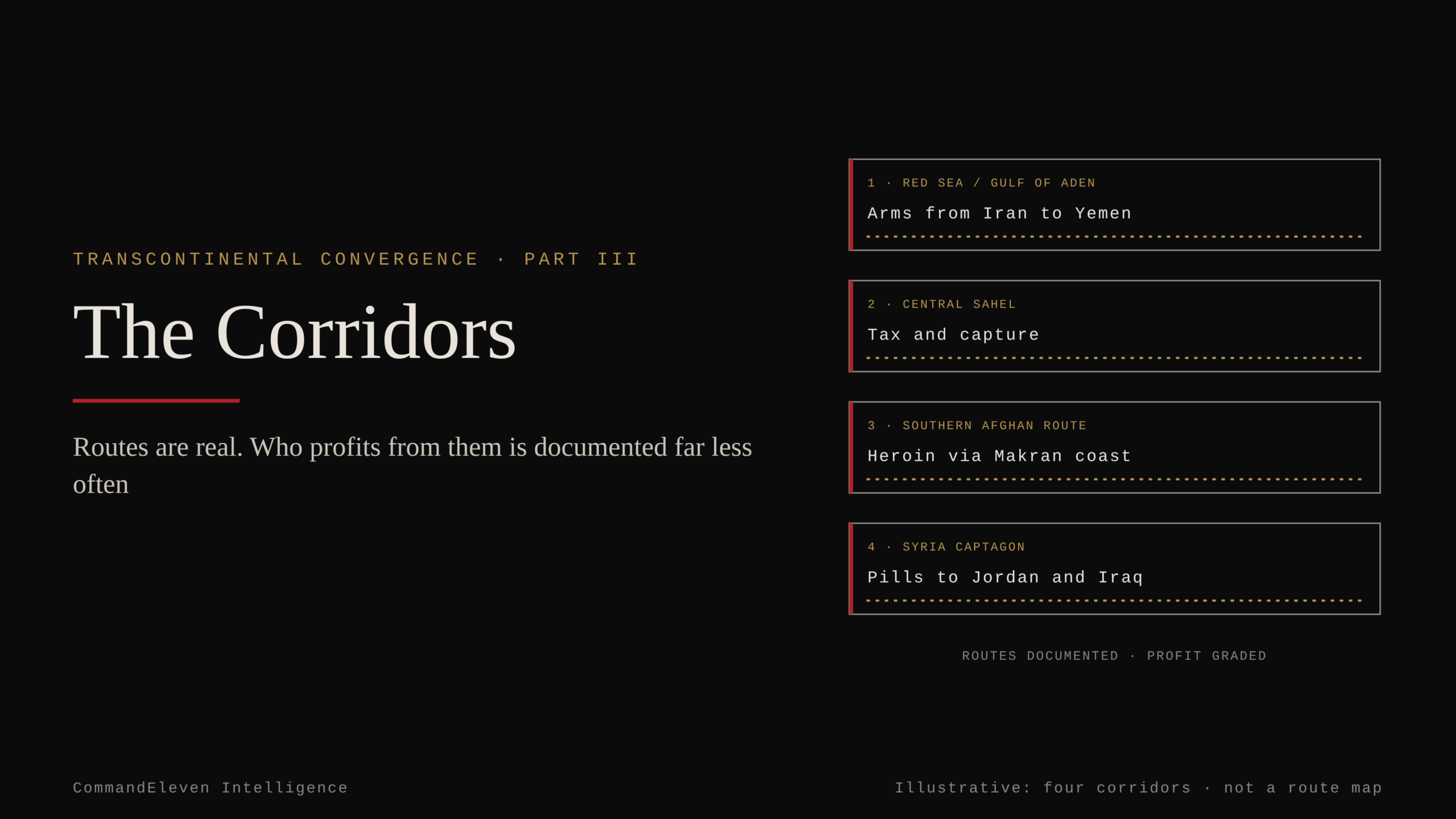
Four trafficking and supply corridors are well enough documented to examine: the Red Sea and Gulf of Aden arms route to Yemen, the Central Sahel in Mali, the southern Afghan heroin route through Pakistan’s Makran coast, and Syria’s Captagon routes into Jordan and Iraq. The record shows corridors as geography and local brokers. Armed groups tax, capture, shelter beside or are alleged to profit from what moves along them, but no public source we reviewed shows one group running a route from end to end, and none shows a terrorist group and a criminal syndicate sharing a route by agreement. The strongest documented link is the Houthi supply line from Iran, and the strongest allegation, from a UN panel, is Houthi cooperation with al-Shabaab. This is Part III of our Transcontinental Convergence series.
Key Judgments
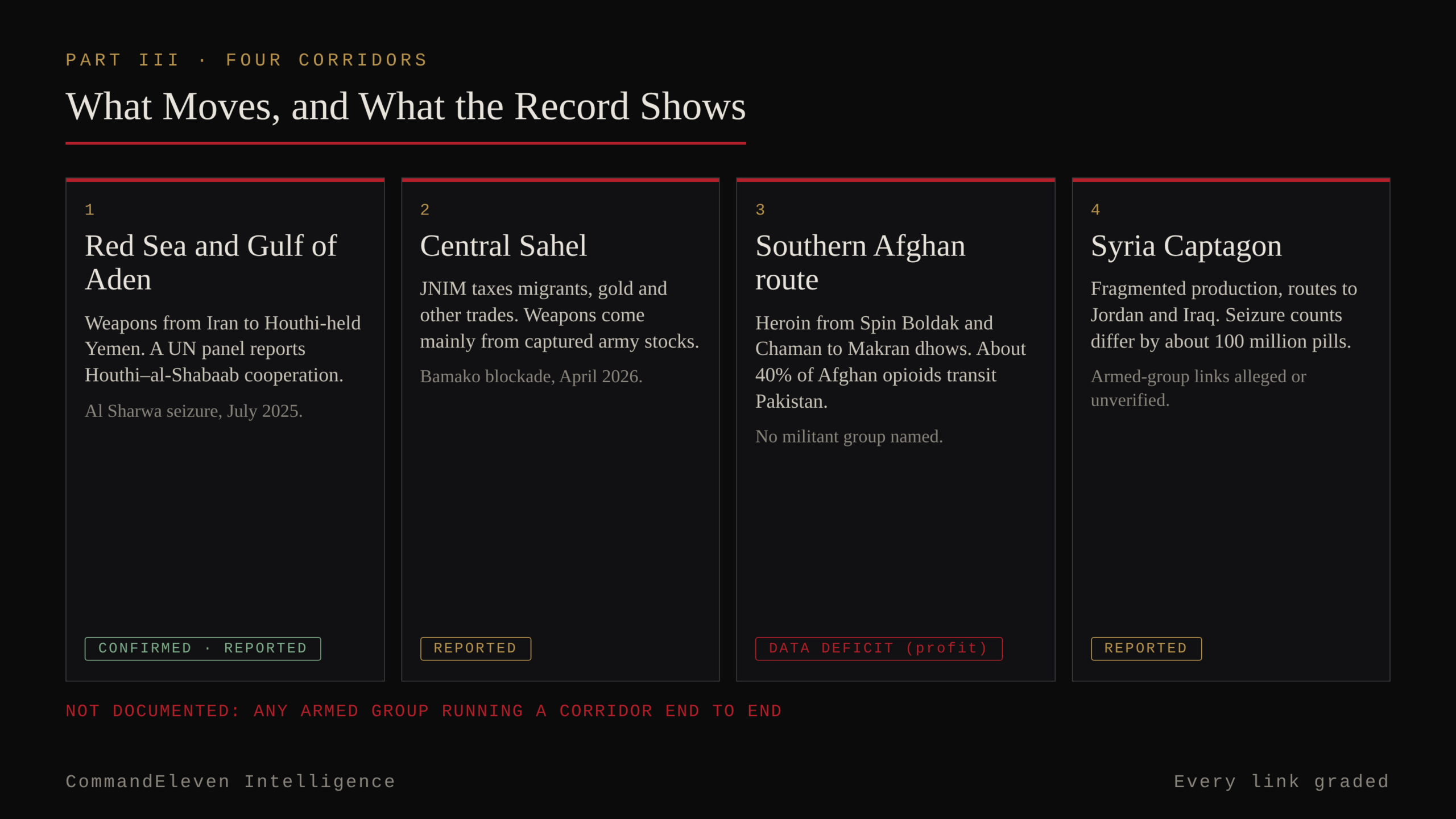
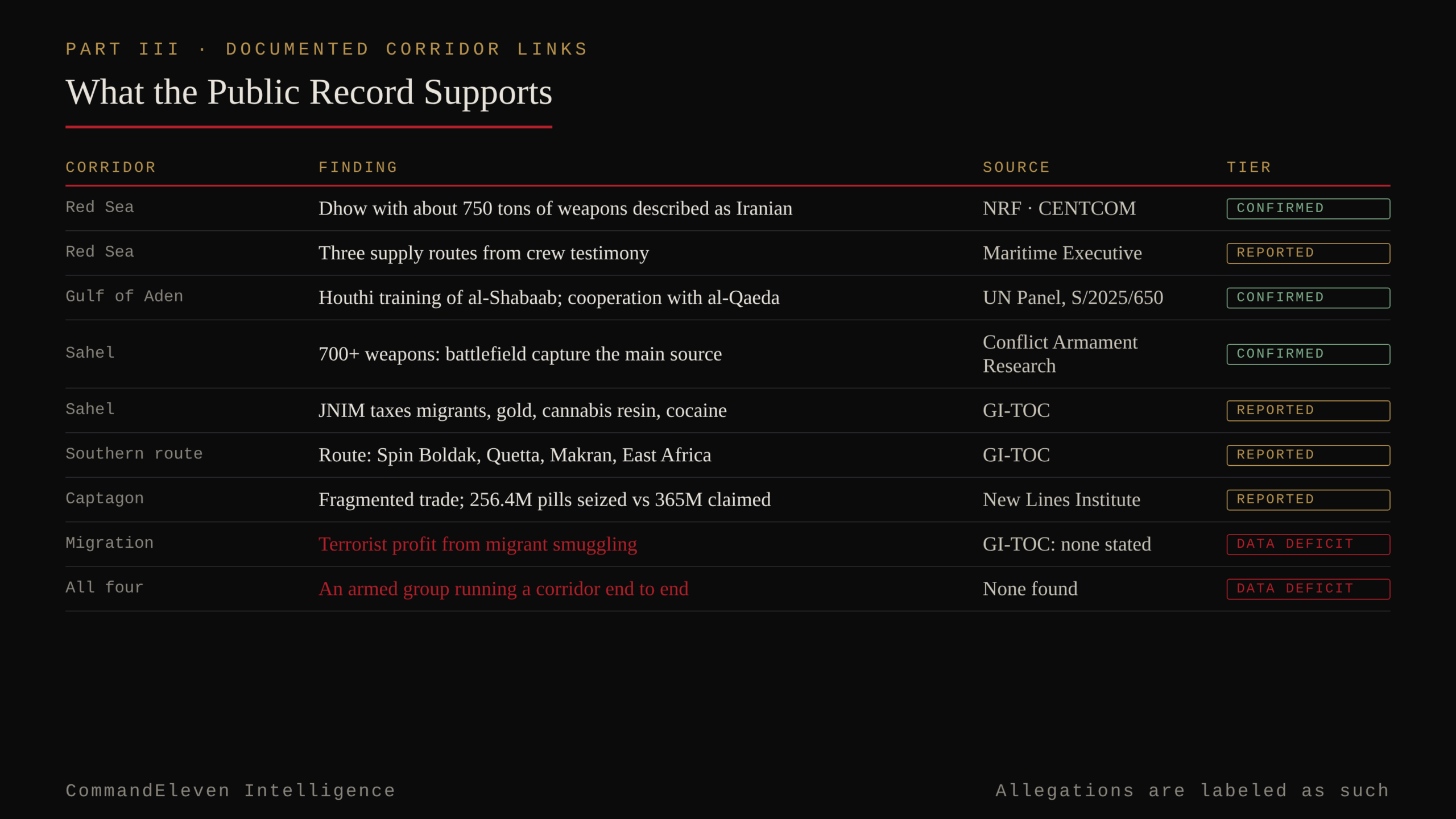
- CONFIRMED: In July 2025 Yemen’s National Resistance Forces seized the dhow Al Sharwa carrying about 750 tons of weapons that Yemeni forces and U.S. Central Command described as Iranian and bound for the Houthis. Crew testimony reported by Maritime Executive described three routes into Yemen, which we hold as REPORTED.
- CONFIRMED: The UN Panel of Experts on Yemen reported in its final report, S/2025/650 (October 2025), that cooperation between the Houthis and al-Shabaab has intensified, including Houthi engineers training al-Shabaab in improvised explosive devices and drone adaptation. We hold it as a UN Panel finding. It rests on official sources and the confession of one detained al-Shabaab liaison, and it has not been tested in court.
- CONFIRMED: Conflict Armament Research documented more than 700 weapons recovered from jihadist groups in the Central Sahel between 2015 and 2023. It found battlefield capture from regional armies to be the main source and found no evidence of outside supply. This contradicts the older claim of a Libya-to-Sahel weapons pipeline.
- REPORTED: The Global Initiative Against Transnational Organized Crime (GI-TOC) reports that JNIM has taxed migrants, foodstuffs, cannabis resin, cocaine and gold in Mali, and that its April 2026 offensive with Tuareg separatists shifted control of trafficking routes.
- REPORTED: About 40 percent of Afghan opioids pass through Pakistan, with heroin leaving the Makran coast by dhow. GI-TOC says the revenue is “repeatedly linked” to militant financing in Balochistan but names no group.
- REPORTED: The Captagon trade in Syria has fragmented since the fall of Assad. Two counts of 2025 seizures differ by roughly 100 million pills, and links to the Islamic State, Iran-backed groups and the Syrian Democratic Forces are alleged or unverified.
- DATA DEFICIT: We found no public source documenting a terrorist group profiting from migrant smuggling in North Africa and the Sahel, and none showing any group operating a corridor end to end. We hold both open.
Sourcing and Analytical Confidence
We grade every claim on one scale. Government statements, UN panel findings and think-tank reports are treated as allegations or analysis, not proven fact. Crew testimony and press accounts of unpublished reports are labeled. “(Unconfirmed)” is an inline hold tag only.
| Tier | Meaning |
|---|---|
| CONFIRMED | Documented by an official source, a primary document or multiple independent credible sources |
| REPORTED | Credible outlet or analyst, not independently verified by us |
| ASSESSED | Our judgment from the confirmed and reported record |
| DATA DEFICIT | We looked and the public record does not answer the question |
What a Corridor Is, and What It Is Not
A corridor is a route that goods and people use repeatedly because geography, weak border control and willing local brokers make it cheap. It is not the same as a network. Several actors can use one corridor without knowing each other, and one actor can tax a corridor without running it. We therefore separate four questions: what moves, who controls the ground, who profits, and whether anyone coordinates. The record answers the first two reasonably well, the third unevenly, and the fourth almost never.
Corridor One: The Red Sea and Gulf of Aden
The best-documented corridor in this series carries weapons to the Houthis. In July 2025 Yemen’s National Resistance Forces, a militia allied with the Yemeni government, seized the dhow Al Sharwa off the coast with about 750 tons of weapons aboard, which Yemeni and U.S. officials described as Iranian. Maritime Executive reported, from the interrogation of the crew, that shipments have moved by three routes: directly from Iran’s Bandar Abbas to the Yemeni coast near Salif, by transfer from a mother ship off Somalia, and through front companies based in Djibouti. The crew account is a claim by detainees held by a party to the war, so we hold it as REPORTED. The seizure itself and the cargo description are CONFIRMED by multiple outlets and U.S. Central Command. (Maritime Executive)
The second claim is more consequential for this series. The UN Panel of Experts on Yemen reported in its final report, S/2025/650 (October 2025), that cooperation between the Houthis and al-Shabaab has intensified, covering weapons smuggling, technical training and logistical support, and that the Houthis and al-Qaeda in the Arabian Peninsula have also increased collaboration. Its detailed case rests on a detained al-Shabaab liaison who, according to the Panel, named two Houthi military engineers who reportedly traveled to Jilib, Somalia, to train al-Shabaab members in making improvised explosive devices and adapting drones, and who said he had facilitated the travel of nearly 400 Somalis for training in Houthi-controlled areas of Yemen. The Panel says official sources supplied documentary evidence and that material found with the man corroborated his statements. That ties directly back to Part I, where armed drones appear in several theaters. If the Panel’s finding holds, it is the only documented direct transfer of tactical know-how between a state-backed insurgency and a jihadist group in this series. We grade it CONFIRMED as a UN Panel finding, not as an adjudicated fact, and it names the groups as cooperating, not as sharing a supply chain. (UN Security Council, S/2025/650)
Our assessment is that the Gulf of Aden is a corridor for state-supplied weapons and for contact between armed groups on either side of the water. Money is not shown to flow along it.
Corridor Two: The Central Sahel
The Sahel is where the older convergence story breaks down. The claim that weapons flow from Libya into the Sahel does not survive the field data. Conflict Armament Research recorded more than 700 weapons recovered from jihadist groups in the Central Sahel between 2015 and 2023 and found that capture from state forces in battle was the main source, with no evidence of outside supply. Groups arm themselves mainly from the armies they fight. (allAfrica, May 12, 2025)
What the groups do take from the corridor is revenue. GI-TOC’s analysis of the coordinated attacks in Mali beginning April 25, 2026, when the Jama’at Nusrat al-Islam wal-Muslimin (JNIM) and the Azawad Liberation Front struck together and JNIM announced a blockade of Bamako on April 28, reports that JNIM has taxed migrants, foodstuffs, cannabis resin, cocaine and gold, including at the N’Tahaka site, and that the offensive realigned who controls the routes. Taxing a trade is not the same as running it, and we do not read the analysis as saying JNIM runs the cocaine or cannabis trade. Earlier reports of JNIM taxing fuel are historical and we do not carry them as current. (GI-TOC)
In our assessment, the Sahel corridor shows a jihadist group profiting from other people’s trafficking by controlling the ground. It does not show a link to a transcontinental syndicate.
Corridor Three: The Southern Afghan Heroin Route
GI-TOC’s July 2026 study of heroin routes describes the southern route in detail. Opium is refined in Helmand, Nimroz, Kandahar and neighboring provinces and crosses into Pakistan at Spin Boldak and Chaman. Quetta is a consolidation point, and heroin leaves the Makran coast from Gwadar and nearby sites on dhows, fishing boats and in containers. A western branch crosses into Iran at Zaranj and Milak, and Iran is described as the primary land bridge to Türkiye and the Caucasus. From the coast, consignments move down the Indian Ocean to East African ports. The authors estimate that about 40 percent of Afghan opioids pass through Pakistan. (GI-TOC, July 9, 2026)
Supply is far lower than it was. Afghan opium output is estimated to have fallen about 97 percent from 2017 levels after the Taliban’s 2022 ban, though the same study notes that production and trafficking adapted. On the militant question, the study says trafficking revenues in Balochistan are “repeatedly linked” to militant and terrorist financing, and does not name a group. We therefore hold the link between this corridor and any specific militant group as DATA DEFICIT. The route is documented, and who profits from it is not. (GI-TOC study, PDF)
Corridor Four: Syria’s Captagon Routes
Captagon production was once centralized under the Assad government. A July 2026 New Lines Institute report says the trade has since split into a decentralized network of small producers and traffickers embedded in Syria’s postwar economy. Smuggling runs from Suwayda and Daraa toward Jordan, and through the northeast and the Albu Kamal area toward Iraq, with Syria acting as a transit and production site. (New Lines Institute, July 2026)
The numbers are contested. The institute’s seizure database recorded 256.4 million pills seized in 2025, while Syrian officials said 365 million were seized by the end of the year; the report describes the gap as nearly 100 million pills, and notes that not every seizure is reported in open sources. Armed-group involvement is where the record is thinnest. The report says some Islamic State remnants operate alongside local tribes in the northeast and that some tunnels have been repurposed for smuggling, on anecdotal evidence; that parts of Iraq’s Popular Mobilization Forces appear to have followed Hezbollah’s precedent, without confirmation in Syria; that there are unconfirmed reports of Iranian involvement; and that it could not verify whether Syrian Democratic Forces leadership is involved. It finds no evidence tying the new government in Damascus to the trade. Every one of those links is alleged or unverified, and we carry them as such. (New Lines Institute, policy report PDF)
Migration Routes: A Corridor Without a Documented Terrorist Profit
Human smuggling across North Africa and the Sahel is a large corridor and is often cited in convergence commentary. GI-TOC’s 2026 analysis, posted November 12, reports that departures from Libya to Europe reached their highest level since 2017 in 2025, that departures from western Libya collapsed in 2026 as the center of the trade shifted east, that fighting in northern Niger limited movement, and that insurgent groups are gaining power and redrawing smuggling routes. It does not identify those groups as jihadist and does not say any armed group profits from migrant smuggling. We therefore describe the corridor, note that the geography overlaps with the Sahel conflict, and hold any terrorist profit as DATA DEFICIT. (GI-TOC, November 12, 2026)
What the Four Corridors Show Together
Read side by side, the four corridors show the same pattern as Parts I and II. The routes are real, and the armed groups present on them are real. What the sources document is proximity and taxation, not partnership. Two corridors, the Gulf of Aden and the Sahel, have named armed groups with documented roles. The other two, the Makran route and Captagon, have documented routes and unnamed or unverified beneficiaries. One alleged link, Houthi training of al-Shabaab, would be a genuine transfer between armed groups, and it still needs its primary source.
Links We Could Not Source
These claims circulate widely, including in earlier drafts of this series. We looked for a public source for each and are not carrying any of them.
| Claim | What we found | Tier |
|---|---|---|
| Russian organized crime brokers arms to the Houthis | We found no source. | DATA DEFICIT |
| The Sahel feeds a weapons and funds funnel to Egypt, Gaza and Yemen | No public source documents the route or the flow of weapons or money. | DATA DEFICIT |
| Sahel territory is a sanctuary for senior jihadist commanders | Not supported by the sources we reviewed. | DATA DEFICIT |
| Islamic State core sends cryptocurrency to ISKP | Part II documents ISKP wallets and their Chainalysis totals; no source ties them to funds from the core. | DATA DEFICIT |
| Levant-developed attack designs are delivered to a South Asian border | We found no public source. | DATA DEFICIT |
What To Watch
- A follow-up UN Panel report on Houthi and al-Shabaab cooperation, and any follow-up seizure of Houthi-bound cargo.
- Whether GI-TOC or UN monitors confirm JNIM revenue from specific commodities after the Bamako blockade.
- Any government or UN source that names the Balochistan militant group receiving heroin revenue.
- A reconciled count of 2025 Captagon seizures, and any source that documents Islamic State or Iran-backed involvement beyond allegation.
- Evidence that any armed group runs, and does not merely tax, a trafficking route end to end.
What Would Change Our Assessment
- A UN, government or court document showing a named armed group operating a corridor end to end.
- Documentation that a terrorist group and a criminal syndicate share a route by agreement.
- A primary UN document that differs from the press accounts of the Houthi and al-Shabaab finding.
- Credible sourcing for any of the five unsourced links above, which we would add with a tier.
Calls We Will Score
- By March 31, 2027: A U.S. or Yemeni government source will attribute another seized Houthi-bound arms shipment to Iranian origin.
- By June 30, 2027: No government or UN source will name a specific Baloch militant group as receiving revenue from southern-route opiate trafficking.
- By July 31, 2027: A UN monitoring report will again describe cooperation between the Houthis and al-Shabaab.
We score each call on its due date and publish the result, hit or miss, on the Foresight Record.
What This Assessment Does and Doesn’t Establish
- Does establish: that four corridors are documented, that armed groups tax or sit astride at least two of them, that the Sahel weapons-pipeline claim fails on the field data, and that the public record does not show a terrorist group and a criminal syndicate sharing a corridor.
- Does not establish: that any group runs a corridor end to end, that Houthi and al-Shabaab cooperation is proven beyond the UN panel’s reported finding, that any militant group profits from southern-route heroin or from migrant smuggling, or that Captagon involvement by named armed actors is more than alleged. Public output stays at the organizational and strategic level and does not describe how routes are run or evaded.
Frequently Asked Questions
Do terrorist groups run drug and smuggling routes?
The public record shows groups taxing or controlling ground along routes, as JNIM does in Mali. It does not show a group running a route end to end.
Do Sahel jihadists get weapons from Libya?
Not according to the field data we reviewed. Conflict Armament Research found battlefield capture from regional armies to be the main source and found no evidence of outside supply.
Are the Houthis working with al-Shabaab?
The UN Panel of Experts on Yemen reported in S/2025/650 that cooperation has intensified, including Houthi training of al-Shabaab in explosives and drone adaptation. We hold it as a UN Panel finding.
What is Part IV about?
Part IV, The Transcontinental Crime, profiles the transnational criminal organizations that operate across these theaters, at the organizational level, and grades what links each has to armed groups.
Related CommandEleven Intelligence Reading
- Transcontinental Convergence: A CommandEleven Intelligence Series
- Tactical Diffusion: How Militant Drone Warfare Spreads – Part I
- The Money: How Terrorist and Criminal Finance Share the Same Rails – Part II
Related Reading
- GCTA Foresight Audit: Financing and the Stealth State – Part 1
- Tactical Diffusion: How Militant Drone Warfare Spreads – Part I
- The Criminal-Terror Nexus: How Insurgencies Monetize Instability – Part 1
- The Money: How Terrorist and Criminal Finance Share the Same Rails – Part II
Sources
- Maritime Executive, “Iranian Arms Shipment Routes to Houthis Revealed by Large Seizure,” 2025
- allAfrica, “Somalia: UN Experts Report Secret Collaboration Between Houthis, Al-Qaeda and Al-Shabaab,” November 5, 2025
- UN Security Council, Final report of the Panel of Experts on Yemen, S/2025/650, October 17, 2025
- allAfrica, “West Africa: Where Do Jihadist Groups in the Sahel Get Their Weapons?” May 12, 2025
- Conflict Armament Research, “Salafi Jihadists in the Central Sahel, Issue 02”
- GI-TOC, “Coordinated attacks in Mali shift territorial control and realign illicit economies,” 2026
- GI-TOC, Paddy Ginn and Danial Husain, “Heroin trafficking along the northern and southern routes,” July 9, 2026
- New Lines Institute, “Captagon Creeps into Syria’s Contested Areas,” July 2026
- GI-TOC, “Human smuggling and trafficking in North Africa and the Sahel,” November 12, 2026