
Key Judgments
- [CONFIRMED] – On September 11, 2026, marking the 25th anniversary of the September 11 attacks, U.S. Ambassador to the UN Mike Waltz told the Security Council that the international community has spent 25 years building a counterterrorism architecture and “now we have to deliver” – remarks accompanying the UN Security Council’s first counter-terrorism presidential statement in five years, a body publicly signaling its existing framework requires renewal.
- [CONFIRMED] – CommandEleven Intelligence’s April 2026 Global Counter-Terrorism Assessment (GCTA) explicitly documented the obsolescence of the legacy counter-terrorism model five months before this convergence of official statements, stating directly that “the Hard War model of counter-terrorism has reached its ceiling of efficacy” and calling for a structural shift from a military-intelligence-centric model to a community-based, cognitive-response framework.
- [CONFIRMED] – Specific GCTA forecasts have since been independently validated by primary institutional sources: the GCTA’s April 2026 identification of “global Hawala-Crypto bridges” as a core al-Qaeda financial mechanism precedes FATF’s September 3, 2026 report identifying “digital hawala” – the same hawala-to-formal-finance convergence – as a principal global money-laundering channel used by more than 80% of reporting jurisdictions.
- [CONFIRMED] – Independent analysis published around the same 25th-anniversary window reaches convergent conclusions without citing the GCTA: NCTC Director Kent told Congress in December 2025 that today’s threat represents a “new terrorist playbook” oriented toward targets of opportunity rather than 9/11-style spectacular attacks, and Atlantic Council analysis published September 10, 2026 states plainly that AI “is already reshaping the terrorist threat landscape by making a familiar playbook easier, cheaper, and faster to execute.”
- [ASSESSED] – CommandEleven Intelligence assesses that the GCTA’s April 2026 analysis was not a one-time forecast but the opening document in a sustained body of work – more than fifteen major dossiers and series published in the five months since, spanning every region and threat category the GCTA identified – and that this track record, not any single correct prediction, is the more meaningful evidence that the assessment’s underlying analytical framework has held up under six months of subsequent events.
The Thesis, Stated Plainly
CommandEleven Intelligence has argued repeatedly, on air and in its own published work, that the United States is fighting the 2026 threat landscape with a playbook built for 2000: an al-Qaeda-era model premised on hierarchical command structures, state-sponsored financing, physical training camps, and long-form ideological recruitment, applied against a 2026 reality that looks almost nothing like that. This white paper exists to test that thesis against the documentary record – CommandEleven Intelligence’s own April 2026 forecasting, the primary institutional sources that have since confirmed or extended it, and the continuous body of published analysis CommandEleven Intelligence has produced in the intervening five months.
The argument is not that the legacy playbook was wrong when it was built. It is that the threat it was built to counter has evolved past it, and that recognizing this gap explicitly – rather than continuing to fund and structure counter-terrorism institutions around 2001-era assumptions – is now a matter of public record among the officials responsible for the response, not merely an outside critique.
What the Old Playbook Assumes
The post-9/11 counter-terrorism architecture was built around a specific threat model: a centralized organization (al-Qaeda Central) directing regional affiliates through a hierarchical chain of command, financed substantially through wealthy state and individual donors, operating from physical training camps in ungoverned territory, and recruiting through long-form ideological instruction – sermons, printed literature, in-person indoctrination – that took months or years to produce an operational actor. The institutional response built to counter this model – SIGINT-driven strike operations, financial sanctions targeting identifiable donor networks, kinetic degradation of physical camps – was well-matched to that threat.
What 2026 Actually Looks Like
CommandEleven Intelligence’s April 2026 GCTA documented, in granular and specifically sourced detail, how far the actual 2026 threat landscape has diverged from that model.
The assessment’s own executive summary captures the core paradox:
- Total global terrorism deaths fell 28% to a post-2007 low, even as Western nations experienced a 280% surge in fatalities, driven by what the GCTA termed a “triple threat” of antisemitism, Islamophobia, and political extremism
- Pakistan surpassed every nation to become the most-impacted country in the world for the first time, driven by the Tehreek-e-Taliban Pakistan and the Baluchistan Liberation Army
- Drone attacks became a standard battlefield tactic for groups including ISIS and the Houthis – 77 recorded incidents in 2025 alone, substantially influenced by technology transfer from the Ukraine conflict
- Investigations into minors involved in terrorism tripled since 2021
- In the West, 93% of fatal attacks were carried out by lone actors, many radicalized in weeks rather than months via short-form content platforms
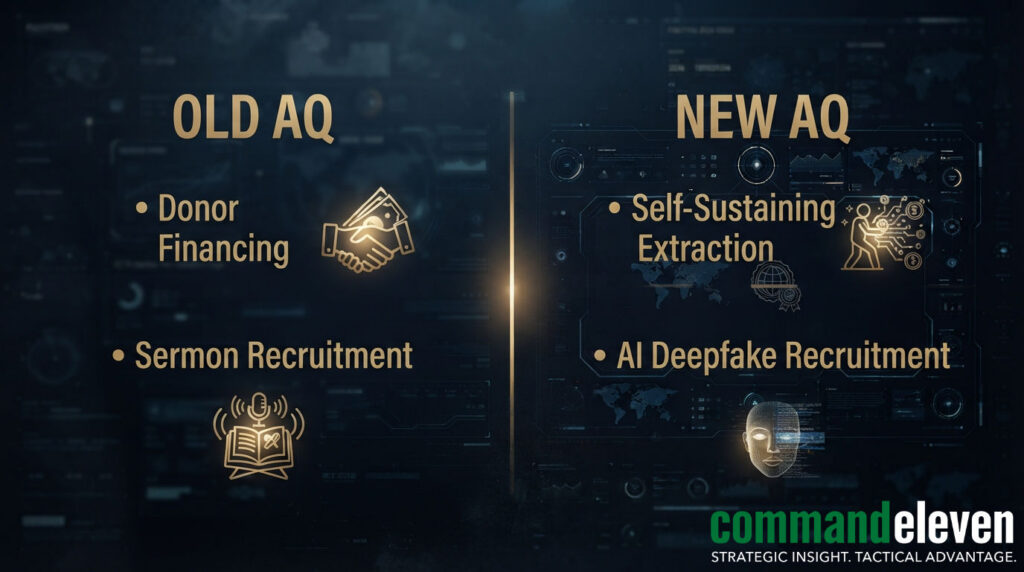
The GCTA’s own name for al-Qaeda’s current model, the “Stealth State,” captures the structural shift most directly: in 2026, it assesses, al-Qaeda Central has “moved away from being a single organization to becoming a decentralized venture capital firm for insurgency,” providing the funding, technical R&D and ideological licensing that allow regional groups (the TTP, JNIM, al-Shabaab) to operate as effectively independent franchises rather than directed affiliates. The document’s own contrast is explicit: “Old AQ relied on the golden chain of wealthy donors. New AQ is self-sustaining” – financing itself through nationalized artisanal gold and charcoal industries in the Sahel and Somalia rather than wire transfers from donors. “Old AQ recruited through long-form, academic-style sermons. New AQ utilizes AI-facilitated deepfake propaganda” and meets recruits inside gaming environments and Discord servers before a physical training camp ever enters the picture.
Foresight Audit: What Was Called in April, Confirmed Since
The Hawala-Crypto Bridge
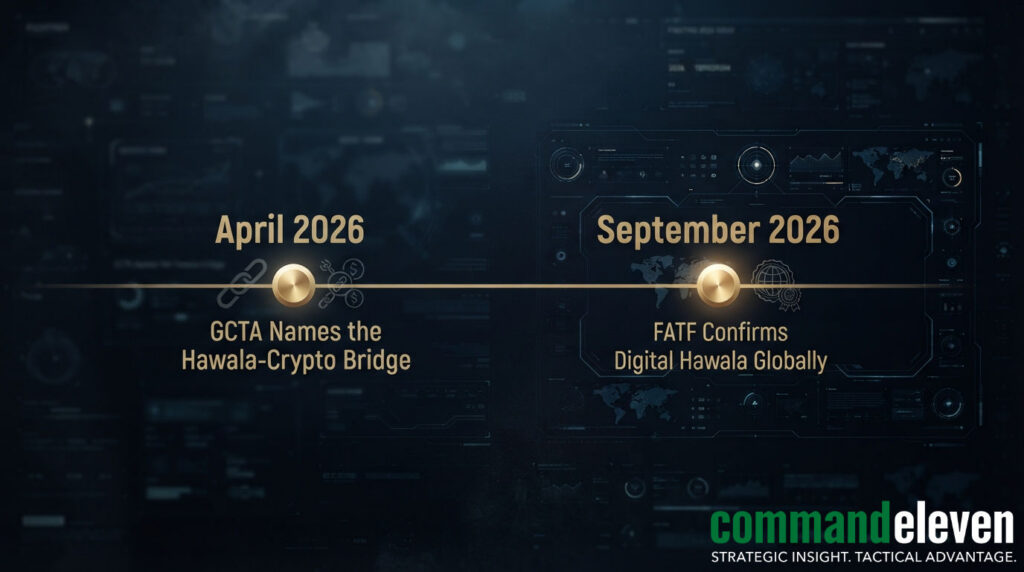
The GCTA’s April 2026 assessment named “global Hawala-Crypto bridges” explicitly as a core al-Qaeda financial mechanism, describing how the network facilitates movement of affiliate revenue – including al-Shabaab’s documented $150 million annual revenue – into global markets through exactly this hybrid channel. Five months later, FATF’s September 3, 2026 report on underground banking identified “digital hawala” – hawala networks integrating with formal financial infrastructure including cryptocurrency wallets – as a principal money-laundering channel used by more than 80% of reporting jurisdictions globally, with individual cases moving over €500 million in months.
CommandEleven Intelligence’s own Terrorist Financing white paper, published this month, built directly on that FATF report; this audit traces that finding back one additional step, to CommandEleven Intelligence’s own April forecast that anticipated the mechanism FATF has now formally confirmed at global scale.
The Playbook Obsolescence Itself
The GCTA’s “Strategic Pivot” section stated in April that “the Hard War model of counter-terrorism has reached its ceiling of efficacy” and called explicitly for a shift from a “military-intelligence-centric model” to a “Community-Based De-radicalization model” – reallocating resources from purely kinetic overseas operations toward domestic social cohesion investment, algorithmic transparency requirements, and inter-agency convergence between counter-terrorism, education, and public health institutions.
Five months later, this is no longer a minority position:
- Ambassador Waltz’s September 11 remarks explicitly frame the existing 25-year architecture as insufficient absent a shift toward delivery
- NCTC Director Kent’s December 2025 congressional testimony independently describes a “new terrorist playbook” oriented toward opportunistic rather than spectacular attacks
- the Atlantic Council’s September 10, 2026 25th-anniversary retrospective states that AI is actively making the “familiar playbook” cheaper and faster to execute – precisely the erosion-of-efficacy argument the GCTA made five months earlier
- [DATA DEFICIT] – This audit does not claim any of these subsequent sources drew directly on CommandEleven Intelligence’s GCTA – no such citation or attribution has been identified. The claim here is convergent validation: independent analysts and officials, working from their own institutional vantage points, reached substantially the same conclusions the GCTA reached first, which this white paper treats as a stronger form of confirmation than direct citation would provide.
Continued Development: The Track Record Since April
A single accurate forecast, however validated, would not on its own support the broader claim that CommandEleven Intelligence’s analytical framework has kept pace with a fast-moving threat landscape. What supports that claim is the sustained body of work produced in the five months since the GCTA’s publication – evidence that the April assessment was a starting point CommandEleven Intelligence has continued to test, extend, and revise against unfolding events, not a static document allowed to age in place.
Since April 2026, CommandEleven Intelligence has published:
- a six-part grey-zone warfare series examining China, Russia, and Iran’s coordinated operations against global infrastructure
- a standalone Axis of Evil dossier mapping China-Russia-Iran-North Korea coordination
- a multi-part IRGC series covering Iran’s Garrison State model, Latin American operations, and the Axis of Resistance proxy network
- two China-focused series on cyber espionage and South China Sea maritime activity
- a five-part Muslim Brotherhood in America series built substantially on a retired FBI Special Agent’s Senate testimony
- a five-part U.S. Domestic Threat Landscape series covering right-wing accelerationism, left-wing violent extremism, Islamist-inspired lone-actor threats, and a Europe-as-leading-indicator comparative analysis
- a five-part Ukraine-Russia War series tracing the conflict’s hybrid, military, economic, and diplomatic dimensions
- a six-part Iran War Doctrine & Strategy series testing Iran’s asymmetric doctrine against six months of wartime evidence
- a standalone dossier mapping the Turkey-coordinated Berlin-Vienna Hamas network
- a eight-part series updating the original 2026 GCTA with a Q3 assessment of global conflict zones
- Terrorist Financing white paper
Each of these pieces extends specific threads the GCTA identified in April – the Cyber-Kinetic Convergence, decentralized financing, regional lethality hubs, the intelligence-privacy friction – rather than treating the GCTA as a closed assessment.
What an Updated Playbook Requires
The GCTA’s own Strategic Playbook Synthesis, drafted in April, remains the most complete articulation CommandEleven Intelligence has published of what a genuinely updated counter-terrorism posture would require, organized around a contagion-stage framework rather than a one-size-fits-all model:
- Hot Zone strategy (the Sahel, Khorasan/Pakistan, the Badiya Desert): decoupling the “Shadow State” from local populations through rapid deployment of mobile, digital-first government services – banking, justice, healthcare – before groups like JNIM can establish competing shadow-governance institutions, paired with vocational counter-recruitment specifically targeting the technical skills (drone maintenance, tech support) these groups otherwise absorb at-risk youth into.
- Expansion Zone strategy (Western Europe, North America, Southeast Asia, the Gulf Coast): interrupting the “Cognitive Opening” before an individual’s tasking phase through Digital Intervention teams – former extremists engaging at-risk individuals in the same online spaces where radicalization occurs – rather than relying exclusively on kinetic arrest-based intervention after a plot has matured.
- Institutional restructuring: a proposed National Resilience Act shifting funding emphasis from purely kinetic overseas contingency operations toward domestic social cohesion investment, upstream algorithmic transparency requirements enabling public health officials (not solely intelligence agencies) to access radicalization-surge data, and a permanent Education and HHS seat within the National Counterterrorism Center.
- Law enforcement retraining: a shift from a purely “Warrior” posture toward Behavioral Threat Assessment and Management, including plain-clothes Digital Community Officers operating in gaming and Discord environments not to entrap but to interrupt radicalization funnels and connect at-risk individuals to mental health resources.
[ASSESSED] – CommandEleven Intelligence does not present this framework as a finished or exhaustive policy program – the GCTA itself frames it as a strategic pivot requiring sustained institutional commitment, not a checklist.
What this white paper adds to that April framework is the observation that the officials and institutions responsible for implementing exactly this kind of shift are now, five months later, using language that describes the same underlying diagnosis, even where they have not yet matched it with the same structural specificity.
Closing Assessment
The convergence documented in this white paper – a April 2026 CommandEleven Intelligence forecast, a September 2026 FATF confirmation of one of its specific financial predictions, and a cluster of independent official and analytical statements arriving at the same “the old playbook is insufficient” conclusion around the 25th anniversary of September 11 – is not, on its own, proof that CommandEleven Intelligence’s broader analytical framework is correct in every particular. It is evidence that the framework has held up against six months of subsequent events closely enough to be worth taking seriously, and that the continued, granular body of work CommandEleven Intelligence has produced since April represents an active, ongoing test of that framework against a genuinely fast-moving threat landscape – not a single assessment resting on its own initial claims.
Sourcing Base (Confidence-Tiered, with Links)
CONFIRMED – Primary/Official Record:
- CommandEleven Intelligence, 2026 Global Counter-Terrorism Assessment, published April 2026 (internal source document for this audit)
- United States Mission to the United Nations, “Remarks at a UN Security Council Briefing Marking the 25th Anniversary of 9/11,” Sept. 11, 2026
- Financial Action Task Force, “New FATF report finds underground banking and hawala are key channels for professional money launderers,” Sept. 3, 2026
- House Committee on Homeland Security, “THREAT SNAPSHOT: House Homeland Unveils Updated ‘Terror Threat Snapshot’ Assessment” (NCTC Director Kent’s “new terrorist playbook” testimony), Dec. 19, 2025
- UN Security Council press release on the 25th-anniversary presidential statement
ASSESSED – Credible Secondary/Analytical Reporting:
- Atlantic Council, “The state of terrorism, 25 years after 9/11,” Sept. 10, 2026
- CSIS, “Counterterrorism and Homeland Security: Research & Analysis” (declining CT prioritization amid rising uncertainty)
- Foreign Policy, “Trump Administration’s New Counterterrorism Strategy Is Alarming,” May 15, 2026
- Atlantic Council, “The future of US counterterrorism: An expert assessment of the 2026 White House strategy,” May 22, 2026
- Lawfare, “Trump Administration Releases 2026 Counterterrorism Strategy“
Excluded from this white paper: Any claim that subsequent official statements or the FATF report directly cited or drew on CommandEleven Intelligence’s GCTA. No such attribution has been identified; this audit’s claim is convergent, independent validation, not demonstrated influence.

