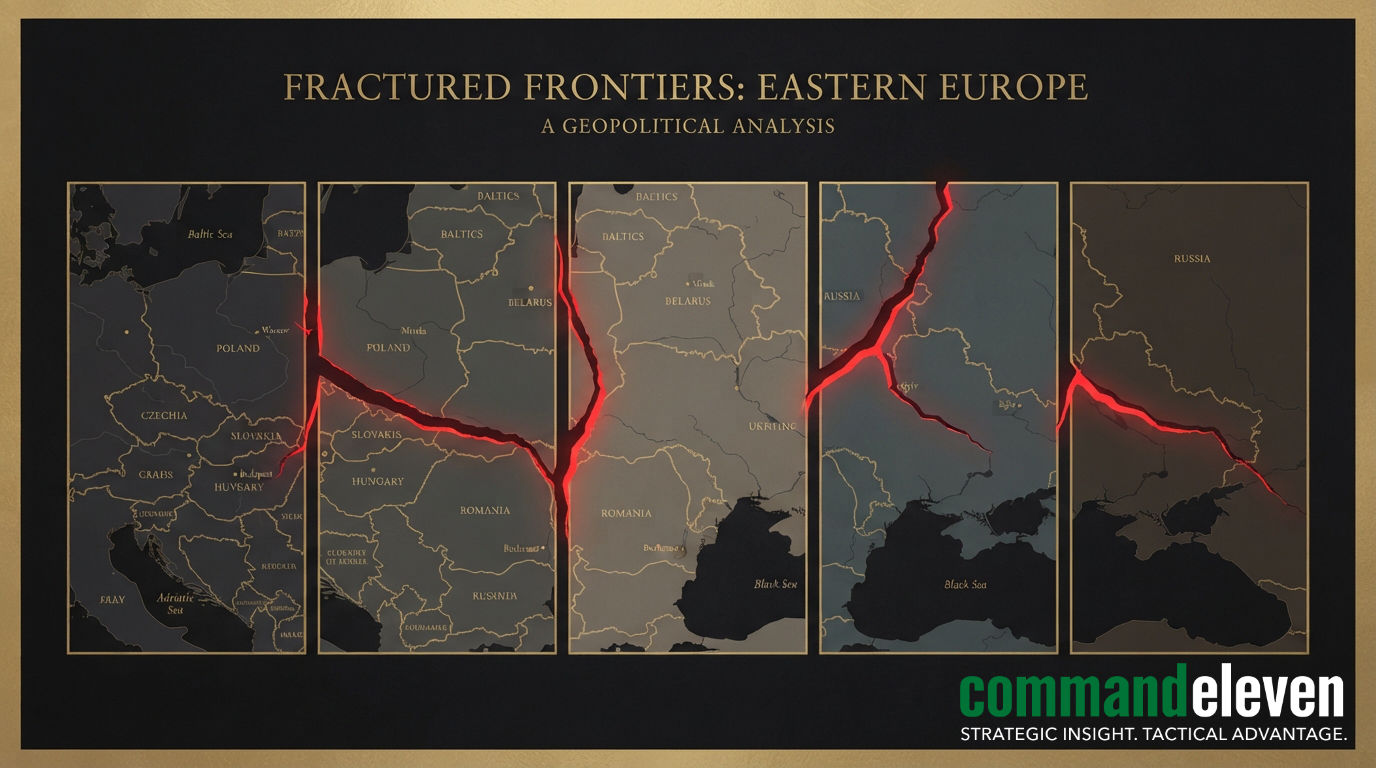
Why This Series, Why Now
On September 1, 2026, Ukrainian President Volodymyr Zelensky warned every airline, insurer, and government still using Russian airspace that it was becoming “completely dangerous.” The warning wasn’t rhetorical – it activated the same insurance-market mechanism that had already shut down commercial shipping through the Strait of Hormuz months earlier, before Iran’s navy fired a shot. That single episode captures why this series exists: the Ukraine-Russia war is no longer a story that can be told through front-line maps alone. It is being fought simultaneously across aviation and shipping insurance markets, sanctions architecture, electromagnetic and cyber domains, and a battlefield whose character has been fundamentally rewritten by drone saturation – and each of those fronts is moving at a different speed, often invisibly to readers focused only on territorial control.
This series treats those fronts as distinct, evidence-based chapters rather than folding them into a single undifferentiated “war update.” Where a headline might say Russia is escalating or NATO is responding, this series asks a harder question of each development: what, specifically, has actually happened, what has it cost, and what does the gap between rhetoric and formal action reveal that the rhetoric alone does not.
What This Series Covers

- Part I: Russian Airspace at War – Zelensky’s aviation warning, the deep-strike campaign against Russian oil infrastructure behind it, and the Strait of Hormuz insurance-weapon precedent that makes the warning credible rather than theatrical.
- Part II: NATO’s Response – the EU-wide diplomatic mobilization following the Leipzig drone attack, and the more consequential finding beneath it: no NATO member has requested Article 4 consultations since Poland’s September 2025 incursion, even after an attack on an active NATO logistics hub.
- Part III: Sanctions and Economic Warfare – the EU’s 21 sanctions packages, the shadow fleet’s measurable 90% activity drop under joint enforcement, and a price cap caught between squeezing Moscow and a Hormuz-driven global energy shock.
- Part IV: Battlefield Realities – how drone-enabled kill zones rewrote the war’s tactical grammar, and the data behind Russia’s territorial offensive collapsing from a November 2025 peak into outright net losses by spring 2026.
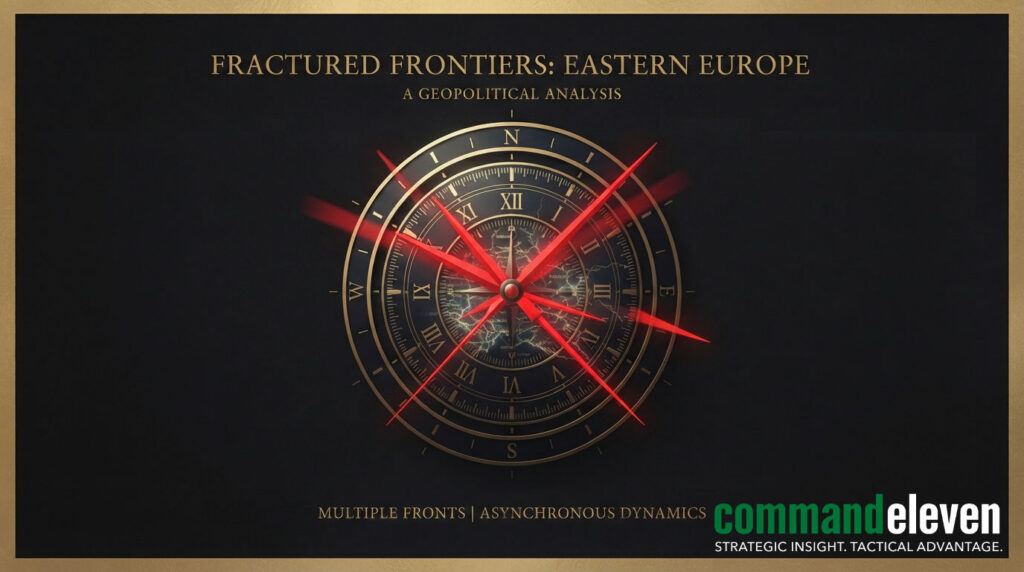
- Part V: Escalation Risk and Endgame Scenarios – Putin’s negotiating maximalism, the widening gap between Russian and Ukrainian public opinion, why nuclear escalation is assessed as unlikely despite constant signaling, and a four-clock framework for reading where this war actually stands.
A Note on Method
Every claim across this series is confidence-tiered – CONFIRMED, ASSESSED, or explicitly excluded where sourcing does not meet either bar. Territorial and casualty reporting from an active war carries inherent lag and methodology differences across sources, and this series flags that uncertainty directly rather than presenting single-source figures as settled fact. Where this series draws connections to CommandEleven Intelligence’s parallel Iran War Doctrine & Strategy series – and it does, particularly around sanctions, drone technology, and energy markets – those connections are stated explicitly rather than implied, since the two wars have become genuinely, mechanically linked through global shipping and energy markets, not merely analogous to one another.