Key Judgments
- [CONFIRMED] – The European Union has issued 21 successive sanctions packages against Russia since 2022, with the shadow fleet – the aging tanker network Moscow uses to export oil outside the G7 price cap – as the consistent, escalating target: from 632 designated vessels under the 20th package (April 2026) to over 20 additional tankers blacklisted under the 21st package, alongside the EU’s first-ever restrictions on Russian LNG.
- [CONFIRMED] – Independent tracking of shadow fleet tankers sanctioned jointly by the U.S., EU, and UK shows their departure activity from Russian ports down approximately 90% year-over-year, compared to an 86% drop for U.S.-only sanctioned vessels – evidence that coordinated multilateral sanctions meaningfully outperform unilateral action, and that the enforcement architecture, where applied, functions as designed.
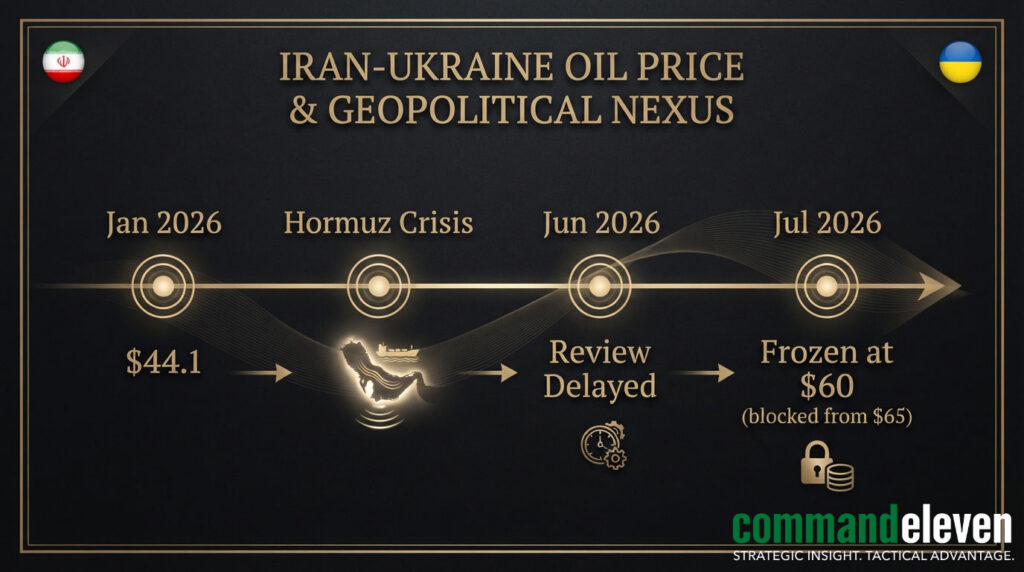
- [CONFIRMED] – The G7 oil price cap has moved considerably during 2026: lowered to $44.1 per barrel in January, then effectively overtaken by market forces after the Strait of Hormuz’s closure-driven price spike, and now frozen at $60 per barrel under the 21st package – blocking a proposed increase to $65 that reflected the changed energy market rather than reduced pressure on Moscow.
- [CONFIRMED] – U.S. participation in the sanctions campaign has been comparatively limited in 2026: per Brookings’ tracking, the U.S. led shadow-fleet vessel designations at the end of the Biden administration (216 ships, versus 75 for the EU and 110 for the UK at that time), but the current administration’s most notable action has been joining Europe in sanctioning Rosneft and Lukoil directly rather than expanding vessel-by-vessel shadow fleet designations, leaving the EU and UK to carry the bulk of the shadow fleet’s continued expansion in enforcement.
- [ASSESSED] – CommandEleven Intelligence assesses the sanctions campaign shows the same asymmetry documented in this series’ Part II: real, measurable EU-led capability and effectiveness where jointly enforced, alongside a comparatively passive U.S. posture on this specific front – even as Washington remains fully engaged in the parallel Iran conflict. This dossier treats that as the more consequential finding than the headline sanctions-package count itself.
The Sanctions Architecture
The EU’s sanctions campaign has evolved from broad, symbolic early packages into an increasingly technical, enforcement-focused instrument. The 20th package (April 2026) introduced mandatory due-diligence checks on tanker sales, a ban on servicing Russian LNG tankers and icebreakers, and a legal mechanism – activatable by joint proposal from the EU’s High Representative and Commission, in coordination with the G7 – that could impose a comprehensive ban on maritime services for Russian crude entirely, pending Council timing. The 21st package, finalized in the same window as the Leipzig fallout examined in this series’ prior installments, added over 20 more blacklisted tankers, froze the oil price cap at $60 rather than allowing a proposed rise to $65, and imposed the EU’s first-ever direct restrictions on Russian LNG – a step EU members had specifically resisted for over a year prior.
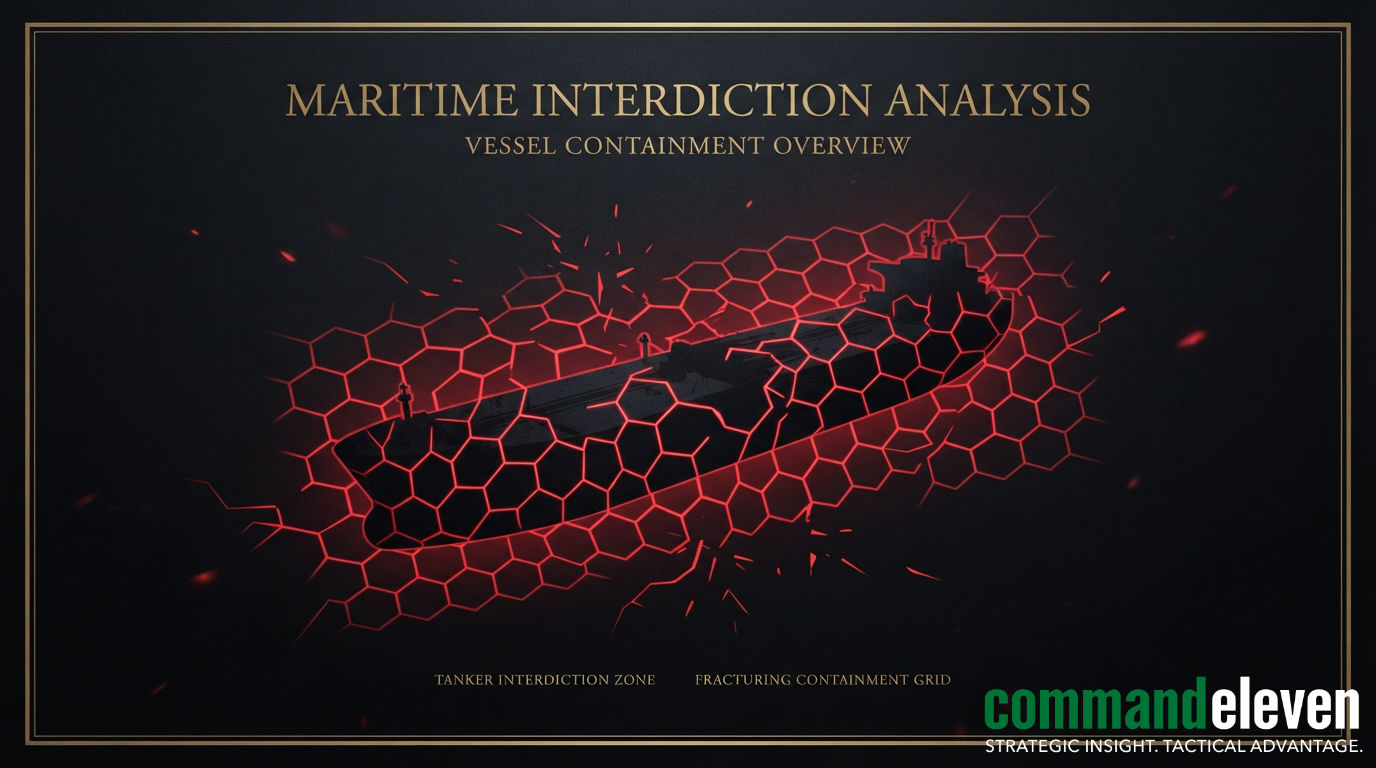
Enforcement has grown teeth alongside the designations: France’s June 1, 2026 seizure of a shadow fleet tanker in the Bay of Biscay near Brittany stands as the most high-profile enforcement action to date under the expanded framework, a concrete signal that the sanctions regime is shifting from list-building toward physical interdiction.
What’s Actually Working
The shadow fleet fight offers this dossier’s clearest evidence that economic pressure, properly coordinated, produces measurable results. Tracking of a 343-vessel shadow fleet database shows departure activity from Russian ports down roughly 90% for tankers under joint U.S.-EU-UK sanction, versus 86% for U.S.-only designated vessels – a meaningful but secondary difference suggesting unilateral sanctions still carry real weight, with coordinated multilateral action adding a further, measurable edge. This is a rare data point in this dossier’s broader research suggesting that when the U.S., EU, and UK act together with real enforcement teeth (as with France’s Brittany seizure), the shadow fleet’s core function – evading the price cap – is genuinely degraded, not merely inconvenienced.
- [DATA DEFICIT] – This dossier does not have visibility into how much of the remaining 10-14% of shadow fleet activity represents genuinely unstoppable evasion (flag-of-convenience churn, ownership obfuscation) versus enforcement gaps that could still be closed with additional resources. The 90% figure should be read as a strong directional result, not a precise ceiling on achievable pressure.
The Price Cap Dilemma
The price cap’s 2026 trajectory illustrates the tension at the center of this entire economic-warfare campaign: squeeze Russian revenue without triggering a global energy price shock that would ease pressure on Moscow by raising the ceiling itself. The cap’s fall to $44.1 in January reflected confidence that the mechanism was working as designed. That confidence was upended by the Strait of Hormuz closure crisis this dossier examined in earlier reporting on the Iran war’s shipping-insurance effects – global oil prices surged, and by June the EU was forced to delay a scheduled cap review specifically to avoid handing Moscow unearned relief as market prices rose independent of anything Russia had done. The 21st package’s decision to freeze at $60 rather than allow the proposed $65 increase represents a deliberate choice to hold the line against market pressure rather than let the cap drift upward with global prices – a harder political call than it might appear, opposed by tanker-servicing member states Greece and Malta, who made clear they would not move ahead of G7 consensus.
- [ASSESSED] – CommandEleven Intelligence assesses this episode as a clear illustration of how the Iran and Ukraine conflicts are now mechanically linked through global energy markets, not merely through the Russia-Iran military-technical cooperation this series’ companion Project C430L dossier examined – a genuine finding this series did not initially set out to establish but which the price cap’s own 2026 history makes difficult to avoid.
The US Question, Continued
Part II of this series identified a gap between NATO’s rhetorical escalation and its restraint on formal collective-defense mechanisms. The sanctions picture adds a parallel, economic-front version of the same asymmetry. At the close of the Biden administration, the U.S. led global shadow-fleet designations outright – 216 vessels sanctioned, nearly double the EU and UK combined. Under the current administration, that leadership role has not continued in the same form: the most significant 2026 U.S. action was joining the EU in sanctioning Rosneft and Lukoil directly – a real and consequential move that, per Brookings’ analysis, sharply reduced global demand for Russian oil – but Washington has not matched the EU and UK’s continued, incremental expansion of vessel-by-vessel shadow fleet designations and enforcement actions like France’s Brittany seizure.
Despite this combined pressure, Russia’s fossil fuel export revenue has proven durable rather than collapsing: CREA figures put Russian fossil fuel export revenue at roughly €500 million per day even after reaching a two-year low point, sustained substantially by shadow fleet volume that continues moving through chokepoints like the Danish straits.
Assessment: Two Fronts, One Pattern
Read alongside Part II’s Article 4 finding, this dossier’s central observation is that Western pressure on Russia currently runs on two tracks that share a structural similarity: genuine, demonstrable capability (Eastern Sentry’s real multinational assets; the shadow fleet’s real 90% activity drop where jointly enforced) paired with a reluctance to take the more decisive step available (a formal Article 4 consultation; a full ban on shadow fleet maritime services, which the 20th package’s own legal mechanism explicitly allows for but has not yet activated).
- [ASSESSED] – CommandEleven Intelligence assesses this is a deliberate, calibrated strategy of sustained pressure short of maximal escalation on both the military and economic fronts – not evidence of an alliance unable to act, but one choosing incrementalism, for reasons this dossier’s evidence cannot fully adjudicate (avoiding uncontrolled escalation, managing internal G7/EU consensus difficulty, or genuine uncertainty about whether harder measures would work). Whether that incrementalism will hold if the Leipzig-style provocation pattern continues to escalate remains, per this series’ Part II, the single most important open question.
Series Continuity
Part IV of this series will examine battlefield realities and doctrine shifts driving the underlying war, before the series closes with an escalation-risk and endgame-scenario synthesis.
Sourcing Base (Confidence-Tiered, with Links)
CONFIRMED – Primary/Official Record:
- Council of the European Union (Consilium), “21st package of sanctions: EU hits Russian energy, financial services and crypto hard,” July 23, 2026
- Council of the European Union (Consilium), “Russia’s war of aggression against Ukraine: 20th round of stern EU sanctions…” April 23, 2026
- Herbert Smith Freehills Kramer, “Sanctions Tracker: EU’s 20th sanctions package…” (legal mechanism for comprehensive maritime services ban)
- EU Insider, “EU Locks Russia Oil Cap at $60 and Hits LNG for First Time” (France’s Brittany tanker seizure, $65 proposal blocked)
- Brookings, “An update on Europe’s Russia sanctions” (US vs EU/UK shadow fleet designation totals, Rosneft/Lukoil action)
- Robin Brooks (Substack), “Effectiveness of Shadow Fleet Sanctions” (343-vessel database, 90%/86% activity-drop figures)
- Euronews, “EU proposes new sanctions on Russian oil, ‘shadow fleet’, fisheries and soldiers” (Hormuz-driven price cap review delay, Greece/Malta opposition)
ASSESSED – Credible Secondary Reporting:
- Novaya Gazeta Europe, “EU lowers price cap on Russian oil as shadow fleet continues to flout international sanctions” (CREA revenue figures, January 2026 cap level)
Excluded from this dossier: Any precise estimate of Russia’s total sanctions-adjusted war-fighting budget or a specific timeline for economic collapse. This dossier’s sourcing supports confident conclusions about sanctions mechanisms and measured effectiveness, not a predictive economic model.