
Key Judgments
- [CONFIRMED] – Following Germany’s September 1 formal accusation over the Leipzig/Halle drone incident, the Netherlands, France, Belgium, and Sweden each separately summoned Russia’s ambassador in protest, and the EU’s own foreign policy service in Brussels, under High Representative Kaja Kallas, did the same – a genuinely bloc-wide diplomatic response rather than a bilateral German-Russian matter.
- [CONFIRMED] – European Commission President Ursula von der Leyen characterized Leipzig as marking a “new escalation on European soil, directly attributed to Russia,” calling it “the new normal” and vowing to pursue deeper sanctions on Moscow’s revenue streams. NATO Secretary-General Mark Rutte, appearing alongside her, said Russia had grown “increasingly reckless.”
- [CONFIRMED] – Despite this rhetorical mobilization, no NATO member has requested Article 4 consultations – the alliance’s mechanism for formal collective consultation when a member’s territorial integrity or security is threatened – since Poland’s September 2025 mass drone incursion. Neither a Russian cruise missile landing 100 kilometers inside Polish territory nor the Leipzig attack on an active NATO logistics hub has triggered that step, a gap this dossier treats as more analytically significant than the diplomatic summons wave itself.
- [CONFIRMED] – NATO’s actual institutional response has been real but incremental: Operation Eastern Sentry (launched September 12, 2025, contributing air and ground-based air defense assets from at least seven member states) and Baltic Sentry (January 2025) were both stood up in direct response to incursions, and Baltic Air Policing was upgraded from a policing mission to a full air-defense mission on July 8, 2026, vesting shoot-down authority in NATO’s Supreme Allied Commander Europe (SACEUR) rather than requiring individual national authorization.
- [ASSESSED] – CommandEleven Intelligence assesses the gap between NATO’s rhetorical escalation and its restraint on formal collective-defense mechanisms is the more important signal for evaluating alliance cohesion than either the diplomatic summons wave or the incremental air-defense buildup – and is the central data point bearing on the “can NATO hold without full U.S. commitment” question this dossier examines directly in Testing the Thesis: Can NATO Hold Without Full U.S. Commitment?
The Diplomatic Mobilization
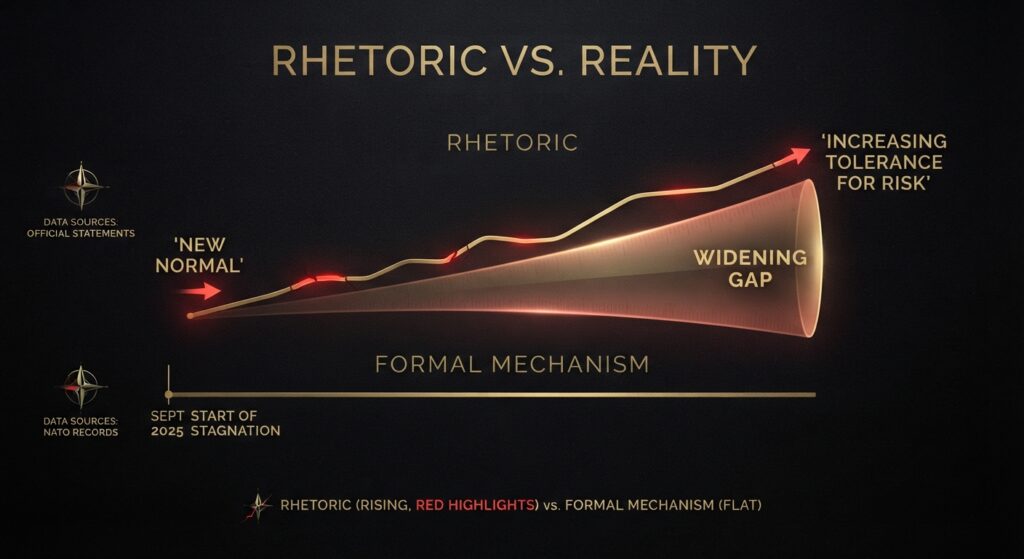
The scale of the September 2026 response to Leipzig marks a genuine escalation from prior incidents. Beyond Germany’s own measures – the Bonn consulate closure, the Berlin Russia House closure, the national threat-level increase – the Netherlands, France, Belgium, and Sweden each independently summoned Russia’s ambassador within days, and the EU’s collective foreign policy apparatus in Brussels did the same. Belgian Foreign Minister Maxim Prévot called the incident “an extremely serious hostile act.” French Foreign Minister Jean-Noël Barrot went further, calling explicitly for EU-wide sanctions targeting Russia’s “shadow fleet” – the aging tanker network Moscow uses to evade oil price caps. Von der Leyen’s “new normal” framing, delivered alongside Rutte, was a deliberate signal that Brussels now treats this pattern as structural rather than episodic.
What NATO Has Actually Built
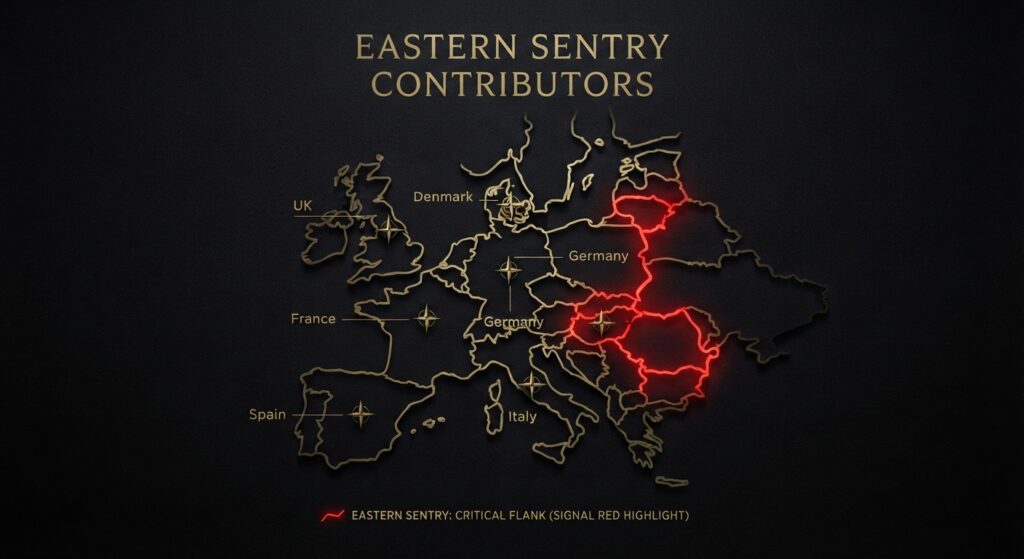
Set against that rhetoric, NATO’s concrete institutional response traces back further than Leipzig itself, to Poland’s September 9-10, 2025 incident, in which an estimated 19-23 Russian drones crossed into Polish airspace during a broader strike on Ukraine – the first-ever Polish invocation of Article 4 over an airspace matter. That incident prompted Operation Eastern Sentry, launched September 12, 2025: a flexible framework allowing NATO commanders to reposition fighters, sensors, and ground-based air defenses to wherever risk is assessed highest along the eastern flank, with initial contributions including Danish F-16s, French Rafales, German Eurofighters, Italian F-35As and a SAMP/T missile system deployed to Estonia, and British and Spanish Eurofighters. This complemented Baltic Sentry, stood up in January 2025 to address undersea infrastructure sabotage concerns.
The more structurally significant change came later: on July 8, 2026, Baltic Air Policing was formally upgraded to a full air-defense mission, shifting shoot-down authority from individual national governments to NATO’s Supreme Allied Commander Europe operating through the Combined Air Operations Centre – the same authority structure Romania’s July 2026 drone shoot-downs operated under via the equivalent center at Torrejón. This is a real institutional shift: NATO moved from a framework requiring national-level political authorization for each intercept decision toward centralized alliance authority, a change with direct bearing on response speed for future incidents.
The Article 4 Gap
Here is the finding this dossier treats as the most analytically important: despite the scale of the September 2026 diplomatic mobilization, and despite Leipzig striking an active NATO Strategic Airlift International Solution hub with an explosive device – a more direct hit on alliance logistics infrastructure than Poland’s September 2025 airspace violation – no member state has requested Article 4 consultations since that September 2025 incident. Not after a Russian cruise missile came down 100 kilometers inside Polish territory in a separate incident. Not after Leipzig. The North Atlantic Council’s own public language has hardened – its August 12, 2026 statement described Russia’s “increasing tolerance for risk,” a sharper formulation than its September 2025 language, which had warned only of the risk of miscalculation – but that hardened rhetoric has not translated into the formal consultative step the alliance’s own founding treaty provides for exactly this kind of situation.
- [ASSESSED] – CommandEleven Intelligence assesses this gap is not an oversight but a deliberate choice: individual member states and the alliance collectively appear to be calibrating their response to remain below the threshold that would force a harder collective decision, even as the underlying pattern – an International Institute for Strategic Studies count puts drone incursions across a dozen NATO countries at 144 between August 2024 and February 2026 alone – continues to accumulate. German defense chief General Carsten Breuer’s own assessment, given directly to the Wall Street Journal, states this plainly: “Russia is testing us and looking at how we respond.” The absence of an Article 4 request is itself a response, and an increasingly conspicuous one as the incident count grows.
- [DATA DEFICIT] – This dossier does not have visibility into individual member states’ internal deliberations over why Article 4 has not been invoked – whether from an assessment that the threshold has genuinely not been met, from a desire to avoid escalatory signaling, or from uncertainty about whether the alliance could reach consensus on next steps if consultations were requested. Any of these readings is consistent with the public record.
Testing the Thesis: Can NATO Hold Without Full U.S. Commitment?
Syed Khalid Muhammad’s, Executive Director & Founder of CommandEleven Intelligence, standing on-air assessment has been skepticism that NATO, absent full U.S. backing, could successfully manage sustained pressure from a coordinated Russia-China-Iran-North Korea axis – the same coordination CommandEleven Intelligence’s Axis of Evil dossier previously documented. The evidence in this dossier supports a mixed answer rather than a clean validation or refutation of that thesis:
On the capability side, Eastern Sentry’s actual contributor list – Denmark, France, Germany, Italy, Spain, and the UK all providing assets – demonstrates genuine multinational military capacity being deployed collectively, and the July 2026 SACEUR authority upgrade represents real institutional consolidation, not merely symbolic gesture.
On the political-will side, the Article 4 gap is the more concerning signal. An alliance confident in its collective resolve and unified political will would have a lower bar for formal consultation, not a higher one, as provocations accumulate. The pattern observed – hardening rhetoric paired with static formal-mechanism thresholds – is more consistent with an alliance managing internal consensus difficulty than with one operating from a position of unified strength.
On the coordination-gap question specifically, this dossier’s review of Eastern Sentry and Baltic Sentry finds no evidence of a comparable formal, standing coordination mechanism between the US, EU, and NATO command structures for responding jointly to the kind of multi-vector pressure (hybrid sabotage plus conventional military posturing) the Axis of Evil dossier described the opposing coalition as capable of generating.
- [ASSESSED] – This is a genuine structural asymmetry worth taking seriously: NATO’s response architecture has been built incrementally, incident by incident, while the coordination among its principal adversaries – per CommandEleven’s prior reporting – has developed with more explicit strategic intent behind it.
CommandEleven Intelligence does not conclude from this evidence that NATO “cannot” hold without full US commitment – that would overstate what a pattern of incremental institutional response and rhetorical escalation can establish. What this dossier does conclude is that the Article 4 gap is the single most important indicator to watch going forward, more so than any additional ambassador summons or sanctions announcement: the day a member state does request Article 4 consultations, or conspicuously continues not to despite a clearly graver provocation, will tell considerably more about alliance cohesion than anything documented in this dossier to date.
Series Continuity
Part III of this series will examine the sanctions and economic-warfare dimension in detail, including the “shadow fleet” measures France has proposed and the broader question of whether economic pressure is proving more or less effective than the military-posture response examined here.
Sourcing Base (Confidence-Tiered, with Links)
CONFIRMED – Primary/Official Statements & Institutional Record:
- RFE/RL (via GlobalSecurity.org), “EU, NATO Seek Stronger Response To Russian Threat After Leipzig ‘Escalation’” (von der Leyen/Rutte statements, Sept. 2, 2026)
- NL Times, “The Netherlands summons Russian ambassador after explosive drones are found in Germany“
- IR-Press, “Dutch Foreign Ministry summons Russian ambassador over drone incident at Leipzig airport” (Belgium/France/Sweden/EU summons detail)
- Wikipedia, “Operation Eastern Sentry” (contributor list, launch date, mandate)
- Wikipedia, “2025 Russian drone incursion into Poland” (Article 4 invocation, incident detail)
- Grosswald.org, “Russian Drone and Missile Incursions into NATO Territory: The Running Record” (Article 4 gap finding, SACEUR authority detail, IISS 144-incursion count, North Atlantic Council Aug. 12 2026 statement)
- Stars and Stripes, “NATO defenses facing Russian drone test, German military chief warns” (Gen. Carsten Breuer quote, Mechernich incident)
- The Media Line, “‘More Visible and Credible’: NATO Debuts Eastern Sentry After Russian Drone Incursions“
ASSESSED – Credible Secondary Reporting:
- Al Jazeera, “‘New level of danger’: Drone incidents scare Europe amid Russia-Ukraine war” (DNA link between Leipzig drone and July 2024 firebomb)
- Wikipedia, “2026 Leipzig Airport drone incidents”
Excluded from this dossier: Any definitive conclusion about why individual NATO member states have not requested Article 4 consultations. This dossier documents the gap and offers assessed possible explanations without asserting which, if any, is correct absent direct access to member-state internal deliberations.