Key Judgments
- [CONFIRMED] – In his December 2025 year-end remarks, President Putin stated that ending the war by peaceful means depends on implementation of conditions he outlined in 2024, and that Russia is prepared to continue military operations if those conditions are not accepted. Moscow has specifically rejected proposals to freeze the conflict along the current line of contact and has rejected a mutual halt to energy-infrastructure strikes as an initial de-escalation step – positioning that has not shifted despite the economic pressure examined in this series’ Part III.
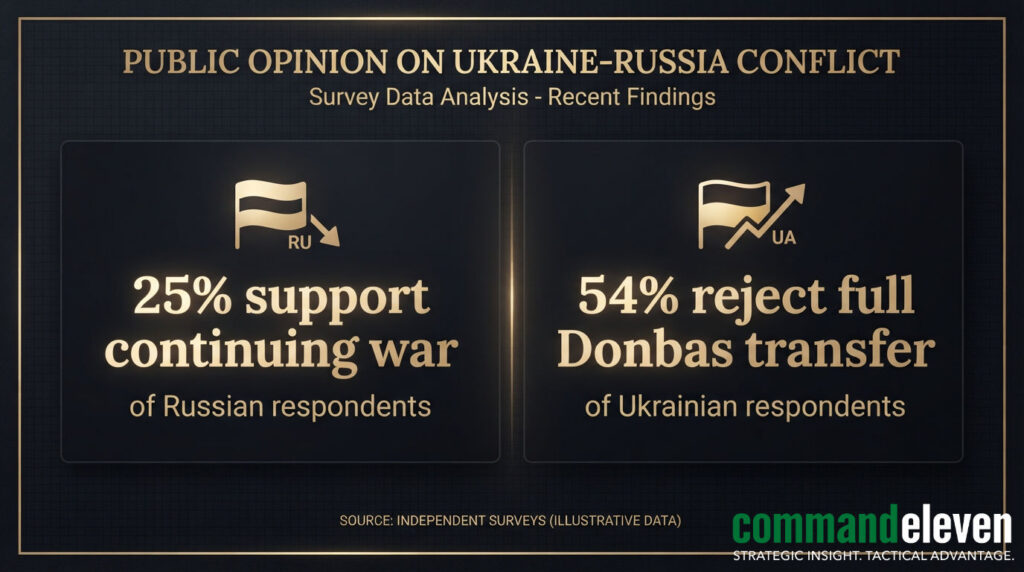
- [CONFIRMED] – Russia’s own domestic polling shows a widening gap between public sentiment and Kremlin policy: Levada Center data from December 2025 found support for continuing the war at 25%, its lowest level since 2022, with 66% of respondents favoring a transition to peace negotiations. Ukrainian polling shows a parallel but distinct pattern: a Kyiv International Institute of Sociology survey found 54% of Ukrainians categorically reject transferring all of Donbas to Russian control even in exchange for U.S. and European security guarantees, though independent reporting has noted a growing minority beginning to consider territorial compromise previously considered unthinkable.
- [CONFIRMED] – Nuclear and escalatory signaling has been a recurring feature of Russian messaging throughout the war, including the use of an Oreshnik intermediate-range missile in a strike near EU/NATO borders, widely characterized as an unacceptable escalation. Despite this signaling, credible historical and analytical assessment – citing both the pattern of Russian “red lines” being crossed without nuclear response and historical precedent from other nuclear powers accepting battlefield setbacks without escalation (France in Algeria is the most-cited case) – assesses actual nuclear use as unlikely absent a threat Moscow perceives as existential to the Russian state itself, a threshold this war has not yet approached.
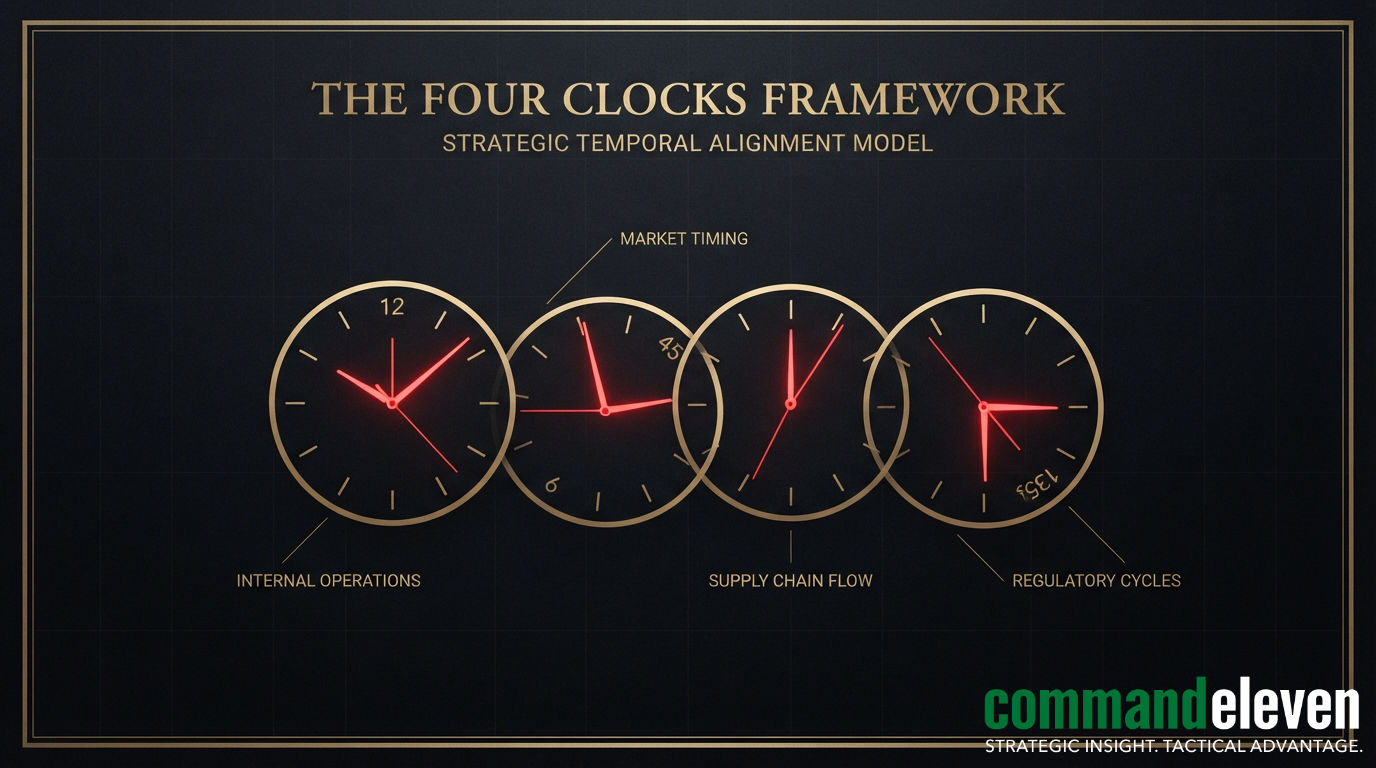
- [CONFIRMED] – Independent strategic analysis frames the war’s trajectory through four simultaneous “clocks” – battlefield, industrial capacity, coalition politics, and Russian regime stability – none of which point toward rapid resolution; the most-cited projection for 2026-2028 is continued prolonged conflict with periodic escalation but without decisive military breakthrough on either side.
- [ASSESSED] – CommandEleven Intelligence’s own synthesis across this series’ four preceding parts is consistent with that external assessment: the hybrid-pressure campaign (Part I), NATO’s calibrated but formally restrained response (Part II), incremental sanctions escalation short of maximal available measures (Part III), and a battlefield trending against rapid resolution in either direction (Part IV) collectively describe a war being managed toward sustained attrition by all major parties, rather than one any actor is currently positioned or willing to force toward rapid conclusion.
Russia’s Position: Maximalism Amid Strain
Despite the economic pressure this series’ Part III documented – a shadow fleet with measurably reduced activity where jointly sanctioned, a price cap held despite market pressure to raise it, and fossil fuel revenue at multi-year lows even if still substantial – Russia’s stated negotiating position has not softened. Putin’s December 2025 framing treats peace as conditional on Ukraine and the West accepting terms Russia set unilaterally in 2024, not as a matter for mutual concession. Russian strategic commentary reviewed for this dossier (writing attributed to analyst Vasily Kashin) frames a specific, narrower objective as Moscow’s realistic ceiling: securing territory “under the terms of the Anchorage agreements,” combined with a permanent prohibition on Ukrainian NATO membership and foreign troop basing, characterized in that commentary as constituting “a complete military victory” even without full occupation of Ukraine, which the same commentary explicitly describes as militarily unachievable.
- [DATA DEFICIT] – This dossier has not independently verified the full terms attributed to “the Anchorage agreements” referenced in Russian strategic commentary, and flags this as requiring further sourcing before any future CommandEleven Intelligence product treats those terms as an established negotiating baseline. Readers should treat this reference as reported Russian framing, not confirmed diplomatic fact.
Ukraine’s Position: Growing Openness, Firm Limits
Ukrainian public opinion shows real movement without approaching consensus for major territorial concession. The 54% rejecting a full Donbas transfer even for security guarantees leaves a substantial minority open to that trade – and independent reporting suggests that minority has grown as the war’s fifth year began, even as it remains short of majority support. Zelensky’s own public position – accepting a ceasefire that would fix the current front line as a future line of contact, rather than insisting on full territorial restoration – represents Kyiv’s own acknowledgment that Part IV’s battlefield data (Russia’s continued, if slowing, positional advantage) constrains what outcome is realistically achievable in the near term. Control of the Zaporizhzhia nuclear power plant remains, per multiple sources reviewed, one of the most intractable specific sticking points in any negotiated framework, independent of the broader territorial question.
The Nuclear Question
Russian nuclear signaling has been a constant background feature of this war – from repeated statements by Putin, Medvedev, and Lavrov widely characterized as nuclear blackmail, to the Oreshnik missile strike near EU/NATO borders that provoked explicit nuclear-war concern in European commentary.
- [ASSESSED] – CommandEleven Intelligence assesses, consistent with the historical and analytical sourcing reviewed for this dossier, that actual nuclear use remains unlikely under current conditions. British historian Lawrence Freedman’s assessment – that Putin is likely to reserve nuclear use “for the most extreme contingencies when the state faces an existential threat” – is corroborated by the simple observational fact that numerous previously stated Russian “red lines” have already been crossed over the course of this war without nuclear response. Historical precedent points the same direction: nuclear-armed France absorbed a genuinely humiliating defeat in Algeria – a fully annexed part of metropolitan France, not a distant colony – without resorting to escalation. This dossier treats continued nuclear signaling as a coercive-diplomacy tool aimed at Western decision-making rather than as evidence of rising actual-use probability, while acknowledging that signaling of this kind carries inherent miscalculation risk that cannot be fully discounted.
Four Clocks: A Framework for the Endgame
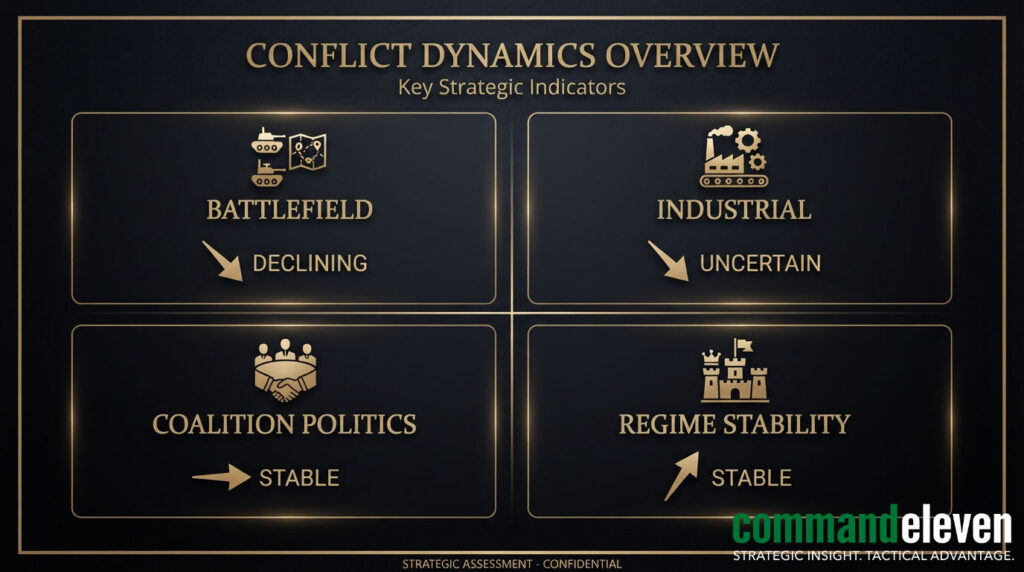
Independent strategic analysis frames this war’s trajectory as governed by four simultaneous clocks running at different speeds, a framework this dossier finds useful for organizing this series’ own findings:
- The battlefield clock, examined in Part IV: trending against rapid Russian breakthrough, with territorial gains in sustained decline since November 2025, but not trending toward Ukrainian battlefield victory either – a slow-moving clock in relative Ukrainian favor without approaching resolution.
- The industrial clock: Russia’s capacity to sustain drone and munitions production at current tempo against a Ukrainian deep-strike campaign that has, per Part IV, disabled roughly 30% of refining capacity – a clock this series has not examined in full industrial-capacity detail, but one implied throughout Parts III and IV as running against Russia’s sustainment ability.
- The coalition-politics clock, examined in Part II: NATO and EU cohesion under sustained hybrid pressure, with the Article 4 restraint documented there suggesting this clock’s political-will dimension is more fragile than its military-capability dimension.
- The Russian regime-stability clock: the Levada polling data in Key Judgment 2 is the clearest available indicator this dossier has found bearing directly on this clock, though translating declining public war support into regime pressure is a longer and less certain causal chain than this series’ other three clocks.
- [ASSESSED] – None of these four clocks, individually or collectively, currently point toward rapid resolution – a conclusion independent analysis places at the center of its 2026-2028 outlook, and one this series’ own evidence across four parts does not contradict.
CommandEleven Intelligence’s Assessment
This five-part series describes a conflict being actively managed toward sustained pressure by every major party rather than one being driven toward rapid conclusion by any of them. Russia calibrates hybrid provocations (Part I) precisely enough to avoid triggering NATO’s Article 4 mechanism (Part II) while absorbing sanctions pressure it has proven able to endure, if not comfortably (Part III), even as its battlefield position measurably erodes (Part IV). NATO and the EU escalate rhetoric and incrementally expand both military posture and economic pressure without activating the more decisive instruments available to either domain. Ukraine sustains a deep-strike campaign with real strategic effect while its public position on territorial compromise slowly, incompletely shifts. This is not stalemate in the sense of stasis – every one of this series’ four preceding parts documents real movement – but it is a war whose current trajectory, per both independent analysis and this series’ own evidence, points toward continuation with periodic escalation rather than toward near-term resolution by any single decisive event this dossier can currently identify.
What This Series Does Not Claim
- It does not predict a ceasefire or settlement timeline
- It does not claim nuclear escalation is impossible, only that current evidence assesses it as unlikely
- It does not resolve whether NATO’s Article 4 restraint reflects prudent calibration or genuine alliance fragility, a question Part II left explicitly open and this dossier does not attempt to close
- It does not claim the “four clocks” framework is CommandEleven Intelligence’s own original analytical model – it is drawn from and credited to independent strategic analysis, applied here to organize this series’ findings rather than presented as a novel framework
Sourcing Base (Confidence-Tiered, with Links)
CONFIRMED – Primary/Official Statements & Polling Data:
- Observer Research Foundation, “Russia–Ukraine War in 2026: At the Crossroads of Peace and War” (Putin’s Dec. 2025 remarks, Levada Center polling)
- oiip, “The War in Ukraine: The Moment of Truth in 2026?” (KIIS polling, Oreshnik strike, Zaporizhzhia sticking point)
- Council on Foreign Relations, “The Time Is Ripe for Russia-Ukraine Peace Talks, But Putin Could Escalate Conflict,” July 10, 2026 (Ankara NATO summit, Trump-Zelensky meeting)
- Russia Matters, “Russia Analytical Report, May 26-June 1, 2026” (Kashin commentary on Anchorage-agreement framing and Russian escalation logic)
- Wikipedia, “Nuclear risk during the Russo-Ukrainian war” (Freedman assessment, red-lines-crossed pattern)
ASSESSED – Credible Secondary/Analytical Reporting:
- Foreign Policy, “Why Nuclear Escalation by Russia Against Ukraine Is Unlikely,” Aug. 25, 2026 (France/Algeria historical precedent, Zelensky ceasefire position)
- Strategy International, “Ongoing War: Strategic Balance, Negotiation Dynamics, and Near-Term Futures in Ukraine and Russia war” (four-clocks framework, 2026-2028 outlook, reconstruction cost estimate)
- GLOBSEC, “Seven Security Scenarios on Russian War in Ukraine for 2025-2026”
Excluded from this dossier: Confirmed terms of any “Anchorage agreements” beyond what Russian strategic commentary attributes to them. This dossier flags the reference as reported framing requiring independent verification, not as an established diplomatic baseline.