
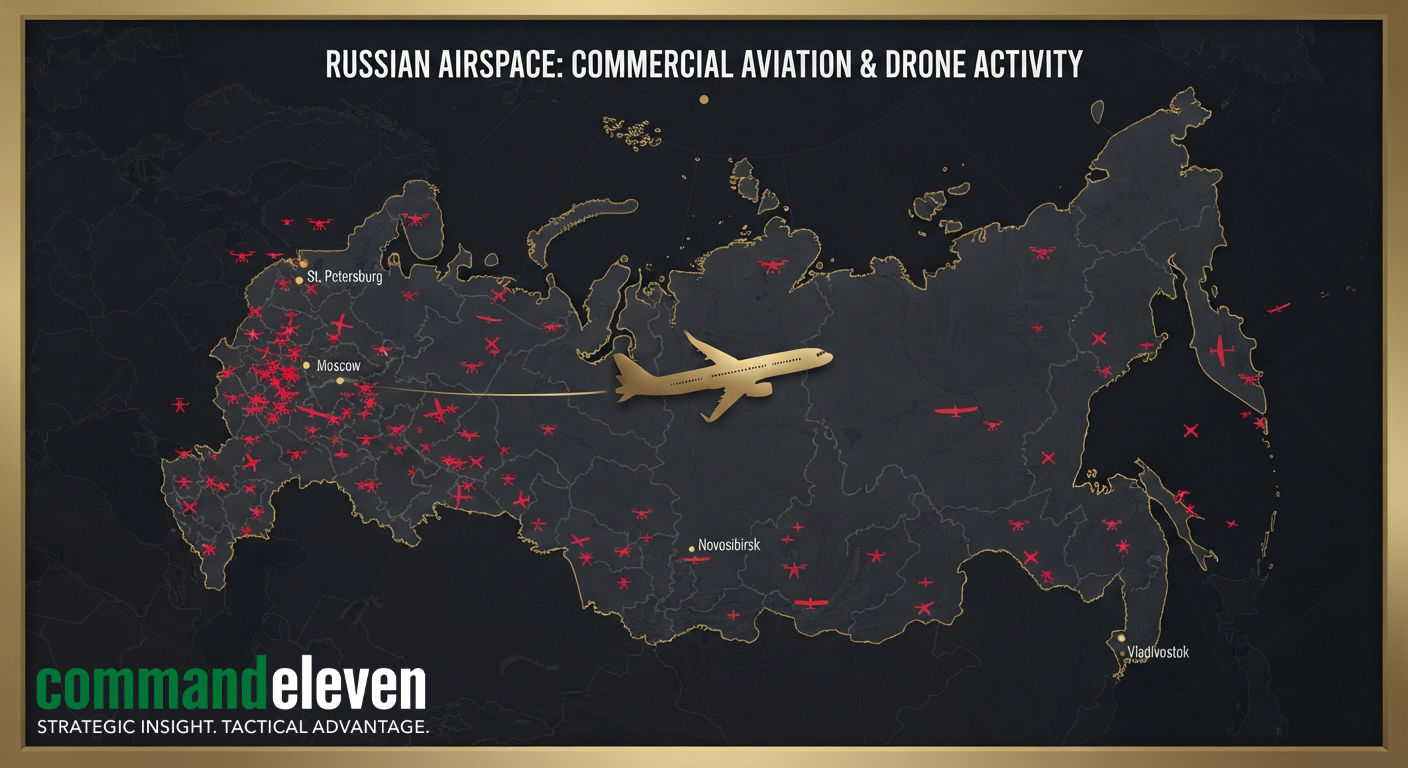
Key Judgments
- [CONFIRMED] – On September 1, 2026, Ukrainian President Volodymyr Zelensky formally warned every airline, insurer, and government still using Russian airspace that it is “becoming completely dangerous,” stating Russia’s skies will be “de facto closed” due to the scale of Ukraine’s drone campaign – while explicitly denying any intent to target civilian aircraft.
- [CONFIRMED] – Russian President Vladimir Putin, speaking at a Shanghai Cooperation Organization summit in Bishkek hours later, called the warning “a declaration of state terrorism,” said Russia does not negotiate with terrorists, and ordered Russian forces to prepare massive retaliatory strikes on Ukraine’s energy infrastructure. Shares in Aeroflot, Russia’s national carrier, fell over 5% the same day.
- [CONFIRMED] – The warning did not emerge in isolation – it follows a sustained, multi-year Ukrainian deep-strike campaign against Russian oil infrastructure that has recorded over 300 strikes since the war began, with a marked intensification since mid-2025. The International Energy Agency assessed the campaign was suppressing Russian refinery throughput by roughly 500,000 barrels a day as of late 2025.
- [ASSESSED] – The practical mechanism behind Zelensky’s warning is not a formal airspace closure – Ukraine has no authority to impose one – but an insurance-market lever: war-risk coverage for overflight is priced on assessed threat and can be withdrawn by underwriters at short notice, meaning airlines can be forced out of Russian airspace commercially before any government acts.
- [ASSESSED] – The credibility of that lever is reinforced by the specific historical shadow of Malaysia Airlines Flight 17, shot down over separatist-controlled Ukrainian territory in 2014 with a loss of all 298 aboard – a precedent insurers and airlines evaluating Russian airspace risk are highly unlikely to have forgotten, even though the current threat profile (Ukrainian drones over Russian territory) is a different scenario in almost every respect.
The Warning and the Reaction
Zelensky’s September 1 address was notable for its audience as much as its content – not a message to soldiers or citizens, but to airline schedulers, flight-planning departments, and insurance underwriters specifically. His framing was deliberate: Ukraine is “not threatening civilian aviation as such,” he said, but “there will simply be drones in Russia’s skies on a scale that has to be taken into account.” That is a careful legal and rhetorical distinction – Ukraine is not claiming the right to shoot down airliners, but is stating plainly that the volume of its drone campaign makes safe transit unpredictable.
Putin’s response, delivered at a press conference following the SCO summit in Bishkek, escalated rather than de-escalated: he characterized the warning itself as a “declaration of state terrorism,” ruled out negotiations, and ordered preparation of large-scale retaliatory strikes on Ukrainian energy infrastructure – a direct, symmetric answer in kind. Kremlin spokeswoman Maria Zakharova separately suggested the warning undercut any Ukrainian claim to want peace talks. The market reaction was immediate and measurable: Aeroflot shares dropped more than 5% on the day, a concrete signal that investors treated the warning as materially credible rather than rhetorical.
The Campaign Behind the Warning
Zelensky’s warning cannot be read in isolation from the deep-strike campaign that produced it. Ukraine’s long-range drone strikes against Russian oil refineries, fuel depots, and logistics hubs escalated sharply beginning in the second half of 2025, following a slower buildup earlier in the war. By mid-2026, Ukraine’s General Staff was claiming its strikes had affected over 40% of Russia’s oil refining capacity; independent tracking has recorded over 300 confirmed strikes on Russian oil infrastructure since the war’s start, with record months in mid-to-late 2025 hitting more than a dozen refineries in a single month. The International Energy Agency’s independent assessment – separate from Ukraine’s own claims – put the throughput impact at roughly 500,000 barrels a day suppressed as of late 2025, with the effect expected to persist into mid-2026.
- [DATA DEFICIT] – Russia classifies most refinery-run and fuel-production data, which makes independent verification of the campaign’s precise cumulative effect difficult. This dossier treats Ukraine’s own percentage claims (such as the 40%+ capacity-affected figure) as an ASSESSED, not CONFIRMED, data point, while treating the IEA’s independently-modeled barrel-per-day estimate as the more defensible baseline figure.
The campaign has produced visible domestic effects inside Russia – gasoline rationing, fuel-export restrictions extending through the end of the year, and queues at filling stations in multiple regions – giving Ukraine a demonstrated track record of imposing real economic cost through this specific method. The September 1 airspace warning is best read as an extension of that same campaign into a new domain: having already degraded Russia’s energy economy through strikes on fixed infrastructure, Ukraine is now leveraging the campaign’s scale to impose a second-order cost on Russia’s connectivity to the outside world.
The Insurance Mechanism: Why the Threat Doesn’t Need to Name a Target
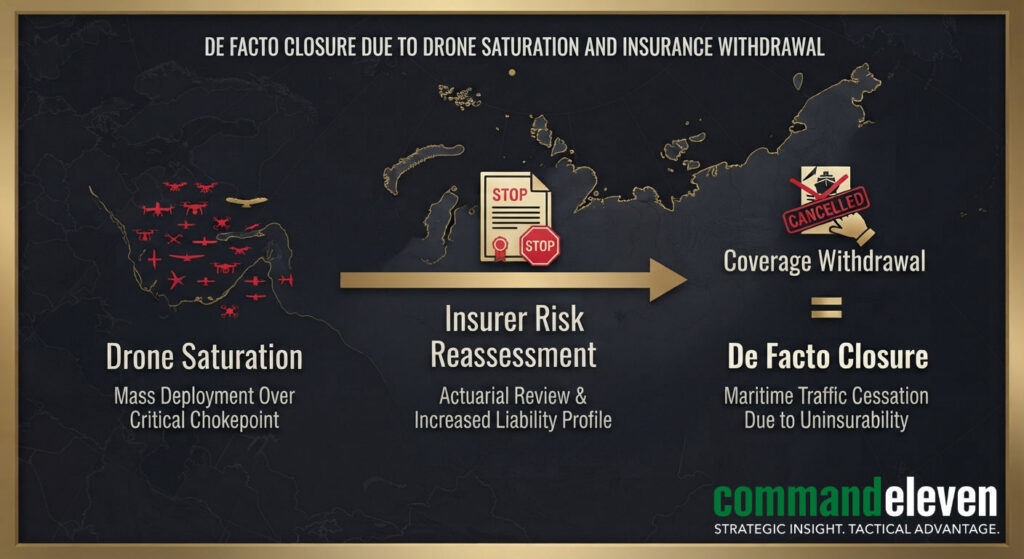
The operative lever here is not a government order grounding flights – it is the war-risk insurance market. Coverage for overflight through an active conflict zone is priced against assessed threat, and underwriters can withdraw it at short notice when that assessment changes. In practice, this means airlines can be forced out of Russian airspace by their own insurers long before any regulator issues a formal notice, because no carrier will dispatch an aircraft it cannot insure.
- [ASSESSED] – This is precisely why Zelensky addressed insurers directly and by name in his warning, rather than only airlines and governments – CommandEleven Intelligence assesses this was a deliberate choice to activate the fastest-acting pressure point available, one that does not require any single incident to actually occur. The 2014 downing of MH17 – attributed by international investigators to a Russian-supplied Buk missile system operated from separatist-held Ukrainian territory, with the International Civil Aviation Organization’s council finding Russia responsible in a ruling roughly a year prior to this warning – remains the reference case underwriters and carriers weigh when evaluating conflict-zone overflight risk generally. CommandEleven Intelligence notes this only as relevant historical context shaping how the aviation-insurance sector is likely to receive Zelensky’s warning; the current situation (Ukrainian drones over Russian territory, not surface-to-air missile risk to transiting airliners) is a materially different threat profile, and this dossier does not equate the two beyond their shared relevance to insurer risk calculus.
Most Western carriers have avoided Russian and Ukrainian airspace since 2022 already; the carriers most exposed to this specific warning are Chinese, Turkish, Gulf, and Indian airlines that have continued flying into Moscow, St. Petersburg, and other Russian hubs.
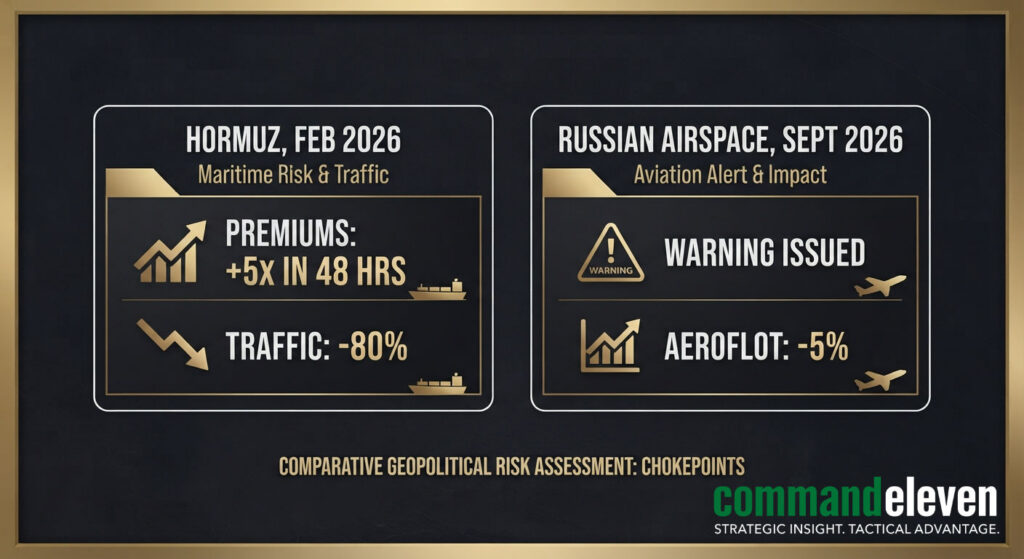
This is not a novel mechanism – it has already played out once this year, in a different domain. When the US and Israel struck Iran on February 28, 2026, war-risk insurance premiums for tankers transiting the Strait of Hormuz surged roughly fivefold within 48 hours, several major marine insurers withdrew coverage outright, and Lloyd’s Joint War Committee redesignated the entire Arabian Gulf as a conflict zone; tanker traffic through the strait fell more than 80% before Iran’s IRGC navy had struck a single vessel or laid a single mine. One analysis of that episode observed that the commercial shutdown of the strait preceded its physical blockade – insurance closed Hormuz before Iran did. Premiums in the Gulf corridor have continued swinging by an order of magnitude through 2026 in direct response to each new round of tanker strikes and diplomatic movement, according to insurance-market reporting.
- [ASSESSED] – CommandEleven Intelligence assesses Zelensky’s airspace warning is best read as a deliberate application of the same insurance-weapon logic already demonstrated at Hormuz: a state actor recognizing that modern war-risk insurance architecture is tightly enough coupled that a credible warning, without a single incident occurring, can impose the practical equivalent of a blockade or no-fly zone through commercial channels alone. The Hormuz case establishes that this mechanism works and works fast – premiums moved within 48 hours of the triggering event – which is the strongest available evidence that Zelensky’s September 1 warning should be taken as a serious economic lever rather than rhetoric.
Series Context and Outlook
This dossier opens CommandEleven Intelligence’s new Ukraine-Russia War series, combining the hybrid-warfare and conventional-war lenses into a single throughline: the airspace warning sits exactly at that intersection, a hybrid-domain pressure tactic (insurance, aviation, economic cost) built directly on top of the conventional deep-strike campaign that gives it credibility. Subsequent installments in this series will examine the battlefield dynamics driving the campaign’s scale, NATO’s own airspace and air-defense posture in response to the broader pattern of European drone incursions, and the sanctions and economic-warfare dimension of the conflict.
- [ASSESSED] – CommandEleven Intelligence assesses that Russia’s retaliatory strike order is very likely to be carried out at meaningful scale in the near term, consistent with the pattern of symmetric response Moscow has followed throughout the war; the more open question is whether the airspace warning produces a measurable shift in the small remaining pool of non-Western carriers still using Russian airspace, or whether continued use by Chinese, Turkish, Gulf, and Indian carriers signals those governments assess the warning as more rhetorical than operational.
Sourcing Base (Confidence-Tiered, with Links)
CONFIRMED – Primary/Official Statements & Market Data:
- Kyiv Independent, “The Russian sky is becoming completely dangerous” (full text of Zelensky’s Sept. 1 address)
- Euromaidan Press, “Putin calls Zelenskyy’s airspace warning ‘state terrorism’ as shares in Russia’s national airline fall 5%“
- Meduza, “Putin says Zelensky’s warning to civilian airlines operating in Russian airspace is a ‘bid for state terrorism’“
- Bloomberg, “IEA Sees Drone Hits Weighing on Russia Refinery Runs to Mid-2026“
- Wikipedia, (Deep strike campaign), aggregating multiple sourced strike-count figures
ASSESSED – Credible Secondary Reporting:
- Irregular Warfare Initiative, “The Insurance Weapon: How Commercial Risk Logic Became an Irregular Warfare Tool at Hormuz” (the Feb 28, 2026 premium-surge/JWC-redesignation precedent)
- The National, “Shipping insurance surges again as attacks intensify over Strait of Hormuz“
- S&P Global, “Middle East shipping insurance costs rise on Hormuz risks: Marsh“
- Aviation Week, “Ukraine Warns Airlines As Drone Strikes Threaten Russian Airspace“
- Bloomberg, “Zelenskyy Warns Airlines on Russian Airspace, Threatens Drone Campaign“
- MiGFlug, “Zelensky Warns Airlines: Russian Airspace Is No Longer Safe” (insurance-mechanism explainer)
- Newsweek, “Putin Calls Kyiv Plane Warning ‘State Terrorism’ 12 Years After MH17 Downed” (MH17/ICAO ruling context)
- Aviation A2Z, “Airlines on High Alert as Zelensky Warns Russian Airspace Could Become Too Dangerous for Civil Flights” (carrier-exposure detail)
- Kyiv Independent, “Ukraine hits 2 Russian oil refineries in latest deep strike drone attack” (campaign scale detail)