
Key Judgments
- [CONFIRMED] – A Financial Times investigation, based on leaked Russian correspondence, travel records, and military patent analysis, has revealed a covert Russian program – codenamed C430L – to help Iran develop ramjet propulsion technology for supersonic and hypersonic cruise missiles, under a formal contract signed with Iran’s Ministry of Defense and Armed Forces Logistics in November 2023.
- [CONFIRMED] – The program was organized by Russia’s state arms exporter, Rosoboronexport, in coordination with NPO Mashinostroyenia – a Russian missile design bureau the US Treasury has sanctioned since 2014 for its role in cruise missile systems launched from ships, submarines, and ground platforms, and for supporting Russia’s strategic nuclear forces.
- [CONFIRMED] – Russian engineers did not simply transfer designs; leaked correspondence shows they reviewed Iranian flight-test data and provided technical troubleshooting on fuel systems, combustion stability, air intakes, and engine nozzles – active engineering collaboration, not a one-time sale.
- [CONFIRMED] – Iran has built and flight-tested a ramjet propulsion system. No public evidence confirms an operational, Russian-assisted supersonic cruise missile has been deployed as of this writing.
- [ASSESSED] – The program continued into 2026, with correspondence as recent as June showing Rosoboronexport and Iranian officials still discussing the next stage of development – meaning the collaboration has continued through, not been suspended by, the active US-Israel-Iran conflict.
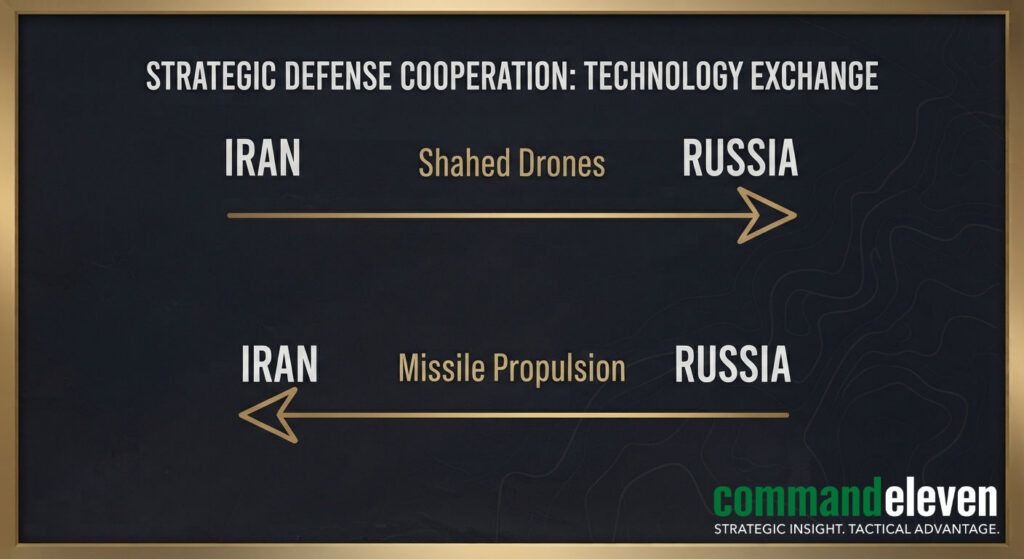
- [ASSESSED] – The most plausible strategic logic connects this program to Iran’s earlier supply of Shahed-series attack drones to Russia for use against Ukraine: Moscow’s missile-propulsion assistance functions as reciprocal payment for capability Iran already provided, tying the Ukraine and Iran wars together as a single transactional relationship rather than two separate theaters.
Anatomy of a Covert Transfer
The C430L program is a materially different category of cooperation than the drone and air-defense transfers Russia and Iran have conducted more openly. Leaked travel records show Russian arms-export officials and senior NPO Mashinostroyenia engineers making repeated trips to Iran in the lead-up to the program’s formal November 2023 contract with Iran’s Ministry of Defense and Armed Forces Logistics. By 2025, NPO Mashinostroyenia had received a substantial cache of Iranian technical material on the ramjet propulsion system – and Russian specialists responded not by handing over a finished design, but by working through Iran’s own test data to identify and help resolve specific technical problems.
That distinction matters for how this dossier characterizes the relationship: this is not Russia selling Iran a weapon. It is Russia embedding its own missile engineering expertise inside an active Iranian development program, with correspondence continuing at least through mid-2026 on the program’s next development phase.
- [DATA DEFICIT] – Neither the Kremlin, Rosoboronexport, NPO Mashinostroyenia, nor the Iranian government responded to the Financial Times’ inquiries. This dossier’s assessment rests on leaked documentary evidence rather than any official confirmation from either government, and should be weighted accordingly – credible and detailed, but not independently corroborated by either state.
The Capability: What Ramjet Propulsion Actually Threatens
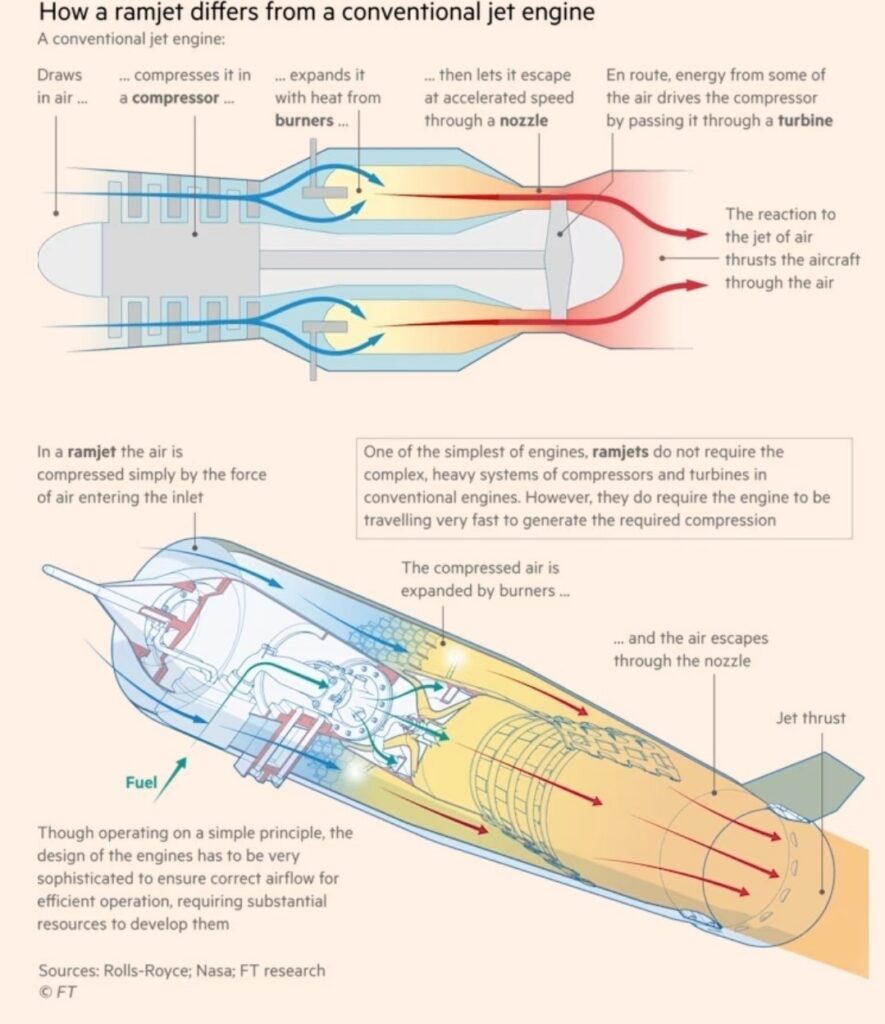
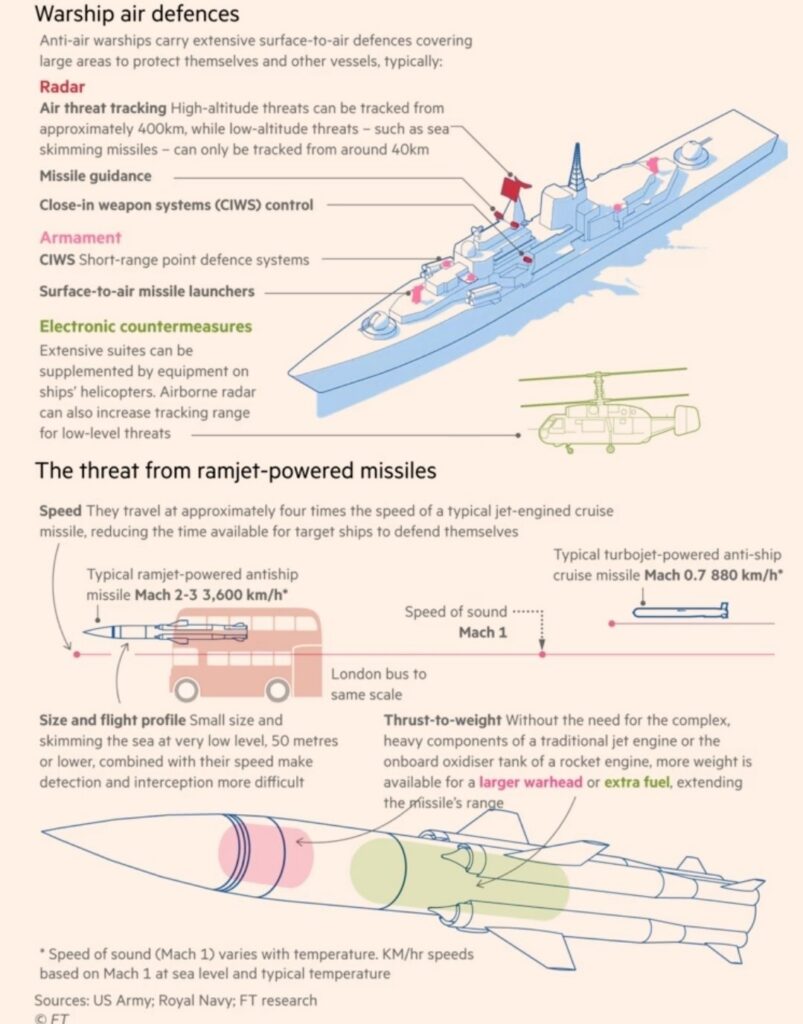
A ramjet has no compressor or turbine; it relies on forward motion to compress incoming air before combustion, which makes it suited to sustained high-speed flight once a missile is already moving fast. Missile and military experts cited in the FT’s reporting assess the technology is almost certainly intended for anti-ship cruise missiles and land-attack strikes – weapons capable of threatening US aircraft carriers and other naval assets in the Middle East. Low-flying, sustained-supersonic missiles compress an intercepting ship’s reaction window; that is the specific capability gap this program is designed to close for Iran.
- [DATA DEFICIT] – This dossier does not assess a specific operational timeline for deployment. Iran’s demonstrated flight test of the ramjet system establishes technical progress, not an imminent fielded weapon.
The Precedent Already Visible: Russia’s Jet-Powered Shahed Evolution
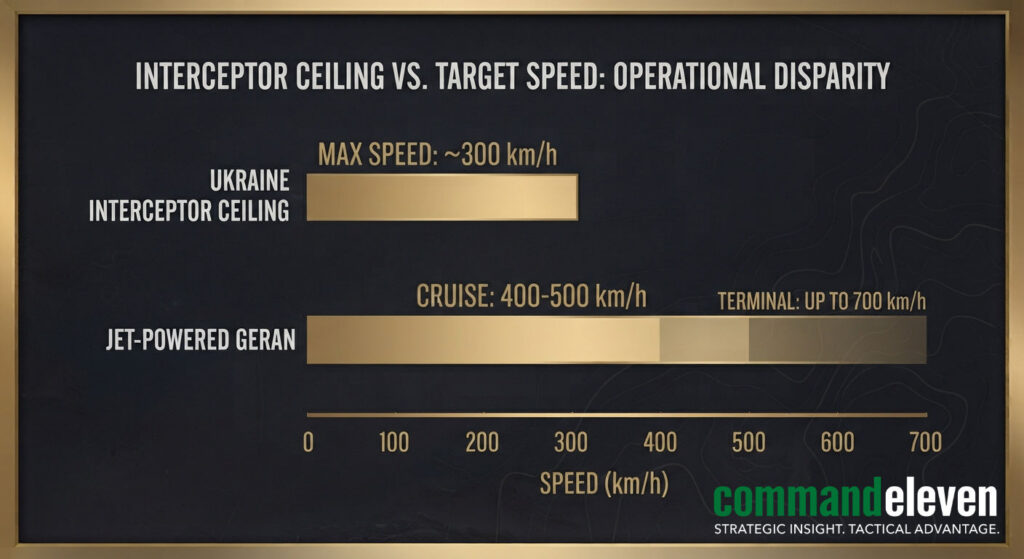
The clearest public preview of where C430L-derived propulsion technology may eventually land is not speculative – it is already flying over Ukraine. Russia has spent 2026 fielding jet-powered variants of its Shahed-derived Geran drones (the Geran-3, -4, and -5), replacing the original design’s small piston engine with a turbojet on the same basic airframe. Ukraine’s Defense Intelligence (HUR) has stated the jet-powered variants were designed specifically to outrun Ukraine’s interceptor fleet, and has said Russia intends to raise jet-powered production to roughly half of total Geran output.
[CommandEleven Intelligence Assessment] CommandEleven Intelligence’s own tracking puts the jet-powered Geran’s cruise speed at 400-500 km/h in level flight, rising to as much as 700 km/h in its terminal attack dive – a performance envelope that exceeds the roughly 300 km/h engagement ceiling of Ukraine’s current mobile interceptor-drone fleet. Independent reporting corroborates the same basic pattern at varying figures (estimates across open sources range from roughly 350 km/h up to 600 km/h depending on variant and production batch), and Ukrainian officials have said interception rates against the jet-powered models drop meaningfully below the roughly 88-90% rate achieved against older, piston-driven Shaheds. Whichever figure is used, the operative fact is the same: Ukraine’s existing low-cost interceptor layer, built to catch a slow propeller-driven drone, was not built to catch this.
- [ASSESSED] – This is directly relevant to C430L. The jet-powered Geran demonstrates that Russia already has, and is actively fielding, propulsion upgrades capable of defeating a defense system tuned to a slower threat profile. A ramjet-propelled Iranian cruise missile – sustaining speeds well beyond even the jet Geran’s turbojet performance – represents the next rung on the same technology ladder. Read together with Section II, the Shahed jet upgrade is best understood not as a separate Russian program, but as a preview of the class of capability Russian propulsion assistance is positioned to hand Iran once C430L matures from tested prototype to fielded weapon.
The Quid Pro Quo: Reading This Alongside the Ukraine War
The most analytically useful context for this program is not Iran’s conflict with the United States in isolation – it is Iran’s prior role as a supplier to Russia. Iran has provided Shahed-series attack drones to Russia since early in the Ukraine war, and helped Moscow establish domestic Shahed production on Russian soil to sustain the tempo of strikes against Ukrainian infrastructure. CommandEleven Intelligence assesses that Russia’s missile-propulsion assistance under C430L reads as reciprocal compensation – technical capital of considerably higher strategic value than the drone technology Iran originally provided, extended specifically because Moscow’s own bombardment campaign against Ukraine has depended on a steady Shahed supply.
This reframes the relationship: it is not simply “Russia backing Iran” as a matter of anti-Western alignment. It is a transactional exchange in which each state’s war effort has become a resource the other draws on – Iranian drone technology sustaining Russia’s campaign against Ukraine, and Russian missile expertise now flowing back to sustain Iran’s standoff with the United States and Israel. Sciences Po’s Nicole Grajewski has characterized the broader pattern as Russia working to extend the Ukraine war’s logic into other theaters, calculating that Moscow has less to lose by ignoring regional red lines than it once did.
Strategic Implications
- Sanctions evasion at the institutional level. NPO Mashinostroyenia has been under US Treasury sanctions since 2014, specifically for its cruise-missile and strategic-forces work – this program proceeded regardless, and continued rather than paused once the current Iran conflict began.
- A widening Axis of Evil coordination pattern. This program should be read alongside CommandEleven Intelligence’s Axis of Evil dossier: it is a concrete, technically-documented instance of the China-Russia-Iran-North Korea coordination pattern examined there, specifically on the military-technical transfer axis.
- Feeds directly into the Iran War Doctrine & Strategy series’ shadow supply chain chapter, which this dossier should be read as a companion piece to once that series is built out – C430L is close to a textbook case of the kind of covert capability-transfer relationship that chapter is designed to examine.
Outlook
CommandEleven Intelligence assesses the most important open question is not whether the technology transfer occurred – the documentary record is strong – but whether Iran’s demonstrated ramjet system converts into a fielded, operational missile, and on what timeline. That is a distinct, harder question the current reporting does not answer, and one worth revisiting as further reporting emerges.
Sourcing Base (Confidence-Tiered, with Links)
CONFIRMED – Primary Investigative Reporting:
- Financial Times investigation (original reporting; paywalled) – relayed in full detail by multiple outlets below
- Pravda Ukraine, relaying the FT investigation in detail (program origins, Grajewski quote, November 2023 contract date)
- Iran International, relaying the FT investigation (includes context on Russia’s Verba air defense transfer and Chinese satellite acquisition by Iran)
- The Statesman, “C430L explained” (NPO Mashinostroyenia 2014 sanctions history, November 2023 contract, 2025 data transfer detail)
- WION News, “Inside C430L” (technical troubleshooting detail – fuel systems, combustion, air intakes, nozzles)
ASSESSED – Credible Secondary Reporting:
- CNN, “Ukraine racing to develop new interceptors as Russian drones and missiles ravage the country” (Geran-4/-5 jet-powered variants, 3x faster than original Shaheds) –
- Ukrainska Pravda, “The jet threat. Can Ukraine’s air defence withstand the new high-speed Shahed drones?” (origins of jet-powered Shahed-238/M-237 design, HUR production-share assessment)
- RFE/RL, “Russia’s Jet-Powered Drones: A Major New Threat to Ukraine Amid Speeding Arms Race“
- Militarnyi, “Jet-Powered Shahed Drones Remain a Challenge for Interceptor Drones” (interception-rate and speed-threshold detail) –
- Chase Tactical, “Russia’s Jet-Powered Shaheds Outpace Kyiv’s Air Defenses Now” (Geran-4/-5 speed and range figures, August 2026 saturation-attack data)
- The Defense News, “Leaked Documents Reveal Russia Helps Iran Develop Engines for Supersonic Cruise Missiles“
- Rare Earth Exchanges, “Project C430L Russia Iran Supersonic Missile Program Explained“
- Atalayar, “Operation C430L: The dangerous favour Putin owed Iran” (Shahed-for-missile-tech reciprocity framing)
- UA.News, relaying the FT investigation (no-response confirmation from Kremlin/Rosoboronexport/NPO/Iran)