
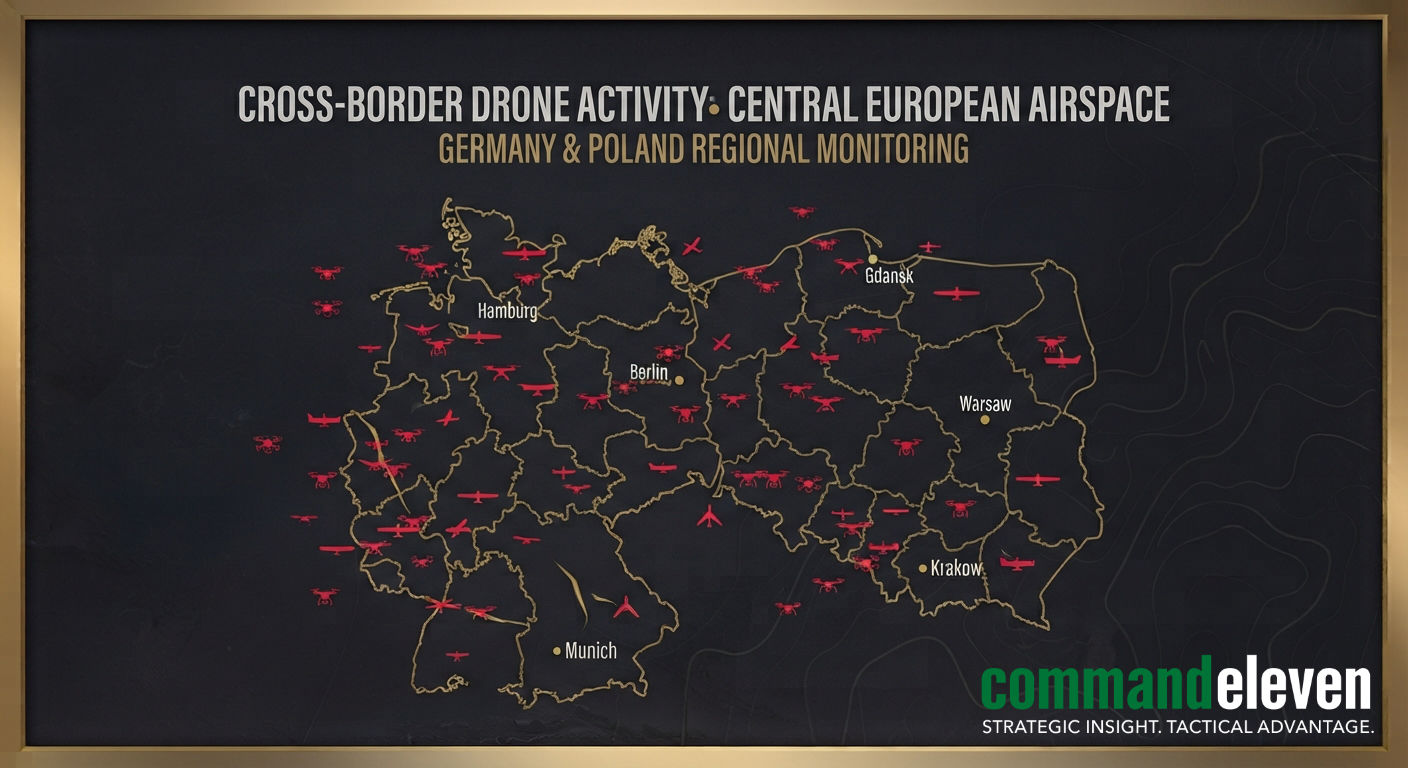
Key Judgments
- [CONFIRMED] – On September 1, 2026, Germany formally accused Russia of orchestrating an August 4 explosive-drone attack at Leipzig/Halle Airport, targeting a Ukrainian cargo aircraft. Interior Minister Alexander Dobrindt cited drone components, explosives, and detonator signatures matching prior Russian hybrid operations; the device failed to detonate only due to a faulty detonator. A U.S. defense official independently told CNN a separate American assessment reached the same conclusion.
- [CONFIRMED] – Leipzig/Halle Airport is not an arbitrary target – it is an operational hub for NATO’s Strategic Airlift International Solution (SALIS) program, which moves equipment to alliance battle groups along NATO’s eastern flank and supports Ukrainian cargo operations. Germany, NATO Secretary-General Mark Rutte, and EU Commission President Ursula von der Leyen have all characterized the incident as an attack on alliance logistics infrastructure, not merely a bilateral German-Russian matter.
- [CONFIRMED] – Germany’s retaliatory measures include closing the Russian consulate in Bonn (effective Sept. 18), terminating the Russian House cultural center’s lease in Berlin, raising the national threat level from “general” to “high,” and tightening entry controls on Russian nationals. Russia responded by ordering the closure of Germany’s Goethe-Institut cultural centers in Moscow, St. Petersburg, and Yekaterinburg, with Russian officials signaling further retaliation is likely, potentially including Germany’s consulate in St. Petersburg.
- [CONFIRMED] – Der Spiegel reports Chancellor Friedrich Merz’s government is now considering providing Ukraine with target coordinates for strikes inside Russia – a direct response to Leipzig – alongside an accelerated September delivery of attack drones and IRIS-T interceptor missiles, and a planned autumn intelligence law permitting German services to penetrate systems used to smuggle sanctioned components to Russia.
- [CommandEleven Intelligence Assessment – stated on Survival Dispatch broadcasts] Syed Khalid Muhammad’s, CommandEleven Intelligence Executive Director and Founder, standing on-air thesis has been that Russia’s broader sabotage and hybrid-pressure campaign against Europe is designed to provoke a NATO overreaction that Moscow can then use to justify wider escalation or to fracture Western unity. CommandEleven Intelligence assesses Germany’s shift toward providing strike coordinates – a substantive operational step beyond its prior role as an arms supplier – is a plausible candidate for exactly that miscalculation, given Germany’s position as Ukraine’s second-largest arms supplier after the United States and the qualitative difference between funding a war and directing strikes within it.
The Incident and Germany’s Case
The August 4 incident involved an explosive-laden drone discovered on Leipzig/Halle Airport grounds near a Ukrainian Antonov cargo aircraft, prompting an hours-long airport closure; a second drone separately collided with a Boeing 757 that was forced to go around during the closure. German officials said the attack bore “hallmarks” consistent with prior Russian hybrid operations across Europe – an assessment the Association Press has tied to a broader pattern of roughly 200 Russia-attributed sabotage incidents across the continent since the full-scale invasion began, ranging from arson plots to cyberattacks on critical infrastructure. Notably, a similar incendiary-device plot targeting the same airport’s logistics center in 2024 was separately suspected of Russian intelligence involvement, meaning Leipzig has now been targeted at least twice.
- [DATA DEFICIT] – Germany’s public evidentiary disclosure – drone configuration, component sourcing, and detonator type consistent with known Russian hybrid-operation signatures – is detailed but not fully public in forensic specifics. Putin has publicly accused Germany of fabricating evidence to implicate Moscow; this dossier cannot independently adjudicate that dispute from open sources; readers should weigh Germany’s disclosed evidentiary basis against the fact that an independent U.S. assessment reportedly reached the same conclusion via separate channels.
The Retaliatory Cascade
Germany’s response moved beyond statements into concrete diplomatic action within the same news cycle: closure of the Russian consulate in Bonn, termination of the Russian House’s operating lease in Berlin, a national threat-level increase, and tightened Russian entry screening. Moscow’s countermeasure – ordering the closure of Goethe-Institut branches in three Russian cities – is a direct, symmetric cultural-diplomacy retaliation in the same register, with Russian Deputy Foreign Minister Alexander Grushko explicitly signaling additional measures are coming “very soon,” reportedly including possible closure of Germany’s St. Petersburg consulate.
- [ASSESSED] – This cascade pattern – consulate for consulate, cultural center for cultural center – mirrors a prior 2023 round of German-Russian diplomatic reductions, suggesting both governments are drawing on a familiar playbook rather than improvising a novel response. The notable departure from that precedent is what follows below.
Why NATO and the EU Treated This as an Alliance Matter
Rutte and von der Leyen’s “full solidarity” statements, and von der Leyen’s promise of additional EU sanctions this week, reflect Leipzig’s specific strategic function: SALIS flights through the airport are a working logistics artery for NATO’s eastern-flank battle groups from Finland to Romania, in addition to supporting Ukrainian cargo operations directly. An attack there is not analytically equivalent to sabotage at an ordinary civilian facility – it targets the physical supply chain NATO uses to arm and resupply its own forward-deployed units, in addition to Ukraine.
- [ASSESSED] – CommandEleven Intelligence assesses this framing choice by NATO and EU leadership – treating an attack on a German civilian airport as implicating alliance-wide logistics infrastructure – is itself a significant marker of how seriously the alliance is treating the broader sabotage campaign, independent of whatever Germany itself decides to do next.
The Escalation Ladder: From Arms Supplier to Targeting Partner
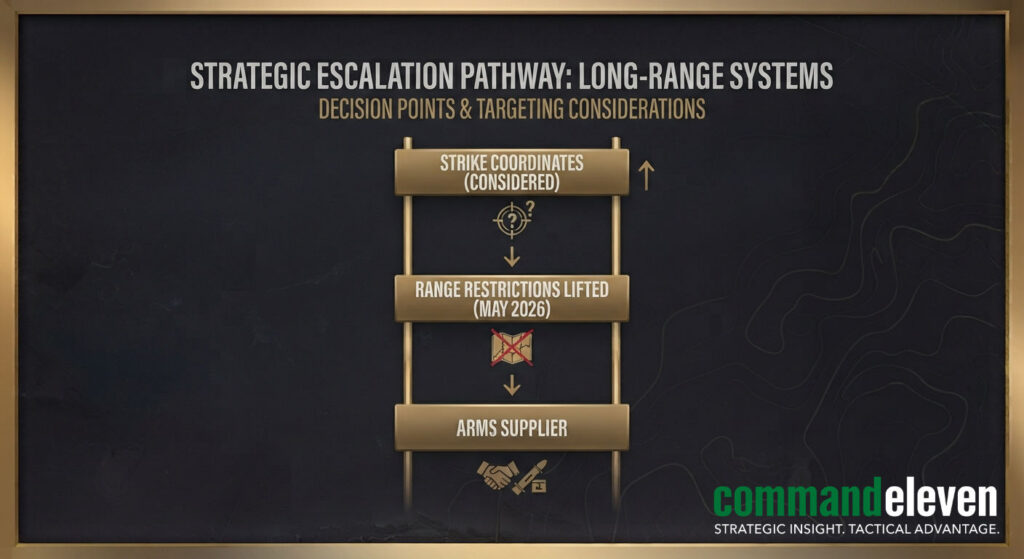
This elevates Leipzig from a diplomatic incident to a strategic inflection point. Der Spiegel’s reporting that Merz’s government is weighing providing Ukraine with target coordinates for strikes inside Russia represents a qualitatively different category of involvement than Germany’s existing role as an arms supplier – funding and equipping a war is analytically distinct from directing where strikes land inside Russian territory. This is not without precedent-adjacent context: Merz had already announced in May 2026 that Germany, alongside France, the UK, and the US, had lifted all range restrictions on Ukraine’s use of Western-supplied weapons for strikes on Russian territory. The coordinate-sharing consideration reported now would be the next rung on that same ladder – a move from permitting to actively facilitating specific strikes.
The accompanying measures reported alongside it – accelerated September deliveries of attack drones and IRIS-T interceptors, and a Bundestag intelligence law permitting German services to penetrate systems involved in smuggling sanctioned components to Russia – reinforce that this is a coordinated policy shift, not an isolated leak.
CommandEleven Intelligence Assessment: Has Russia Set a Trap NATO Is Walking Into?
Syed Khalid Muhammad, CommandEleven Intelligence Executive Director and Founder, has argued on Survival Dispatch broadcasts that Russia’s sustained hybrid-sabotage campaign against European targets functions, at least in part, as deliberate provocation – pressure applied specifically to draw a NATO member into a response Moscow can then use either to justify broader military escalation, or to test and fracture the alliance’s cohesion by forcing individual members into decisions their populations and governments are not uniformly prepared to make.
CommandEleven Intelligence Assessment
Read against that framework, Germany’s shift toward providing strike coordinates – as opposed to continuing in its existing, already-substantial role as Ukraine’s second-largest arms supplier – is a plausible candidate for exactly the miscalculation that thesis anticipates. The distinction matters: a state that arms a belligerent is a supporter; a state that helps select targets for strikes inside another state’s territory is participating in targeting decisions in a way that Russia has previously signaled it may treat as direct co-belligerency. Whether Berlin’s government has fully weighed that distinction – or is responding to Leipzig’s provocation with the exact category of escalation the sabotage campaign was designed to elicit – is, in CommandEleven Intelligence’s assessment, the central strategic question this incident raises, and one that will not be answerable until Germany’s actual decision, not merely Der Spiegel’s reporting of deliberations, becomes public.
The Poland Precedent
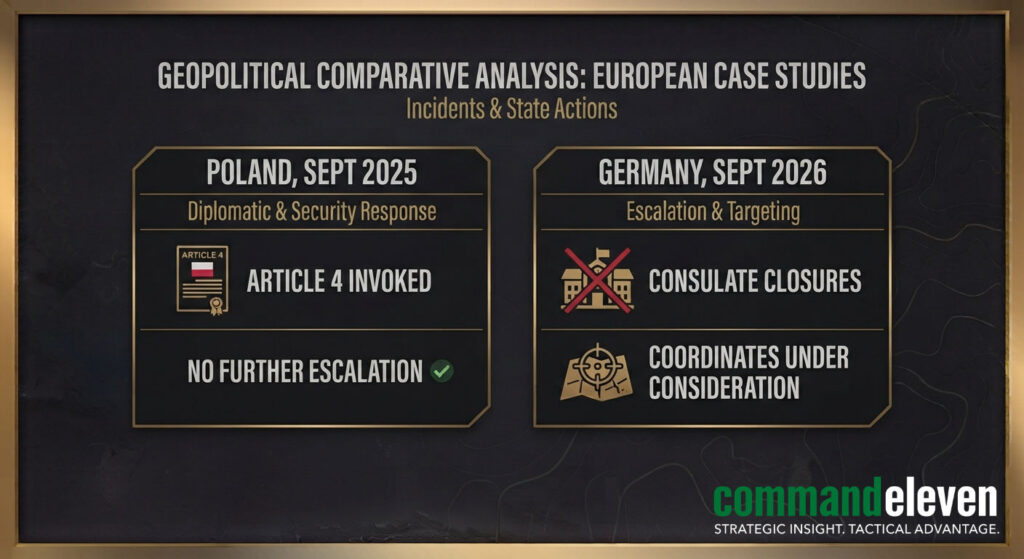
This is not the first time this pattern has played out. In September 2025, 19-23 Russian drones breached Polish airspace during a strike on western Ukraine, forcing Poland to invoke NATO’s Article 4 for the first time over an airspace incident. Belarus attributed the drones’ deviation to “electronic warfare,” and Russia’s Defense Ministry offered no direct claim of intent – plausible deniability preserved throughout. Poland’s own president characterized the incursion as a deliberate test of NATO’s reaction capability, not an accident. That episode establishes a template: an ambiguous, deniable provocation against alliance territory, followed by a real-time test of how far member states and the alliance as a whole are willing to escalate in response. Leipzig fits the same template one year later, with Germany now the state facing the choice Poland faced in 2025 – and the strike-coordinate consideration reported by Der Spiegel would represent a considerably larger step than anything Poland itself took in response to its own incident.
- [DATA DEFICIT] – This assessment describes a plausible strategic logic, not a confirmed Russian intent. CommandEleven Intelligence has not identified open-source evidence establishing that provoking German co-belligerency was Moscow’s specific objective in ordering the Leipzig operation, as opposed to simpler sabotage-campaign objectives (degrading NATO logistics, intimidation, testing response times). Both readings are consistent with the available facts.
Outlook
The immediate items to watch: whether Germany’s government confirms or denies the Der Spiegel coordinate-sharing report in the coming days; the EU’s promised additional sanctions package; and whether Russia’s “very soon” retaliation threat materializes as a further consulate closure or something more significant. CommandEleven Intelligence will treat any confirmed German decision to provide strike coordinates as a substantial escalation warranting its own follow-on dossier within this developing Ukraine-Russia series.
Sourcing Base (Confidence-Tiered, with Links)
CONFIRMED – Primary/Official Statements & Reporting:
- France 24, “Germany blames Russia for Leipzig airport drone attack, orders Russian consulate closed” (NATO/EU “full solidarity” statements)
- Wikipedia, “2026 Leipzig Airport drone incidents” (incident timeline, Dobrindt statement, threat-level change)
- CNN, “Germany blames Russia for drone attack on Leipzig airport” (independent US defense-official confirmation)
- NBC News/AP, “Germany blames Russia for airport drone plot, shuts down consulate” –
- Washington Times/AP, “Germany blames Russia for last month’s attempted drone attack at Leipzig airport” (AP’s ~200-incident sabotage tracking)
- УНН/Der Spiegel relay, “Germany may provide Ukraine with target coordinates in Russia“
- Bloomberg, “Russia to Shut Goethe Institut to Retaliate for Germany Closures“
- RT, “German arms giant reports booming sales” (Germany’s #2-arms-supplier status)
- Survival Dispatch News, “Russia Is About To Test NATO“
ASSESSED – Credible Secondary Reporting:
- Newsweek, “Poland invokes NATO’s Article 4 over Russia’s drones” (Sept 2025 precedent, Belarus “electronic warfare” claim)
- TWZ/Yahoo, “Poland Says Russia’s Mass Drone Incursion Was ‘A Test’“
- Al Jazeera, “What to know about Germany’s drone attack accusations against Russia” (Saxony-Anhalt election context)
- Time, “E.U. Chief Says Alleged Russian Drone Plot Had ‘Hallmarks of State-Sponsored Terrorism’“
- The Moscow Times, “Russia Will Close Germany’s Goethe-Institut Cultural Centers, Lavrov Says” (Putin’s evidence-fabrication counter-claim)
- Yahoo/Ukrainska Pravda relay, “German chancellor says four countries have lifted restrictions on strikes deep inside Russia” (May 2026 range-restriction lift, precedent context)