
Key Judgments
- [CONFIRMED] – Drones now account for 70-80% of Russian strikes at the front line, with artillery relegated primarily to poor-weather conditions – a fundamental doctrinal shift from the artillery-dominated attrition warfare that characterized 2022-2024. Both sides have constructed drone-enabled kill zones tens of kilometers deep in which massed armored formations cannot survive, forcing offensives to proceed instead through small groups of dismounted infantries filtering forward in twos and threes.
- [CONFIRMED] – Russian territorial gains peaked in November 2025 at 725 square kilometers captured in a single month, overrunning an overstretched Ukrainian defense in southern Donetsk Oblast. Gains have declined in nearly every month since: 401 square kilometers in December, 321 in January, 189 in February, and 133 in March 2026 – the lowest monthly total since June 2024. By the four-week period ending April 21, 2026, DeepState recorded a net Russian territorial loss of roughly two square miles; by June 2026, Russian net gains had slowed to approximately 12 square miles over four weeks, a pace this dossier assesses would require decades to conquer the remainder of Donetsk Oblast alone.
- [CONFIRMED] – Ukraine’s air defense integration has measurably improved even as Russian drone volume has increased: interception rates rose from 82-88% in spring/early summer 2025 to 90% by March 2026 – the same month Russia launched more drones than in any other single month of the war to that point.
- [CONFIRMED] – In late June 2026, President Zelensky authorized a 40-day Security Service of Ukraine (SBU) campaign against Russian energy and logistics infrastructure, subsequently extended in August. Kyiv claims the operation disabled approximately 30% of Russia’s oil-refining capacity and damaged most of the logistics network belonging to Wildberries, Russia’s largest online retailer – the same deep-strike campaign this series’ Part I examined from the airspace-warning angle and Part III examined from the sanctions-interaction angle.
- [ASSESSED] – CommandEleven Intelligence assesses the cumulative 2026 data supports a genuine, if still fragile, shift in battlefield momentum: Russia’s offensive capacity has visibly degraded month over month even as its drone campaign has intensified, while Ukraine’s deep-strike campaign against Russian economic and logistics infrastructure – examined across this series – appears to be exerting more strategic leverage than front-line territorial exchange, which by mid-2026 had slowed to a pace neither side’s own stated objectives can be achieved on within any realistic timeframe.
The Stalemate’s New Character
The war’s tactical grammar has changed. Where 2022-2024 fighting centered on artillery duels and armored maneuver, 2026’s front line – roughly 700 miles long – is dominated by drone-enabled kill zones extending tens of kilometers back from contact lines on both sides. Massed armor cannot survive transit through these zones; Ukrainian commanders report drones now account for 70-80% of Russian strikes, with artillery increasingly reserved for conditions (heavy cloud cover, storms) that ground drone operations. The practical effect is that offensive action on both sides has been pushed down to the level of small dismounted infantry teams infiltrating forward individually or in pairs, rather than the battalion-scale mechanized assaults that characterized earlier phases of the war. Ukraine’s General Staff recorded 236 distinct combat engagements in a single day (April 24, 2026) – a measure less of decisive battle than of the sheer granularity modern drone-saturated combat has forced fighting down to.
The Offensive Curve: A Measurable Decline
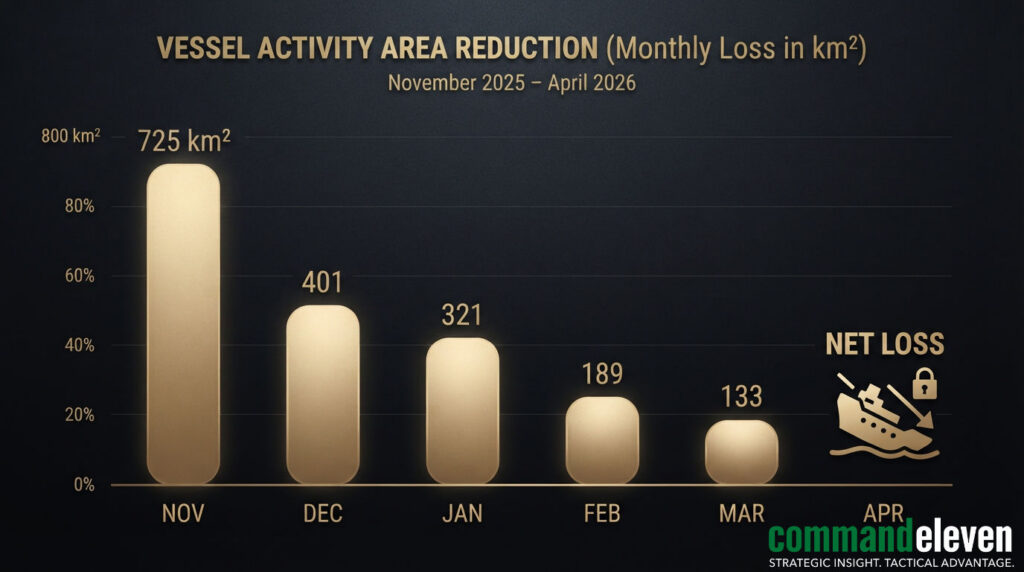
Russia’s territorial gains provide the clearest quantified evidence of this shift’s operational effect. November 2025 marked the war’s high-water mark for Russian advances in this dossier’s dataset: 725 square kilometers captured in a single month, exploiting an overstretched Ukrainian defensive line in southern Donetsk. Every month since has seen a decline – 401 square kilometers in December, 321 in January, 189 in February, 133 in March (the lowest since June 2024) – a trajectory that continued into outright reversal: DeepState recorded a net Russian territorial loss of approximately two square miles over the four weeks ending April 21, 2026. By June, Russian net gains had slowed to roughly 12 square miles over four weeks, a pace this dossier calculates would take decades to complete the conquest of Donetsk Oblast alone, let alone Ukraine’s other contested regions.
Ukraine’s own battlefield performance improved over the same window. Commander-in-Chief Oleksandr Syrskyi stated Ukrainian forces captured more territory than they lost in February 2026 for the first time in the recent period, with Zelensky separately claiming 300 square kilometers “liberated” in a southeastern counteroffensive; AFP’s analysis of Institute for the Study of War mapping put Ukrainian gains at approximately 78 square miles over five days in mid-February, an unusually fast pace analysts tied partly to disruptions in Russian battlefield communications. By late May 2026, multiple defense analysts characterized the war as entering “a new phase,” with Ukraine’s drone dominance credited as the mechanism finally beginning to break the roughly two-year positional stalemate that had held since late 2023.
- [DATA DEFICIT] – This dossier treats the “new phase” characterization as an assessed analytical judgment from cited defense analysts, not as CommandEleven Intelligence’s own independently verified conclusion. Territorial control measurement in an active, drone-contested war zone carries inherent reporting lag and methodology differences across sources (DeepState, ISW, Ukraine’s own General Staff), and this dossier’s confidence in the overall declining-Russian-momentum trend is higher than its confidence in any single month’s precise square-kilometer figure.
Air Defense and the Deep War
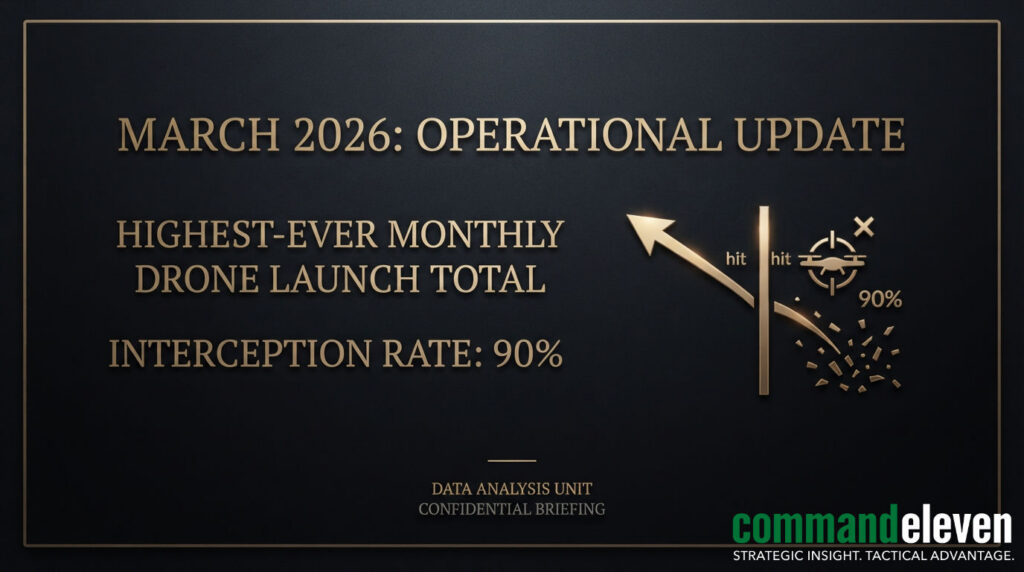
Ukraine’s improving interception performance – up to 90% by March 2026, even as Russia launched its highest-ever single-month drone total that same month – reflects a maturing integrated air-defense architecture rather than a static capability. That improvement matters directly for this series: it is the same air-defense picture underlying Part I’s discussion of jet-powered Geran drones designed specifically to defeat interceptor-drone engagement envelopes, meaning the 90% figure likely masks a widening gap between interception rates against older, slower Shahed-derivative drones and the newer jet-powered variants examined there.
The more strategically significant story in this dossier’s view is not the front line at all, but the deep war: the SBU’s 40-day (later extended) campaign against Russian energy and logistics infrastructure, which Kyiv claims disabled roughly 30% of Russian oil-refining capacity and damaged most of Wildberries’ logistics network. Read alongside Part III’s sanctions findings – Russian fossil fuel export revenue proving durable but under sustained pressure – this dossier assesses the combination of external sanctions pressure and internal deep-strike disruption to Russian refining capacity as a more consequential two-year trendline than the front line’s meter-by-meter territorial exchange, even though the front line remains the war’s most visible and most reported dimension.
The Diplomatic Track, Briefly
Diplomacy has run in parallel without resolving the underlying military picture. Trilateral talks between the U.S., Russia, and Ukraine in Geneva in February 2026 put territorial questions on the negotiating agenda for the first time in the war, with Zelensky signaling willingness to compromise short of full sovereignty claims; the talks broke down over territory and security-guarantee terms. In June 2026, the UK, France, and Germany issued a joint statement with Zelensky backing direct dialogue, conditioned on any settlement being coordinated with Europe – a condition Moscow rejected within days as “completely unacceptable.”
- [DATA DEFICIT] – This dossier does not have visibility into whether this diplomatic track has resumed in any form since June, and treats it as stalled rather than concluded as of this writing.
Assessment
- [ASSESSED] – This dossier’s battlefield data supports a cautious but genuine reassessment of the war’s trajectory: Russia’s offensive capacity, measured in territory gained per month, has degraded consistently since its November 2025 peak, to the point of net loss in some periods – even as its drone campaign has intensified in parallel. This is not evidence of imminent Russian collapse or an imminent Ukrainian breakthrough; 236 engagements in a single day and a roughly 700-mile front line under constant pressure describe a war still very much unresolved militarily. But it does suggest that CommandEleven Intelligence’s Part III finding – that economic and deep-strike pressure may be outperforming front-line maneuver as the more consequential axis of this conflict – is supported by the battlefield data examined here as well, not contradicted by it.
Series Continuity
Part V closes this series with an escalation-risk and endgame-scenario synthesis, drawing together the hybrid-warfare campaign (Part I), NATO’s institutional response and its Article 4 gap (Part II), the sanctions and economic-warfare picture (Part III), and this part’s battlefield trendlines into a single forward-looking assessment.
Sourcing Base (Confidence-Tiered, with Links)
CONFIRMED – Primary/Official & Direct Battlefield Reporting:
- Pantheon Insights (Substack), “Ukraine War 2026: Stalemate, Summits and the Supply Lines” (drone-percentage-of-strikes figure, SBU 40-day campaign, refining-capacity/Wildberries damage claims, Geneva talks, UK/France/Germany statement)
- Mick Ryan (Substack), “Frontlines and Strategic Fault Lines” (March 2026 interception rate, combat engagement count, Ural Mountains deep strike)
- Kyiv Independent (via Yahoo News), “Ukraine war latest: Russia’s territorial gains in Ukraine drop to lowest level since June 2024” (monthly territorial gain figures, Nov 2025-March 2026)
- Kyiv Independent (via Yahoo News), “Ukraine War Latest: Ukraine captured more territory than it lost to Russia over February 2026, Syrskyi says“
- Fox News, “Ukraine makes fastest gains in years as Russia talks stall, exploiting cracks in Kremlin command” (ISW-sourced 78-square-mile figure)
- Lviv Herald, “Ukraine-Russia conflict: front and rear lines summary assessment, early August 2026“
ASSESSED – Credible Secondary Reporting:
- The Hill, “Ukraine’s battlefield gains fueled by drone dominance” (May 2026 “new phase” analyst characterization)
Excluded from this dossier: Any prediction of when or whether either side will achieve a decisive operational breakthrough. This dossier’s sourcing supports confident description of trendlines through mid-2026; it does not support a forecast of the war’s military resolution.