CommandEleven Intelligence Desk // Energy Security Desk, status as of November 24, 2026
Bottom Line Up Front
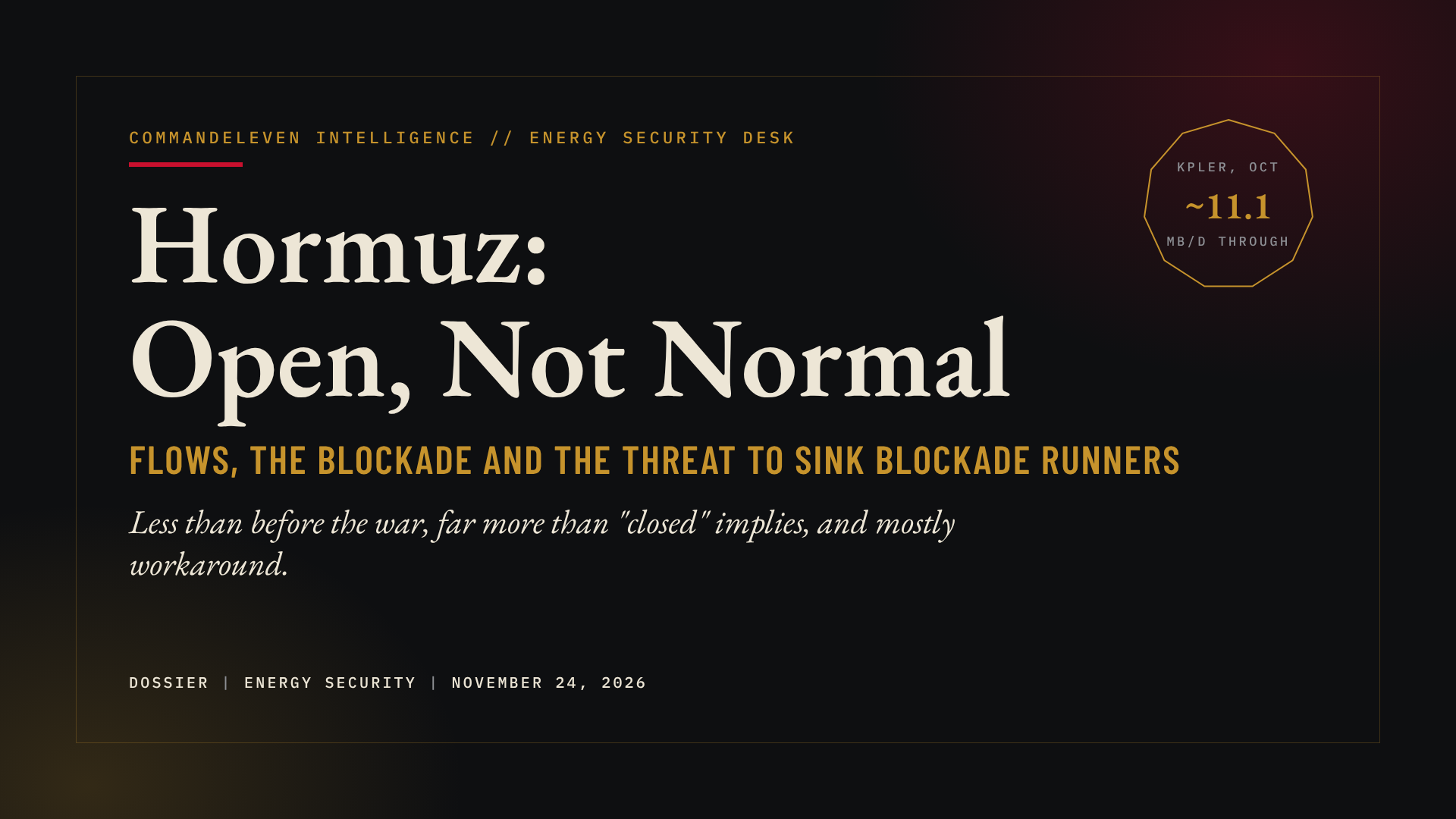
Hormuz is carrying less than before the war but far more than the headlines of a “closed strait” imply. Kpler-tracked crude through the strait was about 9.9 million barrels a day in September and about 11.1 million on average in October, per CNBC citing Kpler. Region-wide, Kpler counted about 16.1 million barrels a day of crude and condensate leaving the Gulf in October, against a pre-war average of about 16.5 million excluding Iran. The recovery came from bypass pipelines and a shuttle of tankers offloading in the Gulf of Oman, not from the strait reopening. In November the strait numbers fell again, to about 10 million barrels a day by November 10 from 13.4 million at the start of the month, per Bloomberg citing Kpler. On November 22 President Trump told Fox News that if Iranian forces test the U.S. naval blockade, “they’ll all be at the bottom of the sea like the rest of the navy.” Iranian outlets have floated a tanker convoy to China. We assess a convoy attempt is possible but unannounced, unofficial and logistically hard. We found no official Iranian plan.
Key Judgments
- CONFIRMED (primary baseline). In 2024 about 20 million barrels a day of oil moved through Hormuz, about 20% of world petroleum liquids consumption, per the U.S. Energy Information Administration. Saudi Arabia sent 5.5 million barrels a day through it (Vortexa data in the EIA analysis).
- REPORTED. Crude through Hormuz was 9.9 million b/d in September (Kpler, data to September 29) and about 11.1 million b/d on average in October (Kpler, via CNBC, as relayed by Gulf News). It fell to 7.3 million b/d in the week ended October 28 (Kpler), then to about 10 million b/d by November 10 from 13.4 million at the start of the month (Kpler, via Bloomberg, as relayed by Gulf News).
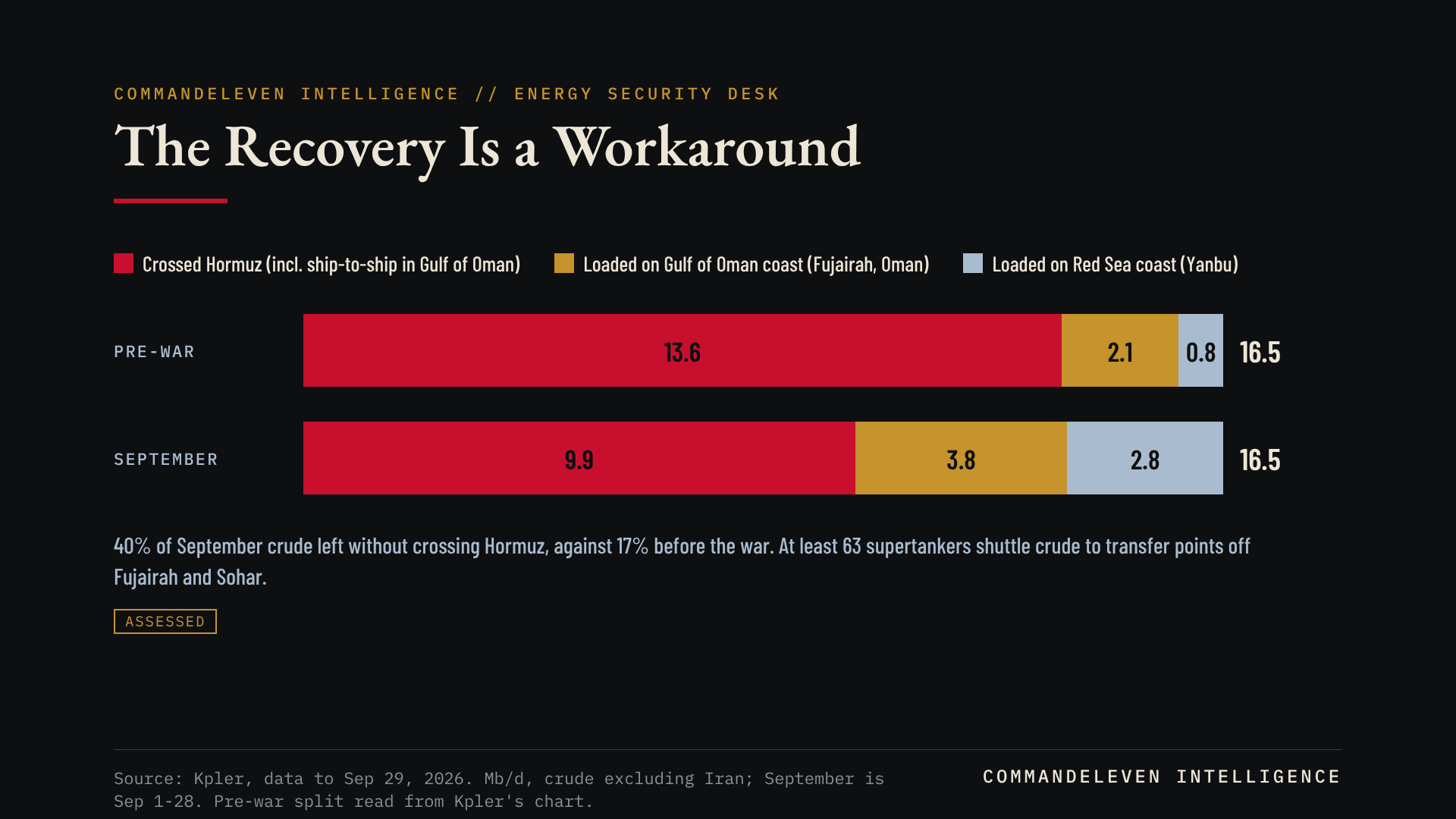
- ASSESSED. Most of the recovery since March is workaround, not reopening. Kpler counts 40% of September crude as bypassing Hormuz (about 23% loaded on the Gulf of Oman coast, mainly Fujairah, and about 17% via Yanbu on the Red Sea), and at least 63 supertankers shuttling crude to transfer points off Fujairah and Sohar.
- REPORTED. Saudi crude exports in September were 5.379 million barrels a day, up nearly 21% from August and the highest since February, per data from the Joint Organizations Data Initiative (JODI) as reported by Reuters on November 19. Kpler’s own count for September was at least 5.1 million. We have not pulled the JODI release ourselves.
- CONFIRMED (statement). Saudi Energy Minister Prince Abdulaziz bin Salman said on October 6 that East-West pipeline flows had reached 5.8 million barrels a day. This is a pipeline flow statement, not an export figure.
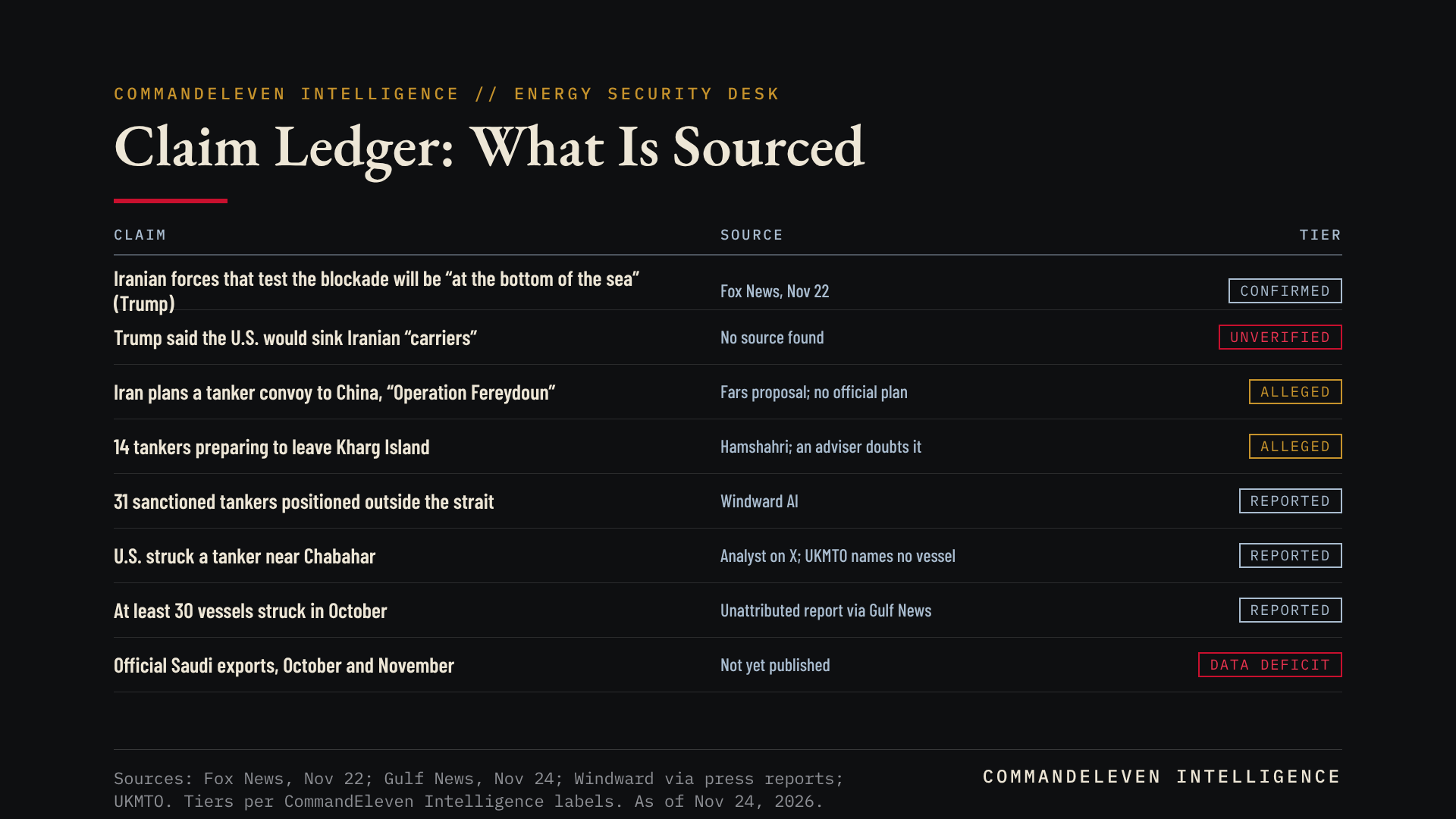
- DATA DEFICIT. We found no official Saudi export figure for October or November. JODI’s October release was not yet out in the sources we reviewed. Until it is, October and November Saudi numbers are Kpler and Vortexa estimates, and both trackers say recent months are likely to be revised upward.
- CONFIRMED (statement). In a Fox News interview published November 22, Trump was asked about Iranian forces testing the blockade and said: “I hope they do, they’ll all be at the bottom of the sea like the rest of the navy.” We have the quote from the Fox News article, not a transcript or video.
- ALLEGED. An Iranian plan to break the U.S. blockade exists only as proposals and claims from outlets and lawmakers. Fars proposed a tanker convoy to China dubbed “Operation Fereydoun”; Foreign Minister Araghchi said the blockade “must be broken”; Tehran has not endorsed a convoy plan.
The Correction on “Carriers”
The threat as published concerns Iranian forces testing the blockade, not aircraft carriers. The Fox News article does not mention tankers or carriers. Iran does not operate aircraft carriers, and none of the reports we found quote Trump about carriers. The U.S. carrier strike groups in the reporting are American ships enforcing the blockade. If the word “carriers” is circulating, it most likely means tankers (oil “carriers”) or has been garbled in retelling. We treat “Trump said the U.S. would sink Iranian carriers” as NOT SUPPORTED and use the quote as published.
What Flows Through Hormuz Now
| Date or period | Reported figure | Source | Label |
|---|---|---|---|
| 2024 average, all oil through Hormuz | About 20 million b/d | EIA, citing Vortexa | CONFIRMED |
| 2024, Saudi crude and condensate through Hormuz | 5.5 million b/d | EIA, citing Vortexa | CONFIRMED |
| Pre-war average, region’s crude exports excluding Iran | About 16.5 million b/d | Kpler explainer | REPORTED |
| Within 10 days of the February 28 closure | Non-Iranian exports trough at 4.5 million b/d (7-day average) | Kpler | REPORTED |
| September 2026, crude crossing Hormuz | 9.9 million b/d | Kpler, data to September 29 | REPORTED |
| October 2026, crude crossing Hormuz | About 11.1 million b/d | Kpler, via CNBC, as relayed by Gulf News | REPORTED |
| Week ended October 28, crude crossing Hormuz | 7.3 million b/d, more than 40% below pre-war baseline | Kpler, as relayed by Gulf News | REPORTED |
| Start of November to November 10, crossing Hormuz | 13.4 million b/d falling to about 10 million b/d | Kpler, via Bloomberg, as relayed by Gulf News | REPORTED |
| October 2026, crude and condensate leaving the region (Hormuz, Red Sea, Gulf of Oman) | About 16.1 million b/d, down from 17.09 million in September | Kpler, via Reuters (Ahmad Ghaddar), November 3 | REPORTED |
| October 2026, all seaborne oil exports excluding LPG and Iran | 17.1 million b/d, down from 18.9 million in September, roughly three-quarters of pre-war | Vortexa, via Reuters, November 3 | REPORTED |
| October 2026, Vortexa split | Crude and condensate 14.0 million b/d (about 86% of pre-war); refined products 3.1 million b/d (just over half) | Vortexa, via Reuters, November 3 | REPORTED |
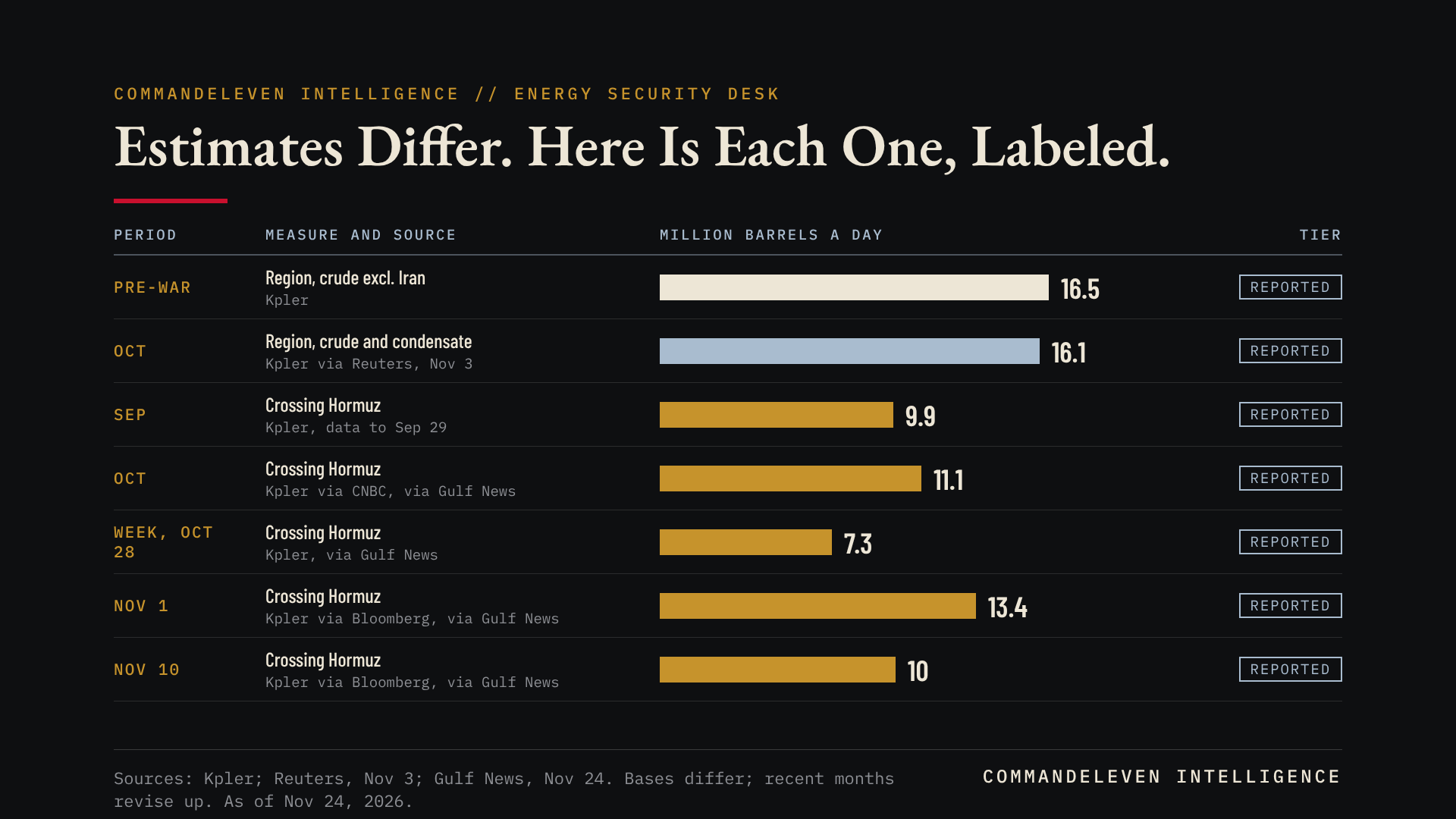
Reading the table. Region-wide exports in October were about 16.1 million barrels a day by Kpler, near the pre-war average excluding Iran, while flows through Hormuz itself were about 11.1 million. That gap is the bypass. Reuters reports both Vortexa and Kpler said their October figures were likely to be revised upward, because many shuttle tankers switch off tracking signals as a safety measure and satellite imagery is needed to confirm cargoes. Vortexa, per Reuters, said it had already revised September sharply upward after its first release. Crude is recovering faster than refined products, which fits the energy-products emphasis of the Shenzhen declaration’s second point.
Why the series do not match. A seven-day chart in circulation shows flows falling from about 16 to about 9 million barrels a day between November 1 and 17, with the last days provisional. Bloomberg’s Kpler series falls from 13.4 to about 10 over a similar window. They may measure different things: crude only or all oil, exports or transits, with or without ship-to-ship transfers (the IEA says Gulf of Oman transfers added 3.7 million b/d to total flows, taking them to 10.9 million, per Gulf News). We cannot reconcile them from what we have, so we do not publish that chart, and we build ours only from the labeled points above. DATA DEFICIT.
How This Fits Our November 15 Count
Our November 15 piece reported that UKMTO’s weekly counts put Hormuz transits about 65% below pre-war, while IEA data showed Gulf oil exports (excluding Oman) at 18.4 million b/d in October, down 26%, with crude around 15 million b/d, about 82% of pre-war. The two sets are consistent with this dossier. Ship counts measure hulls crossing a line, and shuttle tankers and ship-to-ship transfers move barrels in fewer, larger vessels. Barrel estimates run higher than ship counts suggest, and all of them lag. Brent fell from $136 earlier in the conflict to about $93 by mid-November in that piece, and sits near $88 now.
Saudi Arabia: What Is Sourced
| Item | Figure | Source | Label |
|---|---|---|---|
| Crude exports, September (official data) | 5.379 million b/d, up nearly 21% from August, highest since February | JODI, as reported by Reuters, November 19 | REPORTED |
| Crude production, September | 8.37 million b/d, up about 34% from 6.24 million in August | JODI, as reported by Reuters, November 19 | REPORTED |
| Crude exports, September (tracker estimate) | At least 5.1 million b/d (5.6 including likely Red Sea cargoes) | Kpler | REPORTED |
| Saudi crossings of Hormuz | 0.7 million b/d in August, 2.8 million in September | Kpler | REPORTED |
| East-West pipeline flow, October 6 | 5.8 million b/d (“as of this morning”) | Energy Minister, GCC forum in Manama, via Al Jazeera | CONFIRMED (statement) |
| Pipeline capacity | 7 million b/d maximum | Al Jazeera, consistent with EIA’s note of a temporary 2019 expansion to 7.0 | REPORTED |
| Pipeline flow in August | About 2 million b/d | Kpler, via Al Jazeera | REPORTED |
| Pipeline attacks | Drone strikes in early September shut the line for five or six days, per the minister; Al Jazeera attributes them to an Iraqi militia | Al Jazeera | REPORTED |
What the two September numbers show. The official JODI figure (5.379 million b/d) and Kpler’s tracked minimum (at least 5.1 million) agree to within about 5%, which supports both. A pipeline figure is not an export figure, and the 2024 EIA number (5.5 million through Hormuz) measures a different thing from total Saudi exports, so we do not compare them. For October and November there is no official data in hand. We also saw a single secondary report of 5.52 million b/d for October 1 to 25 and a decline at Yanbu, but it is an aggregator relaying Kpler, so we hold it out. We do not use a circulating Saudi export chart that has no stated source or units.
The Blockade and the Threat
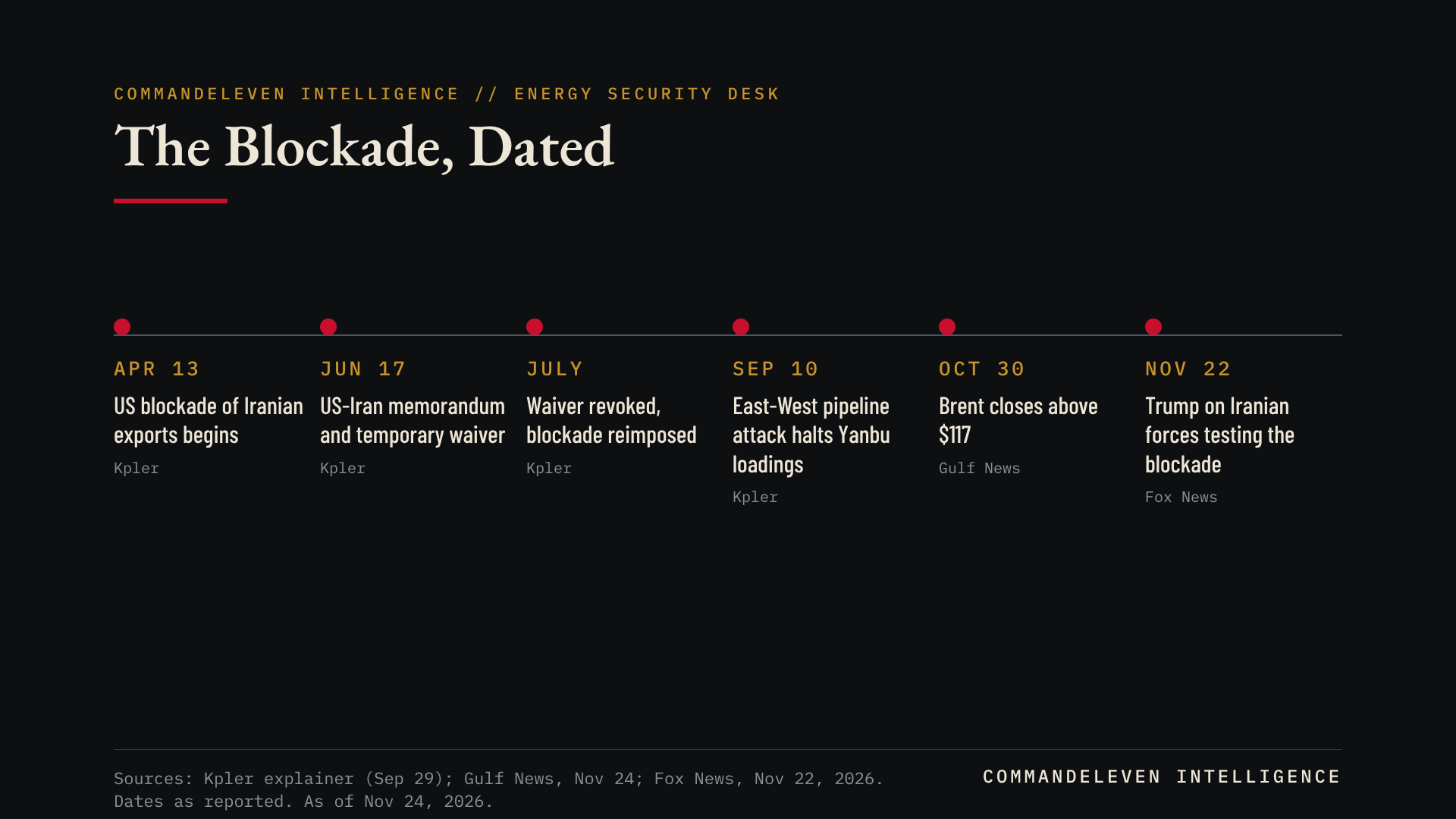
The U.S. blockade of Iranian exports began April 13, was eased by a June 17 memorandum of understanding and temporary waiver, and was reimposed in July, per Kpler. Iranian crude through Hormuz has been near zero since July. Fox News reports the U.S. maintains a naval blockade of Iranian ports. Reporting we reviewed also places two U.S. carrier strike groups in the region without naming them.
What Trump said. In exclusive comments to Fox News on Sunday, November 22, Trump said Iranian negotiators were stalling, that Iran is “more aggressive now than before the election,” and that he is inclined to order strikes after the new year if no agreement is reached, per the Fox News article by Eric Mack and Trey Yingst. Asked about the possibility of Iranian forces testing the blockade, he said: “I hope they do, they’ll all be at the bottom of the sea like the rest of the navy.” Fox also reports Trump predicted tit-for-tat strikes between American and Iranian forces will continue. Earlier that week Trump told Axios he was in no rush to decide on Iran, per Iran International. At the Shenzhen meeting he said he and Xi agree Iran must fully reopen the strait, per AP.
The reported breakout idea.
- ALLEGED. Fars, an outlet affiliated with the Revolutionary Guards, proposed a tanker convoy to China called “Operation Fereydoun” and threatened strikes on energy facilities in the UAE, Saudi Arabia and Qatar if the U.S. intervened. Hardliners and lawmakers backed it. No official convoy plan has been announced.
- ALLEGED. Hamshahri, a Tehran-municipality-linked outlet, claimed 14 tankers were preparing to leave Kharg Island. An adviser at United Against Nuclear Iran called a 14-ship breakout almost logistically impossible. Another report spoke of 31 laden tankers attempting the line. Neither is independently confirmed.
- REPORTED. Windward AI identified 31 sanctioned tankers positioned outside the strait, the nearest three to six hours from the blockade line. That is positioning, not intent.
- REPORTED. Foreign Ministry spokesman Esmaeil Baghaei said Iran would use “all available means” to counter the blockade. Parliament Speaker Ghalibaf said Iran cannot remain in “neither war nor peace.”
Unconfirmed incident. A maritime security analyst reported on X that the U.S. struck a tanker carrying Iranian oil. UK Maritime Trade Operations reported an incident with “military forces” near Chabahar and did not name the vessel. Washington and Tehran have not confirmed a strike. We hold it at REPORTED, unconfirmed.
Our assessment. ASSESSED: a convoy test is possible because Iran has signaled intent through proxies and outlets and tankers are positioned. It is unlikely to be large, because the logistics are hard and Trump has set a public price. The risk is a smaller probing attempt that forces a decision. We do not predict outcomes.
Prices and Vessel Attacks
Brent closed above $117 on October 30 and traded at about $88 on November 24, down roughly 24% from the peak, per Gulf News. One report counted at least 30 vessels struck in October, a wartime record; the report is not attributed to a named tracker and we hold it at REPORTED. Reuters, citing Vortexa, said attacks on shipping around Hormuz reached a record in October and that tankers have stepped up efforts to avoid detection. UKMTO reports attacks without detail, and the attribution of the October strikes is not confirmed in the sources we have. Gulf News also relays that Iran-aligned Houthis said they attacked a Saudi refinery, and that UKMTO reported multiple attacks on shipping over the weekend of November 21-22. Both are REPORTED.
What We Do Not Know
- Official Saudi export volumes for October and November.
- Whether the November series in circulation and Kpler’s measure the same thing.
- Whether any convoy plan exists beyond proposals in outlets and by lawmakers.
- The Fox News transcript or video of Trump’s November 22 remarks, beyond what the article quotes.
- The original CNBC and Bloomberg pieces behind the October and November Kpler Hormuz figures.
- Who carried out the October vessel attacks.
What To Watch
- Any Iranian tanker movement toward the blockade line, tracked by Windward, Kpler or TankerTrackers.
- A CENTCOM or White House statement on the reported tanker strike.
- Whether Trump moves on the new-year decision.
- Pipeline flows at Yanbu and any further East-West pipeline attacks.
- Whether November flows stay near 10 million b/d, and what revised October and November tracker data show.
- The JODI release covering Saudi October exports.
- The OPEC+ ministerial meeting on November 29 on 2027 output policy, per Gulf News.
- Whether Beijing or Moscow publicly asks Tehran to hold back, given the Shenzhen language on stable energy flows.
Calls We Will Score
- By December 31, 2026: no confirmed Iranian tanker convoy crosses the blockade line. ASSESSED.
- By December 31, 2026: Kpler-tracked Hormuz crude flows stay below the pre-war baseline. ASSESSED.
- By March 31, 2027: at least one more confirmed U.S. or Iranian use of force against a commercial vessel in the Gulf of Oman or the strait. ASSESSED.
What This Assessment Does and Does Not Establish
It establishes what the EIA, the Saudi energy minister, JODI-based and Kpler-based reporting say about flows, what Fox News quotes Trump as saying, and what Iranian outlets have proposed.
It does not establish any Iranian decision to break the blockade, the identity of attackers, official Saudi export volumes after September, or that a U.S. strike on a tanker occurred.
Frequently Asked Questions
Is the Strait of Hormuz closed?
Not fully. Flows are below pre-war levels but are running at roughly 10 to 11 million barrels a day by Kpler’s count, helped by bypass pipelines and offshore transfers.
Did Trump say he would sink Iranian aircraft carriers?
No source we found says so. Iran has no aircraft carriers. The quote concerns Iranian forces that test the blockade.
Does Iran have an official plan to break the blockade?
Not that has been announced. A convoy idea has been floated by an IRGC-affiliated outlet and backed by hardliners, and the foreign minister said the blockade must be broken.
How much oil does Saudi Arabia export now?
The latest official figure, from JODI as reported by Reuters, is 5.379 million barrels a day for September, the highest since February. Kpler estimated at least 5.1 million for the same month. There is no official figure yet for October or November.
Related CommandEleven Intelligence Reading
- Shenzhen: What the Trump-Xi-Putin Declaration Says, and What It Does Not, on the declaration’s energy point and Trump’s remark on Hormuz
- Hormuz Shipping Is Still 65% Below Pre-War: What the Weekly Counts Measure and What They Miss, the ship-count baseline
- Strait of Hormuz Crisis 2026: Who Pays When Crude Recovers but Diesel and LNG Do Not, on why crude recovers faster than products
- Trump Says New Iran Strikes Are “Quite Unlikely.” Here Is What the Record Shows, on the blockade posture and the strike signals
- Bab al-Mandab and the Red Sea: What the Houthi Position Does and Does Not Change, on the Yanbu and Red Sea bypass risk
- The Sulfur Shortage, Explained, on another Hormuz supply chain still disrupted
- The Gulf at War, Part 2: Can the Gulf Defend Itself?, on the threat to Gulf energy facilities
Sources
- U.S. Energy Information Administration: Amid regional conflict, the Strait of Hormuz remains critical oil chokepoint (June 16, 2025)
- Kpler: How Mideast Gulf crude exports returned to pre-war levels (data as of September 29, 2026)
- Reuters (Ahmad Ghaddar): Gulf oil flows dip in October from post-Iran war high, data shows (November 3, 2026)
- Reuters: Saudi crude oil exports rise to seven-month high in September, data shows (November 19, 2026)
- Joint Organizations Data Initiative (JODI)
- Reuters via Khaleej Times: Middle East crude oil exports exceed pre-war levels but tanker attacks increase (October 5, 2026)
- Al Jazeera: Saudi Arabia says East-West pipeline pumping 5.8 million bpd (October 6, 2026)
- Fox News (Eric Mack and Trey Yingst): Trump warns of new strikes against Iran after new year, calls negotiators ‘professional tap dancers’ (November 22, 2026)
- Gulf News: Brent drops to $88, WTI at $79 (updated November 24, 2026), relaying Kpler via CNBC and Bloomberg, Reuters, IEA and Vortexa figures
- Gulf News: Trump threatens to sink Iranian vessels as US strikes oil tanker (November 2026)
- Iran International: Trump threatens Iran strikes in new year (November 21-22, 2026)
- Associated Press: Takeaways from the Shenzhen summit (updated November 20, 2026)