Status as of November 18, 2026. Part 2 of 3 in the Gulf at War series. The assessment is ours. IISS is one source among several, and its judgments are attributed. Read the introduction first: The Gulf at War: Eight Months of Iranian Fire, and a Record of Our Own Calls.
Bottom Line Up Front
The Gulf stopped most of what Iran fired at it. It did so state by state, with American sensors and American munitions behind it, and from stocks that the war drew down faster than they can be refilled. That is a tactical success and a strategic warning. Iran spent cheap drones and short-range missiles to force the Gulf to spend expensive interceptors. The Gulf has almost no way to hit back at Iran that it will admit to, little ability to see far beyond its coast without the US, and almost no mine-clearing capacity in a waterway Iran can still close.
We assess, with moderate confidence, that Gulf air defense would perform worse in a second round than in the first unless supply improves and cooperation becomes regional. We assess with high confidence that Hormuz, not the Gulf’s airspace, is where the war is decided.
Key Judgments
- REPORTED. Iran fired more than 6,000 guided weapons at twelve countries in the first six weeks. IISS counts about 4,670 one-way attack drones, about 1,400 ballistic missiles and a few dozen land-attack cruise missiles at the Gulf states, with the UAE taking about half. Reported Gulf casualties are in the “few dozen.” The UAE confirmed 3 military and 10 civilian deaths.
- REPORTED. Reported interception in the first week to March 6: UAE about 93%, Qatar 89% (97% of missiles, 72% of drones), Bahrain 76%. Kuwait claimed 97 ballistic missiles and 283 drones shot down in 48 hours. These are state claims. IISS found no imagery of widespread destruction that contradicts them.
- ASSESSED: MODERATE. Gulf air defense is national, not regional. IISS finds predetermined engagement zones, reach-back to US systems and no deeper integration of the kind the Gulf has talked about for years. The Gulf’s joint bodies played no meaningful role. We agree, and add that the electronic layer mattered too: GPS jamming of Iranian drones is documented, and the UAE claims jammers neutralized 85% of drones. That figure is unverifiable.
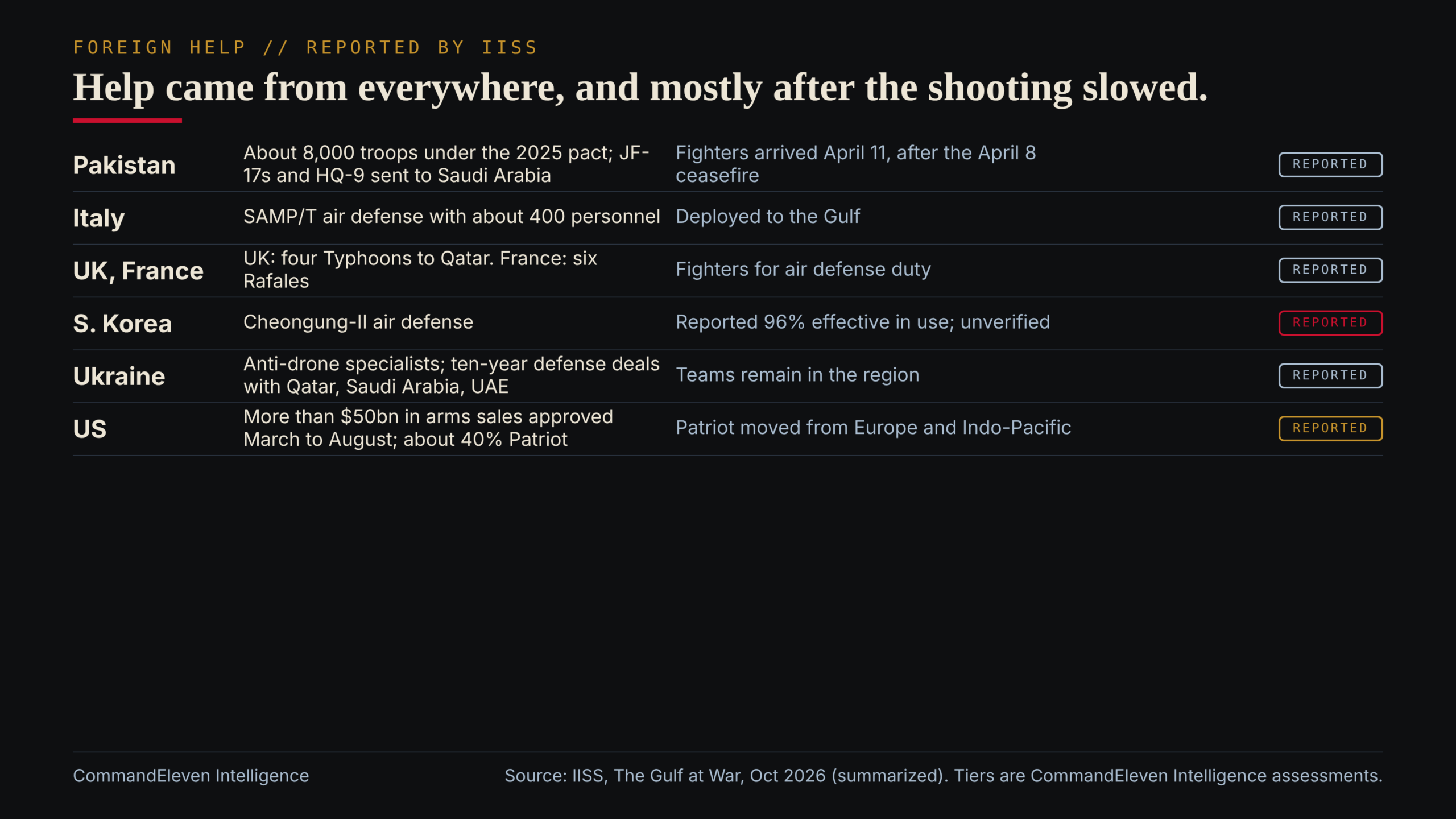
- ASSESSED: MODERATE. Interceptor economics are the Gulf’s real vulnerability. Patriot is the backbone everywhere except Oman, THAAD sits in the UAE and Saudi Arabia, and aircraft and helicopters were used against drones. The State Department approved more than $50 billion in sales to the Gulf from March to August, about 40% of it Patriot interceptors, and more than 21,500 APKWS rockets. Reported stocks were “dangerously low” in IISS’s account.
- ASSESSED: MODERATE. The US is both the Gulf’s shield and its single point of failure. The Gulf’s air picture depends on American sensors and a network that feeds radar data across the Gulf, Jordan and Israel. Three of the world’s eight THAAD batteries, in the UAE and Jordan, were taken out. Iranian strikes also hit early-warning radar in Qatar and disrupted the American air operations center at Al Udeid.
- REPORTED. The Gulf cannot easily strike back. Only the UAE and Saudi Arabia reported strikes on Iran in the initial phase, and Kuwait and Bahrain reportedly followed in July. All were covert. Saudi Arabia has long-range missiles. Qatar, Bahrain, the UAE and Kuwait have shorter-range tools. Only the UAE has its own reconnaissance satellites. IISS lists Saudi, Emirati and US moves to build cheaper long-range drones and missiles.
- REPORTED. The Gulf lacks mine-clearing capacity. IISS says British and American minehunters left days before the war. Saudi Arabia has three old mine-countermeasure ships and the UAE one, about 40 years old. A prospective British and French coalition for clearance depends on a stable truce.
- NOT ESTABLISHED. Whether the Gulf’s low casualty count reflects interception, Iranian targeting choices or under-reporting. IISS says the same.
What Is Established
What came in, and what stopped it
The first day was the heaviest in volume. IISS says Iran fired about 1,000 ballistic missiles and drones across all six Gulf states, Jordan, Iraq and Israel on the first day. The UAE’s worst day was March 10, when 9 of 35 drones got through, including at the Ruwais refinery. Our own reporting of the period matches the pattern IISS describes. Iran used dispersed launchers, started with short-range missiles against near targets, and went for energy, ports, data centers and airports as much as bases.
The state-by-state picture matters, because the Gulf did not fight as a bloc. IISS reports Fujairah attacked repeatedly in the UAE, even after the ceasefire. Qatar’s Ras Laffan was hit twice in March. In a friendly-fire incident, a Kuwaiti F/A-18 shot down three US F-15Es, and all six crew ejected. Kuwait’s airport was hit by a drone on June 3 after the ceasefire. Saudi Arabia lost an E-3G Sentry and had five KC-135s damaged at Prince Sultan Air Base.
The interceptor problem
Patriot interceptors and Hellfire-class rockets cost far more than a Shahed-type drone, and many drones needed more than one shot. IISS says the Gulf is looking hard at the Ukrainian approach of cheaper interceptors and better matching of weapon to target. Ukrainian specialists went to the Gulf at least three times between March and May and remain there. The US sped up Boeing seeker production, Lockheed introduced a new Patriot variant in July, and South Korea’s Cheongung-II was reported at 96% effective in use. IISS notes the limits: China holds a rare-earth chokehold and Ukraine and Taiwan compete for the same munitions.
This is also where the Qeshm episode fits. We reported the US strike on Qeshm in November as a hit on Iranian air-defense systems after American fighter jets were fired on. We did not report desalination damage there. IISS treats the Iranian claim of a Qeshm desalination hit as probable disinformation, noting the site was beyond the range of the missiles it blamed.
The strike and sensing gap
IISS reports that the US fired about 1,100 JASSM in under two months and nearly exhausted its initial batch of PrSM. The Gulf has no comparable stock. Saudi Arabia has Chinese-made ballistic missiles and Qatar a short-range one. Bahrain has HIMARS and ATACMS, and the UAE has ATACMS, Storm Shadow and older Scuds. Our reading is that none of this gives Gulf states a credible way to hold Iranian launchers at risk on their own.
Mines and the strait
The post-ceasefire war is a fight for Hormuz, as IISS says. The US degraded Iran’s coastal surveillance, navy and launchers, and claims it destroyed more than 90% of Iran’s mine stocks. IISS notes that the claim is unverified and the latent threat remains. Two carrier groups, an amphibious group and about ten cruisers and destroyers sustain the effort, and IISS reports that escort missions would exceed the Navy’s means. Our own November 15 reading has transits still about 65% below pre-war.
Why It Matters
A Gulf state that cannot defend itself without Washington cannot say no to Washington, cannot afford to pick a fight with Tehran, and cannot reassure investors. The air-defense record looks good. The stock position, the sensor dependence and the mine problem are what a second round would test.
What Would Change Our View
- A funded regional air-defense architecture with shared command and a shared picture.
- Evidence of a cheap, mass-produced interceptor in Gulf service.
- A declared mine-clearing operation in the strait.
- Official Gulf acknowledgment of strikes on Iran, which would change the deterrence picture.
What To Watch
- Patriot and THAAD deliveries against the $50 billion in approved sales.
- Kuwait’s IBCS and LTAMDS programs and the Korean systems due in 2027.
- UAE and Saudi work on cheaper long-range drones and missiles.
- Any change in the American naval presence in the Gulf.
Calls We Will Score
- By June 30, 2027: The British and French mine-clearance coalition does not begin declared clearance operations in the Strait of Hormuz.
- By June 30, 2027: No Gulf government officially acknowledges conducting strikes on Iranian territory in the 2026 war.
- By September 30, 2027: No GCC state publicly announces an air-defense command network that operates without a US-supplied picture.
What This Assessment Does and Doesn’t Establish
- It does not establish interception rates or casualty totals. They are state-supplied.
- It does not establish the covert Gulf strikes on Iran, which are reported and often denied.
- It does not establish the size of Gulf munitions stocks. They are not public.
- IISS’s judgments are IISS’s, and ours are marked as ours.
Frequently Asked Questions
Did Gulf air defenses work?
On the reported numbers, mostly. Interception rates were high and casualties low. The caveats are that the numbers come from the states themselves and that the defenses leaned on American sensors and munitions.
Why does the cost of interceptors matter?
Iran fired thousands of cheap drones. Each one the Gulf stops with an expensive interceptor costs it more than the attack cost Iran.
Can the Gulf strike back at Iran?
Not openly. The reported Gulf strikes on Iran were covert and mostly denied, and the Gulf lacks the long-range weapons and surveillance to do more alone.
Who will clear the mines?
No one yet. The Gulf has very little capacity, and the British and French coalition depends on a stable truce.
Related CommandEleven Intelligence Reading
- The Gulf at War: Eight Months of Iranian Fire, and a Record of Our Own Calls
- Iran War Doctrine and Strategy: A Six-Part Series
- Iran’s Dead Hand Is a Chain of Command, Not a Machine
- Qeshm, the Qataris and the Post-Midterm Window
- Iran War Update: Task Force Iron Gate
- Hormuz Shipping Is Still 65% Below Pre-War
Sources
- IISS: The Gulf at War: Strategic, Security and Geo-economic Dimensions (Oct 2026)
- CommandEleven Intelligence: Hormuz Shipping Is Still 65% Below Pre-War (Nov 15, 2026)
- CommandEleven Intelligence: Qeshm, the Qataris and the Post-Midterm Window
Assessments and confidence tiers are CommandEleven Intelligence’s own. We do not reproduce third-party text or graphics. Figures attributed to IISS are IISS’s, summarized. Munitions and interception figures are state-supplied and unverified.