CommandEleven Intelligence · Iran Desk. Flash Assessment, status as of October 24, 2026. This is a developing story built on unverified reporting; it will be updated as confirmation arrives or fails to.
Bottom Line Up Front
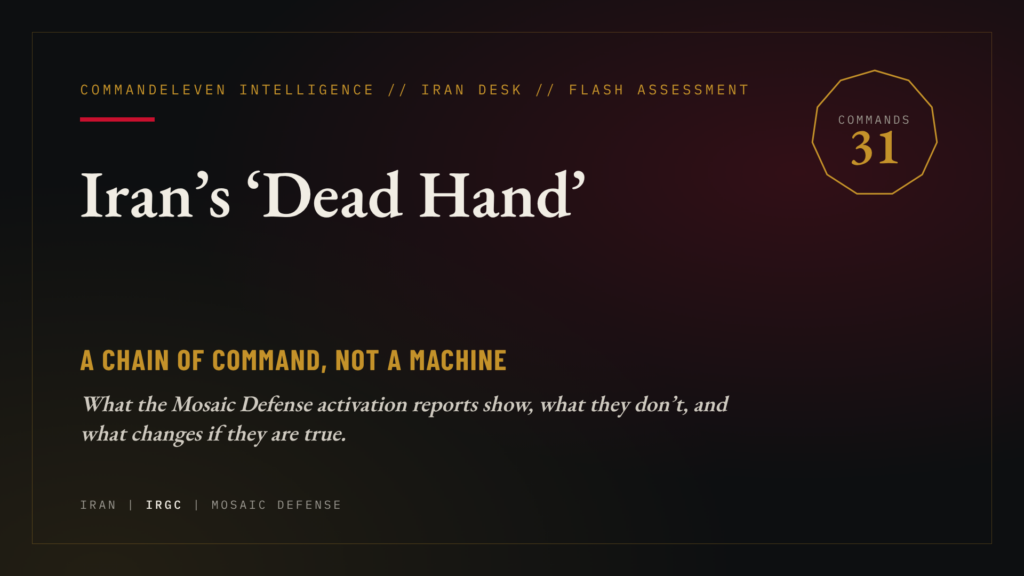
Reports from October 21–22, traced to Iran’s Fars News Agency and an unnamed senior security official, say Iran’s leadership has ordered the IRGC to fully activate its decentralized “Mosaic Defense” doctrine in expectation of a joint US-Israeli attack. Regional commanders have reportedly been given expanded authority to act if contact with Tehran is cut, along with lists of US military, political and economic targets in the region.
Social media has labeled this Iran’s “Dead Hand.” The label is wrong in a way that matters. The Soviet Dead Hand, the Perimeter system, was built to launch nuclear retaliation automatically. What is being described in Iran is a human chain of command: commanders pre-authorized to keep fighting under standing orders if the center goes dark.
The order itself is unverified. The structure it would activate is not: Iran has run its forces through 31 provincial commands since 2008, and used them after the February decapitation strikes. What would be new is wider delegation and more specific targets for the next round. The timing matters most. The report surfaced two weeks before the November 3 US midterms, days after the Financial Times reported that an Israeli strike planned for the weekend of October 10 was called off over President Trump’s opposition to restarting the war before the vote.
Key Judgments
- [SINGLE-SOURCE] The activation order and the target lists rest on one report, from an IRGC-affiliated outlet, citing an unnamed official. No Iranian government statement, no independent outlet and no US or Israeli official has confirmed them.
- [CONFIRMED] The structure exists. Mosaic Defense was developed from 2005 under Mohammad Ali Jafari and implemented through an IRGC reorganization in 2008 that created 31 provincial commands with their own weapons stocks, intelligence and Basij forces. Iran operated in this mode after the February 28 decapitation strikes; Foreign Minister Abbas Araghchi said in March that units were acting independently under general instructions issued in advance.
- [ASSESSED, moderate confidence] The report is at least partly a deterrence signal. It is aimed at the US political calendar and at the argument, made in Israel and Washington, that a leadership strike can end the war quickly. Its message is that killing commanders will not stop retaliation.
- [ASSESSED, moderate confidence] If the delegation is real, it raises the risk of escalation by mistake. Pre-authorized units with target lists and broken communications are harder to stop than to start. The March strikes on Oman, attributed to units that could not be contacted, are the precedent.
- [ASSESSED] The target-list element is not new. Fars carried a near-identical report in March 2026, describing an “updated target bank” extended to US economic assets. Its reappearance now is more consistent with messaging than with a new operational order.
- [EXCLUDED] There is no evidence that any automatic or nuclear retaliation mechanism exists or has been activated. Reports that compare the move to the Soviet Dead Hand describe delegated human command, not automation.
What Was Reported
The core claim, as carried by Fars and relayed by aggregators on October 21–22:
- Iran’s leadership believes a joint US-Israeli attack is imminent.
- The armed forces have been instructed to fully activate the decentralized Mosaic Defense doctrine.
- Local commanders have received “extensive lists” of US economic and political targets across the region, to be struck if war resumes.
- Regional commanders have expanded authority to act if communication with central command is severed.
What the reporting does not establish: which commanders hold the expanded authority, which weapons it covers, whether it extends to long-range missile launches, and what would trigger it. No Persian-language official text of the order has been published. One analyst tracking Iranian state media noted that PressTV showed no change in alert posture on the day the report circulated.
[SINGLE-SOURCE] Treat every specific in this section as the claim of one IRGC-affiliated outlet until a second, independent source confirms it.
What Mosaic Defense Actually Is
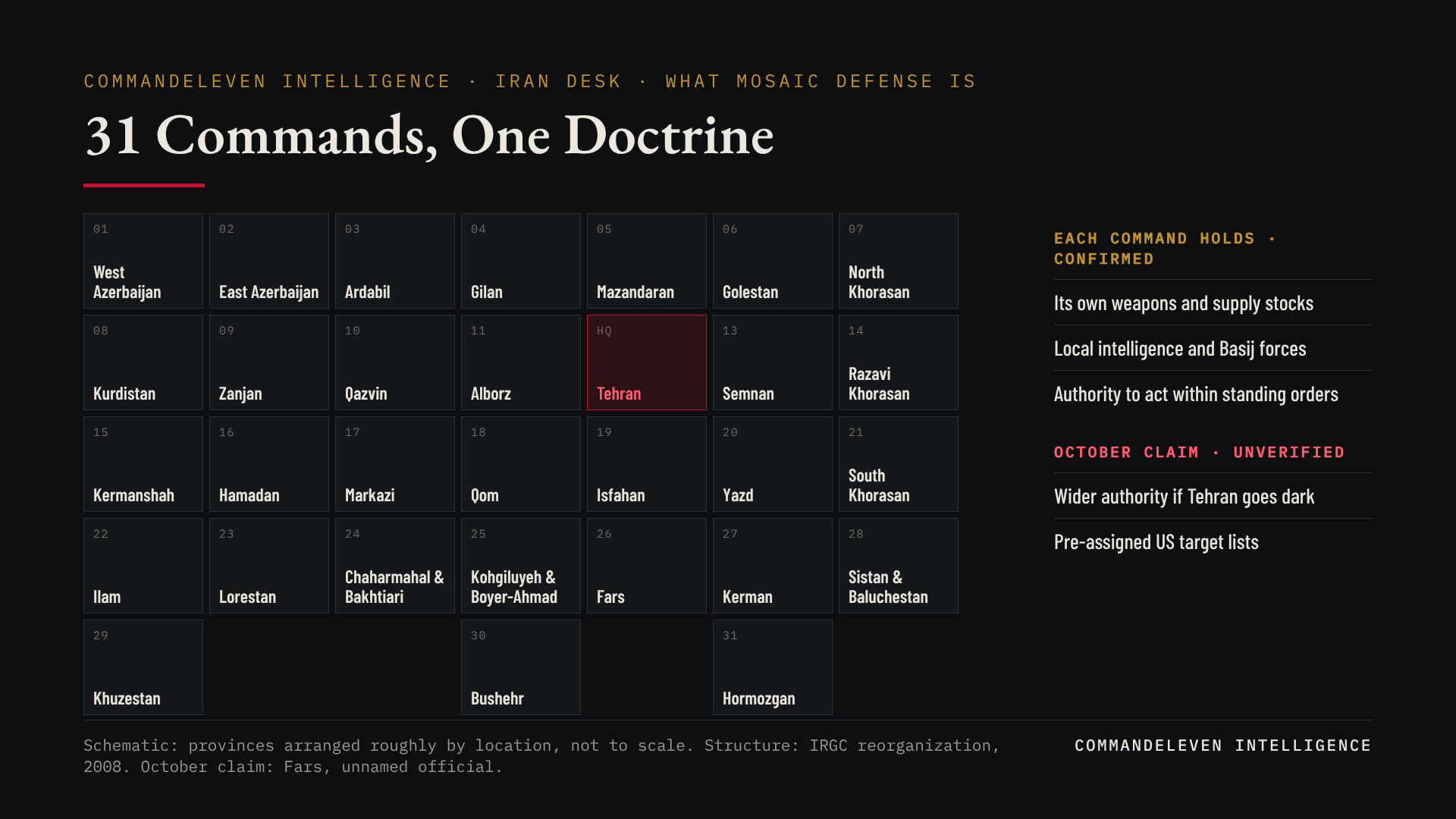
Mosaic Defense is the IRGC’s answer to decapitation. It was developed at the IRGC’s Center for Strategy from 2005, after Iranian planners studied how Iraq’s centralized army stalled in 2003 once its leadership was targeted. The 2008 reorganization put it into practice:
- 31 provincial commands, one for each province, each with its own stocks of weapons and supplies.
- Local intelligence and Basij forces under each command, able to fight a long, attritional war against an invader.
- Delegated decision-making within a predefined strategy, so commanders do not wait for Tehran’s approval.
- A succession model, sometimes called the “Fourth Successor,” that names replacements for key posts several ranks down.
CommandEleven Intelligence covered the doctrine in detail in Iran’s Mosaic Defense Doctrine and placed it within Iran’s wider strategy in the Iran War Doctrine & Strategy series. This assessment does not repeat that analysis; it asks what changes if the October reports are true.
Why “Dead Hand” Is the Wrong Label
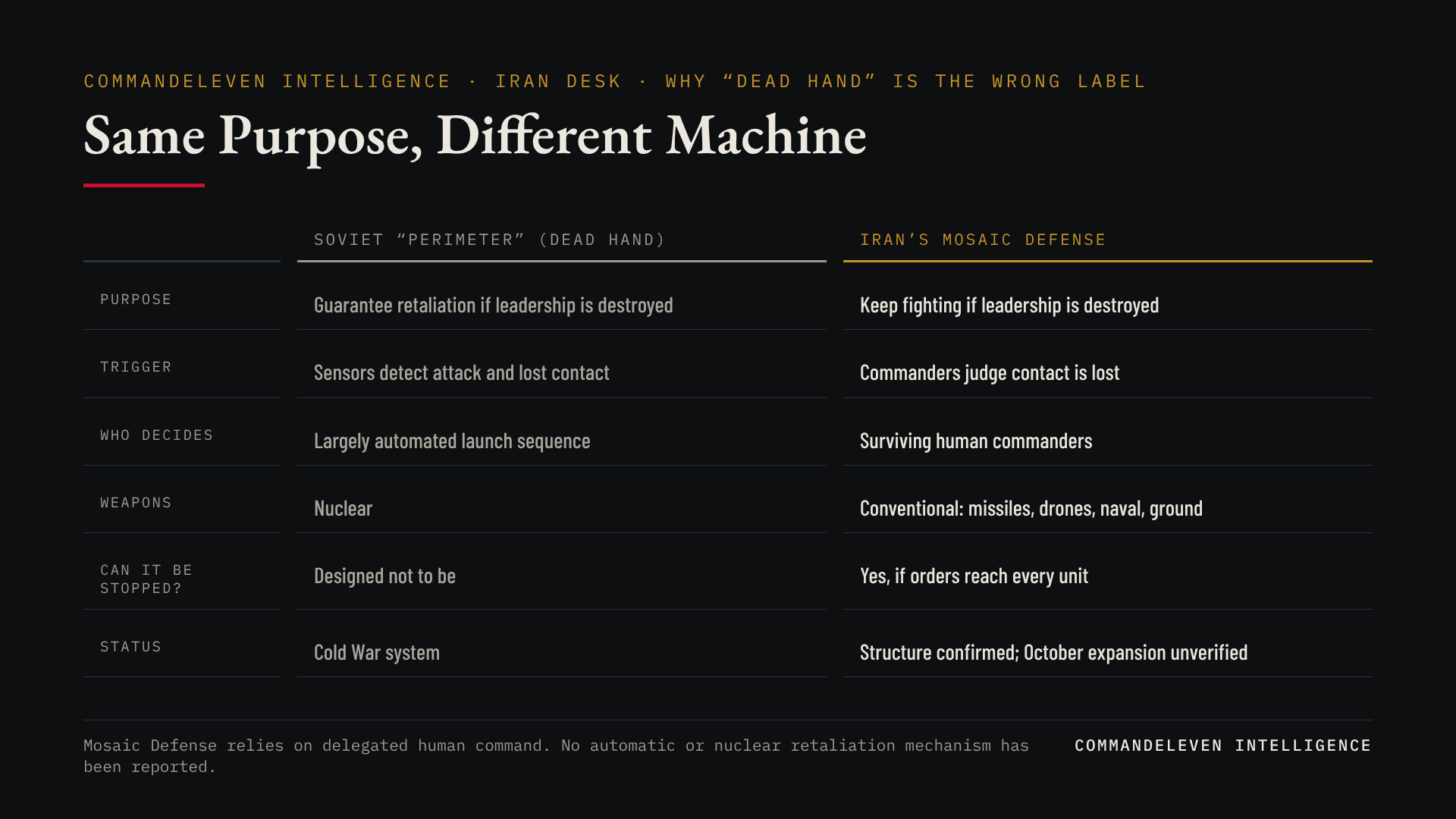
The Soviet Perimeter system, nicknamed the Dead Hand, was designed in the Cold War to launch nuclear retaliation if sensors detected an attack and contact with the leadership was lost. Its purpose was to make retaliation automatic, so that killing the leadership could not prevent it.
Iran’s model shares the purpose and nothing else:
- Humans, not sensors. Retaliation depends on surviving commanders deciding to act, not on an automated trigger.
- Conventional, not nuclear. The forces involved are missiles, drones, naval units and ground forces. There is no evidence of any nuclear component.
- Standing orders, not a launch sequence. Commanders act within instructions issued in advance. How far those instructions reach is exactly what the October reports do not say.
The difference matters for readers and for policy. “Dead Hand” implies a machine that cannot be stopped; a human chain of command can be deterred, delayed, misinformed or reached through intermediaries. It can also make mistakes.
What Would Be New
If the reports are accurate, three things would change from March:
- Wider authority. Commanders would be allowed to act on a broader range of decisions without contact with Tehran.
- Specific targets in advance. Pre-distributed lists of US political and economic targets would let units strike without waiting for target approval.
- Activation before a war, not during one. In March, decentralization was a response to leadership losses. Activating it now would move Iran to a war footing before any strike.
[ASSESSED, moderate confidence] Of the three, the second is the most consequential and the least verified. The first is consistent with how Iran already operates. The third is what makes the report a signal.
The Signal and the Calendar
The report arrived in a specific window:
- October 9: President Trump said the US would not attack Iran before the midterms.
- October 10 weekend: According to the Financial Times, Israel had planned strikes on nuclear facilities, regime sites and civilian infrastructure, more intense than February’s. The strike did not go ahead, reportedly because Trump opposed restarting the war before November 3.
- October 21: The FT report published. The Israeli Prime Minister’s Office has denied seeking to start a war before the US vote.
- October 21–22: The Mosaic Defense activation report surfaces through Fars.
- November 3: US midterm elections.
[ASSESSED, moderate confidence] Read against that calendar, the report works as a message to Washington: a strike after November 3 will not be short, and decapitation will not end it. It also reaches audiences in the Gulf states hosting US forces, reminding them that their territory sits on the target lists.
CommandEleven Intelligence already tracks whether the US pledge of no strikes before November 3 holds, on the Foresight Record’s Audit Calendar.
What Are the Possible Escalations If This Is True?
If regional commanders do hold wider authority and pre-assigned target lists, a resumed war would not follow the pattern of February and March. CommandEleven Intelligence sees six escalation paths, set out here at the strategic level only.
- A race to strike first. [ASSESSED, moderate confidence] Delegated command removes the logic of a short decapitation campaign. Planners in Washington and Jerusalem would have to aim at dispersed launch units from the opening hours, not at leadership alone. That makes any first strike larger, and it rewards whoever moves first.
- Escalation across the Gulf. [ASSESSED, moderate confidence] Target lists that include US political and economic assets in the region put host states directly in the line of fire. Strikes on their territory could pull Gulf governments, and the coalition now forming around Saudi Arabia under the Makkah Pact, into the war as parties rather than hosts.
- Energy and shipping. [ASSESSED, high confidence] Attacks on energy infrastructure and shipping lanes are the fastest way to impose costs on the US economy and its partners. With the global food system already under strain from fertilizer and diesel shortages, the knock-on effects would reach well beyond the region.
- The proxy network moves at once. [ASSESSED, moderate confidence] Hezbollah, the Houthis and Iraqi militias would not need fresh orders from a Tehran that may be unreachable. Simultaneous action on several fronts is more likely under delegated command than under centralized control.
- Plots abroad. [ASSESSED, moderate confidence] Iran’s external plotting arms, examined in Unit 4000 and Unit 600, operate through criminal and deniable intermediaries. A resumed war raises the risk of attacks on US, Israeli and Jewish targets outside the Middle East, including in Europe and North America.
- A war that is hard to stop. [ASSESSED, high confidence] The more authority sits with 31 commands, the harder a ceasefire becomes to enforce. A political decision in Tehran must reach every unit that has already acted, and every unit that believes it still has orders.
[ASSESSED] None of these paths requires the October order to be real; all of them become more likely if it is. The common thread is speed: delegated command shortens the time between a strike on Iran and a response, and lengthens the time it takes to end one.
The Risk of Escalation by Mistake
Delegated command is designed to survive a decapitation strike. Its weakness is control. In March, strikes on Oman were attributed to Iranian units that could not be contacted, and analysts including Hamidreza Azizi warned that decentralization raised the risk of errors and unintended escalation.
[ASSESSED, moderate confidence] Wider authority and pre-assigned targets would raise that risk in three ways:
- Misreading an attack. A unit that loses contact during an Israeli strike, or during an unrelated outage, may conclude that war has resumed.
- Hitting the wrong country. Targets in states hosting US forces are not all equally likely to bring in their hosts. A local commander may not weigh that the way Tehran would.
- Being unable to stop. A ceasefire agreed in Tehran must reach every command that has already acted.
What to Watch
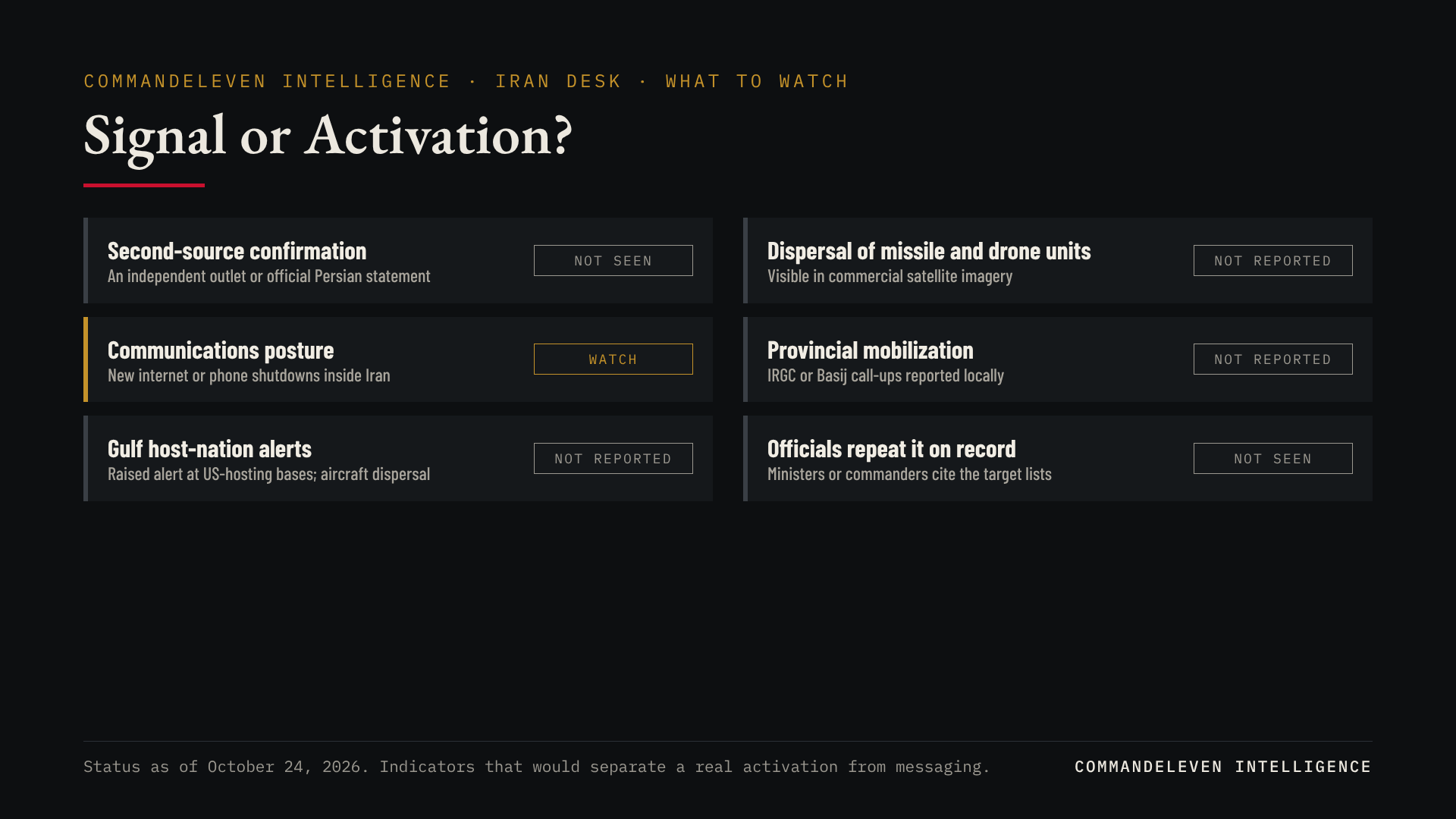
Indicators that would separate a real activation from messaging:
- Confirmation from a second, independent source, or an official statement in Persian.
- Dispersal of missile and drone units away from known bases, visible in commercial satellite imagery.
- Changes in Iran’s internet and communications posture, including new shutdowns, which would make delegated command operational rather than theoretical.
- IRGC or Basij mobilization at provincial level, reported locally.
- Gulf host-nation responses: raised alert levels at US-hosting bases, dispersal of aircraft, or new warnings to citizens.
- Repetition by senior officials. If commanders or ministers repeat the target-list language on the record, the signal is deliberate.
Dated Calls
These calls will be registered on the Foresight Record and scored on the dates given.
- By November 3, 2026: No joint US-Israeli strike on Iran takes place. [ASSESSED]
- By November 15, 2026: No independent outlet or government confirms the October activation order or the target lists in specific terms. [ASSESSED]
- Through December 31, 2026: If strikes on Iran resume, Iranian retaliation includes strikes from more than one provincial command within the first 72 hours, and at least one strike on a US-linked economic or political site in the region. [ASSESSED, conditional]
What This Assessment Does and Doesn’t Establish
- It establishes that the activation report exists, where it came from, and that the command structure it describes is real and has been used before.
- It does not establish that the order was given, what authority it grants, or what the target lists contain.
- It does not describe targets, weapons employment or operational detail. In line with CommandEleven Intelligence editorial policy, it stays at the level of doctrine, signaling and risk.
- It is a snapshot. It will be updated when confirmation arrives or fails to.
Frequently Asked Questions
Has Iran activated a “Dead Hand”?
Not in the sense the phrase implies. The reports describe regional IRGC commanders being given wider authority to keep fighting if Tehran is cut off, not an automatic retaliation system. The order itself has not been independently confirmed.
What is Iran’s Mosaic Defense?
A doctrine developed from 2005 and implemented in 2008 that splits the IRGC into 31 provincial commands with their own weapons, intelligence and Basij forces, so the country can keep fighting if its central leadership is killed.
Why does the timing matter?
The report surfaced two weeks before the US midterms, after reports that an Israeli strike planned for October 10 was called off over President Trump’s opposition. CommandEleven Intelligence assesses it as at least partly a deterrence message aimed at that window.
Does this make war more likely?
It makes a war, if one starts, harder to end quickly and easier to escalate by mistake. It does not by itself make a strike more likely.
Related Reading
- The Makkah Pact’s First Test: Operation Yemen Dawn, Pakistan’s Role, and Iran’s Shrinking Map – Part 1
- IRGC Sleeper Cells in the United States: Intelligence Compilation
- Iran’s Underground Missile City: What Tehran Showed, What We Can Verify, and the Signal to U.S. Bases in Europe
- Iran’s Mosaic Defense: Asymmetric Warfare and Internal Security
Sources
- Times of Israel, Netanyahu planned attack on Iran earlier this month, but Trump opposed it – report
- Israel Hayom, Netanyahu pushed to resume strikes on Iran; Trump blocked offensive ahead of US midterms
- Naked Capitalism, Iran War: Iran Believes Attack Imminent
- Ynet, Iran: Target bank updated – will aim at U.S. and Israeli assets, not just military targets
- Al Jazeera, The ‘Fourth Successor’: Iran’s plan for a long war with the US and Israel
- Small Wars Journal, Mosaic Defense and Dispersed Command: Iran Strikes Back
- Wikipedia, Mosaic defence strategy