Status as of November 18, 2026. This is the introduction to the Gulf at War series, which has three parts. Our assessment draws on our own reporting since February, primary sources and the IISS Strategic Dossier The Gulf at War (October 2026). IISS judgments are attributed to IISS.
Bottom Line Up Front
Since the US-Israeli strikes of February 28, 2026, Iran has fired more than 6,000 guided weapons at twelve countries, and the six Gulf states took most of them. They absorbed the fire with few deaths and large economic damage, and none of them controls the outcome. Their security still rests on a US that has proved both indispensable and unreliable, on air defenses that are national rather than regional, and on an economy whose export route runs through a strait they do not control.
This series asks three questions: who stands with whom (Part 1), whether the Gulf can defend itself (Part 2), and whether it can pay for the war (Part 3). The assessment is ours. IISS is one source among several, and where we agree or differ we say so.
A Disclosure Readers Are Owed
CommandEleven Intelligence’s Executive Director, Syed Khalid Muhammad, has publicly and repeatedly criticized the US-Iran War on Survival Dispatch News and Soft Targets America. His position is that the war was a catastrophic effort undertaken on behalf of the Trump administration, that it should have been handled differently, and that it should not have been conducted start-stop. We say this so no reader mistakes our analysis of the Gulf for support of the administration’s war. It also marks a point where we part from IISS: IISS attributes the war’s launch in part to Israeli pressure on Washington, and we do not adopt that attribution.
Key Judgments
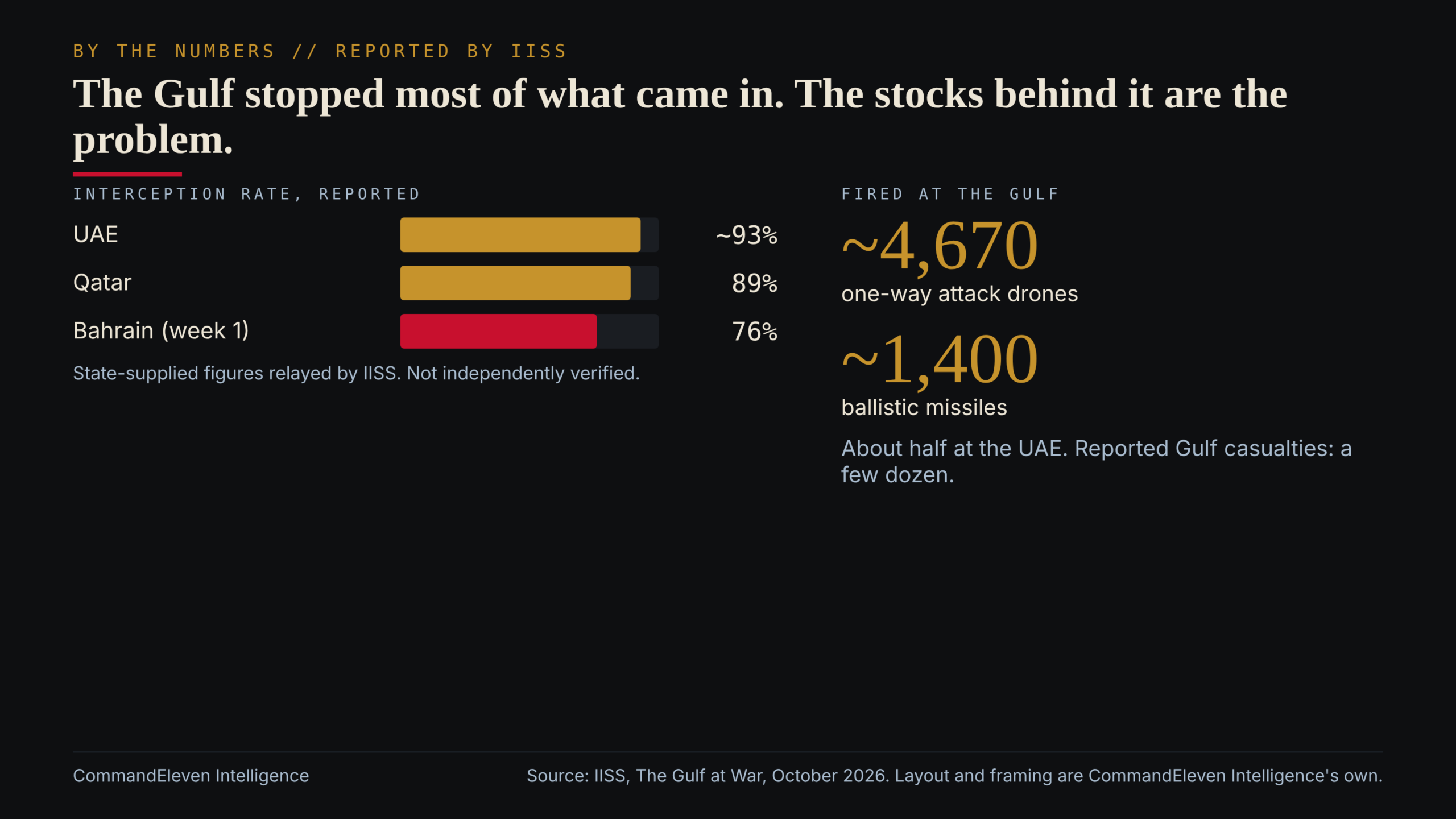
- REPORTED. The war reached every Gulf state, and the damage was economic more than human. IISS counts about 4,670 one-way attack drones and 1,400 ballistic missiles fired at Gulf targets, roughly half at the UAE. Reported Gulf casualties are in the “few dozen” (UAE: 3 military, 10 civilian), and those figures are state-supplied.
- REPORTED. Gulf air defense worked nationally and failed regionally. Reported interception rates were high (UAE about 93%, Qatar 89%, Bahrain 76% in the first week), but each state defended itself from its own stocks. ASSESSED: MODERATE. The exchange ratio between cheap drones and expensive interceptors is the Gulf’s real vulnerability.
- ASSESSED: MODERATE. The Gulf’s trust in the US has changed shape, not ended. Washington struck back, lost 3 of its 8 THAAD batteries by IISS’s count, and approved more than $50 billion in arms sales from March to August. Its Gulf hosts also saw forces dispersed and Israel served first on interceptors. On November 10, Trump said he was holding off new strikes at the request of Gulf neighbors. That is his account, and the Gulf governments have not said it themselves.
- ASSESSED: MODERATE. The Gulf is splitting into blocs. Saudi Arabia, Pakistan, Turkey and Qatar are knitting into a defense architecture around the Makkah pact of August 7, while the UAE leans toward India and its own bilateral deals. A possible quiet UAE-Iran détente after the May 4 Fujairah strike is ALLEGED, and the UAE denies it.
- REPORTED. The bill is large and will keep arriving. IISS has World Bank growth for the Gulf falling from 4.4% to 1.3%, greenfield foreign investment down by half, and 17% of Ras Laffan’s capacity out for up to five years. Our own November 15 reading has Hormuz transits about 65% below pre-war.
- NOT ESTABLISHED. Casualty totals, any damage at the Barakah nuclear plant, and any transfer of funds between the UAE and Iran.
Where We Stand on the Record
This is the centerpiece, and it is a ledger of our own calls, misses included. A series that asks you to trust our read of the Gulf should first show how our reads of this war have held up. Verdicts follow the Foresight Record vocabulary, and the full audits are linked in each row.
| Call | Where we made it | What happened | Verdict |
|---|---|---|---|
| Iran would fight a war of horizontal escalation, with Gulf infrastructure and Hormuz as its main weapon | The Pre-War Iran Debate, Scored and the Doctrine series | Iran struck Gulf infrastructure across the region and throttled Hormuz | CONFIRMED |
| A decentralized shadow supply chain would survive interdiction | Iran Foresight Audit (claims IRN-SC-01, 02) | The network persists | CONFIRMED |
| The IRGC would escalate and sustain attritional tempo | Iran Foresight Audit (IRN-SD-04) | Escalation resumed in September and held | CONFIRMED |
| Electronic warfare and spectrum control would be central | Iran Foresight Audit (IRN-EW-01) | Jamming and spoofing were central, though some techniques named are unproven | PARTIALLY CONFIRMED |
| Cheap drones would force costly interceptor expenditure | Iran Foresight Audit (IRN-SD-02) | Held in direction; IISS adds the stock-depth detail we lacked | PARTIALLY CONFIRMED |
| Sanctions deadlines would be missed and the blockade would do the real work | Economic D-Day scorecard | Six calls scored: 2 confirmed, 1 partial, 1 unresolved, 2 not confirmed | MIXED |
| China-Iran supply and veto calls | China-Iran War Calls audit | Ten calls: 4 confirmed, 1 partial, 4 unresolved, 1 not borne out (rare-earth veto) | MIXED |
| The Fujairah bypass would shift the Gulf’s exposure | Garrison State, Part 3 | Outcome still open | NOT YET RESOLVED |
| “No US strikes before November 3” | Status Brief, October 14 | US struck Qeshm on November 2; the President confirmed strikes on Qeshm air defenses on November 6 | NOT CONFIRMED |
| “No US-acknowledged strikes by December 15” | Iran War Update: Task Force Iron Gate, November 10 | The strike acknowledged on November 6 predates the call | NOT CONFIRMED |
| Iran operates in the gray zone and its resilience deters large-scale direct state engagement | July doctrine series | A direct state war was already under way when we wrote it | NOT CONFIRMED |
| Blinding radars and command nodes would force a “blind response” | July doctrine series | Not borne out by the dated record | NOT CONFIRMED |
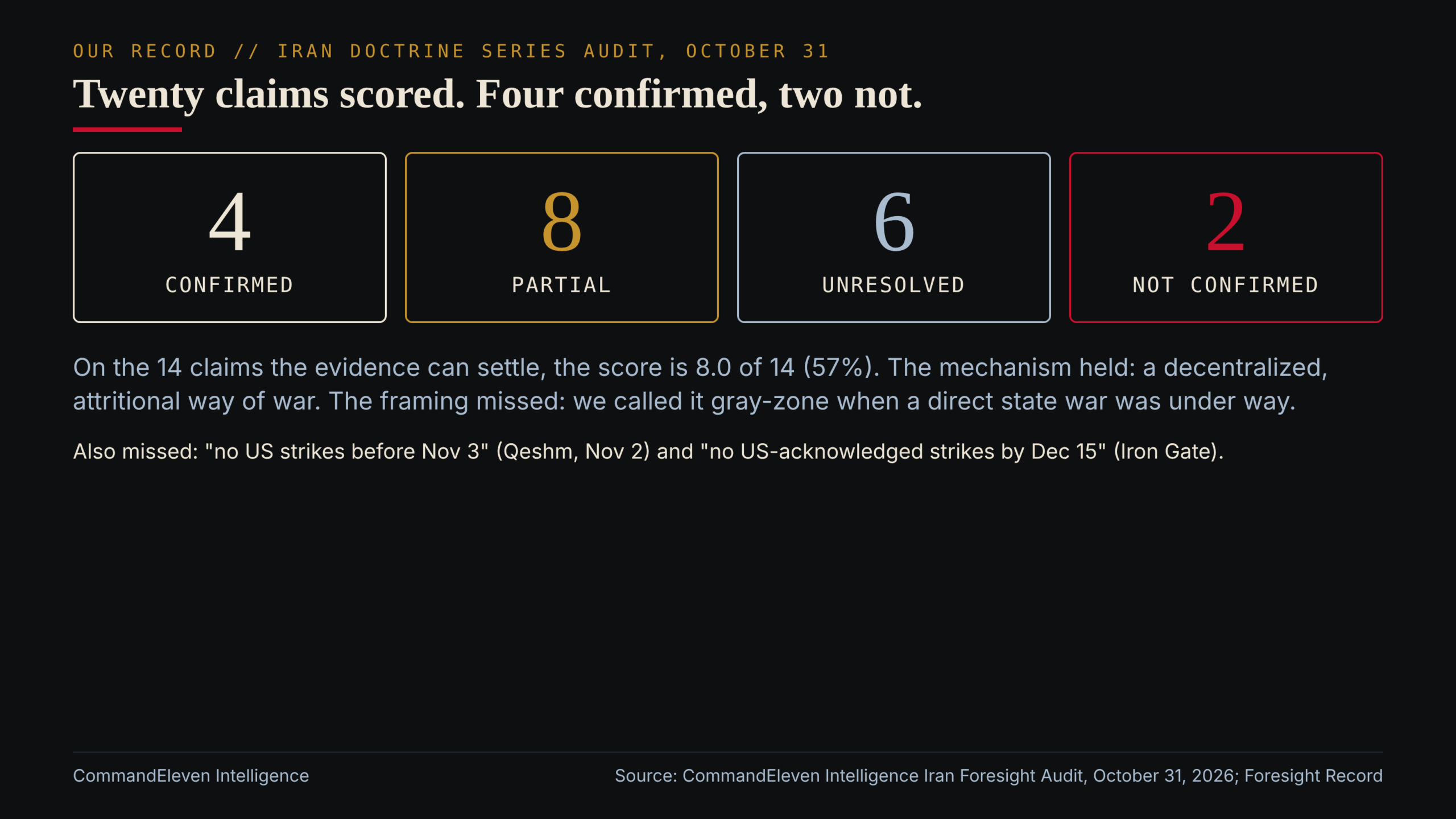
The pattern is plain. We called the mechanism right: a decentralized, attritional way of war with Hormuz as the main weapon. We called some of the framing and the timing wrong. The July doctrine series audit scores 4 of its 20 claims confirmed, 8 partially, 2 not confirmed and 6 unresolved, which is 57% on the 14 claims the evidence can settle. We also under-weighted the Mahan Air air bridge as the main China-Iran channel in our dossiers, though we flagged it on air, and we called the China channel “virtually interference-proof,” which overstated it.
One date we are correcting
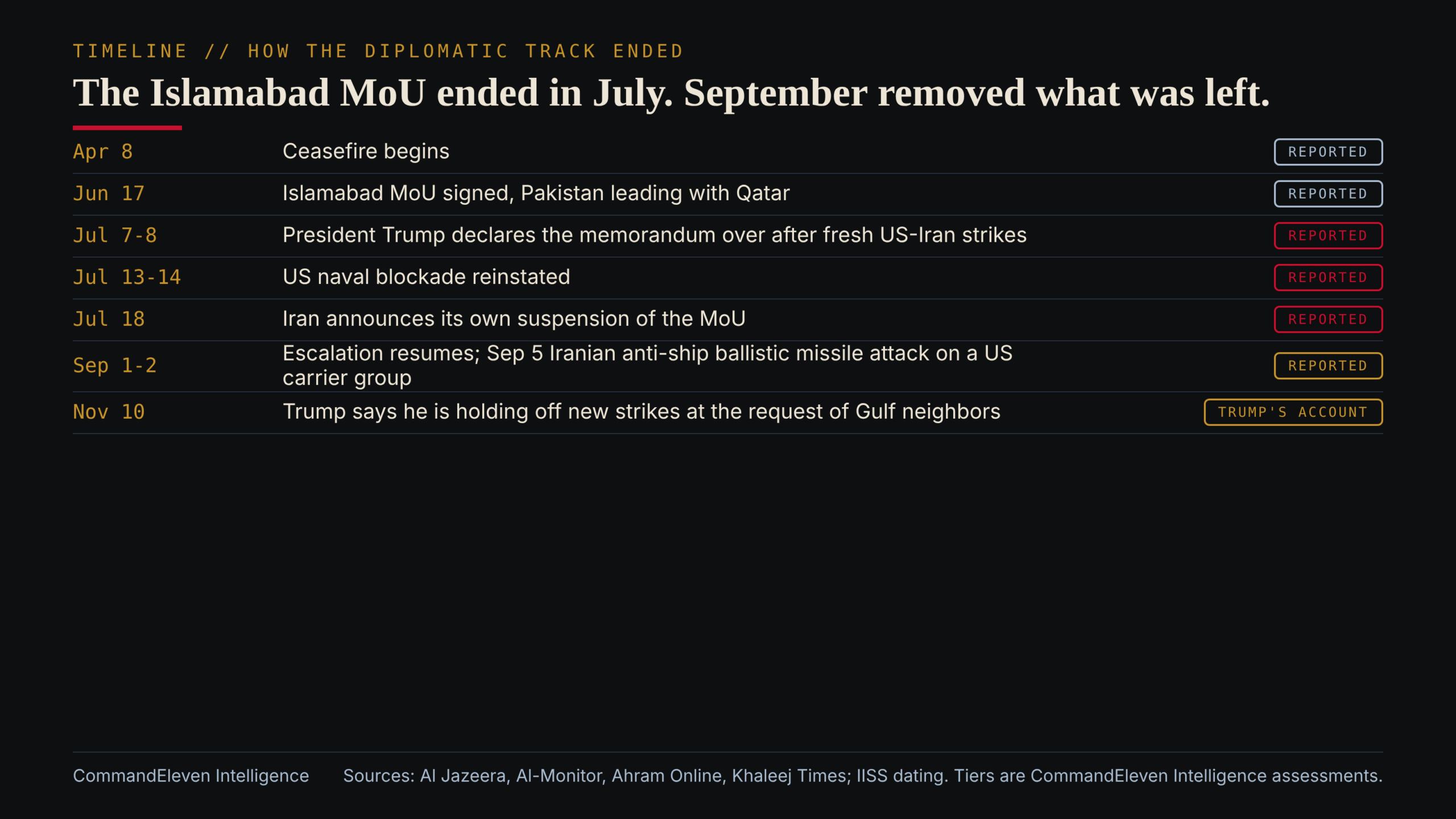
Garrison State, Part 3 said the Islamabad memorandum collapsed over navigation in September. The dated record puts its effective end in July. President Trump declared the memorandum over on July 7 and 8 after fresh US-Iran strikes, the US blockade was reinstated on July 13 and 14, and Iran announced its own suspension on July 18. September is when the last of the diplomatic track went, with the escalation of September 1 and 2 and the Iranian missile attack on a US carrier group on September 5. We are adding a correction note to Part 3 and carrying the dating through this series.
What Is Established
- The ceasefire began April 8. The Islamabad MoU, led by Pakistan with Qatar, was signed June 17. The US blockade began April 13, was suspended June 18 and was reimposed in mid-July, as reported by IISS and the wires.
- Pakistan keeps close to a brigade in Saudi Arabia at all times. The new element in 2026 was the Yemen rollout in August, which our Pakistan Army sources date to that month. IISS reports about 8,000 Pakistani troops in the kingdom from April, and Pakistani and Turkish forces deployed in October under the Makkah agreement.
- Our Qeshm reporting concerned Iranian air-defense systems struck after US fighter jets were fired on. We did not report desalination damage, and IISS treats a claim of that kind as likely disinformation.
- The Barakah nuclear plant appears on IISS’s list of attacks. The UAE denies damage, and we treat the claim as ALLEGED.
Why It Matters
If the Gulf cannot defend itself or fund a long war, three things follow. The US must stay and pay, which is the dependence this war exposed. Gulf rivalries turn into security problems. And the strait, not the battlefield, sets how long this lasts.
What Would Change Our View
- A funded, jointly commanded regional air-defense architecture.
- Hormuz traffic back above 80% of pre-war levels.
- A durable Gulf-Iran understanding that survives a US escalation.
What To Watch
- Interceptor deliveries and the Gulf share of Patriot stocks.
- Hormuz transits and war-risk premiums.
- The Makkah pact secretariat in Riyadh and Saudi-Houthi front lines.
- UAE-Pakistan debt terms.
- Whether Gulf governments confirm, or contradict, Trump’s account that they asked him to hold off.
Calls We Will Score
- By January 31, 2027: Hormuz transits remain below 50% of the pre-war monthly average in the IEA and Kpler series.
- By March 31, 2027: No GCC state announces a jointly funded, jointly commanded regional air-defense system. We expect national and bilateral deals only.
- By June 30, 2027: The UAE and Saudi Arabia do not issue a joint defense statement of the kind the Makkah pact members have issued.
What This Assessment Does and Doesn’t Establish
- It does not establish casualty totals, Barakah damage, any Iran-UAE funds transfer, or why Washington chose to strike when it did.
- IISS’s political attributions are IISS’s own. Ours are marked as ours.
- Interception rates and casualty counts are state-supplied figures relayed by IISS, and we have not verified them.
- Trump’s statement about Gulf requests is his own account.
Frequently Asked Questions
Is this a summary of the IISS dossier?
No. IISS is one source. The judgments are ours, and we say where they differ.
Why publish your misses?
A record that shows only hits cannot be trusted. Our scoring is public in the Foresight Record.
Why does the Executive Director’s criticism of the war appear here?
Readers should know our analysis of the Gulf is not an endorsement of the administration’s war.
When did the Islamabad MoU collapse?
The dated record puts its effective end in July. The diplomatic track was finished off in September.
Related CommandEleven Intelligence Reading
- Iran War Doctrine and Strategy: A Six-Part CommandEleven Intelligence Series
- The Makkah Pact: A CommandEleven Intelligence Series
- The Pre-War Iran Debate, Scored
- Iran Foresight Audit
- Hormuz Shipping Is Still 65% Below Pre-War
- Turkey and Qatar Sign a Mutual Defense Pact
- Trump Says New Iran Strikes Are “Quite Unlikely”
- The Garrison State: Fujairah, Part 3
Sources
- IISS: The Gulf at War: Strategic, Security and Geo-economic Dimensions, Strategic Dossier (Oct 2026)
- IISS: Changing partnerships between the Gulf and South Asia (Nov 2026)
- Al Jazeera: Trump says ceasefire “over” after US and Iran trade attacks (July 8, 2026)
- Al-Monitor: Trump declares MOU with Iran over (July 2026)
- Ahram Online: Trump says US reinstates Iran blockade (July 2026)
- Khaleej Times: Trump says Qatar, UAE, other Gulf allies prefer status quo, to keep up Hormuz blockade (Nov 10, 2026)
Assessments and confidence tiers are CommandEleven Intelligence’s own. We do not reproduce third-party text or graphics. Figures attributed to IISS are IISS’s, summarized.