CommandEleven Intelligence · Iran Desk and Foresight Record. Foresight Audit, status as of October 26, 2026.
Bottom Line Up Front
In the four weeks before the US and Israel struck Iran on February 28, 2026, the argument over whether to go to war produced dozens of predictions. Eight months on, they can be checked. This audit scores 18 specific calls from six widely read pieces published between January 31 and March 2026, from writers on both sides of the debate.
The pattern is clear. The analysts who described how Iran would fight were mostly right. Iran retaliated across several countries, hit Gulf infrastructure, used the Strait of Hormuz as its main weapon, and settled in for a long war it measured by survival. The predictions about politics were mostly wrong on both sides. Public opinion did not stop the war, the hoped-for collapse of the regime did not come, and the confident claim that Washington would soon have to back down has not happened either.
With a new round of strikes openly discussed in Washington, the record of the first round is the best guide available to the second. These are other people’s calls, so they are not counted in CommandEleven Intelligence’s own totals on the Foresight Record.
How This Audit Works
- Only specific calls are scored. Statements of values (“intervention backfires”) and general warnings are left out.
- Each call is quoted or closely paraphrased from the dated original and scored against what happened, using the Foresight Record scale: CONFIRMED, PARTIALLY CONFIRMED, NOT CONFIRMED or NOT YET RESOLVED.
- The evidence base is CommandEleven Intelligence’s war reporting, including the monthly Iran War Status Brief, and the public record cited there.
The Scorecard
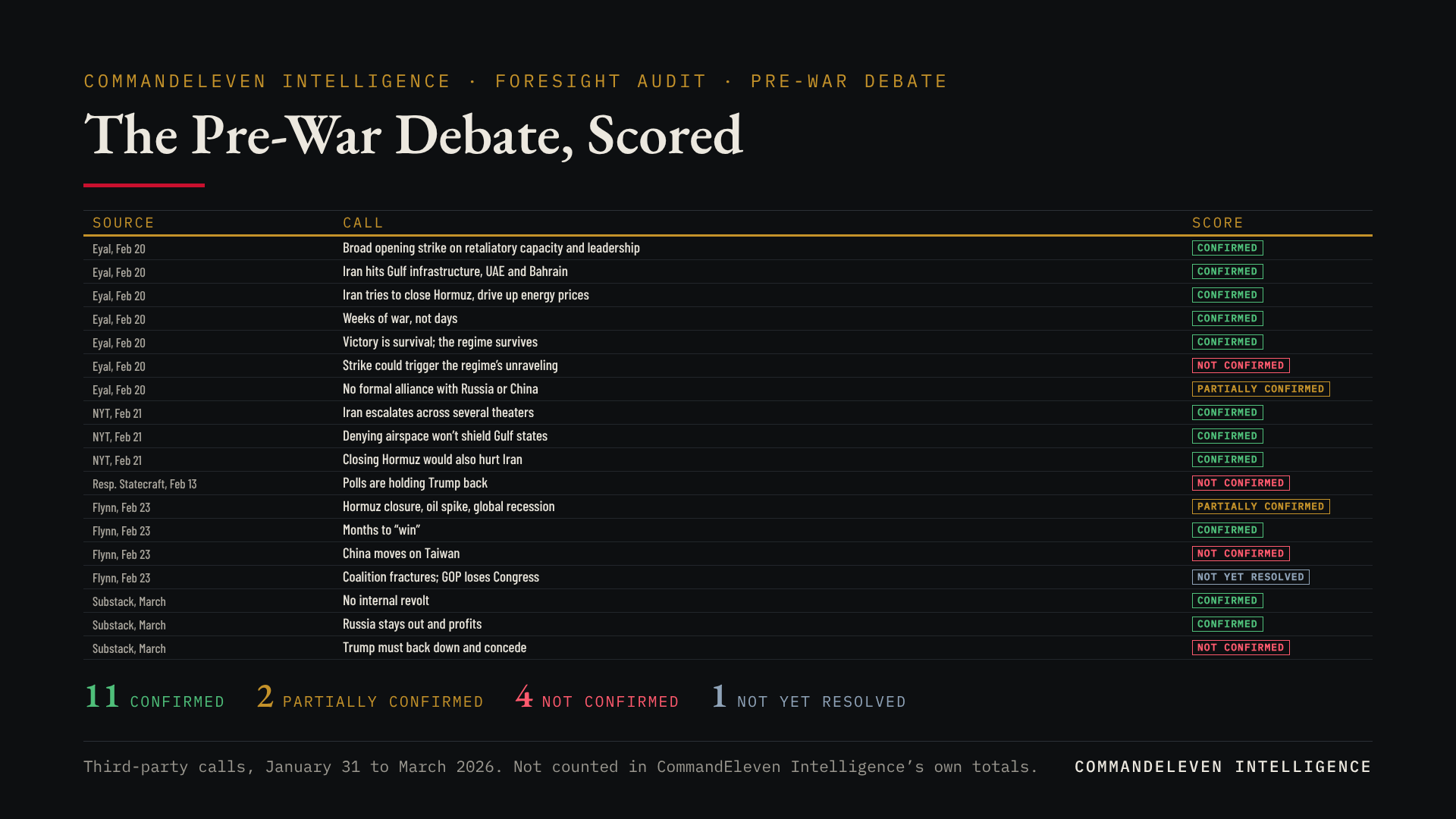
| Source | Call | Score |
|---|---|---|
| Nadav Eyal, Feb 20 | A broad US strike aimed at Iran’s retaliatory capacity and leadership in the opening hours | CONFIRMED |
| Nadav Eyal, Feb 20 | Iran hits Gulf energy and infrastructure, the UAE and Bahrain in particular | CONFIRMED |
| Nadav Eyal, Feb 20 | Iran tries to close Hormuz and drive up energy prices | CONFIRMED |
| Nadav Eyal, Feb 20 | A conflict of weeks, not days | CONFIRMED |
| Nadav Eyal, Feb 20 | For Tehran, victory is survival, and the regime survives | CONFIRMED |
| Nadav Eyal, Feb 20 | A large strike could trigger change inside the regime, or its unraveling | NOT CONFIRMED |
| Nadav Eyal, Feb 20 | No formal alliance with Russia or China | PARTIALLY CONFIRMED |
| NYT (Vakil, Vaez), Feb 21 | Iran escalates across several theaters to spread the pain | CONFIRMED |
| NYT, Feb 21 | Gulf states’ refusal of airspace will not shield them | CONFIRMED |
| NYT (Vaez), Feb 21 | Closing Hormuz would also badly hurt Iran | CONFIRMED |
| Responsible Statecraft, Feb 13 | Poor polling is holding Trump back from a strike | NOT CONFIRMED |
| Michael Flynn, Feb 23 | Iran closes Hormuz, spiking oil prices toward a global recession | PARTIALLY CONFIRMED |
| Michael Flynn, Feb 23 | It may take months to “win” | CONFIRMED |
| Michael Flynn, Feb 23 | China moves against Taiwan while US forces are tied down | NOT CONFIRMED |
| Michael Flynn, Feb 23 | Trump’s coalition fractures and Republicans lose Congress | NOT YET RESOLVED |
| Anonymous Substack, March | No internal revolt in Iran | CONFIRMED |
| Anonymous Substack, March | Russia stays out and profits from higher energy prices | CONFIRMED |
| Anonymous Substack, March | The only endgame is Trump backing down and making concessions | NOT CONFIRMED |
Totals: 11 confirmed, 2 partially confirmed, 4 not confirmed, 1 not yet resolved.
What the Debate Got Right
How Iran would fight. Nadav Eyal’s February 20 piece, written from Israel as US forces massed, is the most accurate of the six. He expected a broad opening strike that included Iran’s command, which is what the February 28 decapitation strikes delivered. He expected Iran to answer outside Israel too, naming the UAE and Bahrain, both of which were hit in March, including two Amazon Web Services data centers in the UAE. He expected an attempt to close Hormuz and drive up energy prices; Iran moved to shut the strait within days of the first strikes, tanker attacks around it hit a wartime record in early October, and Brent has traded above $100. And he wrote that “for the regime, victory is survival.” Eight months later the regime is intact and rebuilding.
That the pain would be spread. Sanam Vakil of Chatham House told The New York Times that Tehran’s strategy was “to quickly escalate and export instability in multiple theaters.” That held across the Gulf, Oman, shipping lanes and, through the Houthis, Saudi Arabia. Ali Vaez warned that closing Hormuz would be “like bringing down the roof on its head” for Iran. The US blockade has since cut Iranian oil afloat outside the blockade line to zero.
That there would be no uprising. The March essay that called the war “a complete disaster” argued that bombing would rally Iranians around the state and that “there will be no internal revolt.” There has been none on any scale.
What the Debate Got Wrong
The polls. Responsible Statecraft argued on February 13 that public opposition, with only 21 percent in favor of an attack, must be what was staying Trump’s hand. The strikes began 15 days later. Polls did not decide the war, although the midterm calendar has since shaped its timing.
Regime change. The optimistic case, set out by Eyal as a possibility and pressed by others in Washington and Israel, was that a heavy enough blow could break the regime or trigger change from within. It did not.
A quick US climbdown. The “complete disaster” essay concluded that “the only plausible endgame is Trump eventually backing down and making concessions.” Eight months on, there has been an interim memorandum in June, but the blockade remains, Trump rejected Iran’s September offer to reopen Hormuz, and Washington is discussing a second round of strikes. The essay was right about the costs, and wrong so far about who would blink.
A second front in Asia. Michael Flynn warned that China might move on Taiwan while US forces were concentrated in the Gulf. It has not.
Still Open
Flynn’s warning that a war would fracture Trump’s coalition and cost Republicans Congress will be tested on November 3. It will be scored after the results.
What It Means for Round Two
[ASSESSED, moderate confidence] The calls that held were about Iranian behavior; the calls that failed were about American and Iranian politics. That is the right lens for the next round. If strikes resume after November 3, the first round’s record points to the same pattern: retaliation spread across Gulf states, pressure on shipping and energy, and a regime that measures success by surviving. Iran has added explicit threats against Gulf undersea cables and data centers, which we set out in The Strike Clock.
What This Audit Does and Doesn’t Establish
- It establishes how 18 specific pre-war calls compare with eight months of the war.
- It does not score CommandEleven Intelligence’s own calls; those are in the China-Iran audit, the Economic D-Day audit and the Foresight Record.
- It does not endorse the arguments for or against the war; it scores predictions, not positions.
Frequently Asked Questions
Who predicted the Iran war best?
Of the six pieces audited, Nadav Eyal’s February 20 analysis was the most accurate: five of his seven scored calls were confirmed, one partially.
Did anyone predict that Iran’s regime would survive?
Yes. Eyal wrote that for Tehran “victory is survival,” and a March essay predicted there would be no internal revolt. Both held.
Were the polls right that Americans opposed the war?
The polls were accurate about opinion, but the prediction that opinion would stop a strike was wrong. The war began on February 28.
Are these calls counted in the CommandEleven Intelligence Foresight Record?
No. They are other analysts’ calls. They are published as a separate audit and do not change our totals.
Sources
- Nadav Eyal, Between Us, What Iran Might Do in War, February 20, 2026
- The New York Times, Abdi Latif Dahir and Samuel Granados, Why Attacking Iran Could Be Riskier Than Capturing Maduro, February 21, 2026
- Michael T. Flynn, A Decision Which Could Change Our World, February 23, 2026
- ZeroHedge (American Greatness), Josiah Lippincott, Seven Reasons Not To Bomb Iran, January 31, 2026 (reviewed; no specific calls scored)
- Responsible Statecraft, Jack Hunter, “Trump hasn’t bombed Iran yet. He must be reading these polls,” February 13, 2026
- Anonymous Substack essay, “This is Becoming a Complete Disaster,” March 2026
- CommandEleven Intelligence, Iran War Status Brief: October 2026