
CommandEleven Intelligence // Iran Desk. Status as of October 26, 2026. A follow-on to our October 24 flash assessment, Iran’s ‘Dead Hand’ Is a Chain of Command, Not a Machine.
Update, October 26: Israel’s Channel 12 reported that IDF Chief of Staff Eyal Zamir resisted an instruction from Prime Minister Netanyahu to carry out an unspecified Iran-related military action before the October 27 election, demanding cabinet discussion and signed legal authorization. Netanyahu called the report “nonsense.” [SINGLE-SOURCE] The report raises the risk of an Israeli move on Iran independent of the US timetable.
Bottom Line Up Front
The question in Washington is no longer whether to strike Iran again but when. US officials told reporters it is a matter of “when, not if.” The Pentagon has had options for a short, intense campaign against Iran’s missiles, drones, energy facilities and Revolutionary Guard headquarters since early October. On October 23, Washington reportedly warned Iraq’s prime minister that strikes could come. President Trump said on Sunday there would be no strike “today,” and framed his choice as making a deal or finishing Iran off.
Tehran’s answer is to threaten the things the Gulf economy runs on. Two senior Iranian security officials told Reuters that Iran has plans to cut undersea internet cables in the Gulf, stop them being repaired, and hit US-linked data centers and AI facilities if the war resumes. One said there would be “no more red lines.” Iran has already shown it can reach Gulf data centers: two Amazon Web Services facilities in the UAE were struck by drones in March.
The calendar points past November 3. Israel votes on October 27 and the US on November 3, and reported options are built for after the US vote. [ASSESSED] We hold our October 24 call that no joint US-Israeli strike takes place before November 3, with lower confidence than a week ago.
Key Judgments
- [CONFIRMED] US strike options exist and have been briefed. Reporting from Axios, The New York Times, The Atlantic and The Hill describes a campaign of about three days against missiles, drones, energy infrastructure and IRGC command sites, ready within days of an order.
- [SINGLE-SOURCE] The warning to Iraq rests on one report, from Kurdish Channel 8, that Washington cautioned Prime Minister Ali Faleh al-Zaidi on October 23 and that he told armed factions not to interfere. It has not been confirmed by either government.
- [CONFIRMED] Iran’s threat now explicitly includes civilian digital infrastructure. Security chief Mohsen Rezaei warned on October 13 that cables, data centers and AI facilities could be attacked; two senior officials repeated it to Reuters on October 23.
- [ASSESSED, moderate confidence] The cable threat is a deterrent aimed as much at Gulf capitals as at Washington. Its value to Tehran lies in making the Gulf’s reliability a bargaining chip, not in any single cut.
- [ASSESSED, moderate confidence] If strikes resume, the most likely Iranian responses are against shipping, Gulf energy and digital infrastructure, and US bases, delivered through the dispersed command structure described in our Dead Hand assessment. Cutting cables is within reach; keeping them cut depends on stopping repairs.
- [EXCLUDED] This brief does not assess cable routes, landing sites or vulnerabilities in operational detail.
Where the Strike Planning Stands
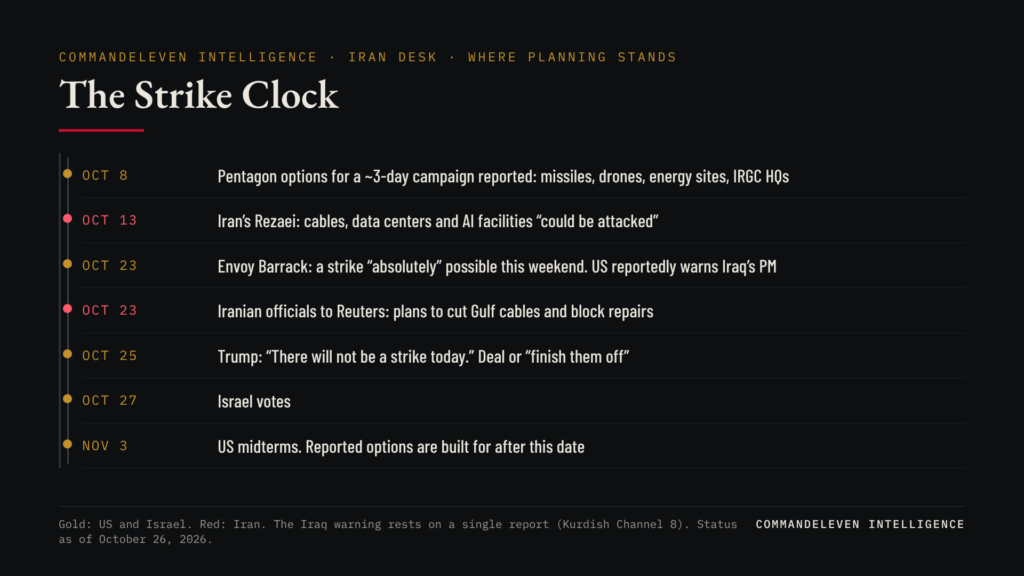
- October 8: The New York Times and Axios reported that the Pentagon had drawn up options for a campaign of about three days against Iran’s missile and drone arsenal, energy facilities and IRGC command posts. Vice President JD Vance chaired a review of the options. Trump said he would not attack before the midterms.
- Mid-October: A third US carrier group was expected in the region by late October, which would be the first three-carrier presence since 2003.
- October 23: Tom Barrack, US ambassador to Türkiye and special envoy for Syria and Iraq, said the US could “absolutely” strike as soon as that weekend. Trump said he knew nothing about it. The same day, Kurdish Channel 8 reported that Washington had warned Iraq’s prime minister of possible strikes.
- October 24–25: Trump said there was “a possibility I will” and “a possibility we’ll have a nice big beautiful agreement.” On Sunday he said “There will not be a strike today,” urged Israelis to vote for Netanyahu so the two countries could “finish the job,” and said the choice was “Do I make a deal with them or do I finish them off?” Qatari mediators were in Tehran the same day.
- October 25: US officials told The Jerusalem Post a joint strike was a question of “when, not if.” The Hill reported CENTCOM options built for after November 3.
- Iraq: Iraqi officials are investigating a series of October explosions at armed-faction weapons stores in Baghdad, which some suspect were Israeli strikes. The government has not assigned responsibility.
[ASSESSED] Three things point to a strike after November 3 rather than before: Trump’s public commitment to wait, the Israeli election on October 27, and the reported design of the options. Three things argue for caution: the carrier build-up, Barrack’s remarks, and the fact that Trump has reversed himself on timing more than once.
Iran’s Threat to Cables, Data Centers and Economic Targets
What Iran has said.
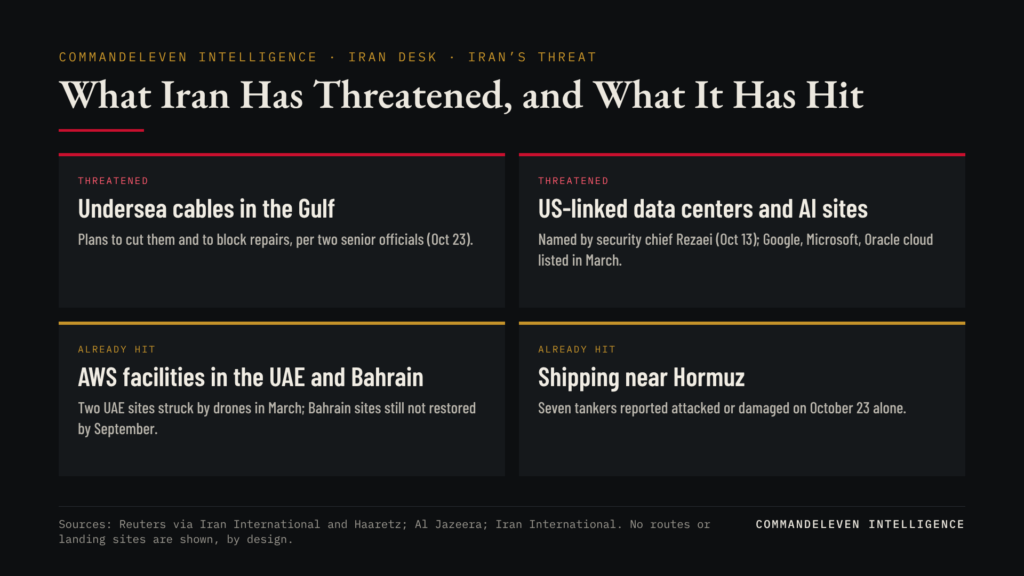
- March 11: Tasnim reported an IRGC list of “new targets” that included the cloud infrastructure of Google, Microsoft and Oracle in Israel and some Gulf states. An IRGC Telegram post named 17 US firms and the Emirati AI company G42.
- October 13: Mohsen Rezaei warned that “cables, data centres and artificial intelligence facilities across the region could be attacked” if the war resumes.
- October 23: Two senior Iranian security officials told Reuters that Tehran has plans to target undersea cables in the Gulf, to prevent their repair, and to hit US-linked data centers and AI facilities. One said: “If Iran is attacked, there will be no more red lines … from undersea cables to military bases, including covert ones.”
What Iran has already done. In March, drones struck two AWS facilities in the UAE, and a strike near an AWS site in Bahrain caused physical damage. By September, AWS had still not restored several Bahrain sites. Seven tankers were reported attacked or damaged in or near the Strait of Hormuz on October 23 alone.
Why it matters. More than 90 percent of data traffic between Europe and Asia runs through cables under the Red Sea, and the Gulf’s own data centers serve banks, governments and the AI build-out the UAE and Saudi Arabia have staked their economies on. A strike does not need to destroy servers: as Andreas Krieg of King’s College London told Al Jazeera, cutting power, cooling or telecoms can be enough. Repairs in a war zone require permits and safety guarantees, which is why Iran’s stated plan to block repairs matters more than the cut itself.
[ASSESSED, moderate confidence] The threat is credible in part. Iran has shown it can hit data centers with drones. Its claim to have “full access” to the cables and to be able to “easily destroy them” comes from an anonymous official and is not independently established. The precedent from the Red Sea in 2024 is that cable damage, even accidental, takes months to repair.
The financial system. Attacks on digital infrastructure reach banking directly. During the March disruption, Abu Dhabi Commercial Bank’s app was unavailable, though the bank did not link the outage to the strikes. [DATA DEFICIT] Claims circulating on social media of a coordinated AI cyberattack on major US banks this month have not been confirmed by any bank, regulator or government, and are not used here.
How This Connects to Our Earlier Calls
On October 24 we set out six escalation paths if Iran’s regional commanders hold wider authority. The cable and data-center threats fall under two of them: escalation across the Gulf, and attacks on energy and shipping. Our three dated calls stand:
- By November 3: No joint US-Israeli strike on Iran. Holding, with reduced confidence.
- By November 15: No independent confirmation of the Mosaic Defense activation order. Holding.
- Through December 31: If strikes resume, retaliation from more than one provincial command within 72 hours, including a US-linked economic or political site. Conditional; open.
New Dated Calls
These calls will be registered on the Foresight Record.
- If US or Israeli strikes on Iran resume before December 31, 2026: Within seven days, at least one undersea cable serving the Gulf is reported damaged, or at least one Gulf data center is reported struck. [ASSESSED, conditional]
- By December 31, 2026: At least one major cloud provider announces new capacity outside the Gulf, or a shift of Gulf traffic to overland routes, citing regional security. [ASSESSED]
What to Watch
- The Israeli election on October 27 and the coalition it produces.
- Carrier movements: a third carrier group on station.
- Iraq: any official confirmation of the US warning, and militia statements.
- Gulf warnings: new travel advisories, shelter guidance, or data-center operators publishing resilience notices.
- Mediation: whether the Qatari channel produces a written offer before November 3.
What This Brief Does and Doesn’t Establish
- It establishes that US strike options exist, that Iran has explicitly threatened Gulf cables and data centers, and that Iran has already struck data centers once.
- It does not establish when or whether the US will strike, or that Iran can carry out every threat it has made.
- It does not describe cable routes, landing sites, or any operational detail of targeting by either side.
Frequently Asked Questions
Is the US about to attack Iran?
Strike options are ready, and officials describe a strike as “when, not if.” President Trump has said there will be no strike before the November 3 midterms, and has framed his choice as a deal or renewed strikes.
What has Iran threatened?
To cut undersea internet cables in the Gulf, block their repair, and strike US-linked data centers and AI facilities, as well as military bases, if the war resumes.
Has Iran attacked data centers before?
Yes. In March 2026, drones struck two Amazon Web Services facilities in the UAE, and a strike damaged AWS infrastructure in Bahrain.
Would cutting Gulf cables affect the rest of the world?
Yes. Cables in the Red Sea and Gulf carry most traffic between Europe and Asia, and repairs in a war zone can take months.
Sources
- Iran International (Reuters), Iran officials say they will target undersea cables if US strikes, October 23, 2026
- Haaretz (Reuters), Iran has plans to hit Gulf undersea cables if war resumes, officials say, October 24, 2026
- Al Jazeera, Iran threatens Gulf data centres: How exposed is the region’s internet?, October 13, 2026
- Iran International, Trump says US and Israel must ‘finish the job’, October 25, 2026
- Anadolu Agency, US envoy suggests Iran strikes possible this weekend, Trump says he’s unaware, October 23, 2026
- JFeed, US warns Iraq of potential airstrikes against Iran, October 23, 2026 (citing Kurdish Channel 8; single source)
- JFeed, US-Israel joint strike on Iran ‘when, not if,’ officials say, October 25, 2026
- investingLive, US commanders ready to hit Iran’s energy sites and missiles within days, October 8, 2026 (reporting The New York Times)
- The Week, Iraq probes Israeli role in explosion at secret warehouse in Baghdad, October 25, 2026
Related CommandEleven Intelligence Reporting
- Iran’s ‘Dead Hand’ Is a Chain of Command, Not a Machine
- Iran War Status Brief: October 2026
- Fortress and ‘Be Ready’: What the Pentagon’s 90-Day Plan and Britain’s Campaign Actually Say
- Critical Infrastructure at Risk: Communications – Part 4
- Black October: PHP2Shell and the Day the Web Went Dark on Purpose
- The Global Food Security Crisis