CommandEleven Intelligence · Cyber Threat Assessment. Status as of Thursday, October 22, 2026, about 13:00 UTC (H+23, where H-hour is the 14:00 UTC PHP emergency release on October 21). This is a fast-moving event; figures will change.
Key Judgments
- [CONFIRMED] Two remote code execution flaws in the PHP engine itself, collectively called PHP2Shell, let an attacker with no login run code on any web server running PHP 5.4 through 8.5 that has not been patched. Both are rated 9.2 on CVSS v4.0. Because the flaw sits below the application, a website can be fully exposed even if its own code is clean.
- [CONFIRMED] Exploitation began before the patch existed. Amazon recorded a first attempt on October 17, four days before disclosure. Cloudflare’s exploit-attempt counts climbed from thousands before the announcement to millions within a day. Amazon now describes PHP2Shell as broadly exploited.
- [CONFIRMED] The most visible damage so far is self-inflicted downtime. Governments in at least ten countries, along with ports, hospitals, banks, universities, political parties and major web platforms, took services offline as a precaution on the advice of the NSA, CERT-EU, the UK NCSC and national agencies. Every government shutdown reported so far has been described as precautionary.
- [CONFIRMED / DATA DEFICIT] As of H+23, no public source has named a confirmed breach victim or published a count of compromised organizations. Absence of confirmed victims is not absence of compromise.
- [ASSESSED, high confidence] The real damage is latent. Compromises made between October 17 and patch time, plus the large population of servers on end-of-life PHP that will never receive an official fix, will surface over weeks and months as data breaches, ransomware intrusions and botnet growth. This follows the Log4Shell pattern of 2021–2022.
- [ASSESSED, moderate confidence] Both criminal and state actors are exploiting PHP2Shell. No public attribution exists. The pre-disclosure exploitation from anonymized infrastructure indicates at least one actor had exploit knowledge while the flaw was still under embargo.
- [ASSESSED, high confidence] This will not collapse the internet. It will leave behind a permanent reservoir of compromised and compromisable servers on the long tail of the web, and it has exposed how much of the world’s public-facing digital infrastructure runs on software nobody is maintaining.
Black October Is Bigger Than PHP
“Black October” is the label social media and parts of the security press have given to a cluster of severe incidents in the second half of October 2026, of which PHP2Shell is the centerpiece. In the same window, LiteLLM disclosed that its release pipeline had been compromised and a malicious version published to public package registries; Railway paused deployments and told customers to rotate all secrets; Node.js shipped fixes for ten flaws; GitLab patched a maximum-severity (CVSS 10.0) unauthenticated remote code execution flaw in self-managed servers on October 12; and SonicWall patched a CVSS 10.0 flaw in its SMA 1000 appliances that attackers began exploiting within days.
ASSESSED: These incidents are not a single coordinated campaign. One analysis of the claim that “swarms” of autonomous AI agents are behind everything concluded there is no single actor. What they share is a common driver: AI-assisted vulnerability research is surfacing deep, old flaws faster than defenders can absorb them, and attackers are compressing the time from disclosure to mass exploitation toward zero.
The Core Problem: What Was Exploited
PHP2Shell is not a bug in WordPress, a plugin or a website’s code. It is a pair of memory-safety flaws in the PHP interpreter, the engine that runs PHP code on the server.
- CVE-2026-109618 involves memory corruption when the engine runs out of memory. On its own, it can also leak the contents of server memory, behavior researchers have compared to Heartbleed.
- CVE-2026-109619 involves request-owned internal state surviving after its memory has been freed, so that a later request handled by the same worker process can touch stale data before it is reset.
Chained together, the two give an unauthenticated attacker code execution on the server. The vulnerable code dates back to PHP 5.4, released in 2012, and every PHP setup that serves web requests is affected: PHP-FPM, Apache with mod_php, php-cgi, FrankenPHP and LiteSpeed. PHP rates mod_php setups as highest risk because a demonstrated exploit fires before any application code runs at all.
Why this matters strategically: For a decade, web security has been built on the assumption that if you keep your application and plugins patched, you are reasonably safe. PHP2Shell breaks that assumption. The trust boundary was in the runtime, beneath the layer most organizations monitor.
How It Was Identified
PHP2Shell was found through AI-assisted research by three groups working together: the security firm Calif, Wiz Research and OpenAI.
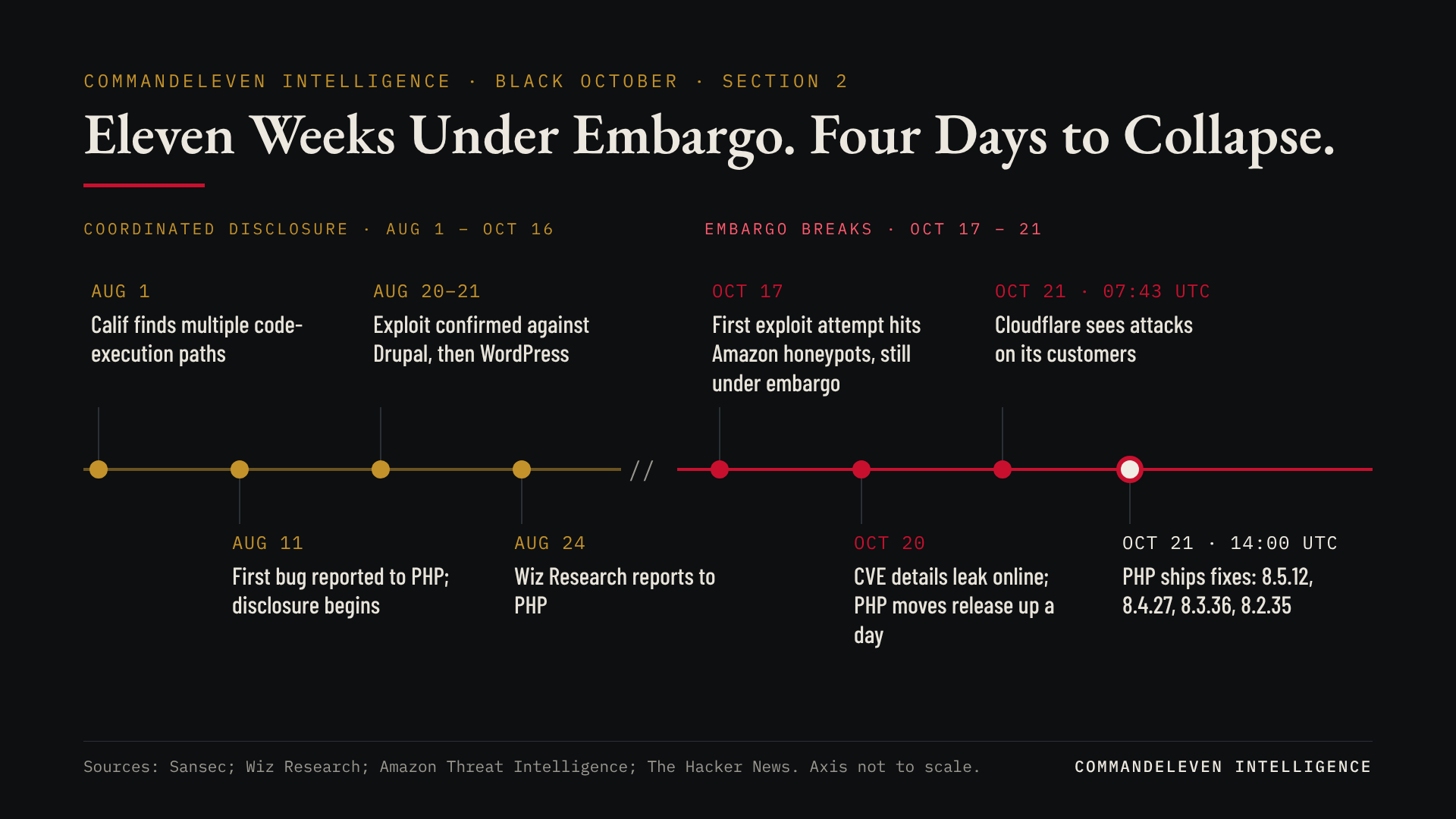
| Date (2026) | Event |
|---|---|
| August 1 | Calif finds multiple remote code execution paths |
| August 11 | Calif reports the first bug to PHP and starts coordinated disclosure |
| August 20–21 | Unauthenticated code execution confirmed against Drupal, then WordPress |
| August 24 | Wiz Research reports the vulnerabilities to PHP |
| October 17 | Amazon’s MadPot honeypot network records the first exploitation attempt, from a commercial anonymization network, while the flaw is still under embargo |
| October 20 | An anonymous Hacker News post leaks the CVE numbers and a planned October 22 disclosure; the post is removed but screenshots spread. watchTowr confirms the leak is genuine. PHP publishes an advance notice and moves the release up a day |
| October 21, 07:43 UTC | Cloudflare reports early attacks against its customers |
| October 21, 13:34 UTC | Advisories appear on GitHub, 26 minutes ahead of schedule |
| October 21, 14:00 UTC | PHP releases fixed versions 8.5.12, 8.4.27, 8.3.36 and 8.2.35 |
The AI dimension is central to the story. Wiz has said the underlying flaws had existed for years, but turning them into a working exploit required a chain of steps at the limit of what human researchers could practically do; frontier AI models lowered that barrier. OpenAI says one of the flaws was found with its GPT-5.6 Sol model, and Google says its Gemini 4 Argon model contributed to discovery, exploit development, attack detection and patch validation.
ASSESSED: The same capability that let defenders find PHP2Shell in August is available, in some form, to attackers. The October 17 exploitation attempt raises an unresolved question: did someone obtain the details from inside the disclosure process, or did a second party independently find the same bug? Amazon itself has said it does not know how the actor got the exploit information before disclosure.
What the Exploit Does to a Target System
In line with CommandEleven Intelligence editorial policy, this section describes effects, not attack methodology.
A successful PHP2Shell attack gives the attacker:
- Code execution as the web server’s user. The attacker can run commands on the server with the same permissions as the PHP worker. From there the NSA warns there is a direct path to the server’s file system and database.
- Memory disclosure. The flaw can leak data held in server memory from other users’ requests, including passwords, session tokens, API keys and encryption keys. This is the most underrated part of the crisis: secrets stolen this way remain usable after the server is patched.
- Denial of service. Related crash conditions can knock services offline.
In practice, the observed early payloads are opportunistic: installing web shells (persistent backdoors that let the attacker return at will) and cryptocurrency miners. Ransomware groups and advanced persistent threat (APT) actors are reportedly using the access as an entry point to move deeper into networks.
The concrete risk to a breached organization: customer data theft, website defacement or malware injection aimed at visitors, theft of credentials that unlock other systems, and a foothold into internal networks.
How Much of the Web Runs on PHP
Websites and web applications have to be measured separately. Public data is strong for the first and weak for the second.
Websites
According to W3Techs, PHP is used by roughly 70% of all websites whose server-side language can be identified (70.2% in its September 8, 2026 snapshot). PHP remains far ahead of every other server-side language.
| PHP version | Share of all websites with a known server-side language | Share of PHP websites | Official PHP2Shell fix? |
|---|---|---|---|
| PHP 8 (all) | ~43–44% | ~63% | 8.2–8.5 yes; 8.0 and 8.1 no |
| PHP 7 | ~19–20% (derived) | ~27–28% (derived) | No (7.4 source backport only) |
| PHP 5 | ~6.6% | ~9% | No |
| PHP 4 | ~0.1% | <1% | Not affected range, but long unsupported |
Sources: W3Techs snapshots from February, June, August and September 2026. PHP 7 share is derived by subtraction and should be treated as ASSESSED. Within PHP 8, version 8.2 alone accounts for about 31% of PHP 8 sites.
ASSESSED: At a minimum, roughly a quarter of all websites with a known server-side language, and more than a third of all PHP websites, run a PHP branch that will receive no official PHP2Shell release. That figure rises once PHP 8.0 and 8.1 are added; W3Techs does not break those out publicly (DATA DEFICIT).
Internet-facing servers and hosts
Server-level scans tell the same story from a different angle:
- Palo Alto Networks identified more than 22.6 million exposed instances potentially vulnerable to PHP2Shell.
- CybelAngel counted about 2.24 million internet-facing PHP hosts that reveal their version, of which 59% run versions with no fix coming. Its post-release scan of 1.3 million assets found 54% on end-of-life branches.
- Check Point and Mallory counted about 884,000 internet-facing hosts advertising PHP 8.1 or older. By branch: PHP 5.x about 369,000; PHP 7.x about 329,000; PHP 8.0–8.1 about 186,000.
Web applications
DATA DEFICIT: There is no reliable public figure for what percentage of web applications (as distinct from websites) run on PHP. Applications behind logins, internal portals and embedded appliance interfaces are not counted by web-crawling surveys.
What is confirmed is the breadth of the application ecosystem at risk. Researchers demonstrated unauthenticated code execution against current versions of WordPress, Drupal, Joomla, Magento, MediaWiki (Wikipedia’s software), Roundcube webmail, phpMyAdmin, Nextcloud, Laravel, Symfony and WHMCS (the billing platform used by much of the hosting industry). E-commerce platforms Shopware and WooCommerce are exposed because they run on the vulnerable engine.
PHP also runs inside commercial products. Palo Alto Networks confirmed that all versions of PAN-OS and Panorama, its firewall operating system and management platform, are affected, and as of H+23 it had not shipped fixed releases. Fortinet is checking 12 products and Cisco 31 products and cloud services.
ASSESSED: The appliance problem is the most dangerous corner of the web-application category. Firewalls and VPN gateways sit at the network edge, are trusted by default, and cannot be patched by their owners until the vendor ships an update.
Major Organizations Affected and Recorded Damage
The single most important distinction in this crisis is between organizations that were taken offline as a precaution and organizations that were breached. Most public reporting, and most social media, blurs the two.
CONFIRMED: As of H+23, no government has reported a breach. Germany’s digital ministry said its federal IT provider removed several sites purely as a precaution with no known incidents. Belgium’s foreign ministry pulled its sites after reports of attacks, but Belgium’s national cybersecurity center said it had recorded none against Belgian websites. Japan’s Bankers Association reported no impact on the online system linking nearly all domestic financial institutions, and Jiji Press reported no confirmed unauthorized access at regional banks.
CONFIRMED: Germany’s Heise reported that successful exploits had not yet been documented, and no organization has published a count of breached entities.
One breach to watch: South Korea’s Yonsei University disclosed a portal breach on October 22. No link to PHP2Shell has been reported, and it should not be presented as a PHP2Shell victim unless one is established.
The full precautionary-shutdown list appears in Section 9.
The First Systems and Web Interfaces Taken Down
The first documented shutdowns came before the patch existed:
- October 20: The city of Mainz’s website (Mainz.de) went offline along with other websites run by Rhineland-Palatinate government agencies, the earliest documented takedown in public reporting.
- October 20–21: The Dutch National Cyber Security Centre took its own website offline, and much of the Dutch public and private sector followed its lead.
- October 21, during the day: Finland’s state IT provider Valtori, Denmark’s municipal IT company Kombit, France’s Interior Ministry (prefecture websites) and German federal sites went dark.
- October 21, 19:00 local: The Czech government took its sites offline on the advice of its cyber watchdog.
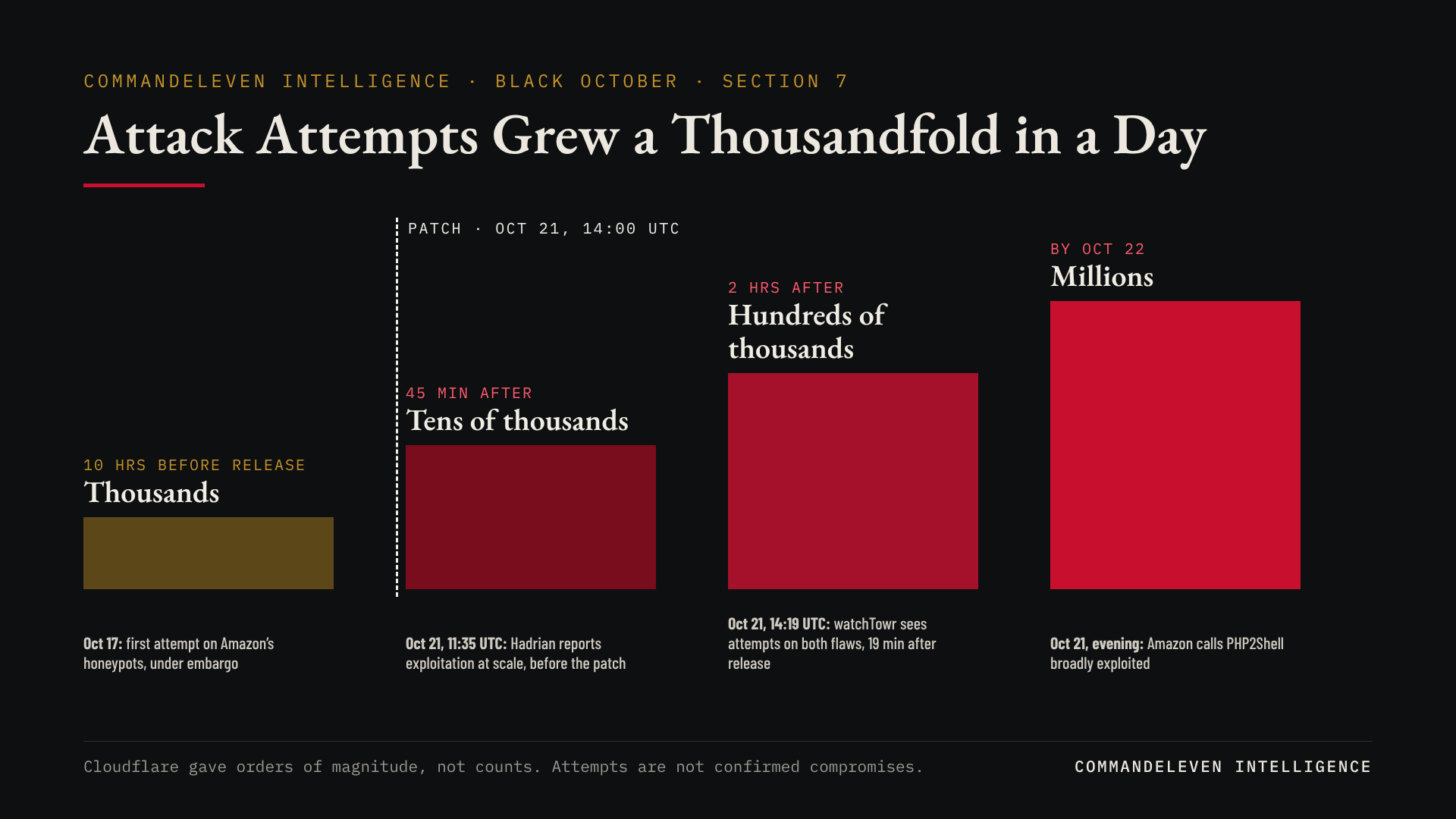
The first systems to be attacked were honeypots: Amazon’s MadPot network on October 17, then Cloudflare’s customer traffic from 07:43 UTC on October 21. watchTowr reported active exploitation attempts against both flaws at 14:19 UTC on October 21, nineteen minutes after the patch shipped. Hadrian reported exploitation at scale from 11:35 UTC on October 21, mostly through a single code path.
The First 12 Hours (October 21, 14:00 UTC to October 22, 02:00 UTC)
Cloudflare’s chief strategy officer posted a stark progression of exploit attempts across its network: thousands in the ten hours before the announcement, tens of thousands in the 45 minutes after it, hundreds of thousands within two hours, and millions by the following day.
By Wednesday evening, Amazon Threat Intelligence was describing PHP2Shell as broadly exploited in the wild. Public proof-of-concept code was already on GitHub claiming to work against any server.
The shutdown wave spread across Europe, then Asia, during the same window:
- Netherlands: The longest list. Logius (which runs the DigiD national login and MijnOverheid citizen portal), the House of Representatives, the Dutch Data Protection Authority, Overheid.nl, NotuBiz council services, the Port of Rotterdam, the football association KNVB, the five largest political parties, media sites and many hospitals.
- UK: Councils and the Metropolitan Police pulled sites after an NCSC alert.
- Germany: Federal sites, plus state agency and police sites in Bavaria and Lower Saxony.
- Web platforms: Parts of Wikipedia, Asana, GOG, Pinboard, 4chan and Something Awful went fully or partly offline.
On naming breach victims: CommandEleven Intelligence does not publish a list of organizations “hacked” in the first 12 hours, because no public source has yet confirmed a single named victim. Naming an organization as breached on the basis of a precautionary shutdown would be inaccurate. What can be stated is that the attack volume in this window, combined with the large share of servers that could not be patched, makes it near-certain that thousands of servers were compromised (ASSESSED), and that victims will surface through breach notifications in the coming weeks.
Where Things Stand at H+23
- Patching is well under way for supported versions. Ubuntu, cPanel’s EasyApache, and hosts including Liquid Web, Hostinger, Hetzner and Pantheon have shipped fixed builds, some covering PHP 8.1 and older. Cloudflare and Imunify360 have pushed virtual patches at the network and server level.
- Sites are returning gradually. The first government sites in northern Germany are back online. No government has given a full restoration date.
- End-of-life branches remain the open wound. PHP published minimal source backports for 7.4, 8.0 and 8.1, usable only by organizations that build PHP themselves; nothing official exists for older branches. TuxCare and some distributions are filling part of the gap with commercial or distribution backports.
- The edge is still exposed. Palo Alto’s PAN-OS and Panorama remain without fixed releases.
- Asia is now in the response phase. South Korea raised its private-sector cyber crisis alert from “Interest” to “Caution” at noon on October 22 and its National Security Office held an emergency meeting. Japan’s Prime Minister Sanae Takaichi publicly warned about the risk, and Japanese banks, SoftBank and others paused services. India’s CERT-In issued a critical alert.
- No attribution, no victim count. Neither has been published.
Affected Institutions and Applications by Industry
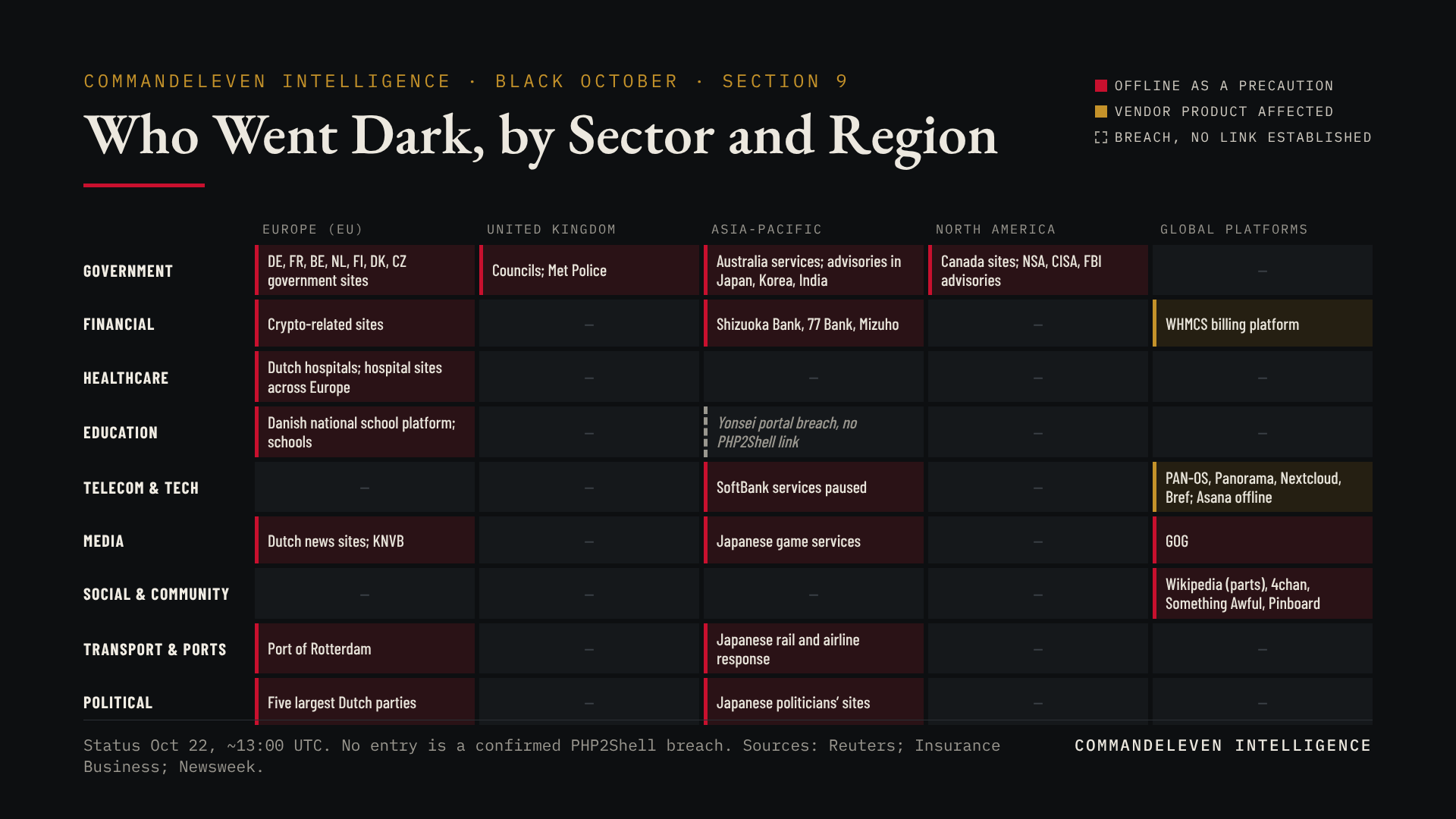
Key to status:
- OFFLINE (precaution): Service deliberately taken down or suspended by its operator
- AFFECTED (vendor): Product confirmed vulnerable; fix pending or issued
- ADVISORY: Issued warnings or guidance; no outage reported
No entry below is a confirmed PHP2Shell breach.
Government and Public Administration
| Organization | Country | Status |
|---|---|---|
| Federal websites (via ITZBund) | Germany | OFFLINE (precaution) |
| Mainz.de and Rhineland-Palatinate agency sites | Germany | OFFLINE (precaution), first documented, Oct 20 |
| State agency and police sites, Bavaria and Lower Saxony | Germany | OFFLINE (precaution) |
| Prefecture websites, Interior Ministry | France | OFFLINE (precaution) |
| Foreign ministry websites | Belgium | OFFLINE (precaution) |
| Logius: DigiD and MijnOverheid | Netherlands | OFFLINE (precaution) |
| House of Representatives; Data Protection Authority; Overheid.nl; NotuBiz council services; NCSC | Netherlands | OFFLINE (precaution) |
| Valtori (state IT services) | Finland | OFFLINE (precaution) |
| Kombit municipal services | Denmark | OFFLINE (precaution) |
| Government websites | Czech Republic | OFFLINE (precaution) |
| Various government services | Australia | OFFLINE (precaution) |
| Local councils; Metropolitan Police | United Kingdom | OFFLINE (precaution) |
| Government sites | Canada | OFFLINE (precaution), per developer-community reporting |
| NSA, CISA, FBI | United States | ADVISORY |
| CERT-EU; UK NCSC; BSI | EU / UK / Germany | ADVISORY |
| KISA / KrCERT; National Security Office | South Korea | ADVISORY; alert level raised |
| JPCERT/CC; IPA | Japan | ADVISORY |
| CERT-In | India | ADVISORY (CIVN-2026-0510) |
Financial Services
| Organization | Country | Status |
|---|---|---|
| Shizuoka Bank | Japan | OFFLINE (precaution): online banking temporarily suspended |
| The 77 Bank | Japan | OFFLINE (precaution): some services suspended |
| Mizuho Bank | Japan | Emergency maintenance; branch-visit reservations suspended |
| Japanese Bankers Association (interbank settlement) | Japan | No impact confirmed |
| Crypto-related sites | Europe | OFFLINE (precaution), several |
| WHMCS (billing platform used across hosting industry) | Global | AFFECTED (vendor) |
Healthcare
| Organization | Country | Status |
|---|---|---|
| Many hospitals | Netherlands | OFFLINE (precaution) |
| Hospital websites (multiple) | Europe | OFFLINE (precaution), per Reuters |
Education
| Organization | Country | Status |
|---|---|---|
| National school communication platform (via Kombit) | Denmark | OFFLINE (precaution) |
| Schools (multiple) | Europe | OFFLINE (precaution), per Reuters |
| Yonsei University portal | South Korea | Breach disclosed; no PHP2Shell link reported |
Telecommunications and Technology
| Organization | Country | Status |
|---|---|---|
| SoftBank | Japan | Some sites or services paused |
| Palo Alto Networks: PAN-OS and Panorama (all versions) | Global | AFFECTED (vendor), fix pending |
| Fortinet (12 products under review); Cisco (31 products and services under review) | Global | Investigating; no vulnerable product confirmed |
| Nextcloud | Global | AFFECTED (vendor); deployments on vulnerable PHP confirmed exposed |
| Bref (PHP on AWS Lambda) | Global | AFFECTED (vendor); images confirmed affected |
| CloudLinux / TuxCare alt-php and ea-php builds | Global | AFFECTED (vendor); fixes rolling out |
| GoDaddy | Global | Customer warning issued |
| Asana | Global | OFFLINE (precaution), reported |
News, Media and Entertainment
| Organization | Country | Status |
|---|---|---|
| Media and news sites | Netherlands | OFFLINE (precaution) |
| GOG (game store) | Global | OFFLINE (precaution), reported |
| Game services | Japan | Paused, per regional reporting |
| KNVB (Royal Dutch Football Association) | Netherlands | OFFLINE (precaution) |
Social Media, Communities and Knowledge Platforms
| Organization | Country | Status |
|---|---|---|
| Wikipedia (parts) | Global | OFFLINE (precaution), partial |
| 4chan; Something Awful (forums) | Global | OFFLINE (precaution) |
| Pinboard (bookmarking) | Global | OFFLINE (precaution) |
Transport, Logistics and Critical Infrastructure
| Organization | Country | Status |
|---|---|---|
| Port of Rotterdam | Netherlands | OFFLINE (precaution) |
| Rail and airline services | Japan | Emergency response, per regional reporting |
Political Organizations
| Organization | Country | Status |
|---|---|---|
| The five largest political parties | Netherlands | OFFLINE (precaution) |
| Politicians’ websites | Japan | Paused, per regional reporting |
Applications Confirmed Exploitable
WordPress, Drupal, Joomla, Magento, Shopware, WooCommerce, MediaWiki, Roundcube, phpMyAdmin, Nextcloud, Laravel, Symfony, WHMCS.
Damage Estimate at H+23
DATA DEFICIT: No authoritative count of downed systems or breached organizations exists. Any precise figure circulating on social media should be treated as unverified.
What can be assessed:
- Exposure ceiling: Over 22 million internet-facing instances were potentially exposed at disclosure (Palo Alto Networks).
- Hard-core residual exposure: Roughly 880,000 internet-facing hosts advertise PHP versions with no official fix (Check Point/Mallory). This is a floor, since most servers hide their version.
- Availability loss: ASSESSED: thousands of public-sector websites across at least ten countries in Europe, Asia-Pacific and North America were deliberately offline for between several hours and more than a day, plus a long tail of private-sector sites in maintenance mode. The heaviest costs fell on citizen services: tax filings, benefits applications, permits, national login systems such as DigiD, and online banking in Japan.
- Compromise: ASSESSED (high confidence): compromise counts are in at least the thousands, given millions of exploit attempts against a population of hundreds of thousands of unpatchable hosts. The scale will not be measurable for weeks.
- Financial: DATA DEFICIT. The insurance industry has noted that PHP2Shell resembles the accumulation scenario cyber underwriters have long modeled, where one shared piece of software exposes thousands of policyholders at once. Expect claims to arrive on a lag.
Bottom line: At H+23, the measurable damage is mostly downtime that organizations chose. The unmeasured damage is the compromise that happened before they chose it, and on the servers that cannot choose at all.
Why It Keeps Expanding After the Patch
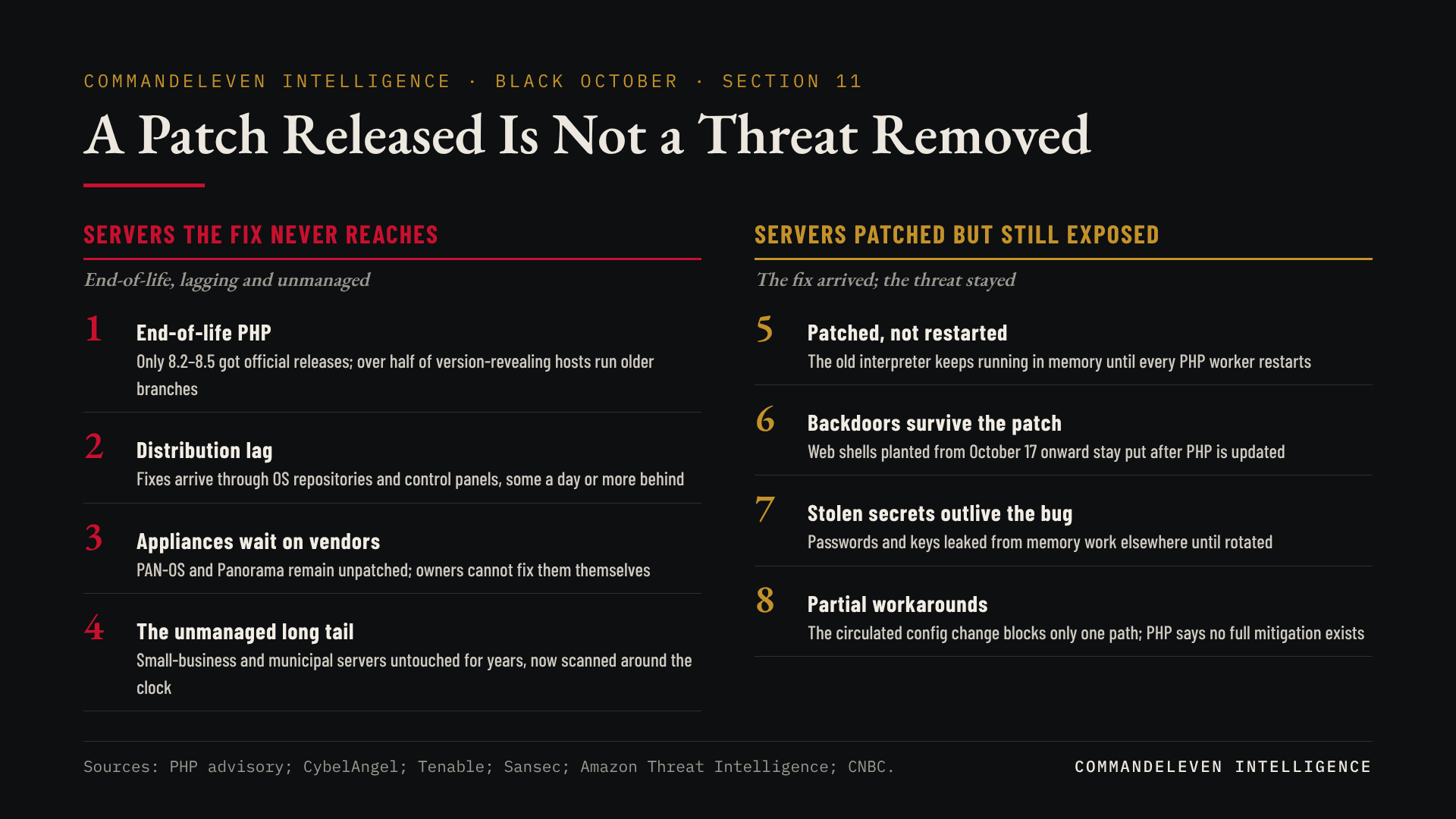
A patch released is not a patch applied, and a patch applied is not a threat removed. PHP2Shell keeps growing for eight reasons, in two groups: servers the fix never reaches, and servers that were patched but stay exposed.
Servers the fix never reaches
- End-of-life PHP gets no fix. PHP officially patched only branches 8.2 through 8.5. Everything older is either limited to source-code backports or receives nothing, and more than half of version-revealing internet-facing PHP hosts run those older branches.
- Distribution lag. Fixes reach servers through operating-system repositories and hosting control panels, not directly from php.net. Some repositories, including Remi’s, which is widely used on Red Hat-family servers, did not have the fix on October 21.
- Appliances are waiting on vendors. Palo Alto firewalls, and potentially other embedded products, cannot be fixed by their owners until the vendor ships an update.
- The long tail is unmanaged. Small businesses, municipal governments and community sites often run on servers nobody has touched in years. One expert told CNBC that city governments and other agencies often have not updated their websites in a decade. Public exploit code and AI tooling mean those servers will be scanned and hit continuously.
Servers patched but still exposed
- Patching is not restarting. The fixed interpreter does nothing until every PHP worker is restarted. Many teams update packages and keep running the old, vulnerable code in memory. The version reported on the command line often differs from the version actually serving web requests.
- Pre-patch backdoors survive patching. Any server compromised between October 17 and its patch time may already hold a web shell. Updating PHP does not remove it. Amazon has warned explicitly that compromise may predate the advisory.
- Stolen secrets outlive the bug. Passwords, tokens and keys leaked from memory can be used against other systems long after the server is fixed, unless they are rotated.
- Workarounds are partial. The configuration change widely circulated as a mitigation blocks only one confirmed path, and the firm that first suggested it later walked back calling it protection. PHP itself says there are no complete mitigations.
How an Organization Should Secure Its Website, Applications and Frameworks
Immediate (next 24–72 hours)
- Update and restart. Move to PHP 8.5.12, 8.4.27, 8.3.36 or 8.2.35, then restart PHP-FPM or the web server so the new interpreter loads. Verify the version the live site is actually serving, not just what the command line reports.
- Deal with end-of-life versions honestly. If you are on PHP 8.1 or older, your options are to migrate to a supported branch, obtain a vendor or distribution backport that specifically addresses both CVEs (for example from your Linux vendor, your host or an extended-support provider), or isolate the server.
- Go dark correctly if you cannot patch. Taking the system offline is a legitimate control, and the NSA, NCSC and CERT-EU all endorse it. Google has advised serving a temporary “503 Service Unavailable” status so search rankings are not damaged.
- Use network-level shields as a stopgap only. Web application firewalls from Cloudflare, Imunify360 and others have deployed rules, but attackers are already altering payloads to evade them.
- Ask your vendors. Get written status from every supplier whose product runs PHP: firewalls, VPNs, hosting control panels, billing systems, intranet tools.
Assume compromise and hunt (next 1–2 weeks)
- Look for new or modified files in the web root, unfamiliar scheduled tasks or cron jobs, and new user accounts.
- Watch for the behavioral signal the FBI flagged: PHP processes unexpectedly launching command shells or downloading files.
- If anything looks wrong, isolate the server and preserve web server and PHP logs before cleaning up.
- Rotate every secret that lived on an exposed server: database passwords, API keys, session-signing keys, cloud credentials, TLS keys where feasible.
Structural (next quarter)
- Inventory: You cannot patch what you do not know you run. Maintain a live inventory of every server, container image and appliance running PHP, including shadow IT and old marketing microsites.
- Least privilege for the web tier: The PHP worker should not be able to reach the internal network, the database administrator account or cloud metadata services beyond what it strictly needs.
- Segmentation: A compromised public website must not be a bridge into finance, clinical or operational networks.
- End-of-life policy: Set a hard rule that no internet-facing system runs a language runtime past its security-support date. PHP 8.6 is expected November 19, 2026, and PHP 8.4 leaves active support at the end of this year. Plan upgrades on that calendar now.
- Static fallbacks: Prepare a static, read-only version of critical public sites that can be switched on in minutes, so going dark does not mean going silent.
State Actors, Non-State Actors, or Both?
CONFIRMED: No public attribution has been made.
CONFIRMED: Amazon’s pre-disclosure detection on October 17 came from a commercial anonymization network, and the variety of payloads and infrastructure seen in the hours before release suggested multiple actors. VulnCheck reported that at least one IP address in China unsuccessfully attempted to deploy a web shell. IP geolocation is not attribution.
ASSESSED (high confidence): criminal exploitation is already under way at scale. The first waves fit the classic opportunistic profile: mass scanning, web shells, cryptominers. Compromised web servers are a commodity; access brokers sell them for a few dollars each to buyers who then resell the access to ransomware operators or use it for phishing and malware distribution.
ASSESSED (moderate confidence): state actors are exploiting it, primarily for access, not disruption. The pattern from comparable mass vulnerabilities is consistent: China-nexus groups moved quickly to exploit React2Shell in late 2025, and state services historically use events like this to quietly plant persistent access in government, defense, telecom and critical-infrastructure networks while defenders are overwhelmed. The goal is prepositioning: access held in reserve for intelligence collection or future disruption.
ASSESSED (moderate confidence): hacktivist and state-aligned “persona” groups will use PHP2Shell for defacement and data-leak operations tied to current conflicts, because public-facing government and media sites are exactly the targets they favor and exactly what PHP2Shell exposes.
SPECULATIVE: The October 17 attempt, during an embargo involving multiple organizations, leaves open the possibility that a capable actor either penetrated the disclosure chain or independently discovered the flaw with its own AI-assisted research. Either possibility should worry defenders: the first means embargoes leak; the second means attackers can now find deep runtime flaws on their own.
Could this be used to launch additional attacks against enemy states? Yes, and that is the most likely strategic use. A state actor does not need PHP2Shell to make headlines. It needs the access PHP2Shell provides: a foothold on a ministry’s public server, credentials scraped from a municipal portal’s memory, a backdoor on a firewall management interface. Those footholds become the launch point for later operations whose connection to October 2026 may never be traced.
The Endgame: Could This Collapse the Internet?
ASSESSED (high confidence): No. The internet’s core (routing, DNS, the major cloud platforms) does not depend on PHP. The largest commercial websites have security teams that patched within hours, and many major sites are likely already safe. The precautionary shutdowns, while disruptive, were a sign that the system’s defenders were working.
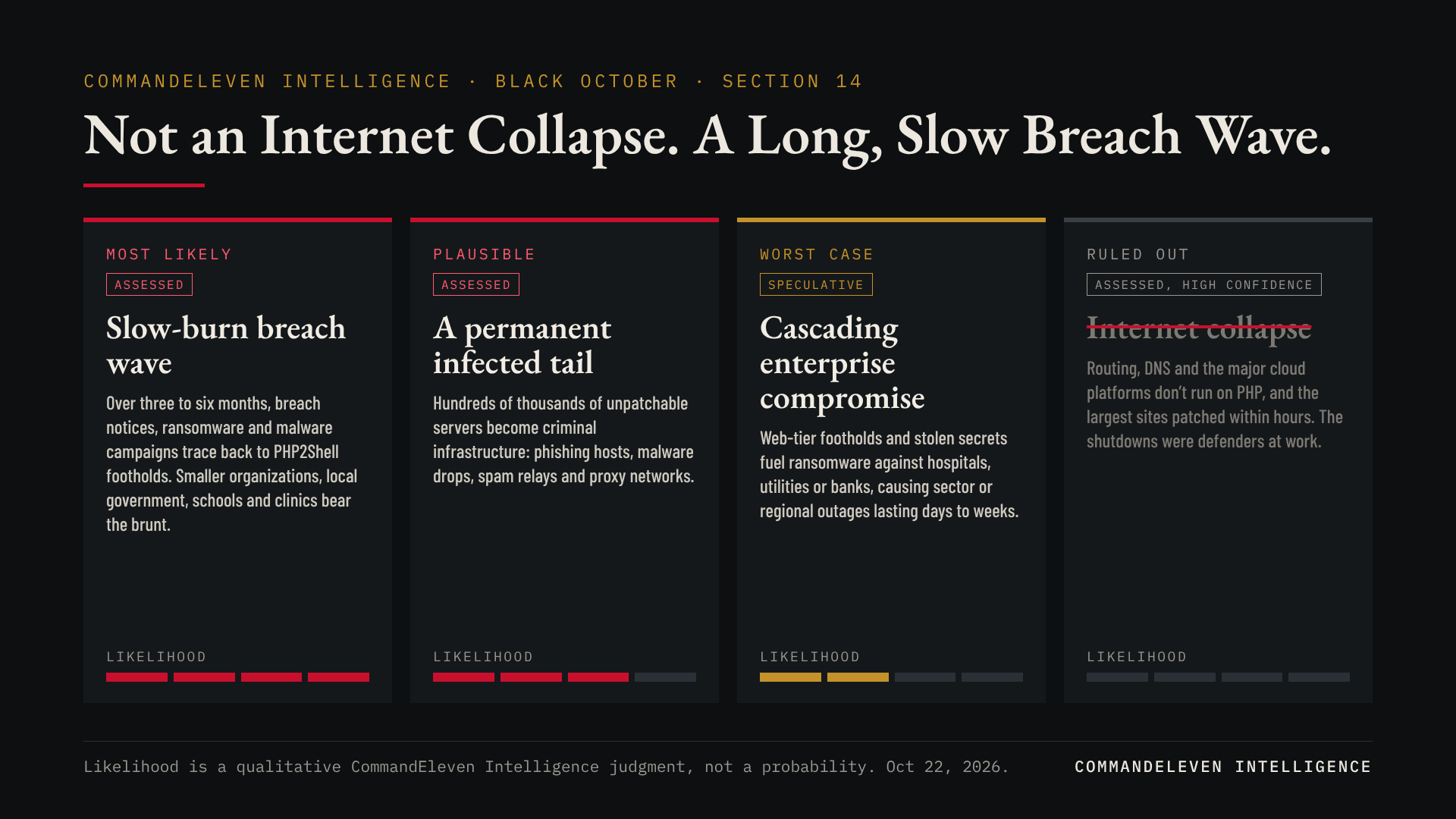
The realistic outcomes, in order of likelihood:
Most likely (ASSESSED): a slow-burn breach wave. Over the next three to six months, a steady stream of data-breach notifications, ransomware incidents and compromised-website malware campaigns traces back to PHP2Shell entry points. Small and medium organizations, local governments, schools and smaller healthcare providers bear the brunt.
Plausible (ASSESSED): a permanent infected tail. Hundreds of thousands of servers on unmaintained, unpatchable PHP become long-term infrastructure for criminals: phishing hosts, malware distribution points, spam relays and proxy networks used to disguise other attacks. Some Internet of Things devices and rarely maintained systems will never be fixed.
Worst case (SPECULATIVE): cascading enterprise compromise. Attackers convert web-tier footholds and stolen secrets into large-scale ransomware against hospitals, utilities or financial firms, combined with an unpatched edge-appliance flaw. This would produce localized “collapses” of specific sectors or regions for days or weeks, the way a single ransomware attack has shut down hospital systems before, not a collapse of the internet itself.
What does change is the baseline. PHP2Shell is a demonstration, in public, that AI-assisted research can turn decade-old latent flaws in foundational software into working exploits. More of these are coming, in PHP and in everything else written in memory-unsafe languages.
Lessons and Future Planning
- Your attack surface is your oldest software, not your newest. More than half of exposed PHP hosts that reveal their version run releases their maintainers abandoned years ago. End-of-life software is no longer a technical-debt problem; it is a national-security problem.
- Security sits below the application. Organizations must track and patch runtimes, interpreters and base container images with the same urgency as applications and plugins.
- Disclosure embargoes are fragile. A leaked forum post forced PHP to ship early, and someone was exploiting the flaw four days before disclosure. Plan as if the public disclosure date is the latest possible date of first exploitation, not the earliest.
- Going dark is a legitimate defense, and should be a planned one. Governments that could switch off cleanly did better than those who scrambled. Every organization needs a tested “dark mode”: static fallbacks, pre-written customer notices, and manual workarounds for critical services.
- Memory leaks mean secret rotation. Any flaw that discloses memory requires rotating credentials, not just patching.
- AI cuts both ways. The defenders found PHP2Shell with AI and used it to validate the fix. Attackers will use the same tools. Organizations should expect a higher rate of critical disclosures and shorter exploitation timelines, and budget patching capacity accordingly.
- Open-source infrastructure needs funding commensurate with its role. Roughly 70% of the web depends on a language maintained by a small team and a foundation. Governments and major platforms that rely on it should fund its security work, extended support for older branches, and migration help for the public sector.
- Accumulation risk is real. Insurers, regulators and boards must treat single-component, internet-wide exposure as a systemic risk category, and require inventory, end-of-life and patch-time evidence as a condition of coverage and contracts.
- Edge devices need a separate emergency track. When firewalls and VPN appliances are themselves vulnerable, the security perimeter becomes the breach point. Contracts should require vendor patch timelines measured in hours for critical flaws.
- Long-term: move off memory-unsafe foundations. PHP2Shell is a memory-safety failure. Sustained investment in memory-safe runtimes, hardened interpreters and sandboxed web workers is the only structural fix.
What This Assessment Does and Doesn’t Establish
- It establishes that PHP2Shell is a real, critical flaw in the PHP engine, that exploitation began before the patch, that fixed releases exist for PHP 8.2 to 8.5, and that the widespread outages of October 20 to 22 were precautionary shutdowns.
- It does not establish any named breach victim, any count of compromised servers, or who is behind the attacks. As of H+23, none of these has been published by a credible source.
- It does not provide attack methodology. In line with CommandEleven Intelligence editorial policy, this assessment describes effects and defenses only.
- Figures are a snapshot. Exposure counts, outage lists and exploitation volumes come from vendors and press reporting at H+23 and will change as the response continues.
Frequently Asked Questions
What is PHP2Shell?
PHP2Shell is the name for two critical flaws in the PHP engine, CVE-2026-109618 and CVE-2026-109619. Together they let an attacker with no login run code on a web server running an unpatched version of PHP from 5.4 to 8.5.
Is my WordPress site affected?
WordPress itself does not need an update; the flaw is in PHP underneath it. A site is protected only if its server runs PHP 8.5.12, 8.4.27, 8.3.36 or 8.2.35 or a vendor backport, and PHP has been restarted. You can check the version under Tools > Site Health > Info > Server, and your host can confirm the backport status.
Why did governments take their websites offline?
The NSA, CERT-EU, the UK NCSC and national agencies advised taking unpatched systems offline until they could be fixed. Every government shutdown reported so far was a precaution, not the result of a confirmed breach.
Will PHP2Shell break the internet?
No. The internet’s core does not run on PHP, and the largest sites patched within hours. CommandEleven Intelligence assesses that the more likely outcome is a slow breach wave over the coming months, concentrated on smaller organizations and servers running PHP versions that will never get an official fix.
Related Reading
- ASEAN Cyber Espionage: APT Architectures & Infiltration
- Pakistan Data Breach: Assessing National Security Risks
- In the Shadow of Algorithms: Pakistan’s Strategic Stakes in the AI Era
- Fridge Hacks Spread to Sweden, Belgium and Estonia: Is It the Same Weakness as France?
Sources
- Wikipedia, PHP2Shell
- Wiz Research, PHP2Shell: AI uncovers critical RCE vulnerabilities affecting 70% of the Internet
- Sansec, PHP2Shell: Critical PHP RCE (CVE-2026-109618, CVE-2026-109619)
- Google Cloud, Responding to core PHP vulnerabilities CVE-2026-109618 and CVE-2026-109619
- AWS Security Blog, Amazon Threat Intelligence identifies PHP2Shell exploitation prior to public disclosure in MadPot
- The Hacker News, PHP Issues Emergency Patches for Two Critical PHP2Shell RCE Flaws as Exploit Attempts Emerge
- The Hacker News, Someone Tried to Exploit PHP2Shell 4 Days Before the Vulnerabilities Were Publicly Disclosed
- The Hacker News, PHP2Shell: What Actually Protects You Before the Patch, and What Doesn’t
- SecurityWeek, PHP2Shell Exploitation Started Days Before Patches
- watchTowr, Frequently Asked Questions About PHP Remote Code Execution (PHP2Shell)
- Tenable, php2shell: Frequently asked questions
- Help Net Security, PHP2Shell: Critical PHP vulnerabilities patched, update now!
- TechTarget, PHP2Shell: 22M exposed servers at risk as emergency patches released
- CybelAngel, 2.24M Internet-Facing PHP Hosts, 59% on Versions With No Fix Coming
- TuxCare, TuxCare Patches php2shell for the PHP Versions Upstream Left Behind
- Recorded Future, PHP2Shell Exploitation: Two Critical PHP Flaws Explained
- Brandefense, PHP2Shell: Two Critical PHP Flaws Reported as RCE
- Techzine Global, PHP shuts the internet: Why PHP2Shell affects every company
- Cyber Kendra, PHP2Shell: Critical PHP Flaws Allow Remote Code Execution
- ActiveSet, PHP2Shell: What WordPress Site Owners Should Check Today
- CNBC, Why governments pulled websites offline over a decades-old programming language
- Al Jazeera, World leaders warn of security flaws found in PHP programming language
- The National, PHP security flaw: Websites taken down as OpenAI spots issue with backbone of internet
- Insurance Business, NSA warns of critical website flaw as Wikipedia, European government websites taken offline
- Insurance Business, UK councils and Met Police among sites pulled offline after NCSC alert
- Newsweek, PHP Vulnerability: List of Websites Powered by PHP as Hacker Threat Prompts Scramble
- Heise, php2shell: Updates trudeln ein, viele Webseiten offline, Angriffe laufen
- eBuilder Security, PHP2Shell Forces Government Websites Offline Across Europe
- Safeguard, PHP2Shell: Why Governments Took Websites Offline on 21 October
- Safeguard, PHP2Shell in Asia: How Korea, Japan, Singapore and India Responded
- BigGo Finance, Emergency Response to PHP Vulnerability Hits Finance and Rail Sectors
- Global Banking & Finance Review, Factbox: Websites taken offline over PHP risks
- Global Banking & Finance Review, Millions of hacking attempts as companies, governments rush to patch PHP flaws
- Bombay Samachar, PHP2Shell Flaws: CERT-In Issues Critical Alert
- How-To Geek, Your favorite websites are down due to an internet-breaking PHP security flaw
- Business Today, From compromised certificates to malicious software: Inside October’s cybersecurity alerts
- W3Techs, Usage statistics of PHP for websites
- W3Techs, Usage statistics of PHP Version 8 for websites
- W3Techs, Usage statistics of PHP Version 5 for websites