
CommandEleven Intelligence · Homeland and Europe Desks. Status as of October 26, 2026.

Bottom Line Up Front
Two governments told their own people to get ready in the same week. In the US, Fox News Digital reported internal Pentagon documents setting a goal for every major base to run for 90 days without the civilian power grid, outside fuel, water or communications. In Britain, the government launched “Be Ready,” a three-year campaign asking households to keep three days of water, food, cash and a radio. Together with a strike on Iran openly discussed in Washington, they have raised a simple question online: what do governments know that they aren’t saying?
The documents answer part of it. The Pentagon plan, called FORTRESS, was announced on September 30 as a long-term resilience strategy, not an emergency order, and much of what it requires will take years and billions of dollars. Britain’s ministers say there is no “specific thing” they are preparing for. [ASSESSED, moderate confidence] Neither move is a sign of an attack expected in days. Both are signs that governments now plan for a long war that reaches the home front: power cut by sabotage or cyberattack, supply chains broken, and state-backed attacks on civilian targets. Britain’s own security service spelled that threat out two weeks ago.
Key Judgments
- [CONFIRMED] FORTRESS is real and public. Secretary of War Pete Hegseth announced it at Quantico on September 30 with five pillars: energy independence, supply-chain resilience, strategic reserves, base hardening and cyber resilience, and space resilience.
- [SINGLE-SOURCE] The 90-day standard comes from internal documents reviewed by Fox News Digital. The Pentagon’s spokesman discussed the plan’s rationale but no document has been published. Reporting describes it as a planning requirement, with no deadline or budget announced.
- [CONFIRMED] “Be Ready” is a Cabinet Office campaign launched on October 22, running for three years, with a three-day household checklist. The Defence Secretary says it is “everyday national resilience,” not preparation for a specific event.
- [ASSESSED, moderate confidence] The timing is not a coincidence, but it is not a countdown either. Both programs respond to the same threat picture: Russia’s hybrid campaign in Europe, Iran’s use of proxies against Western targets, and repeated large cyber incidents, including the PHP2Shell crisis that hit governments days before the UK launch.
- [ASSESSED] The gap between bases and households is the real story. US bases are being told to plan for 90 days without the grid. US households have no comparable national guidance, and UK households are being asked to plan for three.
What the Pentagon Plan Actually Says
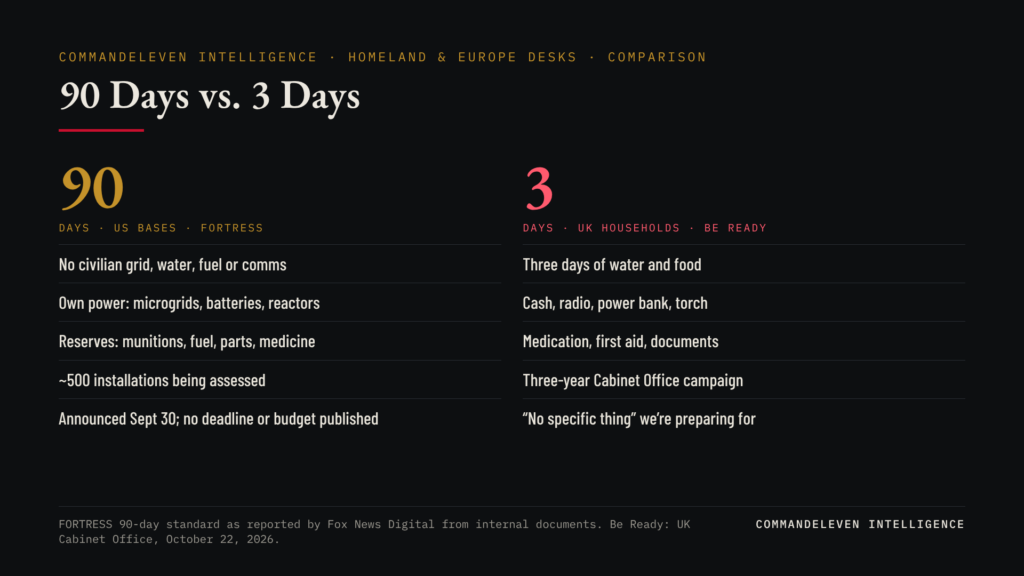
FORTRESS, announced on September 30, sets out five pillars. The 90-day standard, reported by Fox News Digital from internal documents, would require major bases in the continental US to sustain essential operations for at least 90 days without civilian electricity, water, fuel or communications.
- Power: Every major installation would generate its own power, through microgrids, battery storage, solar, geothermal, natural gas and, at five Army posts, small nuclear reactors under a separate program announced in August.
- Reserves: Strategic stocks of munitions, fuel, critical minerals, electronics, spare parts and medical supplies, with at least two supply routes for each critical item.
- Scale: The Pentagon is assessing energy needs at about 500 installations, according to a senior official on October 20.
- Cost and timeline: No budget or completion date has been published. Defense press estimates run from tens to hundreds of billions of dollars.
The Pentagon’s chief spokesman, Sean Parnell, told Fox News Digital that relying on civilian utilities is “an intolerable risk,” that “power is combat now,” and that the next war would likely be fought on several fronts at once and break global supply chains. [ASSESSED] That language describes a planning assumption, not a warning. The US military has worried about base dependence on the civilian grid for more than a decade; FORTRESS turns that worry into a standard.
What Britain’s “Be Ready” Campaign Asks
The Cabinet Office launched “Be Ready” on October 22, with guidance at gov.uk/beready. It asks households to keep three days of supplies:
- Three liters of bottled water per person per day, plus extra for cooking and washing
- Non-perishable food that needs no cooking or refrigeration
- A torch, spare batteries, blankets and warm clothing
- A wind-up or battery radio and a charged power bank
- Cash, copies of documents, and written-down phone numbers
- A first-aid kit and essential medication, and supplies for babies and pets
The threats it names are severe weather, cyberattacks, failures of payment systems, and disruption to supply chains by “hostile state actors or terrorists.” Defence Secretary Wes Streeting said he wanted people “alert but not alarmed” and that there was no “specific thing” the government was preparing for. The guidance matches advice already issued in France, Ireland and the Netherlands.
The Threat Picture Behind Both
MI5’s Director General, Sir Ken McCallum, set out the British side in his annual threat update on October 13:
- Russia remains “aggressor number one,” running a hybrid campaign of arson, sabotage and cyberattacks below the threshold that would trigger NATO’s collective defense. MI5 now devotes more resources to state threats than at any point in the Cold War.
- Iran is “keen on subcontracting its UK violence.” Iran-linked operations led to more than 50 arrests in the past year, against dissidents, Iranian media, Israeli sites, British Jewish communities and, increasingly, “harder targets, like military sites.” The UK prime minister has said an incident at a UK airbase hosting US aircraft was “almost certainly directed” by the IRGC; CommandEleven Intelligence has covered that case in our Rear-Area War series.
- Terrorism: the UK threat level has been “severe” since April. Extreme right-wing terrorism “continues to skew young.”
- AI: MI5 has opened an AI Threat Assessment Centre and has seen attackers use AI to improve reconnaissance.
[ASSESSED, moderate confidence] Read together, FORTRESS, Be Ready and the MI5 update describe the same scenario: a long confrontation in which the home front is a target. That is consistent with what Iran itself threatened last week: to hit cables, data centers and civilian economic targets if the war resumes. It is planning for a type of war, not a date.
What It Means for Households
Be Ready: A Household Baseline. The UK checklist is a sensible minimum anywhere. For a household in the US, where no equivalent national campaign exists, CommandEleven Intelligence’s Critical Infrastructure at Risk series sets out water, power, communications and financial preparation in more detail. The common thread: three days of water and food, cash on hand, a way to receive news without the internet, and medication. If bases are planning for 90 days, households should at least plan for three.
What to Watch
- A FORTRESS budget line in the Pentagon’s next request, or a published directive with deadlines.
- US civil-defense guidance: whether FEMA or DHS issue household advice comparable to Be Ready.
- Further European campaigns following the French, Irish, Dutch and British guidance.
- Any official link between these programs and a specific threat, which would change our assessment.
What This Brief Does and Doesn’t Establish
- It establishes what FORTRESS and Be Ready require, when they were announced, and what officials say about them.
- It does not establish that either program responds to a specific, imminent threat. Officials in both countries say they do not.
- It relies on Fox News Digital’s description of Pentagon documents that have not been published.
Frequently Asked Questions
Has the Pentagon ordered US bases to prepare for 90 days without power?
Internal documents reported by Fox News Digital set a 90-day self-sufficiency standard for major bases under the FORTRESS program, announced on September 30. It is a planning requirement with no published deadline or budget.
What is the UK “Be Ready” campaign?
A three-year Cabinet Office campaign launched on October 22 asking households to keep three days of water, food, cash, a radio, medication and other supplies.
Are these signs of an imminent attack?
Officials in both countries say no. CommandEleven Intelligence assesses that both programs plan for a long conflict that could reach the home front, not for a specific date.
What should households do?
Keep at least three days of water and food, cash, a battery or wind-up radio, a power bank and essential medication.
Sources
- IBTimes UK, Pentagon prepares for potential war: US military bases face reported 90-day self-sufficiency requirement, October 2026
- APA, Pentagon prepares US military bases to operate independently for 90 days, October 26, 2026
- ITV News, What items are on the ‘Be Ready’ checklist and how can households get prepared?, October 23, 2026
- Arab News, Don’t panic: UK govt tells Britons to ‘be ready’ for emergencies, October 2026
- ADS Advance, UK launches national resilience campaign amid growing cyber and security threats, October 2026
- Euronews, Russia remains ‘aggressor number one,’ UK’s MI5 chief warns, October 13, 2026
- TimesLIVE (Reuters), Factbox: MI5 chief lists Iran, Russia, AI and terrorists among threats to UK, October 13, 2026
- Council on Foreign Relations, Unpacking MI5’s warning on a new era of security threats, October 21, 2026
Related CommandEleven Intelligence Reporting
- The Strike Clock: US Attack Planning and Iran’s Threat to Gulf Cables
- Critical Infrastructure at Risk: A CommandEleven Intelligence Series
- The Rear-Area War: RAF Fairford, MacDill and Gig Terrorism
- Iran’s ‘Dead Hand’ Is a Chain of Command, Not a Machine
- Black October: PHP2Shell and the Day the Web Went Dark on Purpose
- Unit 4000 and Unit 600: How Iran Is Rebuilding Its External Plotting Arms