CommandEleven Intelligence · Homeland Desk. Flash Assessment, status as of October 29, 2026.
Bottom Line Up Front
A post circulating widely on X links three things into a countdown: a nationwide emergency alert on every TV and radio in America on November 17, stock-up warnings from “at least 23 countries and the EU,” and a US warning to Gulf states about strikes on Iran after the November 3 midterms. The suggestion is that something is coming and governments know it.
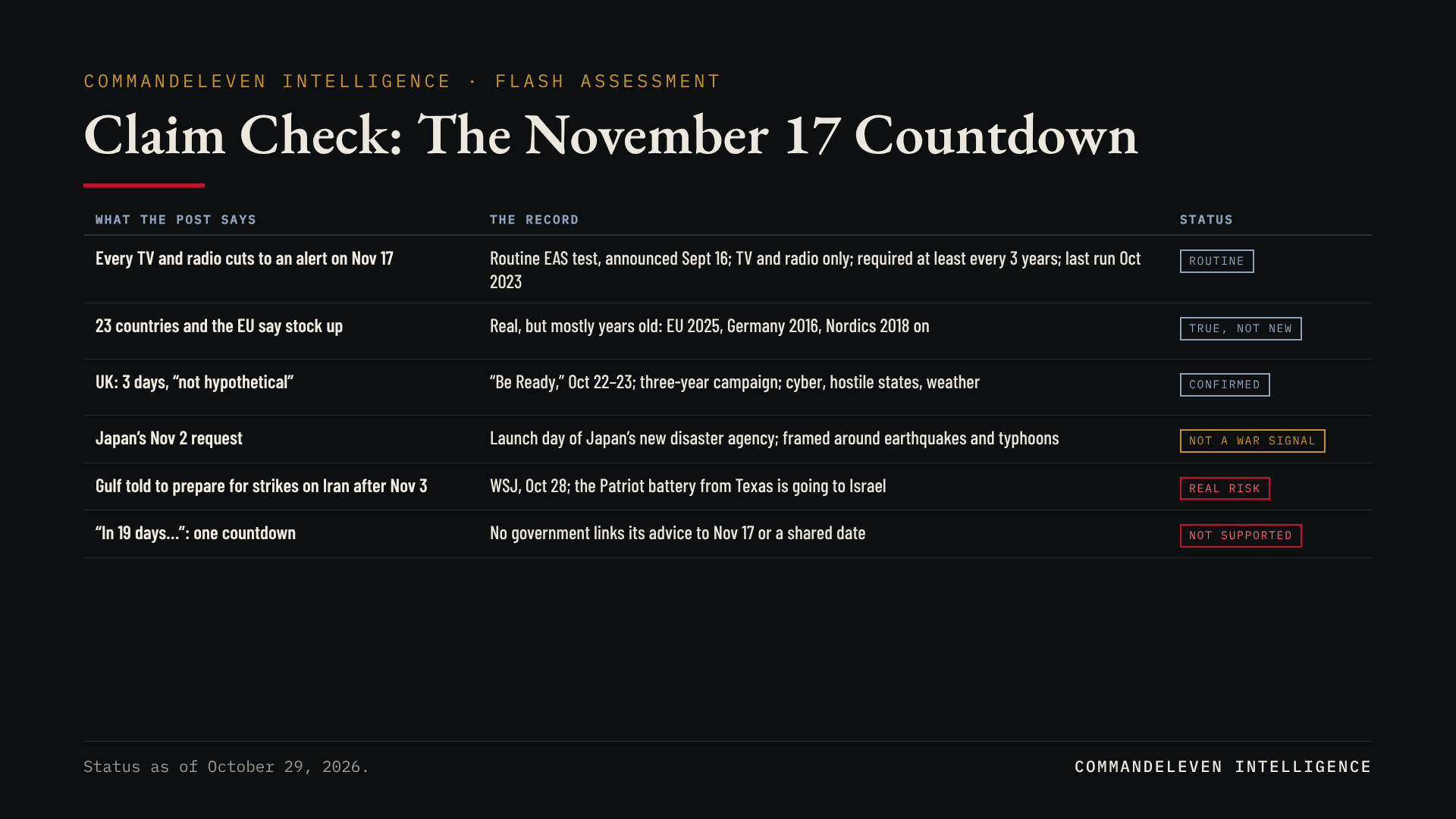
Most of the facts in the post are accurate. The countdown is not. The November 17 alert is a routine test, scheduled in September and required by law at least once every three years. The stock-up campaigns are real, but most are years old, and the new ones were driven by their own national calendars. Only one item has a real date attached to a real risk: the strike window against Iran after November 3.
CommandEleven Intelligence’s advice is the same as it was before the post went viral. Keep a few days of water, food and essentials at home, because that is sensible in any year. Don’t treat November 17 as a signal.
Key Judgments
- [CONFIRMED] The November 17 alert is a scheduled test of the Emergency Alert System. FEMA and the FCC announced it on September 16. It runs at 2:20 p.m. ET on TV and radio only, not on phones, with December 3 as the backup date. The last nationwide test was October 4, 2023.
- [CONFIRMED] The stock-up campaigns are real but are not coordinated. The EU’s 72-hour guidance dates to March 2025, Germany’s 10-day advice to 2016, and the Nordic household booklets to 2018 and after. The UK’s “Be Ready” campaign launched on October 22–23 and Japan’s request goes out on November 2, each for its own stated reasons.
- [CONFIRMED] The Gulf warning is real. The Wall Street Journal reported on October 28 that Washington had told Gulf states to prepare for a possible “short but intense” campaign against Iran after the midterms. The Patriot battery leaving Texas is going to Israel, according to the reporting, not to the Gulf.
- [ASSESSED] The risk environment is genuinely elevated: the Iran strike window, Russian hybrid pressure in Europe, and this month’s PHP cyber crisis. But none of the governments involved has tied its preparedness advice to November 17 or to any shared date.
- [ASSESSED] Posts like this do damage of their own. They turn sensible preparedness into panic buying, and the next real alert competes with the memory of this one.
The November 17 Alert
The Emergency Alert System is how the President, FEMA and state and local officials can break into broadcasts in a real emergency. Federal law requires FEMA to test it nationwide at least once every three years. The last test, on October 4, 2023, also went to phones through Wireless Emergency Alerts. This one does not. [CONFIRMED]
FEMA and the FCC announced the test on September 16, six weeks before the Gulf reporting. Broadcasters must register and file results with the FCC. The message will say it is a test. If you hear it on November 17 at 2:20 p.m. ET, nothing is wrong. [CONFIRMED]
The Stock-Up Warnings, Country by Country
- European Union. The Preparedness Union Strategy of March 2025 urged every household to be able to manage for 72 hours, covering war, pandemics, cyberattacks and climate disasters. [CONFIRMED]
- Germany. Federal civil-protection guidance has recommended about 10 days of supplies since 2016. [CONFIRMED]
- Sweden, Finland, Norway. Each has distributed household booklets for years, most recently updated in 2024 and 2025, advising up to a week of self-sufficiency. [CONFIRMED]
- United Kingdom. “Be Ready” launched on October 22–23 as a three-year campaign asking households to keep three days of water, food and essentials. Ministers cited cyberattacks, hostile states and extreme weather, and the PHP vulnerability disclosed on October 21 that took services offline, the crisis CommandEleven Intelligence covered in Black October. The defense secretary has written that Britain has “a little over 1,000 days” to prepare, with 2030 as the horizon. [CONFIRMED]
- Japan. The request for three days of supplies, a week if possible, goes out on November 2, the day Japan’s new National Disaster Management Agency launches. It is framed around earthquakes, tsunamis and typhoons. [CONFIRMED]
- United States. Ready.gov has long advised keeping food and water “to last for several days.” [CONFIRMED]
[ASSESSED] The pattern is real: governments have spent two years moving civil defense back toward the household, after a pandemic, a war in Ukraine and a series of infrastructure attacks. But it is a trend, not a countdown. Read together, the dates show governments acting on their own calendars, not to a shared signal.
The One Real Date
The post is right that something is scheduled after November 3, but it isn’t the alert. US officials have told Gulf states to prepare for a possible short, intense campaign against Iran after the midterms, and Iran has said further attacks would bring strikes on economic and military targets across the region. CommandEleven Intelligence’s Strike Clock sets out what is planned and what Iran has threatened, including Gulf energy, data centers and undersea cables. [REPORTED; CONFIRMED on the Iranian threats]
[ASSESSED] For most American households, the direct effects of a renewed Iran war would be economic: fuel prices, shipping and markets. The homeland threat from Iranian-directed plotting is real and has been documented in our reporting, but it is not tied to the alert test, and it is not something a three-day kit is designed for.
What to Actually Do
Keep enough at home to get through three days without shops, power or running water, and a week if you can. It is the same advice whether the cause is a storm, a cyberattack or a war:
- Water: about 3 liters (roughly 1 gallon) per person per day.
- Food: anything you can eat without cooking, and a manual can opener.
- Light and power: a flashlight, spare batteries and a charged power bank.
- News: a battery or hand-crank radio.
- Money: some cash, in small bills.
- Health: a first-aid kit and a supply of your own medicines.
- Paper backup: key phone numbers and documents written down, since phones die.
CommandEleven Intelligence’s Critical Infrastructure series carries a household-preparedness checklist for each system, from water to communications, built around a budget of about $500. Additionally, Survival Dispatch News, CommandEleven Intelligence’s broadcast partner, is airing a comprehensive 3-part series that started yesterday on Grid Down preparedness.
What Would Change This Assessment
- A government linking its preparedness advice to a specific threat or date.
- FEMA changing the scope of the November 17 test or adding phones.
- A strike on Iran followed by Iranian action against US or allied infrastructure, which would raise the practical value of household preparedness, though not the meaning of the test.
Frequently Asked Questions
Is the November 17 emergency alert real?
Yes, and it is a test. FEMA and the FCC will test the Emergency Alert System on TV and radio at 2:20 p.m. ET on November 17, with December 3 as the backup date. Phones will not receive it.
Why are so many countries telling people to stock up?
Most of them have said so for years. The EU, Germany and the Nordic countries issued their guidance between 2016 and 2025. The UK and Japan launched new campaigns this autumn for their own reasons: cyber and state threats in the UK, natural disasters in Japan.
Is something going to happen after the midterms?
The US has reportedly warned Gulf states to prepare for possible strikes on Iran after November 3. That is a real risk for the Middle East and for energy prices. It is not connected to the alert test.
What should I keep at home?
At least three days of water, food that needs no cooking, light, a radio, cash, a first-aid kit and your medicines. A week is better.
Sources
- FEMA, FEMA and FCC Schedule 2026 Nationwide Test of the Emergency Alert System for November 17, 2026
- FEMA, 2026 Nationwide Emergency Alert System Test: FAQs
- Radio Ink, FCC, FEMA Set First Nationwide EAS Test Since 2023
- SOFX, UK Launches “Be Ready” Campaign, Urging Households to Stockpile Three Days of Supplies
- NationalTurk, Japan Urges Households To Prepare Emergency Supplies For At Least Three Days
- ITV News, EU tells public to stockpile 72 hours of supplies in case of disaster or attack
- Business Standard (IANS), Germany asks citizens to stockpile food, water for first time after Cold War
- The New Arab, US warns Gulf of “intense” return to Iran war after midterms
- Anadolu Agency, US warns Gulf states of possible “short, intense” Iran war after midterms