
Why This Series, Why Now
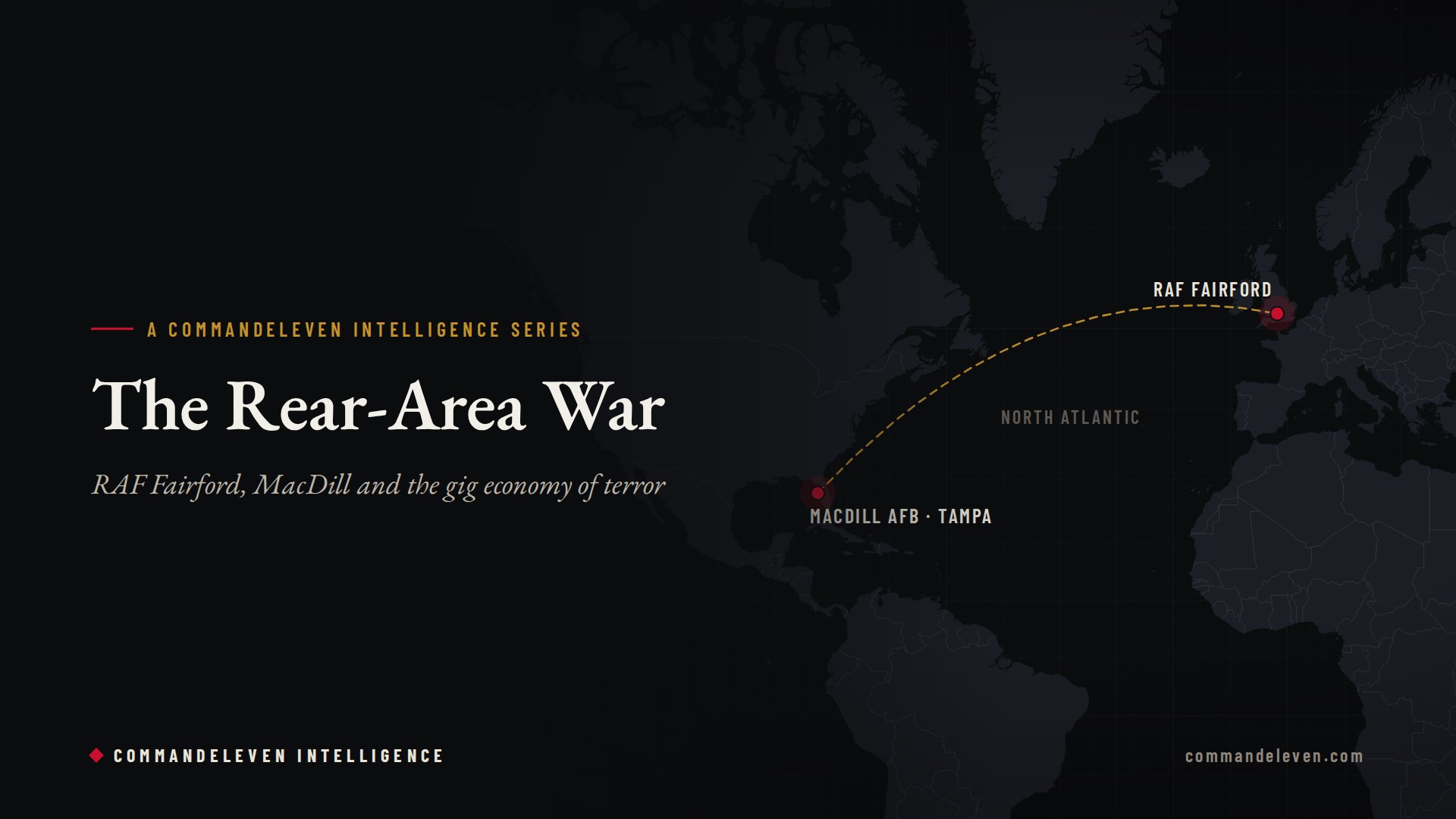
Within roughly 24 hours at the end of September 2026, two installations at the heart of the US–Iran war were tested. On September 26, an intruder breached the perimeter of MacDill Air Force Base in Tampa, home of US Central Command and Special Operations Command. In the early hours of September 27, armed police arrested five young British men beside RAF Fairford, the Gloucestershire airfield from which US heavy bombers have been flying missions in Operation Epic Fury.
On current public evidence there is no demonstrated operational link between the two incidents. But both bases are load-bearing nodes of the same war, both have absorbed repeated security incidents in 2026, and the Fairford arrests landed in the middle of a pattern Europe has been living with since March: hostile states hiring disposable operatives online, paying by the task, and walking away. This series examines the war’s rear area as a front in its own right.
What This Series Covers
- Part 1: RAF Fairford Terror Plot: Dossier on the Averted Attack – what is known about the five arrests, why the base’s force-protection posture was raised before the call that triggered them, and why Iran is the leading but unproven suspect.
- Part 2: MacDill Breach and RAF Fairford Plot: Two Bases, One War – every 2026 security incident at both bases, tested against the hypothesis of a coordinated rear-area campaign.
- Part 3: The Gig Economy of Terror: From Hatzola to Fairford – the task-and-pay proxy model behind the HAYI attack wave across Europe, which the British government attributes to the IRGC Quds Force, and how it maps onto the Fairford case.
How to Read It
Part 1 sets out the facts of the Fairford case. Part 2 widens the lens to the war’s command and bomber nodes on both sides of the Atlantic. Part 3 explains the recruitment model that makes these incidents cheap to attempt and slow to attribute. The investigations remain live, and the series will be updated as charging decisions and official attributions emerge.
A Note on Method
Every claim is confidence-tiered as CONFIRMED, ASSESSED or SPECULATIVE, and competing hypotheses are tested explicitly rather than assumed. No suspect named in these dossiers has been convicted, and attribution to any state is stated only at the confidence level the evidence supports. The series stays at the strategic and force-protection level and does not describe attack methods.

