CommandEleven Intelligence · Foresight Record. Archive re-audit, status as of October 26, 2026.
Bottom Line Up Front
In May 2026, before the Foresight Record set its rules, CommandEleven Intelligence published three reviews claiming that earlier calls had come true: the 2019 Fujairah tanker attacks, the post-2021 surge of the TTP across the Afghan border, and a five-entry “Predictive Audit Ledger.” They were never counted in our totals because they did not quote the dated originals. This audit goes back to those originals and scores what they actually said.
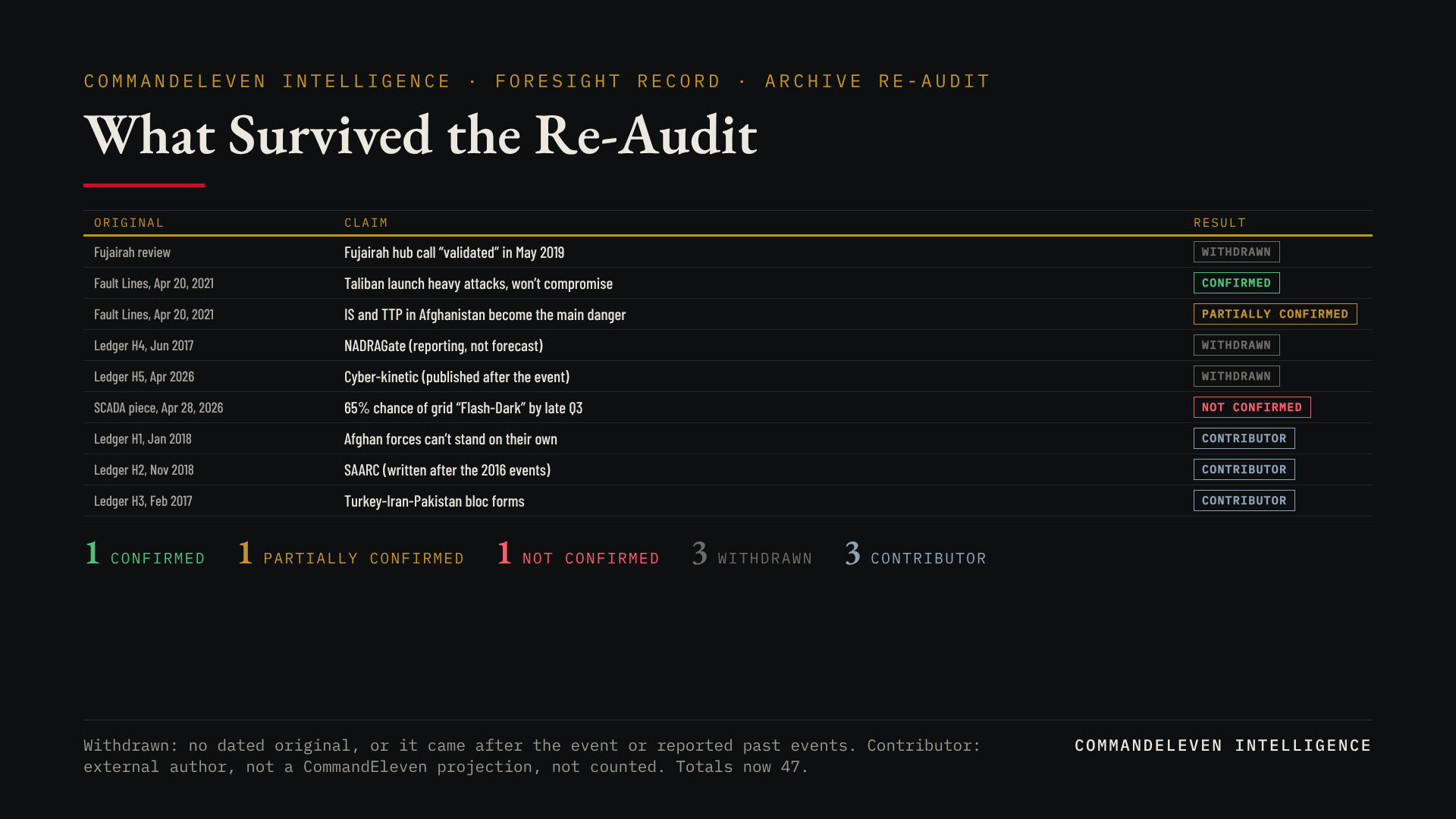
The result is less flattering than the May reviews, and that is the point of doing it. Of the seven claims examined, one holds up as a dated CommandEleven forecast and is now scored. Three are withdrawn, because the original was published after the event it supposedly predicted, was reporting rather than forecasting, or could not be found. Three more are set aside because they came from external contributors, whose projections are not CommandEleven Intelligence projections and are not part of the Foresight Record. One new call also surfaced in the originals, a 65 percent forecast of a cyber-kinetic attack on the US power grid by late in the third quarter of 2026, and it is scored as a miss.
Three calls enter the totals: one confirmed, one partially confirmed and one not confirmed. The three May reviews stay online with a correction note linking here.
The Rules Applied
Every call below is scored under the Foresight Record rules: the original is quoted and dated, the score rests on evidence published afterwards, and a claim with no dated original is not scored. Where a review claimed more than its original said, the original wins.
Whose calls count. The Foresight Record scores the judgments of CommandEleven Intelligence: the Intelligence Desk, our analysts and our Executive Director. Work by external contributors reflects its authors’ views. It is not a CommandEleven projection, so it is not scored, whether it turned out right or wrong. The rule applies in both directions, and it applies here to a hit as well as a miss.
Review 1: The Fujairah Maritime Interdiction (2019)
What the May review claimed. That the May 2019 drone and limpet mine attacks on tankers off Fujairah “clinically validated” earlier CommandEleven assessments that the Fujairah bunkering hub, not the Strait of Hormuz, was the most vulnerable target.
What the record shows. The only assessment the review cites is a Garrison State dossier published in 2026, seven years after the attacks. We have found no CommandEleven publication dated before May 2019 that makes this call. The review also contains a factual error: the May 2019 Fujairah attacks used limpet mines, according to the UAE-led investigation; no drone strike was involved.
Score: WITHDRAWN (no dated original). The drone claim is corrected. The 2026 Fujairah call that followed was separately scored NOT CONFIRMED in The Garrison State, Part 3.
Review 2: The Post-2021 TTP Border Ingress
What the May review claimed. That “in late 2020” CommandEleven warned the US withdrawal would turn Afghanistan into a “Sanctuary Reservoir” for the TTP, and that it was “among the first” to flag NATO night-vision and thermal equipment reaching the group.
What the record shows. We have not found the late-2020 warnings. The earliest dated original we hold is Syed Khalid Muhammad’s appearance on Fault Lines, Episode 13, broadcast on April 20, 2021, four months before Kabul fell. In it he made two calls:
- After Washington missed the May 1 withdrawal deadline, the Taliban “will carry out very very heavy attacks… just to get our point across that we don’t need to compromise anymore.” CONFIRMED. The Taliban offensive began in May and Kabul fell on August 15, 2021.
- The bigger danger was the “disruptors”: “groups like Islamic State, the TTP in Afghanistan… can cause a lot of problems.” PARTIALLY CONFIRMED. Both the TTP and ISKP grew after the takeover, as our Regional Insecurity audit found. But the call was general, and the peace deal it referred to never happened.
The equipment claim is a documented fact, not a scored forecast: US-made night-vision and thermal equipment has reached the TTP since 2021. With no dated CommandEleven original, it is recorded as a verified baseline fact. The review’s claim that Operation Ghazb lil Haq was “forecasted” is withdrawn for the same reason.
Review 3: The “Predictive Audit Ledger”
The May 20 piece, From Commentary to Capability, listed five hypotheses with “lead advantages” of 11 to 42 months. Two of the five, NADRAGate and cyber-kinetic convergence, are CommandEleven work and are checked below. The other three came from external contributors and are covered in the next section.
Hypothesis 4: NADRAGate (June 2017). The original reported earlier disclosures, from the 2015 Snowden-based reporting and the 2016 Shadow Brokers leak, of NSA and GCHQ access to Pakistani networks. It did not forecast the later leaks of citizens’ identity data, which came through insiders and poorly secured systems, not the mechanism it described. Score: WITHDRAWN (reporting, not a forecast).
Hypothesis 5: Cyber-kinetic convergence (listed as April 2025). The original, Cyber-Kinetic Convergence: The Reality of SCADA Targeting in 2026, was published on April 28, 2026, not in April 2025, and after the March 2026 hospital attacks the ledger called its validation. Score: WITHDRAWN (published after the event).
The same original did contain a dated forecast: “We model a 65% probability of a ‘Flash-Dark’ event, a coordinated cyber-kinetic strike on the U.S. Eastern Interconnection, by late Q3 2026.” No such event occurred by September 30. Score: NOT CONFIRMED.
Contributor Work Claimed in May, Not Counted
The May ledger presented three contributor articles as CommandEleven foresight. That was an error. They are listed here so the correction is visible, but none is scored.
- Hypothesis 1: Afghan state collapse. US Failures in Afghanistan (January 10, 2018), by contributor Imran Siddiqui, warned that “raising an Army in a few years is unrealistic.” The Afghan army’s collapse in 2021 bore that out, though the ledger overstated it, describing a “72-hour” collapse that in fact took about ten days. Not counted (contributor).
- Hypothesis 2: India and SAARC. The article, by contributor Andrew Korybko, describes India’s boycott of the 2016 Islamabad SAARC summit, two years before it appeared on our site. It was not a forecast in any case. Not counted (contributor).
- Hypothesis 3: The “South Eurasian Belt.” The February 2017 article, also by Andrew Korybko, argued that Turkey, Iran and Pakistan were forming a cohesive non-Western bloc. That bloc did not form. Not counted (contributor).
What Changes on the Record
| Review | Calls scored | Confirmed | Partial | Not confirmed | Withdrawn | Contributor, not counted |
|---|---|---|---|---|---|---|
| Fujairah (2019) | 0 | 0 | 0 | 0 | 1 | 0 |
| TTP border ingress | 2 | 1 | 1 | 0 | 0 | 0 |
| Predictive Audit Ledger | 1 | 0 | 0 | 1 | 2 | 3 |
| Total | 3 | 1 | 1 | 1 | 3 | 3 |
The Foresight Record’s totals rise from 44 to 47 scored calls: 20 confirmed, 8 partially confirmed, 10 not confirmed and 9 open.
What We Learned
[ASSESSED] The May reviews made four errors that the Foresight Record’s rules now prevent. They counted later writing as earlier foresight. They treated reporting of past events as prediction. They claimed contributors’ work as the firm’s own. And they measured “lead time” from dates that did not match the originals. The success that survives is a plain, dated call made on air in 2021, not the framework language the reviews wrapped around it. The miss on the grid forecast is a reminder that a probability attached to a specific date is still a call, and is scored like one.
What This Audit Does and Doesn’t Establish
- It establishes what the dated originals behind the three May reviews actually said, and scores the CommandEleven calls among them.
- It does not delete the May reviews. They stay online with a note linking to this audit, so the change is visible.
- It does not rule out that earlier originals exist. If a dated CommandEleven publication supporting a withdrawn claim is found, the claim will be re-scored and the change dated.
Frequently Asked Questions
Why are contributor articles not counted?
Contributors write under their own names and reflect their own views. The Foresight Record scores CommandEleven Intelligence’s judgments only, so contributor projections are left out whether they proved right or wrong.
Why withdraw claims rather than score them as misses?
A miss is a forecast that turned out wrong. A withdrawn claim was never a forecast on the dated record: the original came after the event, reported past events, or could not be found.
Did CommandEleven Intelligence predict the Taliban takeover?
In part. On April 20, 2021, Syed Khalid Muhammad said on Fault Lines that the Taliban would launch heavy attacks and would not compromise after the US missed its May 1 deadline. That call is scored confirmed.
How do these changes affect the Foresight Record?
Three calls are added, taking the total to 47 scored calls: 20 confirmed, 8 partially confirmed, 10 not confirmed and 9 open.
Related Reading
- Iran Foresight Audit: July 2026 Doctrinal Series vs. the War Doctrine & Strategy Series
- The Pre-War Iran Debate, Scored
- The Siege That Held: Mali Six Months After the April Offensive
- The Convergence Ledger: Every Link We Graded, and What the Record Supports
Sources
- CommandEleven, You Should Be Worried About NADRAGate, Here’s Why, June 8, 2017
- CommandEleven, Cyber-Kinetic Convergence: The Reality of SCADA Targeting in 2026, April 28, 2026
- Fault Lines, Episode 13, “Afghan peace deal,” broadcast April 20, 2021 (transcript held by CommandEleven Intelligence)
- Imran Siddiqui (contributor), US Failures in Afghanistan, January 10, 2018
- Andrew Korybko (contributor), How India Killed SAARC To The Benefit of China, on site November 18, 2018
- Andrew Korybko (contributor), Has a Multipolar CENTO Sprung Up in the South Eurasian Rimland?, February 16, 2017
- CommandEleven, Foresight Audit: The Fujairah Maritime Interdiction (2019), Foresight Audit: The Post-2021 TTP Border Ingress and From Commentary to Capability, May 2026 (the reviews audited here)