Bottom Line Up Front (BLUF)
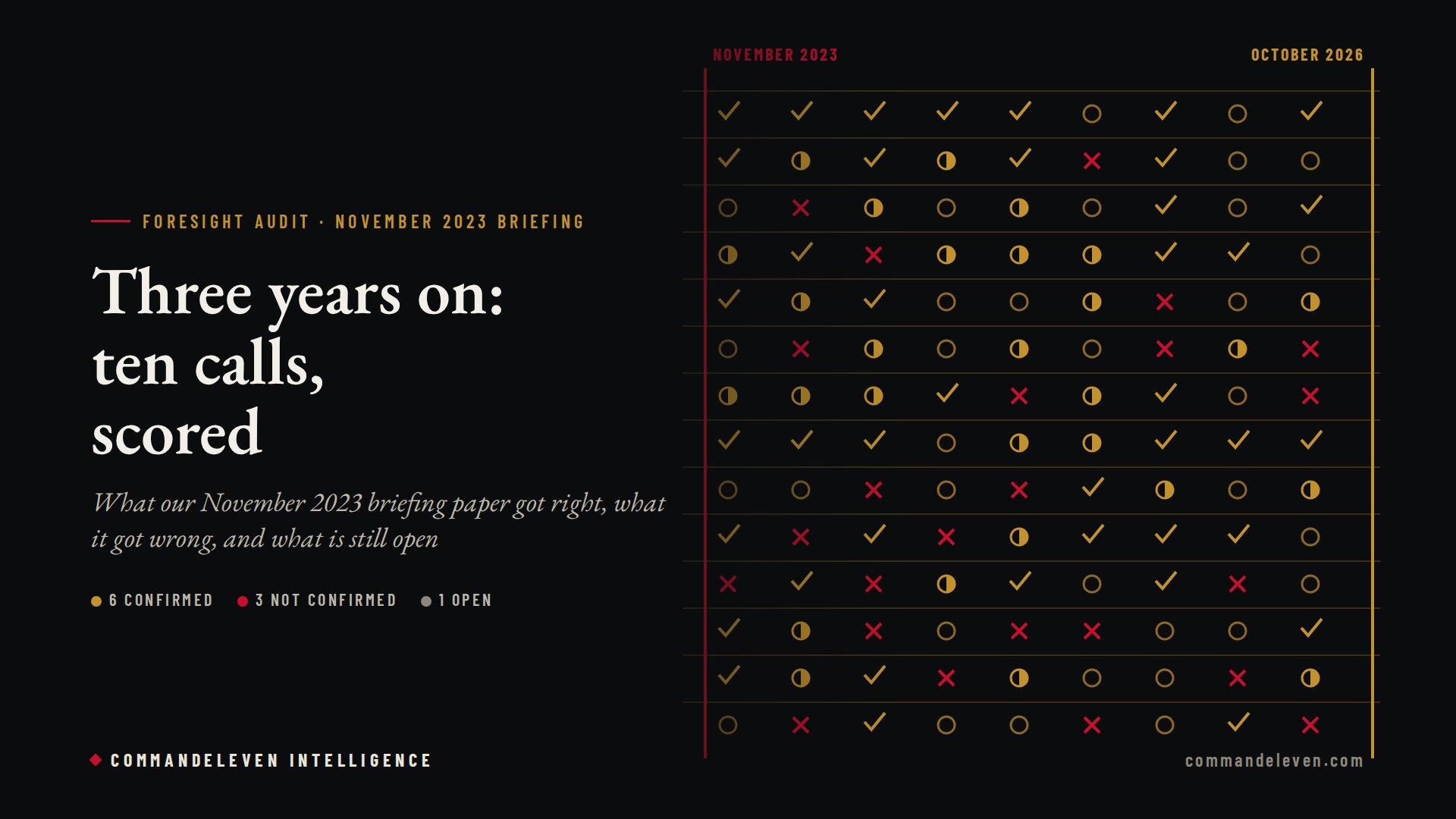
In November 2023, CommandEleven published Regional Insecurity from Afghan Soil, a briefing paper on what the Taliban’s Afghanistan would export to its neighbors. Three years later, this audit scores its ten firmest calls against the record. Six are confirmed, three are not confirmed and one is still open. The paper was right about the core of the problem. The Taliban would not act against the Tehreek-e-Taliban Pakistan (TTP), Pakistan would turn to airstrikes, the dispute would become a regional crisis, and ISKP would use Afghanistan as a base for attacks on other countries. It was wrong about three things: ISKP’s attack tempo inside Afghanistan, which fell under Taliban pressure; Tajikistan’s relations with Kabul, which warmed; and Central Asia, which engaged the Taliban directly rather than retreating behind Russia. Its call that Afghanistan was heading back toward civil war remains open.
The Report and How It Is Scored
Regional Insecurity from Afghan Soil is a CommandEleven briefing paper by Syed Khalid Muhammad, dated November 2023 on its cover and first published on November 29, 2023. It is still available on the site. It surveyed the threat from Afghan soil to Pakistan, China, Iran, Uzbekistan and Tajikistan, a year before most coverage turned to the same question.
This audit follows the method of the CommandEleven Intelligence Foresight Record:
- Only firm calls are scored. The paper also raised several possibilities in hedged terms (“could,” “it is also possible”). Those are listed separately and not scored, because a possibility cannot be wrong.
- The original wording is quoted. Quotes come from the paper’s PDF as published on the site.
- Each call gets one of four scores: CONFIRMED, PARTIALLY CONFIRMED, NOT CONFIRMED or NOT YET RESOLVED.
- Misses stay on the record.
The Calls
RI-01: The Taliban Would Not Act Against the TTP
The paper (2023): “Pakistan needs to abandon hope that the Taliban will take action against the TTP.”
Score: CONFIRMED
UN monitoring in 2025 found that the Taliban “continued to provide TTP with logistical and operational space and financial support,” including funds for the TTP leadership, and later put the group at almost 6,000 fighters in Afghanistan. Kabul did not move against the TTP through repeated talks, a Pakistani air campaign or a declared war. CommandEleven Intelligence’s TTP sanctuary dossier sets out the record.
RI-02: Pakistan Would Answer With Airstrikes on TTP Camps
The paper (2023): If attacked from Afghan soil, “Pakistan will respond with air strikes on known TTP training camps along the Pak-Afghan border.”
Score: CONFIRMED
Four months later, in March 2024, Pakistan struck alleged TTP and Hafiz Gul Bahadur hideouts in Khost and in Barmal, Paktika. In December 2024 it struck Barmal again, and for the first time both its military and its civilian government formally accepted responsibility. The strikes then escalated: the October 2025 strike in Kabul on the TTP’s leader, and the air campaign of February and March 2026.
RI-03: The Dispute Would Become a Regional Crisis
The paper (2023): The Pakistan-TTP problem was building toward “a major crisis that will have repercussions across the region.”
Score: CONFIRMED
In February 2026 Pakistan declared “open war” on the Afghan Taliban and launched Operation Ghazab lil-Haq. The fighting drew in Saudi, Qatari and Turkish mediation and remained unresolved into the autumn. CommandEleven Intelligence’s Pakistan-Afghanistan series documents the war.
RI-04: Afghanistan Would Become a Terrorist Haven Again
The paper (2023): US decisions “put Afghanistan on a collision course to become a terrorist haven again.”
Score: CONFIRMED
At an August 2026 Security Council meeting, the US, China and Pakistan cited ISKP’s presence in Afghanistan, and Pakistan’s ambassador said the TTP, the Balochistan Liberation Army, the East Turkistan Islamic Movement and al-Qaeda maintain “networks and safe havens in Afghanistan.” The concern the paper raised in 2023 is now a standing item on the Council’s agenda.
RI-05: ISKP Attacks Inside Afghanistan Would Increase
The paper (2023): “terrorist attacks originating from ISKP will increase in Afghanistan,” targeting Afghanistan and “its international interests in the region.”
Score: NOT CONFIRMED
The opposite happened inside Afghanistan. The Taliban’s campaign against ISKP killed several of its senior figures, and the International Crisis Group counted a 94 percent fall in ISKP-linked fatalities in the twelve months to July 2024. The UN Secretary-General reported in September 2025 that ISKP attacks had “decreased in both number and scale.” ISKP still carried out high-profile attacks inside the country, including the March 2024 Kandahar bank bombing, but the trend the paper forecast did not occur. The paper underestimated how hard the Taliban would hit a rival that threatened its own rule.
RI-06: ISKP’s Afghan Bases Would Be Used to Attack Neighboring States
The paper (2023): “With time, these camps will be used to attack these regional nations.”
Score: CONFIRMED
Five weeks after the paper, on January 3, 2024, an ISKP double suicide bombing in Kerman, Iran killed about 91 people. On March 22, 2024, an attack on Crocus City Hall near Moscow, which Crisis Group attributes to ISKP’s external operations network, killed about 149. In February 2026, a suicide bombing of a Shiite mosque in Islamabad, claimed by Islamic State’s Pakistan Province, killed 32; Pakistan’s military said the attack was planned and prepared in Afghanistan. In late 2025, a series of attacks from Afghanistan’s Badakhshan on Chinese workers in Tajikistan bore ISKP’s hallmarks, according to analysts, though no group has been officially identified. The paper’s warning about where ISKP would point its Afghan infrastructure held.
RI-07: ISKP Would Stay on the Afghan Battlefield
The paper (2023): ISKP “will not be leaving the Afghan battlefield in the near future.”
Score: CONFIRMED
Crisis Group’s July 2025 judgment was that the group is “down but not out.” It has lost leaders and partly relocated to Pakistan, but it still operates in Afghanistan, still recruits, mostly among Tajik nationals, and still mounts attacks abroad.
RI-08: Tajik-Taliban Relations Would Sour Significantly
The paper (2023): “the relationship is expected to sour significantly.”
Score: NOT CONFIRMED
Relations moved the other way. Tajikistan, the only neighbor that had refused to deal with the Taliban, reopened cross-border markets in 2023. It exchanged security delegations in 2024 and sent its first high-level delegation to Kabul in November 2025. A series of deadly attacks from Badakhshan in late 2025 strained the border, and Kabul offered closer border cooperation in response. Those attacks are the mechanism the paper named (“The ISKP attacks will unsettle relations”), but Dushanbe answered with more engagement, not a rupture.
RI-09: Central Asia Would Turn to Russia for Security
The paper (2023): If the Taliban had not genuinely renounced terrorism, “the Central Asian states will likely rely on Russia for enhanced security support.”
Score: NOT CONFIRMED
The region chose engagement over insulation. Kazakhstan delisted the Taliban as a terrorist group and accepted a Taliban diplomat in Astana; its president explained the delisting as recognition that “this regime is a long-term factor.” Russia itself, rather than serving as a shield against Kabul, became the first country to formally recognize the Taliban government, on July 3, 2025. The condition the paper set was not met, and the region engaged the Taliban anyway.
RI-10: Afghanistan Was on the Path to Civil War
The paper (2023): The collapse that followed the Soviet withdrawal “led to civil war, which seems to be the same path post-US withdrawal.” Sheltering militants would also “case [cause] the Taliban to have increased internal conflicts.”
Score: NOT YET RESOLVED
There is no civil war in Afghanistan as of October 2026. The internal friction the paper expected did surface: in early 2025, Interior Minister Sirajuddin Haqqani spent about 50 days out of public view amid reports of a rift with Hibatullah Akhundzada over the concentration of power in Kandahar, and resignation claims that the Taliban denied. But the leadership held together. In August 2025 Akhundzada ordered ministers to drop the “acting” label from their titles, and Haqqani kept his post. Meanwhile, the pressure the paper described has grown. The Afghanistan Freedom Front, led by former army officers, shifted its campaign to the north and northeast in 2026, claiming clashes in Badakhshan, Kunduz and Nuristan. Pakistan’s war has struck Taliban military infrastructure across the country. [ASSESSED] CommandEleven Intelligence’s standing assessment is that the northern insurgency and Pakistan’s campaign are pushing the Taliban toward internal breakdown. That remains a judgment, not a resolved outcome, and the call stays open.
Possibilities Raised, Not Scored
The paper also raised these as possibilities rather than firm calls. They are recorded here so the full record is visible, but they are not scored:
- That the Taliban “want the TTP to ultimately rise to power in Islamabad”
- That the East Turkistan Islamic Movement might shift its allegiance from the Taliban to ISKP
- That an “Iran-China-Pakistan axis in Afghanistan” could emerge
- That Iran “could embark on a destabilizing campaign of violence” in a hostile Afghanistan
- That proxy competition “could lead to sectarian tensions” between Hazaras and Pashtuns
Scorecard
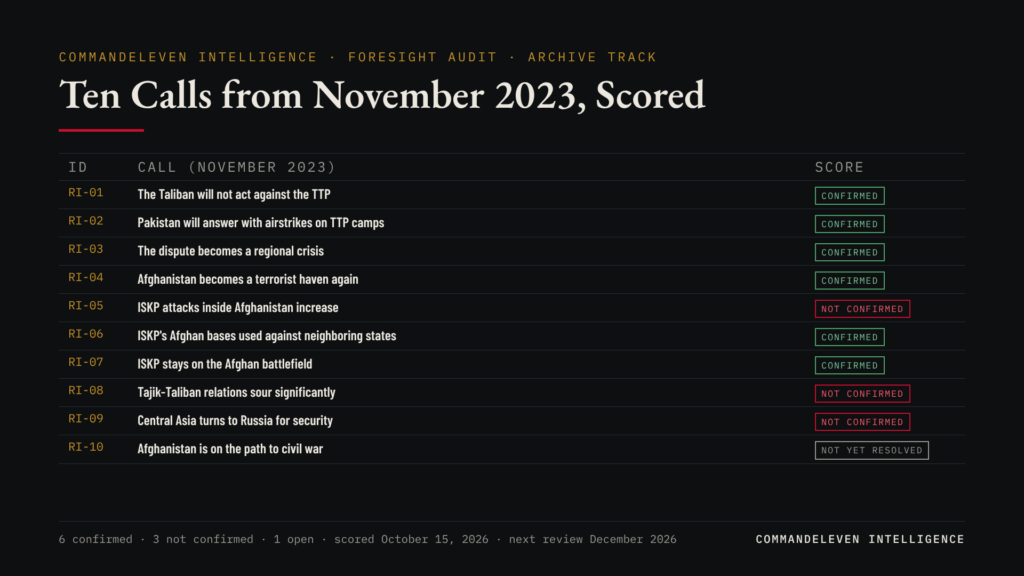
| ID | Call (November 2023) | Score |
|---|---|---|
| RI-01 | The Taliban will not act against the TTP | CONFIRMED |
| RI-02 | Pakistan will answer with airstrikes on TTP camps | CONFIRMED |
| RI-03 | The dispute becomes a regional crisis | CONFIRMED |
| RI-04 | Afghanistan becomes a terrorist haven again | CONFIRMED |
| RI-05 | ISKP attacks inside Afghanistan increase | NOT CONFIRMED |
| RI-06 | ISKP’s Afghan bases are used against neighboring states | CONFIRMED |
| RI-07 | ISKP stays on the Afghan battlefield | CONFIRMED |
| RI-08 | Tajik-Taliban relations sour significantly | NOT CONFIRMED |
| RI-09 | Central Asia turns to Russia for security | NOT CONFIRMED |
| RI-10 | Afghanistan is on the path to civil war | NOT YET RESOLVED |
Date scored: October 15, 2026 · Next review: December 2026 (RI-10).
What the Audit Shows
- The paper read Pakistan’s problem correctly. Its core calls on the TTP, Pakistani airstrikes and a regional crisis all held, with lead times of four months to more than two years.
- It read ISKP’s direction correctly but its tempo wrong. ISKP did turn its Afghan base outward, as the paper warned. But the paper expected the group to grow inside Afghanistan and underestimated the Taliban’s willingness to crush a rival that threatened its own rule.
- It misread Central Asia. The paper expected the region to wall itself off from the Taliban. Instead, governments chose trade and engagement, and Russia led the way to recognition. For future assessments, the lesson is that neighbors facing a durable regime tend to engage it rather than isolate it, whatever their security concerns.
Frequently Asked Questions
What was “Regional Insecurity from Afghan Soil”?
A CommandEleven briefing paper published in November 2023 on the threat the Taliban’s Afghanistan posed to Pakistan, China, Iran and Central Asia.
How accurate was it?
Of ten firm calls, six are confirmed, three are not confirmed and one is still open.
What did it get right?
That the Taliban would not act against the TTP, that Pakistan would strike TTP camps in Afghanistan, that the dispute would become a regional crisis, and that ISKP would use Afghanistan to attack other countries.
What did it get wrong?
That ISKP attacks inside Afghanistan would increase, that Tajikistan’s relations with the Taliban would sour, and that Central Asia would turn to Russia rather than engage the Taliban.
Did it predict civil war in Afghanistan?
It said Afghanistan seemed to be on the same path to civil war as after the Soviet withdrawal. That call is still open: there is armed opposition in the north, but no civil war as of October 2026.
Sourcing Base (Confidence-Tiered, with Links)
Original Report:
- CommandEleven, Regional Insecurity: Assessing Cross-Border Terror Risks, November 29, 2023, with the full briefing paper, Regional Insecurity from Afghan Soil (PDF)
CONFIRMED — Institutional and Primary Record:
- Afghanistan International, “ISKP Attacks Fall But Violence In Afghanistan Increases, Says UN Chief,” September 13, 2025
- International Crisis Group, “The Islamic State in Afghanistan: A Jihadist Threat in Retreat?,” July 16, 2025
- International Crisis Group, “Russia Becomes First State to Recognise Taliban as Afghanistan’s Rightful Government,” July 2025
- Kabul Now, “UNSC Remains Concerned Over Presence and Capabilities of Terror Groups in Afghanistan,” August 6, 2026
- Afghan Witness, “Pakistan air strikes in Afghanistan mark significant policy shift,” January 16, 2025
- Afghan Witness, “Sirajuddin Haqqani resurfaces after 50 days amid claims of resignation,” March 26, 2025
- Dawn, “UN monitoring report” (editorial), February 17, 2025
- Associated Press via WSLS, “Death toll in Islamic State-claimed suicide blasts rises to 91,” January 6, 2024
ASSESSED — Credible Reporting and Analysis:
- Amu TV, “Report: Taliban pay $43,000 monthly to family of TTP leader,” August 19, 2025
- The Diplomat, “Kazakh President Explains Decision to Take Taliban off Terrorist List,” June 2024
- Arab News, “No more ‘acting’: Taliban mark fourth year in power by dropping interim titles,” August 16, 2025
- Wikipedia, “2026 Islamabad mosque bombing” (compiled record)
- Al Jazeera, “Tajikistan-Taliban border clashes: What’s behind them, why it affects China,” December 26, 2025
- Lowy Institute, The Interpreter, “Russia, Central Asia are quietly embracing the Taliban,” August 15, 2025
- Wikipedia, “Afghanistan Freedom Front” (compiled record; AFF casualty figures are the group’s own claims)
- Wikipedia, “Sirajuddin Haqqani” (August 2025 reappointment)
CommandEleven Intelligence Prior Work:
- The TTP Sanctuary Question: Mapping a Denied Safe Haven – Part 2, October 2026
- A Region Under Pressure: The Pakistan-Afghanistan Series, October 2026
- The Coming Militant Civil War in Afghanistan, May 22, 2024
- The Foresight Record
Excluded from this audit: Hedged possibilities in the paper are listed but not scored. AFF claims of Taliban casualties are reported as the group’s own figures. Later CommandEleven calls on Afghanistan, such as the May 2024 civil-war assessment, are not scored here and will be audited separately.