
Key Judgments
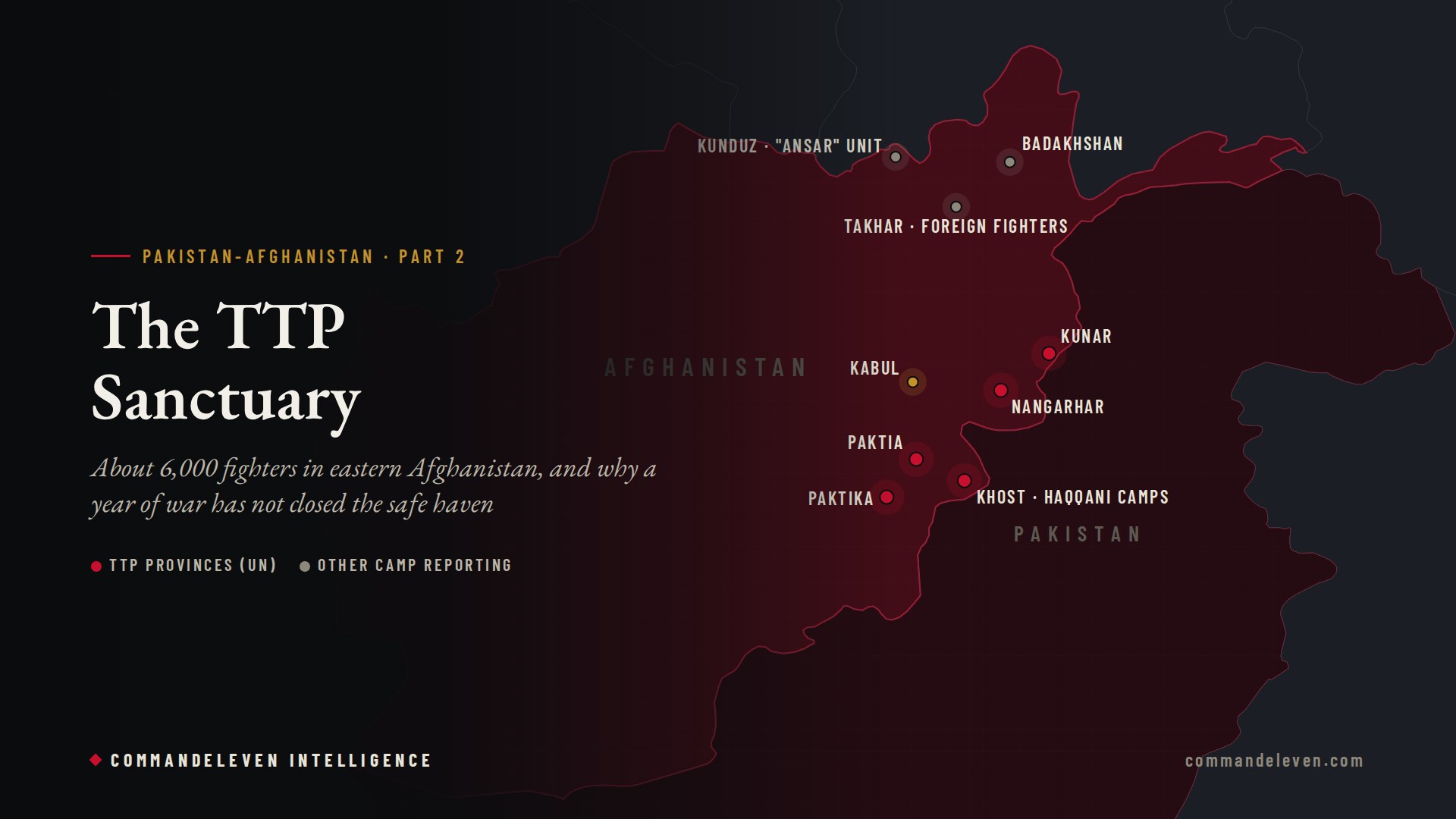
- [CONFIRMED] UN Security Council Monitoring Team reporting — the most authoritative independent sourcing available on this question — has documented approximately 6,000 Tehreek-e-Taliban Pakistan fighters present inside Afghan territory as of December 2025, concentrated in five eastern provinces: Khost, Kunar, Nangarhar, Paktika, and Paktia — precisely the provinces that bore the heaviest weight of Pakistan’s February-March 2026 air campaign documented in this series’ Part 1.
- [CONFIRMED] The same UN monitoring reporting documents TTP training infrastructure, leadership presence, and — critically — “information about individuals allegedly linked to Taliban networks facilitating transfers to the TTP and about financial assistance reaching TTP leadership,” the clearest independent (non-Pakistani-sourced) evidence available that the sanctuary relationship extends beyond passive tolerance into active facilitation by elements connected to the Taliban state itself.
- [CONFIRMED] TTP fighters have documented access to advanced U.S.-origin military equipment — M4 carbines, M24 sniper rifles, and M16A4 rifles fitted with optics and night-vision capability — consistent with equipment abandoned during the 2021 collapse of Afghan National Security Forces and, per Combating Terrorism Center research, in some documented cases directly transferred by sympathetic Afghan Taliban commanders rather than merely scavenged.
- [ASSESSED] The Taliban’s institutional unwillingness to act against TTP reflects a structural condition rather than a diplomatic failure correctable through further negotiation: TTP was organizationally built on the Afghan Taliban’s own template (shadow provincial governments, centralized military commissions), shares deep Pashtun tribal and personal ties with Taliban rank-and-file forged across two decades of shared insurgency, and Taliban leadership itself — even where it discourages formal TTP membership — faces a rank-and-file that regards supporting TTP as what CTC West Point’s research describes as “a religious and national obligation.”
- [ASSESSED] August 2026 UN Security Council session statements placed TTP alongside ISIS-Khorasan, the Balochistan Liberation Army, the East Turkistan Islamic Movement, and al-Qaeda-affiliated networks as groups of continuing international concern operating from Afghan territory — confirming this sanctuary question is not an isolated Pakistan-Taliban dispute but part of a broader, UN-documented pattern of multiple armed groups operating from the same geography, several of which this series treats individually (Part 3: al-Qaeda; Part 4: BLA).
What “Sanctuary” Actually Means Here
Pakistan’s core grievance throughout the war documented in Part 1 is not merely that TTP fighters are present somewhere inside Afghanistan — insurgent groups displaced across a porous, mountainous 2,600-kilometer border is a decades-old regional reality that predates the Taliban’s 2021 return to power. The grievance, stated precisely, is that TTP now operates from Afghan territory with training infrastructure, leadership sanctuary, and — per the UN’s own monitoring findings — facilitation networks connected to elements of the Taliban state itself, at a scale and level of institutional entanglement that distinguishes 2026’s TTP sanctuary from any prior iteration of cross-border militancy in the region’s history.
That distinction matters for how this dossier is built. CommandEleven Intelligence’s standard for this series, consistent with our editorial practice throughout, is to separate what is independently documented (principally, UN Security Council Monitoring Team reporting, which neither Pakistan nor the Taliban controls) from what is claimed by either direct party to the conflict. Pakistan’s own security dossiers and Taliban’s own denials both carry an obvious interest in how this question gets answered; the UN’s monitoring architecture does not carry the same interest, which is why this chapter leads with it.
The UN’s Own Findings
The clearest, most independently sourced picture of TTP’s Afghan footprint comes from the UN Security Council’s Analytical Support and Sanctions Monitoring Team, whose periodic reporting on groups listed under UN sanctions regimes has tracked TTP’s Afghan presence continuously since well before the current war began.
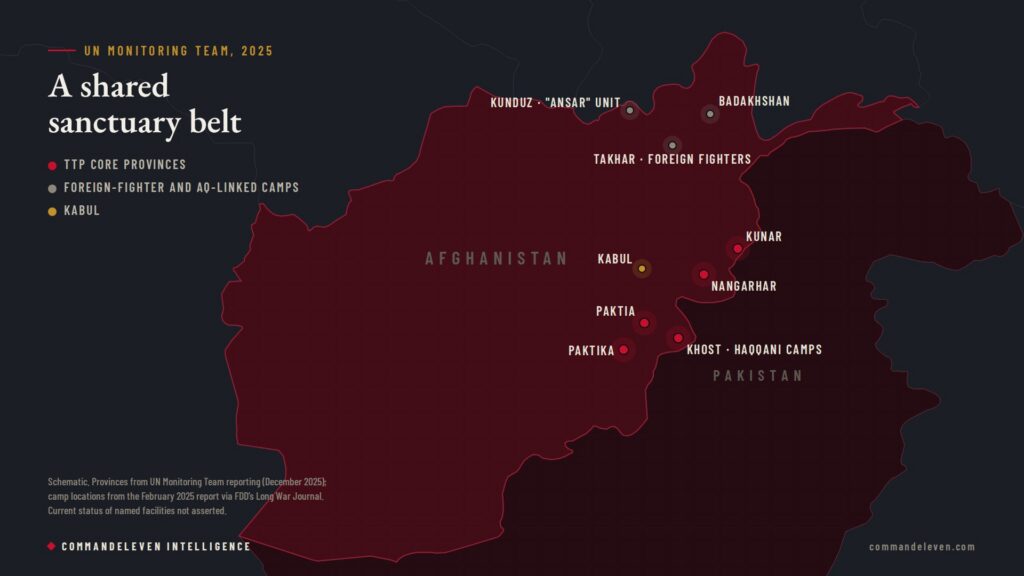
[CONFIRMED] The Monitoring Team’s December 2025 reporting documented approximately 6,000 TTP fighters present inside Afghan territory — a figure broadly consistent with earlier 2025 assessments in the 6,000-6,500 range, suggesting a stable rather than growing or shrinking force presence through the run-up to open war. Geographically, that presence concentrates in five eastern provinces: Khost, Kunar, Nangarhar, Paktika, and Paktia.
[ASSESSED] CommandEleven Intelligence’s own independent assessment, informed by sourcing this dossier does not detail in order to protect method and access, is that the UN’s publicly reported figure represents a credible floor rather than a comprehensive count of TTP’s actual Afghan-based strength. CommandEleven Intelligence is not in a position to disclose the basis for that assessment in a public dossier, and readers should weigh the UN figure above as the independently verifiable number; this note exists so readers are not left assuming CommandEleven Intelligence regards 6,000 as a ceiling. Readers of this series’ Part 1 will recognize all five as among the most heavily struck provinces in Pakistan’s February-March 2026 air campaign — direct confirmation that Pakistan’s targeting, whatever one concludes about its proportionality or effectiveness, was not aimed at diffuse or arbitrary territory but at the specific geography the UN’s own independent monitoring identifies as TTP’s operational core.
Beyond fighter counts and geography, the Monitoring Team’s reporting documents two further findings that CommandEleven Intelligence treats as the most consequential in this entire dossier: first, that TTP fighters have documented access to sophisticated weaponry — M4 carbines, M24 sniper rifles, M16A4 rifles equipped with optics and night-vision capability — representing a materially more capable force than a typical insurgent militia; and second, “information about individuals allegedly linked to Taliban networks facilitating transfers to the TTP and about financial assistance reaching TTP leadership.” This second finding is the independent evidentiary anchor for Pakistan’s central allegation: not merely that the Taliban tolerates TTP’s presence by failing to expel it, but that elements connected to Taliban networks are actively facilitating TTP’s logistics and financing. The UN’s own framing — “individuals allegedly linked to” — is appropriately cautious and falls short of a formal finding of Taliban state responsibility; CommandEleven Intelligence preserves that caution here rather than overstating the finding’s reach.
The Camp Infrastructure: What Satellite and Monitoring-Team Reporting Shows
Separate reporting — most substantially FDD’s Long War Journal, drawing on the UN Analytical Support and Sanctions Monitoring Team’s own periodic (1267 regime) reporting — documents specific training-camp infrastructure beyond TTP alone, illustrating that the eastern Afghan sanctuary belt functions as shared infrastructure for multiple armed groups rather than a TTP-exclusive network:
- Khost and Paktika provinces host newly identified training facilities reported to operate under Haqqani Network control — notable because the Haqqani Network sits inside the Taliban’s own governing structure (the Haqqanis hold senior Ministry of Interior positions in the Taliban government), meaning camp infrastructure in these two provinces carries a more direct institutional connection to the Taliban state than camps operating in more loosely controlled areas.
- Khost province separately hosts Jamaat Ansarullah (the Tajik Taliban) training facilities reported to include al-Qaeda engineers and weapons instructors — direct evidence of operational overlap between TTP’s sanctuary belt and the broader jihadist ecosystem this series’ Part 3 examines.
- Takhar province (Kalafgan district) hosts a dedicated training center reported to instruct Central Asian and Arab foreign fighters — geographically separate from the TTP-specific eastern provinces, indicating Afghanistan’s sanctuary function extends well beyond the Pakistan-specific dispute into a wider foreign-fighter pipeline.
- Kunduz province (Imam Sahib district) hosts what reporting describes as an “Ansar” unit focused specifically on cross-border infiltration operations, and Badakhshan province (Faizabad district) has documented joint Taliban/al-Qaeda/Jamaat Ansarullah operations including a dedicated suicide-bomber unit.
[DATA DEFICIT] CommandEleven Intelligence has not independently verified current (October 2026) operational status of each specific named facility; the sourcing above reflects the most recent systematic reporting available (UN Monitoring Team’s February 2025 report as relayed by FDD, with the UNSC’s August 2026 session statements confirming continuity of concern but not re-confirming each named facility individually). Given the intensity of Pakistan’s February-March 2026 air campaign — which specifically targeted “terrorist camps” in several of these same provinces — some of this named infrastructure may have been degraded or relocated since initial reporting; this dossier does not assume current operational status for any single named facility absent more recent confirmation.
Pakistan’s Own Evidentiary Claims
Separate from UN monitoring, Pakistan has released its own security dossier naming 260 Afghan nationals it alleges were killed while engaged in militant activity, including named individuals such as Dr. Obaidullah Saeed Badri (Logar), Noor Rahman alias Sarhadi (Wardak), and Ahmad Mukhlis (Nangarhar). [DATA DEFICIT] CommandEleven Intelligence treats this dossier as a genuine data point establishing Pakistan’s own targeting rationale and evidentiary basis for its campaign, but notes it is a unilateral document produced by a direct party to the conflict and has not been independently verified by a neutral third party; it is reproduced here as context for Pakistan’s own case, not as independently confirmed fact.
Why the Taliban Doesn’t — and Structurally Can’t Easily — Crack Down
The most analytically important question this chapter addresses is not whether TTP sanctuary exists (the UN’s own findings settle that), but why the Taliban has not acted to close it despite twelve months of escalating war, three failed rounds of Istanbul talks, and direct strikes against its own state military infrastructure. The Combating Terrorism Center at West Point’s research on this question identifies a structural rather than merely diplomatic answer.
TTP was built explicitly on the Afghan Taliban’s own organizational template — shadow provincial governments, centralized ministries, military commissions — by a movement that fought alongside the Afghan Taliban for two decades before 2021 and shares deep Pashtun tribal and personal networks with Taliban rank-and-file. CTC’s research documents that while Taliban leadership publicly discourages formal members from joining TTP’s war against Pakistan, the rank-and-file broadly regard supporting TTP as, in the research’s own framing, “a religious and national obligation” rooted in shared ideology and tribal obligation rather than top-down policy.
This produces exactly the “commitment problem” this series’ Part 1 identified as one of three structural reasons the war has not resolved: even a Taliban leadership genuinely motivated to constrain TTP fully may lack the organizational capacity to do so against a rank-and-file that shares TTP’s ideology and kinship networks. The evidence CTC cites for this dynamic is concrete rather than speculative — hundreds of TTP prisoners held by U.S. and Afghan forces were released after the August 2021 collapse, including founding TTP deputy emir Maulawi Faqir Muhammad Bajauri, who was documented addressing large TTP fighter gatherings urging continued war against Pakistan almost immediately after his release; and TTP’s acquisition of sophisticated U.S.-origin equipment abandoned in 2021 includes, per CTC’s research, cases of direct transfer by sympathetic Afghan Taliban commanders — not merely battlefield scavenging.
[ASSESSED] This is also where this chapter identifies a genuine point of Taliban leverage that undercuts the “the Taliban simply cannot control TTP” framing on its own: CTC’s research also documents that the Taliban successfully pressured TTP into 2021-2022 peace negotiations with Pakistan when it chose to apply that pressure, demonstrating that Taliban leadership does retain meaningful influence over TTP decision-making when sufficiently motivated. The structural sympathy problem described above constrains how far and how reliably the Taliban can act against TTP; it does not mean the Taliban has zero capacity to act at all. That distinction — constrained capacity rather than zero capacity — is the dossier’s central, carefully bounded judgment on this question, and it is precisely the distinction that makes this dispute resistant to either a purely military or a purely diplomatic resolution.
A Shared Sanctuary, Not a TTP-Exclusive One
The August 2026 UN Security Council session on Afghanistan placed TTP in explicit company: alongside ISIS-Khorasan, the Balochistan Liberation Army, the East Turkistan Islamic Movement, and al-Qaeda-affiliated networks, all named by member-state representatives (China, the United States, and Pakistan among them) as groups of continuing concern operating from Afghan territory, with China’s representative specifically noting that “terrorist groups based in Afghanistan…continue to increase both their intent and capability to conduct cross-border attacks.”
[ASSESSED] CommandEleven Intelligence reads this UN session framing as confirmation of this series’ core organizing premise: the TTP sanctuary question examined in this chapter, the al-Qaeda regional re-emergence signal this series’ Part 3 examines, and the Baloch insurgency this series’ Part 4 examines are not three unrelated stories that happen to share a dateline. They are UN-documented as operating from substantially overlapping Afghan territory, in the same window, with — per the camp infrastructure in Section III — documented operational overlap between at least TTP, Jamaat Ansarullah, and al-Qaeda-linked instructors in shared training facilities. A sanctuary belt capable of hosting one armed group’s training infrastructure is, by the same geography and the same state-capacity gap, capable of hosting several simultaneously.
Series Continuity and the GCTA Throughline
This chapter’s findings extend directly from this series’ Part 1: Pakistan’s air campaign targeted precisely the provinces the UN’s own independent monitoring identifies as TTP’s operational core, and twelve months later the sanctuary this chapter documents has been degraded in specific, named locations but not closed as a structural matter — consistent with the structural, rank-and-file-level sympathy problem Section V describes, which no number of airstrikes against camp infrastructure addresses at its root. This is the single clearest regional illustration available of CommandEleven Intelligence’s extended “Hard War ceiling of efficacy” thesis introduced in Part 1 — an application of the GCTA’s original domestic-radicalization framework to regional sanctuary-denial operations: a numerically and technologically superior conventional military campaign, conducted against named and geographically specific targets with real tactical effect, has not resolved a sanctuary problem whose root cause is organizational, ideological, and tribal rather than purely territorial.
This chapter also cross-links rather than repeats CommandEleven Intelligence’s existing ISKP Convergence Series coverage — specifically The TTP/ISKP Technical Handshake and Evolving Profile of TTP: Transnational Safe Havens & Border Operations — which examine TTP’s own operational relationship with Islamic State-Khorasan in greater depth than this chapter’s sanctuary-focused scope requires. Readers seeking the ISKP-specific dimension of TTP’s regional posture should treat that existing coverage as this chapter’s companion piece. Part 3, next in this series, turns from TTP specifically to al-Qaeda’s own regional re-emergence signal — a related but organizationally distinct thread operating from substantially the same geography this chapter has mapped.
Frequently Asked Questions
Where is the TTP based in Afghanistan?
UN Monitoring Team reporting places about 6,000 TTP fighters in Afghanistan’s eastern provinces: Khost, Kunar, Nangarhar, Paktika and Paktia.
Does the Taliban support the TTP?
The UN has reported information about individuals linked to Taliban networks facilitating transfers and financial assistance to TTP leadership. It stops short of a formal finding of Taliban state responsibility.
Why hasn’t the Taliban acted against the TTP?
The TTP was built on the Afghan Taliban’s model and shares deep tribal and personal ties with its rank-and-file, many of whom see supporting it as an obligation. The Taliban’s capacity to act is constrained, not absent.
Sourcing Base (Confidence-Tiered, with Links)
CONFIRMED — UN/Institutional Primary Sourcing:
- Asia Times, “Afghanistan’s TTP sanctuary is becoming harder to deny” (relaying UN Security Council Monitoring Team’s December 2025 report)
- Kabul Now, “UNSC Remains Concerned Over Presence and Capabilities of Terror Groups in Afghanistan” (August 2026 UNSC session)
- Amu TV, “UN says Taliban provide safe haven to terrorist groups“
- Dawn, “Kabul’s claim of denying militants safe haven called into question“
CONFIRMED — Camp Infrastructure Reporting (UN-sourced via FDD/Long War Journal):
- FDD, “Pakistani and Tajik Taliban open training camps in Afghanistan“
- FDD’s Long War Journal, same report (full citation)
- Amu TV, relay reporting on the same UN Monitoring Team findings
ASSESSED — Structural/Analytical Research:
- Combating Terrorism Center at West Point, “The Tehrik-i-Taliban Pakistan After the Taliban’s Afghanistan Takeover“
- GW Program on Extremism, “Understanding Tehrik-e-Taliban Pakistan’s Unrelenting Posture“
- FDD, “The ‘bonds are close’ as the Pakistani Taliban benefits from its Afghan safe haven“
- ACLED, “The battle for the borderlands: The Tehreek-i-Taliban Pakistan challenges the state’s control“
- International Crisis Group, “The Pakistani Taliban Test Ties between Islamabad and Kabul“
CommandEleven Intelligence Prior Work (Cross-Reference):
- CommandEleven Intelligence, ISKP Convergence Series: The TTP/ISKP Technical Handshake and Evolving Profile of TTP: Transnational Safe Havens & Border Operations
- CommandEleven Intelligence, The Asymmetric Triad: Border Transnational Handshakes, June 2, 2026
- CommandEleven Intelligence, Western Weapons Proliferation: TTP & BLA Telemetry Audit, May 25, 2026
- CommandEleven Intelligence, 2026 Global Counter-Terrorism Assessment, April 2026 (Hard War ceiling-of-efficacy thesis, originally applied to domestic radicalization; the regional application here is CommandEleven Intelligence’s own extension)
- CommandEleven Intelligence, GCTA Foresight Audit, Part 2: The Indian Subcontinent, which reconciles this dossier’s UN-sourced province list with the different list the GCTA gave for the same fighter count; the UN record supports the eastern provinces named here
Excluded from this dossier: Pakistan’s 260-name security dossier is presented as Pakistan’s own unilateral evidentiary claim (Section IV), not adopted as independently verified fact. Current (October 2026) operational status of specific named training facilities in Section III is not asserted given the intervening Pakistani air campaign and the absence of more recent facility-level confirmation.
The Pakistan-Afghanistan Series
- Open War: The 2026 Pakistan-Afghanistan Escalation Timeline – Part 1
- The TTP Sanctuary Question: Mapping a Denied Safe Haven – Part 2 (you are here)
- Hamza bin Laden and Al-Qaeda’s Regional Re-Emergence – Part 3
- The Baloch Insurgency Uptick: A Second Front Under Pressure – Part 4
- Synthesis: A Region Under Simultaneous Pressure – Part 5

