Bottom Line Up Front
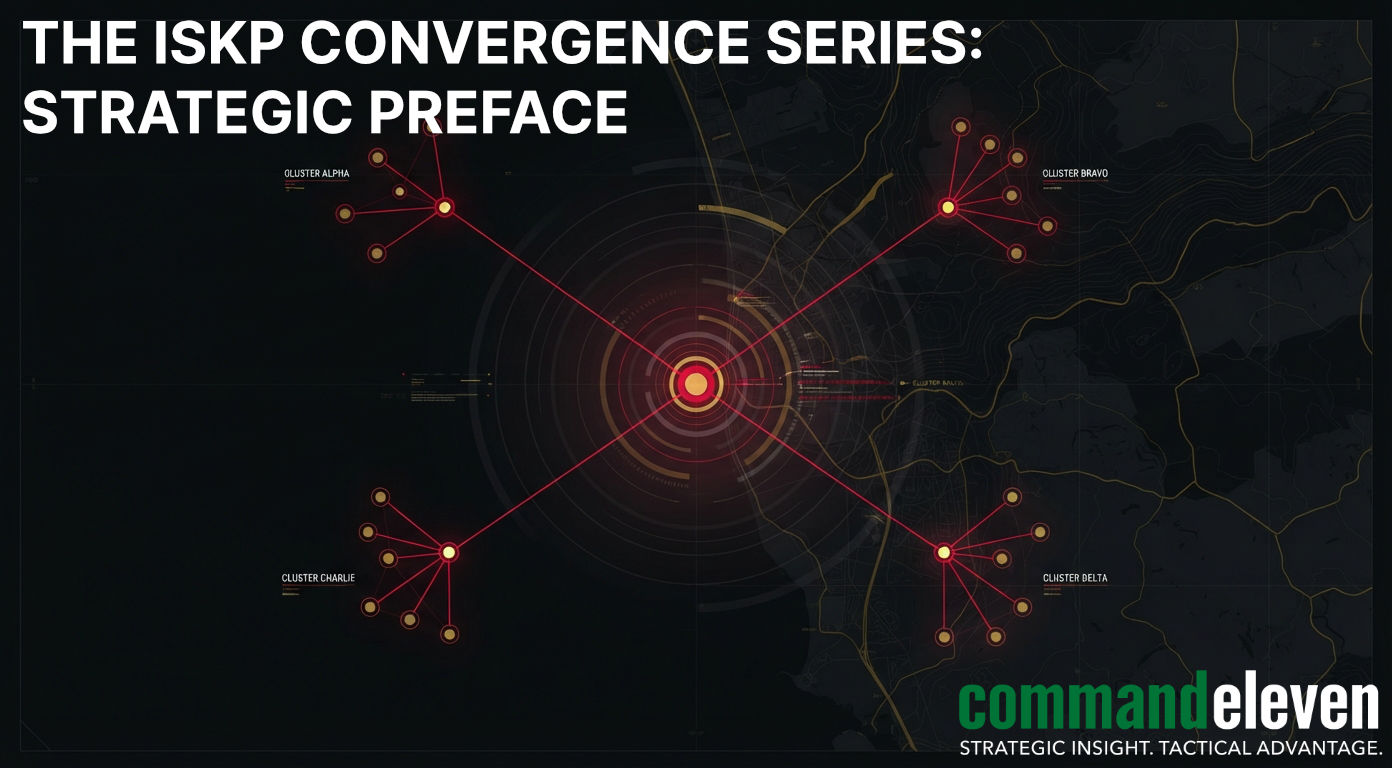
Between May 5 and May 26, 2026, CommandEleven Intelligence documented a pattern that does not fit the standard framework analysts use for South and Central Asian militancy. Islamic State–Khorasan Province (ISKP) – long treated as the ideological outlier among the region’s non-state actors, structurally hostile to the Taliban and rhetorically opposed to nationalist insurgent movements – was found establishing parallel, bilateral technical linkages with three groups it has no business cooperating with: the Baluchistan Liberation Army (BLA), Tehreek-e-Taliban Pakistan (TTP), and elements tied to the Haqqani network. None of these three relationships resembles a merger, a formal alliance, or a change in any group’s stated ideology. What they resemble is a marketplace – logistics, technical know-how, and operational tradecraft moving across ideological lines that were, until recently, treated as fixed.
This series consolidates CommandEleven Intelligence’s reporting on that pattern into a single analytical throughline.
The Convergence Thesis
Regional counter-terrorism analysis has historically modeled South and Central Asian militancy as a set of discrete, ideologically bounded actors: ISKP (transnational Salafi-jihadist, anti-Taliban), TTP (Deobandi, Pakistan-focused, Taliban-aligned), the Haqqani network (Taliban-integrated, historically ISI-adjacent), and the BLA (secular ethno-nationalist, ideologically opposed to all of the above). Treating these as separate lanes has been analytically convenient and, until recently, largely accurate.
The evidence assembled across this series argues that the lanes are no longer fully separate – not at the level of command and ideology, which remain distinct, but at the level of technical infrastructure: weapons and component sourcing, communications tradecraft, safe-haven arrangements, and logistics corridors. CommandEleven Intelligence’s working term for this pattern is the technical handshake – a bounded, transactional point of contact between organizations that remain adversarial or indifferent to one another at the doctrinal level, but that have found it operationally useful to share specific capabilities.
This is a materially different claim than “alliance” or “merger,” and the distinction matters for anyone briefing this series’ findings upward.
Confidence & Methodology Note
Every handshake documented in this series is assessed, not confirmed, unless a specific piece is explicitly sourced to named reporting, seized materiel, or on-the-record government attribution. Readers should treat the “handshake” framing as CommandEleven Intelligence’s structural interpretation of converging tactical, logistical, and technical indicators – not as evidence of coordinated command, shared leadership, or ideological convergence between the groups involved. Where the underlying sourcing is thin, single-sourced, or inferential, the individual dossiers flag it accordingly. This preface does not restate those tiering calls; consult each part’s own sourcing notes before citing a specific claim externally.
Series Roadmap
Framing
- Narrative Pre-Positioning & The ISKP Vector – how ISKP’s information operations set the narrative conditions ahead of the convergence pattern documented below
- The ISKP Vector & Global Security Mandates – why ISKP’s trajectory carries implications beyond South Asia’s immediate theater
- The ISKP Wildcard: Intelligence Assessment on Asymmetric Convergence – the framing piece that first identifies ISKP as the connective node across otherwise-separate insurgent lanes
The Handshakes
- The BLA/ISKP Technical Handshake – the least expected of the three pairings, given the BLA’s secular-nationalist orientation
- The TTP/ISKP Technical Handshake – the most operationally consequential pairing given TTP’s existing footprint inside Pakistan
- The Haqqani/ISKP Technical Handshake – the most sensitive pairing given the Haqqani network’s formal integration into the Afghan Taliban state apparatus
- The HQN/ISKP Handshake: Logistical Convergence & Mechanical Triad – a deeper technical audit of the Haqqani linkage’s logistics architecture
Operational Status & Outlook
- Overwatch Brief: Dual-Front Insurgency Status (North vs. Baluchistan) – a current-state snapshot of the two active insurgent fronts this convergence pattern now touches
- Evolving Profile of TTP: Transnational Safe Havens & Border Operations – how TTP’s own operational posture has shifted in the period covered by this series, read against the handshake findings above
What This Series Does Not Claim
This series does not assert that ISKP, TTP, the Haqqani network, and the BLA have formed a coalition, share a command structure, or have reconciled their respective ideological positions – they have not, and nothing in this series should be cited as evidence that they have. It does not claim these are the only such technical linkages active in the region, only the ones CommandEleven Intelligence has been able to document and assess to a reportable confidence level. And it does not extend this convergence framework to actors or regions outside the specific South and Central Asian theater covered here.
The ISKP Convergence Series
- Narrative Pre-positioning & The ISKP Vector
- The ISKP Vector & Global Security Mandates
- The ISKP Wildcard
- The BLA/ISKP Technical Handshake
- The TTP/ISKP Technical Handshake
- The Haqqani/ISKP Technical Handshake
- The HQN/ISKP Handshake: Logistical Convergence & Mechanical Triad
- Overwatch Brief: Dual-Front Insurgency Status
- Evolving Profile of TTP: Transnational Safe Havens & Border Operations