
Bottom Line Up Front
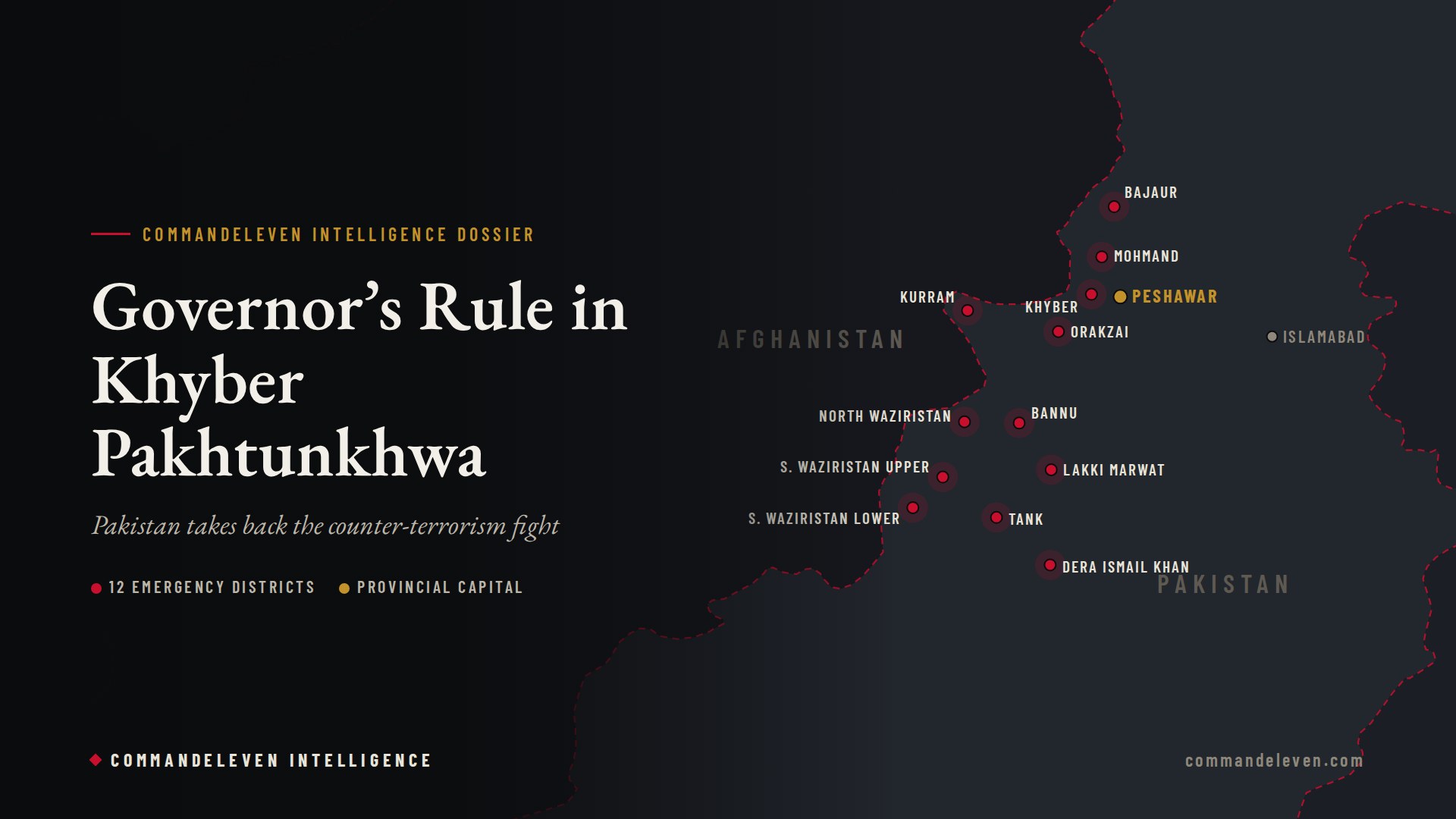
On Sunday, October 11, 2026, President Asif Ali Zardari, acting on Prime Minister Shehbaz Sharif’s advice, imposed Governor’s Rule across Khyber Pakhtunkhwa under Article 234 of the Constitution and an emergency in 12 districts under Article 232. The PTI-led provincial government of Chief Minister Sohail Afridi was suspended. Governor Faisal Karim Kundi now runs the province with an 11-member advisory council, and a new Area Development Secretariat governs the 12 districts where the militancy is concentrated.
The federal government’s stated reason is the provincial government’s “deliberate disengagement from the fight against terrorism.” The numbers behind that charge are severe: terrorist incidents in the province up 195% since March 2024, nearly three-quarters of 2026 attacks aimed at police and security forces, and 556 people killed in the province in the third quarter of 2026 alone.
CommandEleven Intelligence has assessed since 2023 that the counter-terrorism fight in Khyber Pakhtunkhwa was being weakened by a divided command, with the province and the federation pulling in opposite directions. Governor’s Rule ends that split. It does not, by itself, win the fight. It buys a window of two to six months in which the state has to show results, in the province where the Tehreek-e-Taliban Pakistan (TTP) is strongest and where the suspended government’s party is most popular.
Key Judgments
KJ1: Governor’s Rule puts the counter-terrorism fight in Khyber Pakhtunkhwa under one command for the first time since the 2018 merger of the tribal districts. The province’s police, Counter Terrorism Department and district administrations now answer to the same chain as the federal security apparatus, with the army deployed in aid of civil power. [CONFIRMED on structure; ASSESSED on significance]
KJ2: Independent data supports the federation’s security case, but several of its specific charges against the provincial government are still claims. Violence figures from the Center for Research and Security Studies (CRSS) match the trend the federal government presented. The funding and governance charges, such as the police budget shortfall and the delayed Apex Committee meetings, come from the federation and have not been independently tested. [ASSESSED]
KJ3: The announced approach is intelligence-based operations, not a large offensive, and that is the right model. Governor Kundi ruled out full-scale military offensives. Pakistan’s most durable counter-terrorism success, Karachi from 2013, was built on intelligence-based operations against militants, financiers and facilitators. [ASSESSED]
KJ4: The largest risk is political, not military. Khyber Pakhtunkhwa is PTI’s stronghold. Mass detentions, communications blackouts and the suspension of an elected government give the TTP a grievance narrative to exploit, as the Bannu protest shootings of July 2024 showed. [ASSESSED]
KJ5: The clock is short and fixed. A Governor’s Rule proclamation lapses after two months unless a joint sitting of Parliament approves it, and it cannot run beyond six months in total. Measurable results in the 12 districts are needed inside that window. [CONFIRMED on the legal limits]
KJ6: Expect the TTP to test the new arrangement early. A high-profile attack in Peshawar or the southern districts in the first weeks would aim to show that Governor’s Rule changed nothing. [SPECULATIVE]
What Happened
The cabinet met in emergency session on October 11, was briefed on the province’s security situation, and recommended both measures. Talks between the federal government and the provincial leadership had broken down on October 3, reportedly over counter-terrorism cooperation and over access to the jailed PTI founder, Imran Khan.
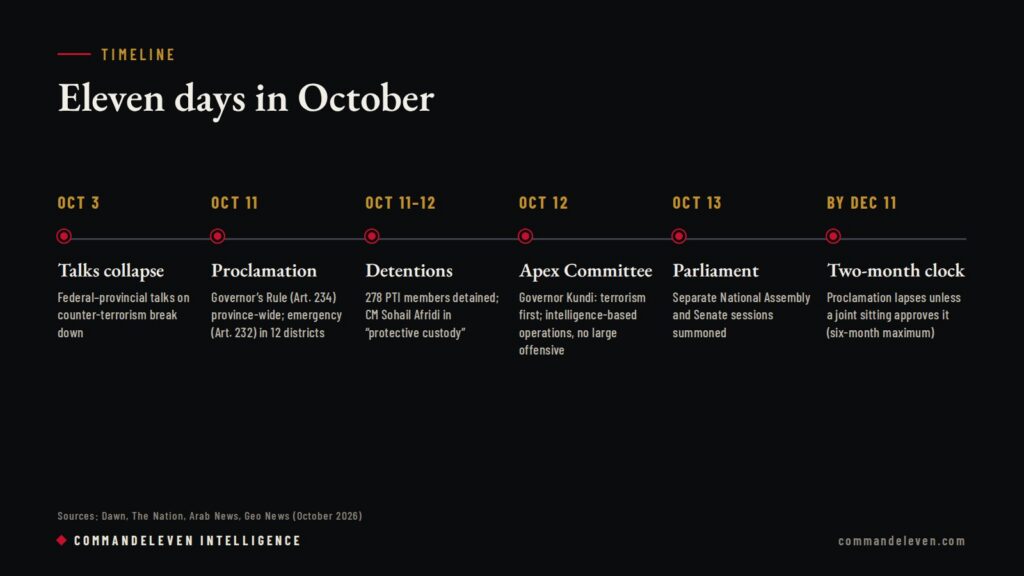
The new arrangement has four parts:
- Governor’s Rule (Article 234), province-wide. Governor Faisal Karim Kundi governs on the federation’s behalf with an 11-member technocratic advisory council. Dr. Muhammad Fakhr Alam Irfan was appointed chief secretary.
- Emergency (Article 232) in 12 districts. The eight merged tribal districts (Bajaur, Mohmand, Khyber, Kurram, Orakzai, North Waziristan, and South Waziristan Upper and Lower) plus Dera Ismail Khan, Tank, Lakki Marwat and Bannu. The emergency fully covers the Bannu and Dera Ismail Khan divisions. Hazara and Mardan divisions are outside it.
- An Area Development Secretariat under an additional chief secretary, which takes operational and administrative control of officials in the 12 districts, supported by a representative council of local members.
- Troops in aid of civil power. The federal government authorized army deployment under Article 245.
Within the first 48 hours, police officials told AFP that 278 PTI members had been detained. The government says Sohail Afridi is in “protective custody.” Containers blocked roads in Peshawar, gatherings were restricted, and mobile and internet services were disrupted in parts of the province. PTI has called the move unconstitutional and says it will challenge it in court.
On October 12, Governor Kundi chaired a Provincial Apex Committee with Interior Minister Mohsin Naqvi, the Peshawar Corps Commander, the chief secretary and the inspector general of police. His stated priorities: terrorism first, development second; more resources, pay and martyrs’ packages for police; strengthening the Counter Terrorism Department; and action against terrorists’ financiers and facilitators. He also said there would be no talks with Kabul and signaled an operation against undocumented Afghan nationals.
Why Now: The Numbers
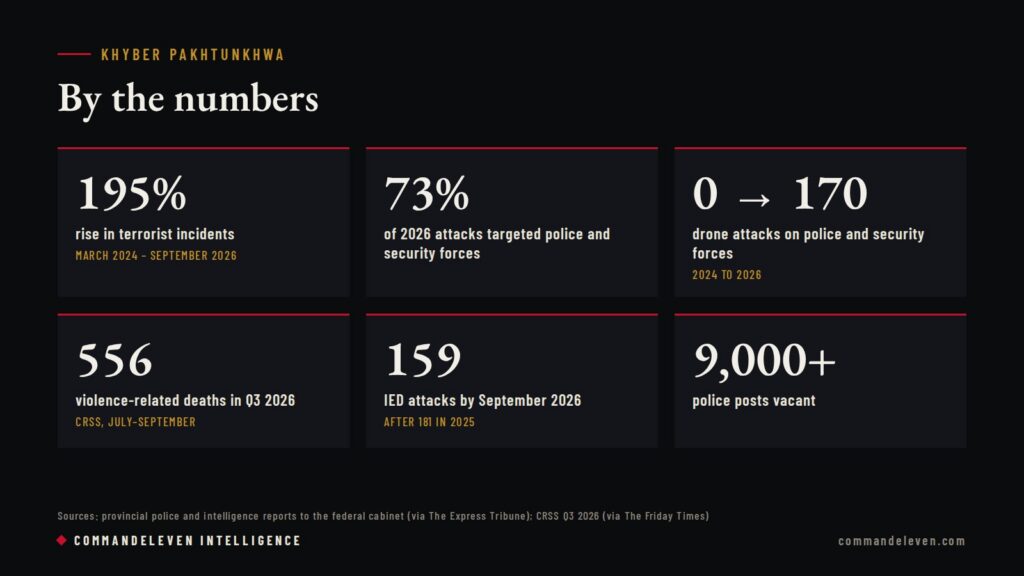
The federal case rests on two security reports by the province’s police and intelligence agencies, presented to the cabinet by the Intelligence Bureau’s director general:
- Terrorist incidents in the province rose 195% between March 1, 2024 and September 23, 2026.
- 73% of 2026 attacks targeted police and security personnel.
- Drone attacks on police and security forces went from zero in 2024 to 170 by 2026.
- 181 roadside-bomb (IED) attacks in 2025, and 159 more by September 2026.
- More than 9,000 police posts are vacant.
Independent data points the same way. CRSS recorded 556 violence-related deaths in Khyber Pakhtunkhwa in the third quarter of 2026 (July to September), with 173 incidents, 45% of the national total. Nationally, fatalities rose 83% over the previous quarter, the sharpest quarter-on-quarter rise since 2021.
The federation’s governance charges are harder to verify. It says the provincial police asked for Rs42 billion, received approval for Rs14 billion, and saw Rs1.4 billion released; that 19% of Counter Terrorism Department posts are vacant; and that the chief minister took 112 days to convene his first Apex Committee meeting. These figures come from the federal government and should be treated as its claims until they are tested in Parliament or court. [ASSESSED]
One fair objection deserves an answer. PTI asks why Balochistan, which CRSS shows was deadlier than Khyber Pakhtunkhwa in the third quarter (829 deaths), was not treated the same way. The answer is that the federal government’s charge is not violence alone, but non-cooperation: Balochistan’s government works with the federal security apparatus, while Khyber Pakhtunkhwa’s had, in the federation’s account, opened its own channels to the Afghan Taliban and stepped back from joint operations. Whether that charge holds is the question Parliament and the courts will now examine. [ASSESSED]
What CommandEleven Intelligence Assessed
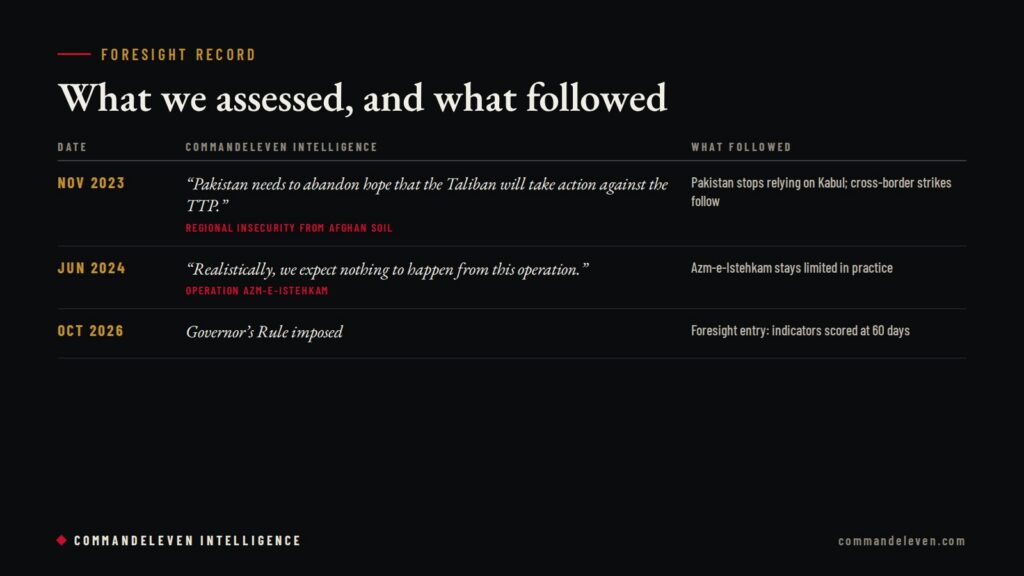
CommandEleven Intelligence’s published assessments on the counter-terrorism fight in the province and along the Pakistan-Afghanistan border:
- November 2023, Regional Insecurity: Assessing Cross-Border Terror Risks: “Pakistan needs to abandon hope that the Taliban will take action against the TTP,” and Pakistan “will respond with air strikes on known TTP training camps.” Both proved correct: Pakistan stopped relying on Kabul and moved to cross-border strikes, culminating in Operation Ghazb lil Haq.
- June 2024, Operation Azm-e-Istehkam: “Realistically, we expect nothing to happen from this operation,” predicting minor, localized operations rather than the grand campaign announced. Azm-e-Istehkam stayed limited in practice.
This dossier will be added to the CommandEleven Intelligence Foresight Record. Its watch indicators below will be scored at the end of the two-month window: what went as assessed, what did not, and what is still pending.
What Changes on the Ground
One command. For eight years, counter-terrorism in the merged districts has depended on cooperation between a federal security apparatus and a provincial government that often did not share its strategy. Under Governor’s Rule, the police, Counter Terrorism Department and district administrations take direction from the same chain as the army and the intelligence agencies. That removes the single largest structural weakness in the province’s counter-terrorism effort. [ASSESSED]
Intelligence-based operations, not offensives. Governor Kundi ruled out full-scale military offensives in favor of intelligence-based operations. That is consistent with what has worked in Pakistan. The Karachi operation that began in 2013, which CommandEleven Intelligence analyzed in The Operation That Empowered a City, succeeded because it targeted militants, financiers and facilitators through sustained intelligence work rather than large-scale clearance. Large offensives in the tribal districts cleared ground but displaced populations and, as the 2024 experience in Bannu showed, turned residents against the security forces. [ASSESSED]
The police are the front line. With 73% of attacks aimed at police and security forces, and drones now a routine part of the TTP’s arsenal, police capacity is the binding constraint. The pledges on pay, equipment and martyrs’ packages matter, but the 9,000 vacant posts will not be filled in two months. Watch whether recruitment and the Counter Terrorism Department’s staffing move measurably inside the window. [ASSESSED]
The Afghan dimension. “No talks with Kabul” formalizes what Operation Ghazb lil Haq already put into practice: Pakistan now treats the Afghan Taliban as the TTP’s sponsor, not as a partner against it. CommandEleven Intelligence’s assessments of the cross-border campaign are in Operation Ghazab lil-Haq Analysis and Battle Damage Assessment: Pakistan Kinetic Operations in Afghanistan. The TTP’s sanctuary structure is mapped in Evolving Profile of TTP: Transnational Safe Havens & Border Operations. [ASSESSED]
The Risks
A legitimacy gap the TTP can use. The suspended government won the province’s last election. Detentions of party workers, the chief minister in custody, and a communications blackout create grievances that militant propaganda will frame as Islamabad occupying the Pashtun belt. In July 2024, security forces firing on protesters in Bannu turned local opinion against the army almost overnight. A repeat under Governor’s Rule would hand the TTP its best recruiting material. [ASSESSED]
Collective blame. The governor’s line that “you will find an Afghan national behind every terrorist activity,” and the signaled operation against undocumented Afghans, risk treating a refugee population as a security category. Pakistan has legitimate grounds on cross-border sanctuary; a blanket crackdown would also serve the Afghan Taliban’s narrative and the TTP’s recruitment. [ASSESSED]
The legal clock and the courts. If a joint sitting does not approve the proclamation within two months, it lapses. PTI has announced a court challenge. An adverse ruling or a stalled approval would end the arrangement before it produces results, and leave the province’s counter-terrorism effort more divided than before. [ASSESSED]
Measuring success honestly. Pressure to show quick results can produce inflated “militants killed” figures. The real tests are fewer attacks on police, fewer civilian deaths, and restored movement on the roads of the southern districts, where residents of the 12 districts reportedly struggle to leave home after sunset. [ASSESSED]
Indicators to Watch (Foresight Entry)
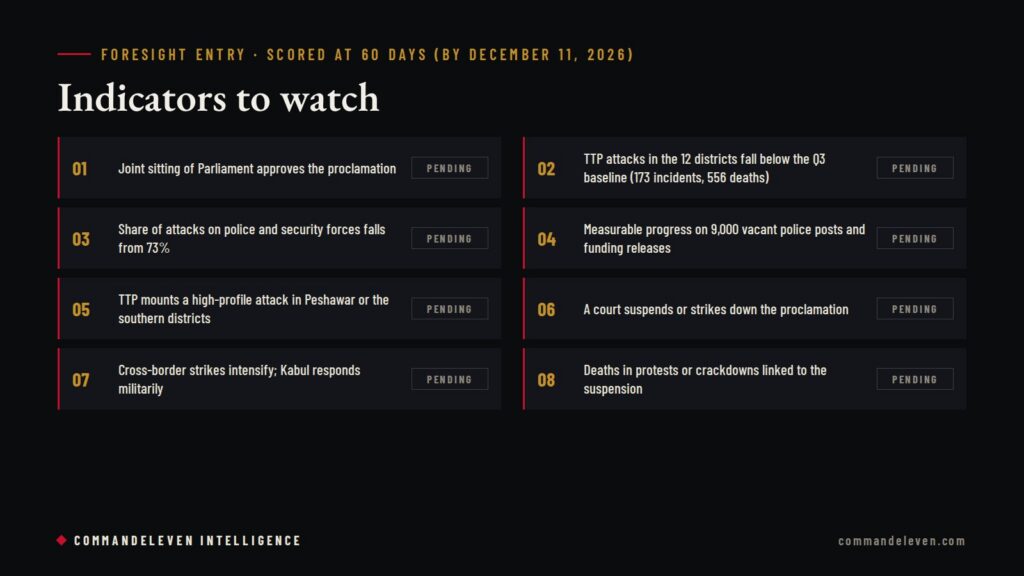
These indicators will be scored at the end of the two-month window, around December 11, 2026:
- Parliamentary approval. Does a joint sitting approve the proclamation within two months?
- Attack tempo. Do TTP attacks in the 12 districts fall, measured against CRSS’s third-quarter baseline of 173 incidents and 556 deaths for the province?
- Attacks on police. Does the share of attacks targeting police and security forces fall from 73%?
- Police capacity. Is there measurable progress on the 9,000 vacant posts and the release of police funding?
- A TTP spectacular. Does the TTP mount a high-profile attack in Peshawar or the southern districts to discredit the arrangement?
- Courts. Does any court suspend or strike down the proclamation?
- Afghanistan. Do cross-border strikes intensify, and does Kabul respond militarily?
- Civil unrest. Are there deaths in protests or crackdowns linked to the suspension of the provincial government?
What This Dossier Does Not Claim
- It does not claim the suspended provincial government had an alliance with terrorists. That is the federal government’s charge, and it has not been proven.
- It does not claim Governor’s Rule will defeat the TTP. It assesses that unified command makes success possible, not certain.
- It does not take a position on PTI’s wider political dispute with the federal government, beyond its effect on counter-terrorism.
Frequently Asked Questions
What is Governor’s Rule in Pakistan?
Under Article 234 of Pakistan’s Constitution, the president can direct a province’s governor to run it on the federal government’s behalf when the provincial government cannot be carried on in line with the Constitution. The proclamation lapses after two months unless a joint sitting of Parliament approves it, and it cannot last more than six months in total.
Why was Governor’s Rule imposed in Khyber Pakhtunkhwa?
The federal government cited the provincial government’s “deliberate disengagement from the fight against terrorism,” after talks broke down on October 3, 2026. Terrorist incidents in the province rose 195% between March 2024 and September 2026.
Which districts are under emergency?
Twelve: Bajaur, Mohmand, Khyber, Kurram, Orakzai, North Waziristan, South Waziristan Upper and Lower, Dera Ismail Khan, Tank, Lakki Marwat and Bannu.
Who is running Khyber Pakhtunkhwa now?
Governor Faisal Karim Kundi, with an 11-member advisory council. Former chief minister Sohail Afridi is in what the government calls protective custody.
Will there be a military operation?
The governor has ruled out full-scale military offensives. The approach announced is intelligence-based operations against militants, financiers and facilitators, with the army deployed in aid of civil power.
Related CommandEleven Intelligence Coverage
- Operation Ghazab lil-Haq Analysis
- Battle Damage Assessment: Pakistan Kinetic Operations in Afghanistan
- Retribution: Assessment of Pakistan’s Kinetic Response in Kabul
- Tehreek-e-Taliban Pakistan (TTP) Strength Assessment
- The Makkah Pact’s First Test
Sources
- Emergency, governor’s rule imposed in KP as president approves cabinet decision, Dawn, October 11, 2026
- Governor vows new era of counterterror efforts, Dawn, October 13, 2026
- Emergency, governor’s rule imposed in KP, The Nation, October 12, 2026
- Khyber Pakhtunkhwa governor says eliminating ‘terrorism’ top priority amid emergency rule, Arab News
- Terror attacks in K-P surge 195% since 2024, The Express Tribune, October 12, 2026
- Governor’s rule imposed in K-P for fourth time, The Express Tribune
- Pakistan Violence: 83% Rise In Fatalities During Third Quarter, The Friday Times (CRSS data), October 5, 2026
- Understanding Governor’s Rule In Pakistan’s Khyber Pakhtunkhwa, Eurasia Review, October 13, 2026
- Pakistan: Governor’s Rule And The Battle To Restore Security In Khyber Pakhtunkhwa, Eurasia Review, October 12, 2026
- Live updates: PTI’s Islamabad long march, Geo News

