Status as of November 18, 2026. Part 1 of 3 in the Gulf at War series. The assessment is ours. The IISS Strategic Dossier The Gulf at War (October 2026) and its Gulf-South Asia analysis are two of our sources, and IISS judgments are attributed to IISS. Read the introduction first: The Gulf at War: Eight Months of Iranian Fire, and a Record of Our Own Calls.
Bottom Line Up Front
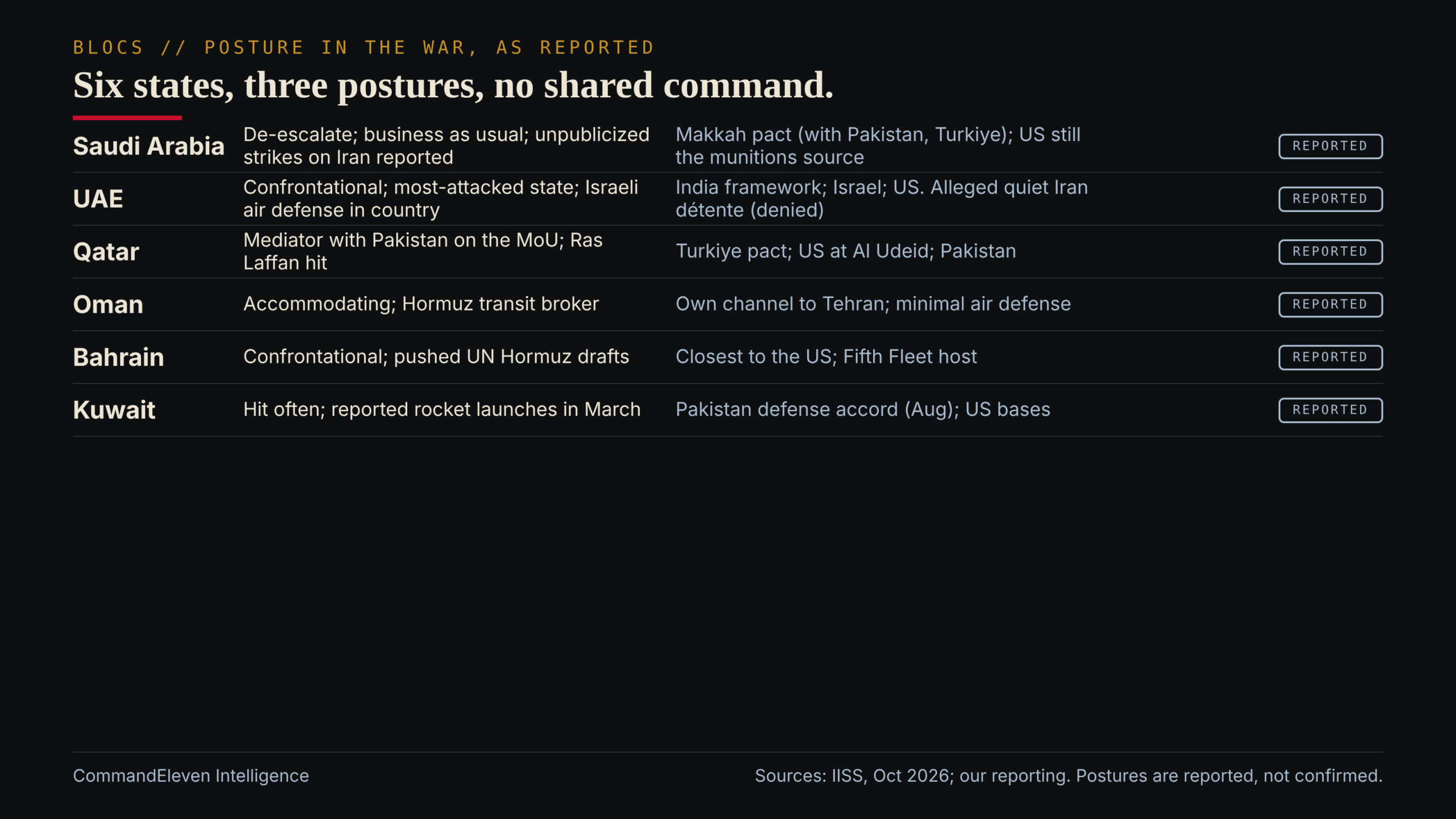
The war did not break the Gulf’s alliances. It changed what each one is for. Washington remains the Gulf’s source of munitions and the only power that can reopen the strait, but the Gulf states now see a partner that dispersed its forces, served Israel first on interceptors and took decisions about the war without them. Their answer is not one answer. Saudi Arabia, Qatar and Oman lean toward de-escalation and hedging. The UAE and Bahrain lean toward a harder line and a closer tie to Washington and, in the UAE’s case, Israel. Pakistan and Turkiye have moved from the edge of the Gulf’s security map to its middle.
We assess, with moderate confidence, that the Gulf now has a real if informal say over whether the US escalates, and that this is the most important change in who stands with whom. We also assess that the Gulf is less united than it was in 2025, and that the split is between Riyadh and Abu Dhabi more than between the Gulf and Iran.
Key Judgments
- ASSESSED: MODERATE. Gulf trust in the US has changed shape, not ended. The Gulf states still depend on American munitions, maintenance and early-warning data. IISS reports that Washington fired more interceptors defending Israel than Israel did and that Gulf stockpiles ended up dangerously low. IISS also counts more than 220 US structures or pieces of equipment struck across the region and three of the eight THAAD batteries in the world taken out.
- REPORTED. The Gulf Cooperation Council’s joint defense pact was not activated in the 2026 war. IISS notes it was invoked for the first time in September 2025 after the Israeli and Iranian attacks on Doha. In 2026, defense was national or bilateral.
- ASSESSED: MODERATE. The Saudi-Emirati split is the Gulf’s main fault line. IISS has Saudi Arabia and Qatar preferring de-escalation while the UAE pressed for a decisive outcome, and the two fell out over Sudan, Yemen and Somalia before the war started. Our own reporting on the Makkah pact and Operation Dawn of Yemen points the same way.
- REPORTED. Saudi Arabia, Pakistan and Turkiye signed the Makkah Joint Defence Agreement in August. The text is not public. The Turkish foreign minister called it technically the same as NATO’s Article 5, according to IISS. A permanent secretariat sits in Riyadh with a Pakistani secretary-general for the first three years. IISS reports that Pakistani and Turkish forces deployed to Saudi Arabia under it in October. We cannot confirm the troop numbers.
- REPORTED. Pakistan keeps close to a brigade in Saudi Arabia at all times. That is standing presence under the 2025 mutual defense pact, not a 2026 deployment. IISS reports about 8,000 Pakistani personnel by April. The new element is the Yemen rollout in August, which our Pakistan Army sources date to that month.
- ASSESSED: MODERATE. Washington’s own account is that the Gulf asked it to hold off. On November 10 President Trump said he was holding off new strikes at the request of Qatar, Saudi Arabia, the UAE, Bahrain and Kuwait, and he repeated the point in an interview with Stephen A. Smith reported on November 13. He made similar claims in May and on August 2. No Gulf government has said this itself. We treat it as the President’s account.
- ALLEGED. A quiet UAE-Iran détente after the May 4 Fujairah strike, including a release of billions held in Iranian accounts. IISS reports it. The UAE denies it.
- NOT ESTABLISHED. That any Gulf state has chosen Beijing over Washington. IISS finds the Gulf will not replace the US with China, and China’s help to Iran has hurt Gulf trust in Beijing.
What Is Established
The Gulf and Washington
Before the war, the Gulf’s outlook was optimistic. IISS lists the May 2025 presidential visit and pledges of about $2 trillion, a Saudi F-35 decision in November 2025, a civil nuclear deal, and an executive order promising to defend Qatar after the September 2025 strike on Doha. The first crack was June 2025, when Iran struck Al Udeid after American strikes on its nuclear sites.
The war then put strain on each of those assumptions. IISS reports that the US pulled command and control back to the United States, dispersed forces from the Gulf, kept destroyers in the eastern Mediterranean and Red Sea, and rendered the Fifth Fleet base in Bahrain at least partly inoperable. It also reports friction over Project Freedom, the American effort in early May to secure commercial transit. Saudi Arabia and Kuwait denied bases at first, and Riyadh backed down after Washington threatened to withhold interceptors.
This is where we part from IISS on attribution. IISS attributes the decision to go to war in part to Israeli pressure on Washington. We do not adopt that. CommandEleven Intelligence’s Executive Director has said publicly, on Survival Dispatch News and Soft Targets America, that this was a catastrophic war effort undertaken on behalf of the Trump administration, that it should have been handled differently and that it should not have been start-stop. He has not said it was driven by Israel’s prime minister. We agree with IISS on the effect, which is that the Gulf bore costs it had not chosen.
What the Gulf says it wants
Trump’s claim that the Gulf asked him to hold off is the clearest recent case. It matters for two reasons. If it is accurate, the Gulf has found a way to shape American escalation that its pre-war partnership did not give it. If it is overstated, it is a way for Washington to present a decision it made for its own reasons as a favor to partners. We cannot tell which from public sources, and the Gulf governments have been silent.
Video placeholder: Trump on the Stephen A. Smith interview, reported November 13. Upload the clip here, and we will add the date, the full quote and the primary source link before publication.
The Saudi-Emirati split
IISS describes a Saudi Arabia that wanted to avoid high-intensity conflict and kept business as usual, and a UAE that pressed for a conclusive outcome, was the only Gulf state not to welcome the April ceasefire, and tried to get Riyadh to join strikes on Iran. It reports that both states carried out unpublicized strikes on Iran, that Bahrain and Kuwait did so in July, and that each government denies some or all of it. We treat these as REPORTED.
The money followed the politics. IISS reports that the UAE demanded Pakistan repay $3.45 billion in April, and that Riyadh then gave Islamabad a $3 billion loan and extended a $5 billion deposit to 2028. The UAE also aligned more closely with Israel, which IISS says supplied air defense and real-time launch intelligence in return. That is the sharpest example of how the Gulf’s security map has divided.
The Makkah pact and South Asia
We covered the pact in detail in our Makkah Pact series, and we do not repeat that here. What the war added is a fuller picture of South Asia’s role. Pakistan is the military backbone, and Qatar and Pakistan together produced the Islamabad memorandum that fixed the June ceasefire. India is moving the other way. IISS reports a Framework for Strategic Defence Partnership between India and the UAE in May, without a mutual-defense clause, and a slump in India-Saudi political ties. India-GCC trade was $178.7 billion in the last fiscal year, and 54% of India’s crude came from the Gulf in September.
IISS expects UAE-Pakistan and India-Saudi ties to weaken in the short term. We agree. Pakistan imports about 85% of its crude from Saudi Arabia and the UAE, has 1.8 million expatriates in the UAE and has a large Shia minority, which limits how far it can go against Iran. It refused the Houthi war in 2015 for similar reasons. The August Yemen rollout is the test of whether that has changed.
Why It Matters
The Gulf’s old model was one patron, many hosts. The new one is several patrons, and they do not agree. That makes the Gulf harder to coordinate, easier for Iran to divide, and more dependent on whichever partner can deliver the next batch of interceptors. It also makes the Pakistan-Turkiye-Saudi axis the first Gulf security arrangement that does not run through Washington.
What Would Change Our View
- A Gulf government publicly confirming or contradicting the President’s account of what it asked.
- The Makkah pact publishing its text or acting on a Gulf state other than Saudi Arabia.
- A US announcement to close or relocate a major Gulf base.
- A UAE-Saudi joint statement on Iran or Yemen.
What To Watch
- Whether Bangladesh, Egypt or Syria accede to the Makkah pact, as IISS says is possible.
- Pakistani and Turkish force levels in Saudi Arabia and the pace of the Yemen rollout.
- UAE-Pakistan debt terms and Saudi support for Islamabad.
- US statements on basing in Bahrain, Qatar and Kuwait.
Calls We Will Score
- By January 31, 2027: No GCC government publicly confirms President Trump’s account that it asked him to hold off on strikes.
- By June 30, 2027: No additional state formally accedes to the Makkah Joint Defence Agreement.
- By June 30, 2027: The US does not formally announce the closure or relocation of NSA Bahrain, Al Udeid or Ali Al Salem.
What This Assessment Does and Doesn’t Establish
- It does not establish the text of the Makkah pact, troop numbers, the covert Gulf strikes on Iran or any funds transfer between the UAE and Iran.
- IISS’s political attributions are IISS’s own. The judgment about why the war started is not ours.
- The President’s statements are his account. We have not seen Gulf confirmation.
Frequently Asked Questions
Did the Gulf ask Trump to hold off on strikes?
Trump says so, and said it on November 10 and again in a November 13 interview. He also said it in May and on August 2. No Gulf government has confirmed it.
Does the Makkah pact mean Pakistan will fight Iran?
Not on the public record. The text is not public, and Pakistan’s history and demographics limit how far it can go.
Did Pakistan send troops to Saudi Arabia in 2026?
Pakistan keeps close to a brigade in Saudi Arabia at all times. The new element in 2026 was the August Yemen rollout, according to our Pakistan Army sources. IISS reports about 8,000 personnel in April.
Is the Gulf moving toward China?
Not on this evidence. IISS finds the Gulf will not replace the US with China, and China’s help to Iran has cost it Gulf trust.
Related CommandEleven Intelligence Reading
- The Gulf at War: Eight Months of Iranian Fire, and a Record of Our Own Calls
- The Makkah Pact: A CommandEleven Intelligence Series
- The Makkah Pact, Part 5
- The Pact Goes to Tehran, Part 6
- Turkey and Qatar Sign a Mutual Defense Pact
- Trump Says New Iran Strikes Are “Quite Unlikely”
Sources
- IISS: The Gulf at War: Strategic, Security and Geo-economic Dimensions (Oct 2026)
- IISS: Changing partnerships between the Gulf and South Asia (Nov 2026)
- Khaleej Times: Trump says Qatar, UAE, other Gulf allies prefer status quo, to keep up Hormuz blockade (Nov 10, 2026)
- Israel National News: One-on-One With President Donald Trump (Stephen A. Smith interview) (Nov 13, 2026)
- NPR via WFAE: Trump says Gulf allies urged him not to launch renewed attacks on Iran (May 21, 2026)
- AP via Local 10: Trump says Gulf leaders’ input weighed heavily in decision to hold off on new Iran strikes (Aug 2, 2026)
Assessments and confidence tiers are CommandEleven Intelligence’s own. We do not reproduce third-party text or graphics. Figures attributed to IISS are IISS’s, summarized. The interview should be cited from the primary video once it is uploaded.